AI Funding: Four Rounds, 65% of All Venture Capital
OpenAI's $122 Billion Was the Largest Private Venture Round Ever Raised
- Frontier Model Labs: Companies building frontier general-purpose AI models.
- Autonomy: Autonomous driving, the largest non-model AI raise of the quarter.
- European Challenger: The leading European model developer.

Visual Intelligence by FactsFigs.com
Crunchbase News / venture funding data
Data Source: Crunchbase News
Overview
AI funding has stopped being a sector story and become the venture capital market itself. In the first quarter of 2026, four companies raised $188 billion between them — approximately 65% of all global venture investment in the period.
OpenAI accounted for $122 billion of that, the single largest private venture round ever recorded. Anthropic raised $30 billion, xAI $20 billion, and the autonomous driving company Waymo $16 billion.
The quarter set an all-time record for venture funding overall, with total investment approaching $300 billion. Four of the five largest venture rounds ever recorded closed within those three months.
The consequence is a market of extreme concentration. Every startup in every other sector — biotech, fintech, climate, enterprise software, consumer — collectively shared roughly the remaining 35%.
Four Rounds, $188 Billion
The concentration figure is the most striking statistic in venture capital's recent history. OpenAI, Anthropic, xAI and Waymo raised $188 billion between them in a single quarter, representing around 65% of global venture investment over that period.
Concentration of this degree has no real precedent. Venture capital has always been a power-law business where a small number of companies capture a disproportionate share, but that has historically described returns rather than a two-thirds share of all capital deployed going to four companies in three months.
It also means the widely reported figure for total venture funding has become close to a measure of AI funding with a remainder attached. Any statement about the health of the startup funding environment now depends almost entirely on whether frontier labs happened to raise that quarter.
OpenAI's $122 Billion Is a Record
OpenAI's round is the largest private venture financing ever closed by any company in any sector.
Sums at this scale sit outside what venture capital was built to provide. Traditional venture funds are not large enough to write cheques of this size, so rounds like this necessarily draw on sovereign wealth funds, corporate strategic investors and infrastructure capital — pools that operate under different mandates and time horizons from conventional venture investing.
The reason is compute. Training and serving frontier models requires data centre capacity, specialised chips and energy contracts priced in the tens of billions, and those are capital expenditures with the profile of heavy industry rather than software. What is being funded here is closer to a utility build-out than a startup.
What 65% of Global VC Actually Means
The remainder is where the consequence sits. If four AI companies took roughly two thirds of global venture investment, then every other venture-backed company on Earth shared about a third.
That covers biotechnology, medical devices, financial technology, climate and energy startups, enterprise software, consumer applications, logistics, agriculture and everything else — across every geography — competing for what was left.
Whether this represents efficient allocation or a bubble depends on whether frontier AI ultimately generates returns proportional to the capital consumed. That question will not be settled for years. What is already observable is that the opportunity cost is being paid now, by founders in other sectors raising into a market where most available capital has been committed elsewhere.
Q1 2026 Set the All-Time Record
Total global venture funding in the first quarter of 2026 reached roughly $297 to $300 billion, an all-time quarterly record.
Read without context, that looks like a broadly healthy funding environment — more capital deployed than in any comparable period, including the peaks of 2021.
Read with the concentration figure, it describes something different. The record was set because four rounds were extraordinarily large, not because capital became widely available. A founder outside AI experienced a quarter in which headline funding hit an all-time high and their own fundraising prospects did not improve at all.
Four of the Five Largest Rounds Ever
Four of the five largest venture rounds ever recorded closed within a single quarter — OpenAI at $122 billion, Anthropic at $30 billion, xAI at $20 billion and Waymo at $16 billion.
Records in venture funding normally fall gradually, as fund sizes and company valuations drift upward over years. Having four of the top five all-time rounds occur simultaneously is a discontinuity rather than a trend.
The most probable explanation is that AI development has moved into a phase where scale is the primary competitive variable. When the leading determinant of model capability is the amount of compute a lab can access, fundraising becomes a direct proxy for competitiveness, and every participant is forced to raise as much as the largest of them.
Mistral and the European Position
European AI funding operates at a different order of magnitude. Mistral AI, the continent's leading model developer, raised approximately €1.7 billion in a round led by ASML.
That is a substantial European round and roughly one seventieth of OpenAI's. A company at the frontier of European AI raised about 1.4% of what the largest American lab raised in the same period.
The gap has strategic implications beyond commercial competition. Europe has been more assertive than any other bloc in regulating AI while its domestic developers operate with a fraction of the capital available to the companies being regulated — a position that constrains how much leverage regulation ultimately has over frontier development.
Why ASML Leading a Model Round Matters
The identity of Mistral's lead investor is more interesting than the amount. ASML manufactures the lithography equipment used to produce advanced semiconductors, and it is the only company in the world making extreme ultraviolet lithography machines.
A chipmaking equipment manufacturer leading a round in a language model company is vertical integration across almost the entire AI stack — from the machines that make the chips, to the models that run on them.
It signals that the hardware layer views model development as strategically adjacent rather than as a customer relationship. It also gives Europe an unusual configuration: its strongest position in the AI supply chain is in equipment nobody can replicate, and that position is now being used to support the model layer where it is weakest.
Why These Numbers Should Be Read Carefully
Private funding figures deserve more scepticism than they usually receive, and several distinctions matter.
Round size and valuation are different things, and sources frequently conflate them. A company raising $30 billion at an undisclosed valuation is a fact; the valuation attached to it in coverage is often an estimate. Published valuations for the largest private AI companies vary substantially between trackers, sometimes by hundreds of billions.
Announced totals may also include capital committed in tranches rather than transferred, and cumulative fundraising totals differ depending on whether debt, strategic investment and infrastructure commitments are counted. The round sizes here are the figures most consistently reported across sources — the derived valuations circulating alongside them are considerably less reliable.
What Concentration Does to Everyone Else
The structural effect of this concentration on the wider startup ecosystem is not yet fully visible, and the mechanisms are reasonably predictable.
Venture funds have finite capital and finite attention. Partners participating in mega-rounds are not evaluating seed-stage companies in unrelated sectors, and limited partners who allocated to AI exposure are not allocating that same capital elsewhere. The talent effect compounds it: companies raising at this scale can pay compensation that startups in other sectors cannot approach.
The historical pattern after concentrated funding booms is that capital eventually redistributes, often abruptly. Whether AI justifies the allocation will determine whether that redistribution looks like a healthy rebalancing or a correction — and either way, the companies that could not raise during this period will not get the years back.
Conclusion
AI funding has reached a scale where it distorts the measurement of venture capital itself. Four companies raised $188 billion in a single quarter, roughly 65% of all global venture investment, with OpenAI's $122 billion standing as the largest private round ever closed.
The quarter set an all-time record for total venture funding at close to $300 billion, and four of the five largest rounds in history closed within it. That is a discontinuity rather than a trend, driven by a phase of AI development in which access to compute is the primary competitive variable.
The figures most worth watching are the ones underneath. Mistral's €1.7 billion — Europe's leading model round — is about 1.4% of OpenAI's, and every startup outside AI shared the remaining third of global capital. Whether that allocation proves correct will take years to establish; the opportunity cost is being paid now.
Data Source and Attribution
Crunchbase NewsIntellizenceAI Funding Tracker
Round sizes, quarterly venture totals and the concentration share come from Crunchbase News venture funding analysis for the first quarter of 2026 and corroborating startup funding trackers. Mistral AI's round size and lead investor are as publicly reported. Round sizes are used throughout in preference to derived valuations, which vary substantially between published sources for large private companies and should be treated as estimates rather than facts.
FactsFigs reviews, cleans, and cross-checks every source dataset before shaping it into a data story. Each visualization is created and designed in FactsFigs Design Studio — an internal tool developed and owned by FactsFigs — and is the original work of a FactsFigs author, not an AI-generated copy of any existing graphic. Individual assets within a visual may or may not be produced with AI tools, but the design of the visual itself is solely FactsFigs' own.
Figures are estimates at the time of publication, provided for information only — nothing here is financial advice or a guarantee of accuracy.
2026-07-20
Weekly Updates
Subscribe for the FactsFigs Weekly Brief
Signals, charts, and data stories delivered every week.
More Intelligence
Other Popular Topics
Additional signals from the FactsFigs intelligence feed.
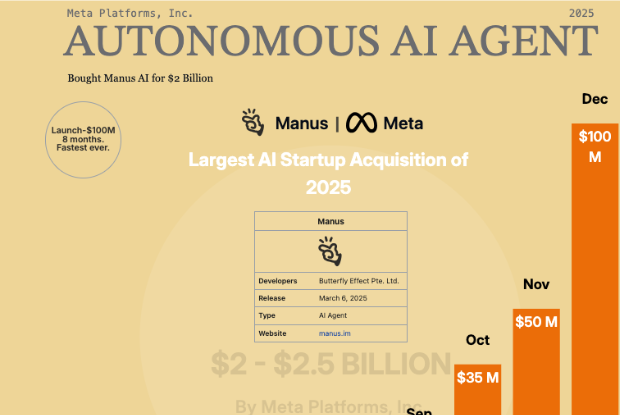
Meta Bought Manus for Over $2 Billion in Ten Days
A Decade of AI Investment: The Crash Everyone Forgot