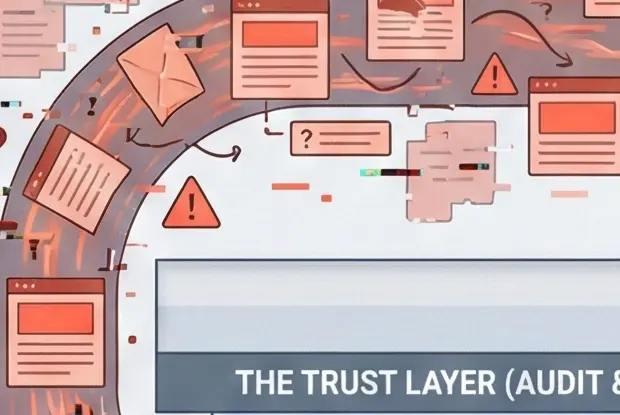
The Truth Broker: What AI Assurance Actually Sells
A $418 Million Market — and Compliance Isn't the Real Bottleneck
- The Market (Actual Size): What the AI governance and assurance market is really worth.
- The Deployment Reality: How enterprise AI projects are actually performing.
- The Regulatory Stick: Penalty exposure created by the EU AI Act.

Visual Intelligence by FactsFigs.com
EU AI Act / Gartner / MIT NANDA
Data Source: EU AI Act Timeline

Overview
AI assurance is a real business. Independent auditing, model evaluation, documentation and governance tooling all genuinely exist, and regulatory deadlines are genuinely creating demand for them.
The market is also considerably smaller than the sector's own promotional material suggests. Global AI governance was worth roughly $308.3 million in 2025 and is estimated near $417.8 million in 2026. Gartner expects it to pass $1 billion only around 2030 — a serious growth story, and three orders of magnitude below the hundred-billion figures sometimes quoted.
The more important correction concerns why enterprise AI stalls. The common claim is that legal teams are blocking deployment over compliance risk. Survey evidence points elsewhere: data infrastructure is the main obstacle to agentic deployment, and roughly two-thirds of respondents name security and risk concerns as the top barrier — well ahead of regulatory uncertainty.
Meanwhile the EU AI Act's high-risk deadlines have moved. Amendments in June 2026 pushed the main obligations back by more than a year, though the transparency rules still arrive on schedule.
The Market Is $418 Million, Not $120 Billion
Sizing this sector honestly matters, because the gap between claim and reality changes what kind of business this is.
The global AI governance market was valued at about $308.3 million in 2025, with 2026 estimates around $417.8 million. Gartner puts 2026 spending near $492 million and expects the market to surpass $1 billion by 2030. Some analyses reach roughly $750 million for 2026 by including an assurance services layer the narrower definitions exclude.
Growth is genuinely strong — compound annual rates around 36% are forecast, reaching roughly $3.6 billion by 2033. But a market measured in hundreds of millions is a promising niche, not the trust infrastructure of the entire algorithmic economy. Figures in the tens of billions typically conflate AI governance with the whole enterprise risk and compliance software category.
Why 95% of Pilots Fail — and It Isn't Legal
MIT's NANDA initiative produced the most-cited number in enterprise AI: 95% of generative AI pilots fail to deliver measurable return on investment.
The reason given is specific and it is not regulatory. The failures are rooted in poor integration and misaligned priorities rather than in flawed models or in legal teams refusing to sign off. Only 17% of companies attribute even 5% of EBIT to generative AI use, and 42% are abandoning most AI initiatives.
The finding has attracted legitimate criticism for how the 95% was derived and how broadly it has been applied. But its direction is consistent with everything else in this area: enterprise AI projects fail at the boring, structural work of connecting a model to real systems and real processes.
What Actually Blocks Agentic Deployment
Agentic AI — systems taking actions rather than producing text — is where liability concerns should bite hardest. Survey data shows only 7% of enterprises have reached a stage where agentic AI delivers measurable business outcomes.
The obstacles that come up are not the ones the assurance pitch assumes.
The barriers enterprises actually report
- Data infrastructure:Identified as the main obstacle to wider agentic deployment — the systems agents must read from and write to are not ready.
- Decision paralysis — 60%:Respondents reporting paralysis over durable infrastructure choices in a fast-moving market.
- Accuracy and reliability — 51%:Cited as a significant barrier to deployment, independent of any regulatory question.
- Security and risk:Named by nearly two-thirds as the top barrier to scaling agentic AI, well ahead of regulatory uncertainty.
- Multiple simultaneous barriers — 87%:Organisations facing a combination of security, privacy, regulatory and policy challenges rather than a single blocker.
Buy Versus Build
One finding from the MIT work deserves more attention than it received, because it is directly actionable rather than merely alarming.
Purchasing AI tools from specialised vendors and building partnerships succeeded about 67% of the time. Internal builds succeeded only about a third as often.
That gap says something important about where the real difficulty lies. If models were the constraint, internal teams with access to the same frontier APIs would perform comparably. They do not, because the hard parts are integration, evaluation, iteration and organisational fit — capabilities that specialised vendors have built repeatedly and that most internal teams are attempting for the first time.
The EU AI Act Timeline Just Moved
Anyone planning compliance work against the previously published schedule needs to recheck it, because amendments agreed on 16 June 2026 pushed the central deadlines back substantially.
Annex III high-risk obligations — the use-based category covering employment, credit, education, law enforcement and similar applications — moved from 2 August 2026 to 2 December 2027. Annex I high-risk systems, which are product-regulated and include radio equipment, lifts and medical devices, moved from 2 August 2027 to 2 August 2028.
That is more than a year of additional runway for the obligations most enterprises were preparing for. It also complicates the assurance sector's commercial position, since much of the near-term urgency in its sales pitch was tied to an August 2026 deadline that no longer applies to those categories.
What Still Lands in August 2026
The postponement was not general, and the transparency obligations under Article 50 still take effect on 2 August 2026.
Three requirements arrive on that date: disclosure that a user is interacting with a chatbot rather than a person, machine-readable marking of AI-generated content, and labelling of deepfakes.
These apply far more broadly than the high-risk rules. A company with no high-risk system anywhere in its operations may still deploy a customer-facing chatbot or publish AI-generated media, and those obligations are live now. It is the most widely applicable part of the regulation and the part most likely to be overlooked by organisations that concluded the deadlines had moved.
The Penalties That Concentrate Minds
The enforcement structure is tiered by severity, and the headline numbers are large enough to justify board-level attention regardless of market size.
Violations involving prohibited AI practices carry fines up to €35 million or 7% of worldwide annual turnover, whichever is higher. Breaches of high-risk obligations reach up to €15 million or 3% of global annual turnover.
The turnover-based structure is what makes this consequential for large firms, since a percentage of global revenue scales with the company in a way a fixed cap does not. It is also why compliance spending will eventually rise substantially — the current $418 million market reflects an obligation set that has, for the most part, not yet come into force.
Why ISO 42001 Isn't a Compliance Shortcut
ISO/IEC 42001, the AI management systems standard, has become the default answer for organisations wanting to demonstrate governance. Major vendors have certified: AWS in November 2024, Anthropic in January 2025, Microsoft in July 2025.
It is genuinely useful and it is not sufficient. The overlap with EU AI Act high-level requirements runs to roughly 40-50%, covering risk management, data governance, technical documentation, record-keeping, transparency, human oversight and quality management systems.
What certification does not cover
- Not a harmonised standard:As of 2026 ISO 42001 has not been formally recognised under the EU Official Journal process, so certification does not create a presumption of conformity.
- Conformity assessments:The Act requires specific assessment procedures that no voluntary standard performs on your behalf.
- EU database registration:A legal registration obligation with no equivalent in the standard.
- GPAI model rules:Obligations specific to general-purpose AI models sit outside the standard's scope entirely.
- The practical read:Certification is strong evidence of a governance process and roughly half the work — treating it as compliance is a documented mistake.
What Assurance Can Genuinely Sell
Stripping out the liability-shield framing leaves a narrower proposition that is still worth buying. Independent evaluation of a model's behaviour, adversarial testing of its guardrails, documentation that satisfies auditors, and monitoring that detects drift after deployment are all real services addressing real gaps.
What no vendor can credibly sell is the transfer of legal responsibility. Under the EU AI Act, obligations attach to providers and deployers of AI systems. A third-party certificate is evidence of diligence; it does not move liability off the company operating the system, and a regulator assessing a prohibited practice will not be redirected to an auditor.
The honest pitch is that assurance reduces the probability of a failure and improves your position if one occurs. That is valuable — it is simply a different product from the insurance-style shield the category's marketing has tended to imply.
Conclusion
AI assurance is a genuine and growing market that has been described at roughly two hundred times its actual size. At around $418 million in 2026, passing $1 billion near 2030, it is a promising sector rather than the foundational infrastructure of the algorithmic economy.
The diagnosis behind the pitch is also wrong in an important way. Enterprises are not mostly stuck because lawyers will not sign off. They are stuck because data infrastructure is not ready, because accuracy remains unreliable, and because security concerns outrank regulatory ones — and no certificate resolves any of those.
The regulatory pressure is coming regardless, just later than advertised for high-risk systems and right on time for transparency. Companies that spend the extra runway fixing integration and data foundations will be ready for both. Those that buy a certificate and consider the problem closed will discover that liability was never transferable in the first place.
This article summarises published regulatory requirements for general information and is not legal advice. Compliance obligations depend on specific systems and jurisdictions.
Data Source and Attribution
EU AI Act TimelineGartnerMIT NANDA (via Fortune)
Market sizing comes from published AI governance market research and Gartner's forecasts for AI governance platform spending. Enterprise deployment figures come from MIT's NANDA research on generative AI pilots and from published surveys of agentic AI adoption barriers. EU AI Act deadlines, the June 2026 amendments, Article 50 transparency obligations and penalty structures come from the European Commission's AI Act implementation materials. ISO/IEC 42001 mapping and its limitations reflect published compliance analyses and vendor certification announcements.
FactsFigs reviews, cleans, and cross-checks every source dataset before shaping it into a data story. Each visualization is created and designed in FactsFigs Design Studio — an internal tool developed and owned by FactsFigs — and is the original work of a FactsFigs author, not an AI-generated copy of any existing graphic. Individual assets within a visual may or may not be produced with AI tools, but the design of the visual itself is solely FactsFigs' own.
Figures are estimates at the time of publication, provided for information only — nothing here is legal or financial advice.
2026-07-20
Weekly Updates
Subscribe for the FactsFigs Weekly Brief
Signals, charts, and data stories delivered every week.
More Intelligence
Other Popular Topics
Additional signals from the FactsFigs intelligence feed.

The Fertility Divide: Korea Rebounds as China Collapses
AI Investment by Country: America Took 83% in 2025