XRP and the SEC: What the Court Actually Ruled
Retail Sales Were Not Securities — Institutional Sales Were, and the Injunction Stands
- The Split Ruling: How the court divided the securities question by sale type.
- The Penalty: Financial penalties imposed and sought.
- Supply Facts: Verifiable facts about the asset's supply.

Visual Intelligence by FactsFigs.com
SDNY court records / legal analysis
Data Source: National Law Review

Overview
The most commonly repeated claim about this case is that a court declared XRP is not a security. That is not what the ruling said, and the distinction is legally substantial.
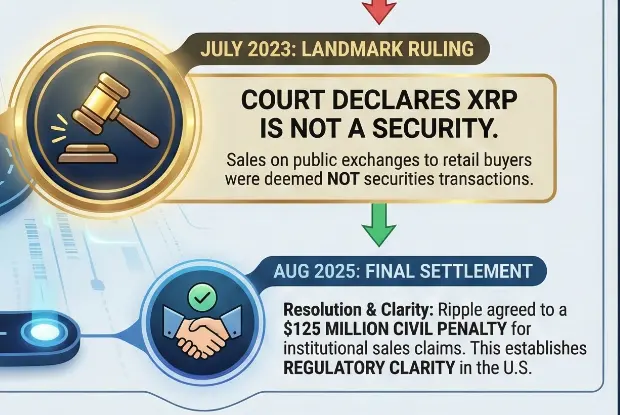
On 13 July 2023, Judge Analisa Torres held that programmatic sales of XRP on public exchanges did not require registration under securities laws, while sales by Ripple to institutional investors were sales of securities that did require registration.
Ripple therefore won one half and lost the other. The court imposed a permanent injunction restricting institutional sales and later ordered a civil penalty of slightly more than $125 million — considerably less than the nearly $2 billion the regulator had sought.
In 2025 both parties dropped their appeals, leaving the 2023 ruling intact. An attempt to dissolve the injunction and return part of the penalty was rejected by the court, which held that parties cannot override a final judgment by agreement.
The Ruling Was Split, Not a Win
The July 2023 decision addressed a single question — whether particular sales of XRP were investment contracts requiring registration — and answered it differently depending on how the sale occurred.
Programmatic sales, meaning sales into the open market on public exchanges, were held not to require registration. Institutional sales, meaning direct sales by Ripple to sophisticated buyers under written agreements, were held to be securities sales that did require registration.
Reporting that compressed this into 'XRP is not a security' dropped the half Ripple lost. The asset itself was not classified either way — the court assessed the circumstances of sale, which is how the relevant legal test works.
What 'Programmatic Sales' Means
The reasoning behind the retail half of the ruling turns on what the buyer could reasonably have known, and it is more specific than it is usually presented.
Someone buying XRP on an exchange transacts through a blind bid-and-ask process. They do not know who the seller is, receive no representations from Ripple, and cannot form expectations based on promises made by the issuer — because there is no direct relationship with an issuer at all.
The investment contract test depends substantially on an expectation of profits derived from the efforts of others, arising from the transaction itself. The court found that anonymous exchange purchases did not establish that relationship, which is a conclusion about the manner of sale rather than about the token.
Institutional Sales Were Securities
The other half of the ruling went against Ripple, and it carried the practical consequences.
Sales to institutional investors were made under written contracts, directly negotiated, with the buyers aware they were purchasing from Ripple and doing so on the basis of Ripple's representations about developing the asset's ecosystem. The court held these were investment contracts requiring registration.
This is the finding that produced both the penalty and the injunction. It also has broader implications than the retail half — many token sales involve direct institutional placements, and that structure was found to require registration.
The Permanent Injunction
Alongside the monetary penalty, the court imposed a permanent injunction preventing Ripple from selling XRP to institutional buyers in the manner found unlawful, while permitting continued retail market operations.
An injunction of this kind is an ongoing legal restraint rather than a one-off punishment. It constrains conduct indefinitely and carries contempt consequences if breached.
It also remains in force. Descriptions of the case ending with regulatory clarity and unrestricted operation omit that a permanent court order governing how Ripple may sell to institutions is still in effect.
$125 Million, Not $2 Billion
The financial outcome was substantially better for Ripple than the regulator sought. The court ordered slightly more than $125 million in penalties against a request approaching $2 billion.
That is roughly 6% of the amount sought, and it reflects the court's view of the scope of the violation — confined to institutional sales rather than extending to the entire market for the asset.
It is a meaningful partial victory. It is not an exoneration, and a $125 million penalty is imposed for conduct a court found unlawful.
The Judge Rejected the Settlement
The most revealing episode came afterwards, when both parties tried to revise the outcome and could not.
Following a change in the regulator's leadership, the parties jointly asked the court to dissolve the injunction and return a portion of the penalty. Judge Torres refused, and refused again on a renewed request, holding that parties cannot override a final court judgment by agreement between themselves.
This matters beyond this case. It establishes that a regulatory outcome reached through litigation is not simply undone when enforcement priorities change — the judgment belongs to the court, not to the parties, and a shift in political direction at an agency does not vacate it.
Both Sides Dropped Appeals
The case concluded when both parties filed jointly with the Second Circuit to drop their respective appeals, leaving the 2023 ruling intact.
Ending an appeal is not the same as winning one. The decision stands as issued by a district court, with both the retail finding and the institutional finding preserved exactly as decided.
Because no appellate court reviewed the reasoning, its precedential weight is limited. A district court decision that was never tested on appeal binds the parties to it and is persuasive rather than controlling for anyone else.
Why This Isn't Broad Regulatory Clarity
The case is frequently described as having settled how digital assets are regulated. It is considerably narrower than that.
It concerns one asset, sold by one company, in specific ways, decided by one district court, and never reviewed on appeal. The finding depended heavily on facts particular to how Ripple conducted its sales.
The genuine takeaway is a principle rather than a classification: the same token can be sold in ways that require registration and in ways that do not, so the manner of sale governs rather than the asset itself. That is useful guidance and it is not a rulebook — which is why legislative and rulemaking efforts to define digital asset regulation continued after this case ended.
The Supply Facts
Separate from the litigation, a few properties of the asset are straightforwardly verifiable and worth stating precisely.
XRP has a fixed maximum supply of 100 billion units, all created at inception rather than issued through mining. Roughly 60 billion are in circulation, with a substantial remainder held in escrow and released on a schedule.
That structure differs fundamentally from proof-of-work assets, where new units are issued continuously to miners. It also means a large portion of total supply sits outside circulation under the control of arrangements that determine when it enters the market — a factor anyone assessing the asset should understand, and one that is separate from the legal questions above.
Conclusion
The July 2023 ruling did not declare XRP not to be a security. It held that programmatic sales on public exchanges did not require registration while institutional sales by Ripple did — a split decision in which Ripple won one half and lost the other.
The consequences of the half it lost persist. A permanent injunction restricting institutional sales remains in force, and the court ordered slightly more than $125 million in penalties, against nearly $2 billion sought.
The attempt to unwind it failed. When both parties jointly sought to dissolve the injunction and return part of the penalty, the court refused twice, holding that a final judgment cannot be overridden by agreement — a point with implications well beyond this case.
This article summarises court findings and publicly verifiable asset properties for general information. It is not investment advice, contains no price information or forecasts, and is not a recommendation regarding any asset. Cryptocurrency carries substantial risk including total loss.
Data Source and Attribution
National Law ReviewKutak Rock (case analysis)Banking Dive
Findings regarding programmatic and institutional sales, the permanent injunction, the civil penalty amount and the rejection of subsequent settlement requests come from the July 2023 decision of Judge Analisa Torres in the United States District Court for the Southern District of New York and subsequent orders in the same proceeding, together with published legal analysis. The dropping of appeals reflects the joint filing with the Second Circuit. Supply figures reflect publicly documented properties of the XRP Ledger.
FactsFigs reviews, cleans, and cross-checks every source dataset before shaping it into a data story. Each visualization is created and designed in FactsFigs Design Studio — an internal tool developed and owned by FactsFigs — and is the original work of a FactsFigs author, not an AI-generated copy of any existing graphic. Individual assets within a visual may or may not be produced with AI tools, but the design of the visual itself is solely FactsFigs' own.
This content is for information only and is not legal, investment or financial advice. It is not a recommendation regarding any digital asset.
2026-07-20
Weekly Updates
Subscribe for the FactsFigs Weekly Brief
Signals, charts, and data stories delivered every week.
More Intelligence
Other Popular Topics
Additional signals from the FactsFigs intelligence feed.
Ethereum After Pectra and Fusaka: What Actually Shipped
XRP and the SEC: What the Court Actually Ruled