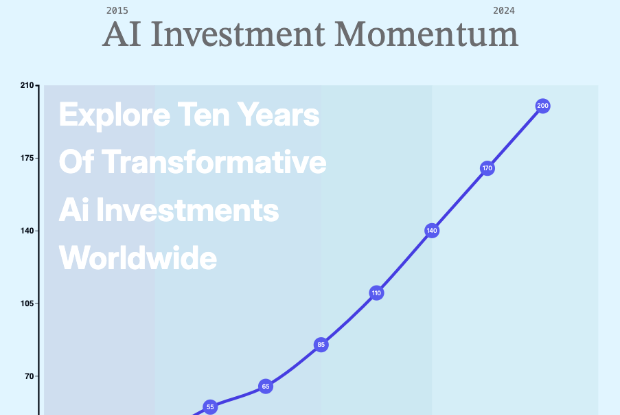
AI Investment by Country: America Took 83% in 2025
The United States Invested $240.6 Billion — China Invested $10.4 Billion
- Dominant (United States): The United States, which accounts for most global private AI investment.
- Distant Followers: Europe and China, each an order of magnitude behind.
- Everyone Else: All other countries combined.

Visual Intelligence by FactsFigs.com
Stanford AI Index via Our World in Data
Data Source: Our World in Data

Overview
Global private AI investment reached $290.1 billion in 2025, and the geographic distribution is more lopsided than almost any comparable technology statistic.
The United States accounted for $240.6 billion — roughly 83% of the world total. Europe recorded $17.6 billion and China $10.4 billion, meaning the American figure is around thirteen times Europe's and twenty-three times China's.
The cumulative picture since 2013 is similarly skewed but less extreme: the United States at $695.9 billion, China at $130.9 billion and Europe at $97.5 billion. China's position has weakened substantially in recent years rather than being consistently marginal.
One caveat governs everything here. This measures private investment — venture capital and private equity — and excludes state funding, internal corporate research and capital expenditure. For China in particular, that omission is large enough to change the interpretation.
America Took 83% of Global AI Investment
Out of $290.1 billion invested privately in AI worldwide during 2025, $240.6 billion went to companies in the United States.
That share exceeds what any single country holds in almost any other major industry. American dominance in AI research output or model capability is real but nothing like this proportionate — on capital, the concentration is close to total.
The remaining $49.5 billion was divided among every other country on Earth. Europe's entire private AI investment was less than 8% of the American figure, and the combined total of Europe, China and everywhere else amounted to roughly a fifth of what the US deployed alone.
China's $10.4 Billion
The most surprising number in the 2025 data is China's, at $10.4 billion — less than Europe's and a small fraction of the American total.
For a country routinely described as America's peer competitor in AI, ranking third on private investment and trailing by a factor of twenty-three is difficult to reconcile with the strategic narrative.
The reconciliation lies in what the measure captures. Chinese AI development is substantially state-directed and state-funded, channelled through government programmes, state-owned enterprises and national research institutions. None of that appears in a series counting venture capital and private equity deals, so the figure describes China's private investment market rather than its AI effort.
The Cumulative Picture Since 2013
Taking the full period from 2013 to 2025 flattens some of the recent volatility. Cumulative private AI investment stands at $695.9 billion for the United States, $130.9 billion for China and $97.5 billion for Europe.
On that basis China's position looks considerably stronger — roughly a fifth of the American total, and ahead of Europe. It reflects a period during which Chinese technology companies raised substantial private capital, particularly through the late 2010s.
The divergence between the cumulative and single-year figures is the finding. China accumulated $130.9 billion over thirteen years but contributed only $10.4 billion in 2025, which means its recent annual rate has fallen well below its historical average while America's has risen sharply.
China's Share Collapsed
In 2025, China accounted for roughly 3.6% of global private AI investment. Against a cumulative share closer to 14% across the full period, that is a substantial retreat.
Several factors plausibly contribute. Chinese technology companies faced a sustained regulatory tightening that reduced private venture activity across the sector. Capital controls and geopolitical tension have complicated foreign investment into Chinese technology firms. And export restrictions on advanced semiconductors constrain the compute-intensive work that attracts the largest rounds elsewhere.
What the decline does not indicate is a retreat from AI development. Chinese labs have continued releasing competitive models throughout this period, in some cases at notably lower training costs — which is precisely the point about what this series can and cannot see.
Why Private Investment Understates China
The exclusions in this dataset are not minor for a state-directed economy, and reading the figure as a measure of national AI effort would be a straightforward error.
Government funding programmes, provincial technology initiatives, state-owned enterprise spending and national research institute budgets all sit outside the series entirely. In a system where the state is the principal allocator of strategic capital, counting only private deals measures the smaller channel.
The same limitation applies elsewhere in a different form. American AI development conducted inside large technology companies, funded from their own revenues rather than through external rounds, is also invisible here — and that is an enormous quantity of capital. This measures the flow through private investment markets, which is a well-defined thing and not the same as total investment in AI.
Europe at $17.6 Billion
European private AI investment reached $17.6 billion in 2025, placing the continent second and comfortably ahead of China — a ranking that gets little attention.
It remains a small figure in absolute terms. Europe's entire AI investment across all countries is under 8% of the American total, and less than a sixth of what a single large American round can now absorb.
This has direct consequences for European AI policy. The bloc has been the world's most assertive AI regulator while its domestic developers operate on a fraction of the capital available to the companies being regulated. Regulating an industry you do not fund is a coherent position, and it means European rules apply mainly to firms headquartered elsewhere.
What This Series Excludes
Being precise about scope matters more for this dataset than for most, because the excluded categories are larger than the included one.
The series covers external funding for privately held AI companies raising above $1.5 million — venture capital and private equity. It excludes internal corporate research and development, capital expenditure and public-sector funding.
Consider what that leaves out in 2025 specifically: the data centre construction programmes of the largest technology companies, funded from cash flow and debt rather than venture rounds, running to tens of billions each. Those are among the largest AI investments being made anywhere and none of them appear in this $290.1 billion figure.
Why the Gap Is About Capital Markets
The American advantage measured here is not primarily one of talent, research output or technical capability, all of which are far more evenly distributed than a twenty-three-to-one ratio would suggest.
It is a difference in financial infrastructure. The United States has deep pools of capital willing to fund companies with no profits, long time horizons and substantial failure rates — venture funds, sovereign and pension allocations, and public markets that reward growth over earnings. Few other countries have assembled that combination at scale.
That is why European and Asian founders have historically raised American capital and, frequently, relocated. The constraint elsewhere is rarely a shortage of good companies; it is a shortage of investors able to write nine-figure cheques into unprofitable ones.
Beware Fabricated Precision
Country-level AI investment rankings circulate widely with granular figures for a dozen or more nations, and those breakdowns deserve scepticism.
The authoritative underlying series reports the United States, China and Europe as an aggregate. It does not resolve individual European countries, and it does not publish separate figures for most of the nations that appear in popular rankings. Where those numbers come from is frequently unclear, and they are often presented with a precision the source data does not support.
The reliable statements are the ones the data actually contains: America took roughly 83% of global private AI investment in 2025, Europe was second, China third, and the cumulative gap since 2013 is narrower than the current-year gap. Anything more granular than that should come with a citation to a source that genuinely publishes it.
Conclusion
Private AI investment in 2025 was concentrated to an extraordinary degree. The United States took $240.6 billion of a $290.1 billion global total — around 83% — with Europe at $17.6 billion and China at $10.4 billion.
China's position is the one most easily misread. Its cumulative $130.9 billion since 2013 represents a serious investment history, and its 3.6% share of 2025 reflects both a genuine decline in private venture activity and a funding model that runs primarily through the state, where this series cannot see it.
The concentration measured here is about capital markets rather than capability. Research talent and model quality are distributed far more evenly than twenty-three to one. What the United States has that others do not is a financial system willing to fund unprofitable companies at enormous scale — and in a phase of AI development where compute access is the binding constraint, that has become the decisive advantage.
Data Source and Attribution
Our World in DataStanford AI IndexStanford HAI 2026
Investment figures come from the Stanford AI Index as published by Our World in Data, measuring external funding for privately held AI companies raising above $1.5 million, in inflation-adjusted US dollars. The source reports the United States, China and Europe as distinct entities and does not publish separate figures for most individual countries; the rest-of-world figure is derived from the global total. The series excludes internal corporate research and development, capital expenditure and public-sector funding — an exclusion that materially understates state-directed AI programmes.
FactsFigs reviews, cleans, and cross-checks every source dataset before shaping it into a data story. Each visualization is created and designed in FactsFigs Design Studio — an internal tool developed and owned by FactsFigs — and is the original work of a FactsFigs author, not an AI-generated copy of any existing graphic. Individual assets within a visual may or may not be produced with AI tools, but the design of the visual itself is solely FactsFigs' own.
Figures are estimates at the time of publication, provided for information only — nothing here is financial advice or a guarantee of accuracy.
2026-07-20
Weekly Updates
Subscribe for the FactsFigs Weekly Brief
Signals, charts, and data stories delivered every week.
More Intelligence
Other Popular Topics
Additional signals from the FactsFigs intelligence feed.

Railway Giants: Who Really Has the Biggest Network
The Glucose Gap: What CGM Data Can and Can't Tell You