Albert Einstein

Albert Einstein
Born 14 March 1879 • Died 18 April 1955
Albert Einstein (1879-1955) was a German-born theoretical physicist whose 1905 'miracle year' papers and 1915 general theory of relativity rewrote humanity's understanding of space, time, gravity, and energy. Awarded the 1921 Nobel Prize in Physics and ranked 10th by Michael Hart among history's most influential people, his equation E=mc^2 and his warning letter about atomic weapons left a mark on science and history alike.
Rank
#10
Influence
91
Field
Scientist
Historical Perspective
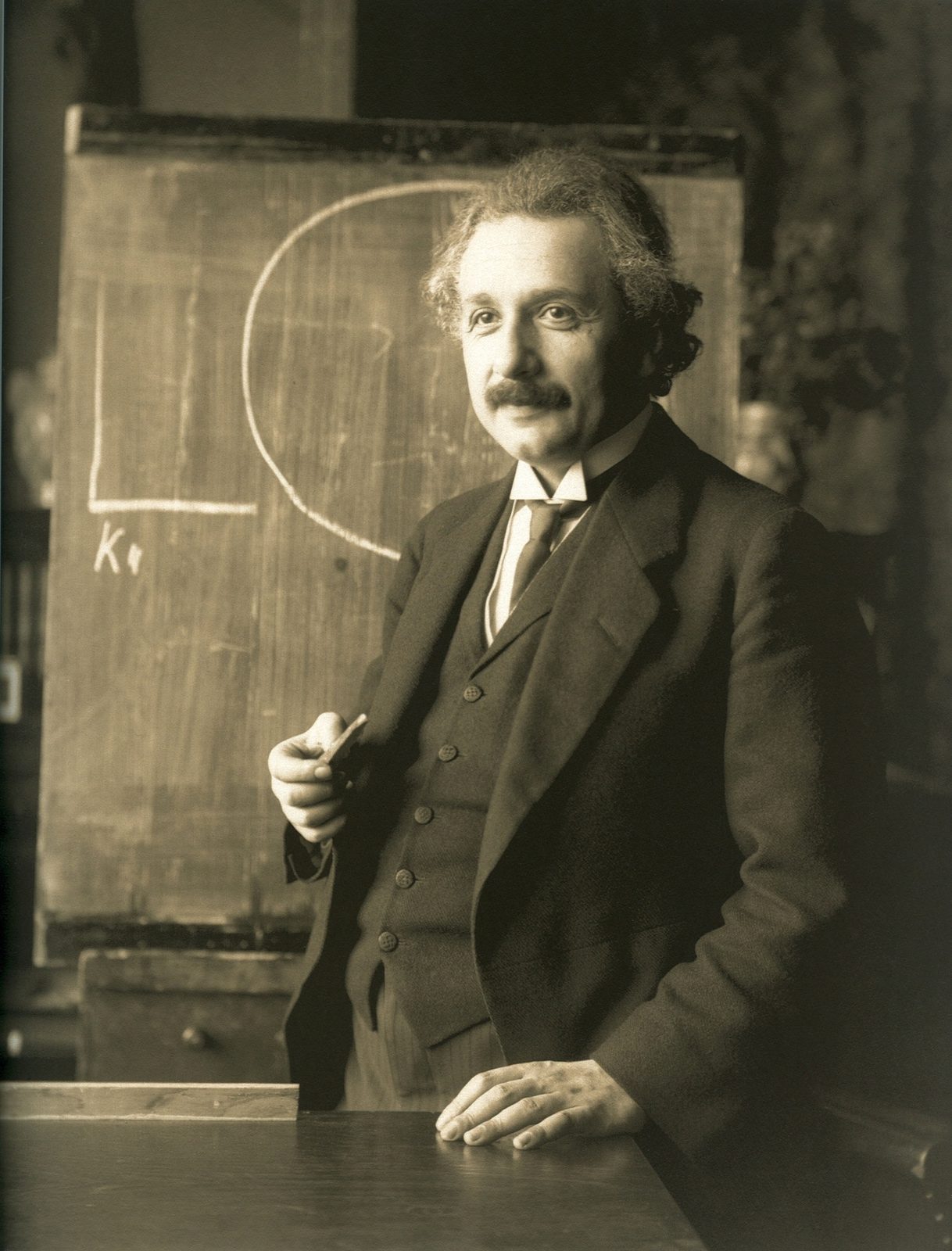
Born on 14 March 1879 in Ulm in the Kingdom of Wurttemberg, Albert Einstein showed an early fascination with mathematics and physics, graduating from the Swiss Federal Polytechnic (ETH Zurich) in 1900. Unable to secure an academic post, he took a job in 1902 as a technical expert at the Swiss Federal Institute of Intellectual Property in Bern, examining patent applications by day while pursuing physics on his own time. In 1905, still a patent clerk, he published four papers in the journal Annalen der Physik that explained the photoelectric effect, accounted for Brownian motion, introduced the special theory of relativity, and derived the mass-energy equivalence E=mc^2 - a body of work later called his annus mirabilis, or miracle year. He extended these ideas into the general theory of relativity in 1915, describing gravity as the curvature of spacetime, a prediction spectacularly confirmed in 1919 when Arthur Eddington's eclipse expeditions to Principe and Sobral measured starlight bending around the Sun exactly as Einstein had calculated. He was awarded the 1921 Nobel Prize in Physics, formally for his explanation of the photoelectric effect rather than for relativity, which remained scientifically contested at the time. As a Jewish scientist and outspoken pacifist, Einstein left Germany for good in 1933 as the Nazis rose to power, settling at the Institute for Advanced Study in Princeton, New Jersey, where in 1939 he signed a letter to President Franklin D. Roosevelt warning that Nazi Germany might be pursuing an atomic bomb, a warning that helped set the Manhattan Project in motion. He died in Princeton on 18 April 1955. Michael Hart ranked Einstein 10th in The 100, crediting his theory of relativity with fundamentally altering how humanity understands the physical universe.
Influence Meter
91
Measured on a 100-point scale
A patent clerk's 1905 papers that rewrote space, time, and energy
1902-1909
The Patent Clerk Who Moonlighted as a Physicist
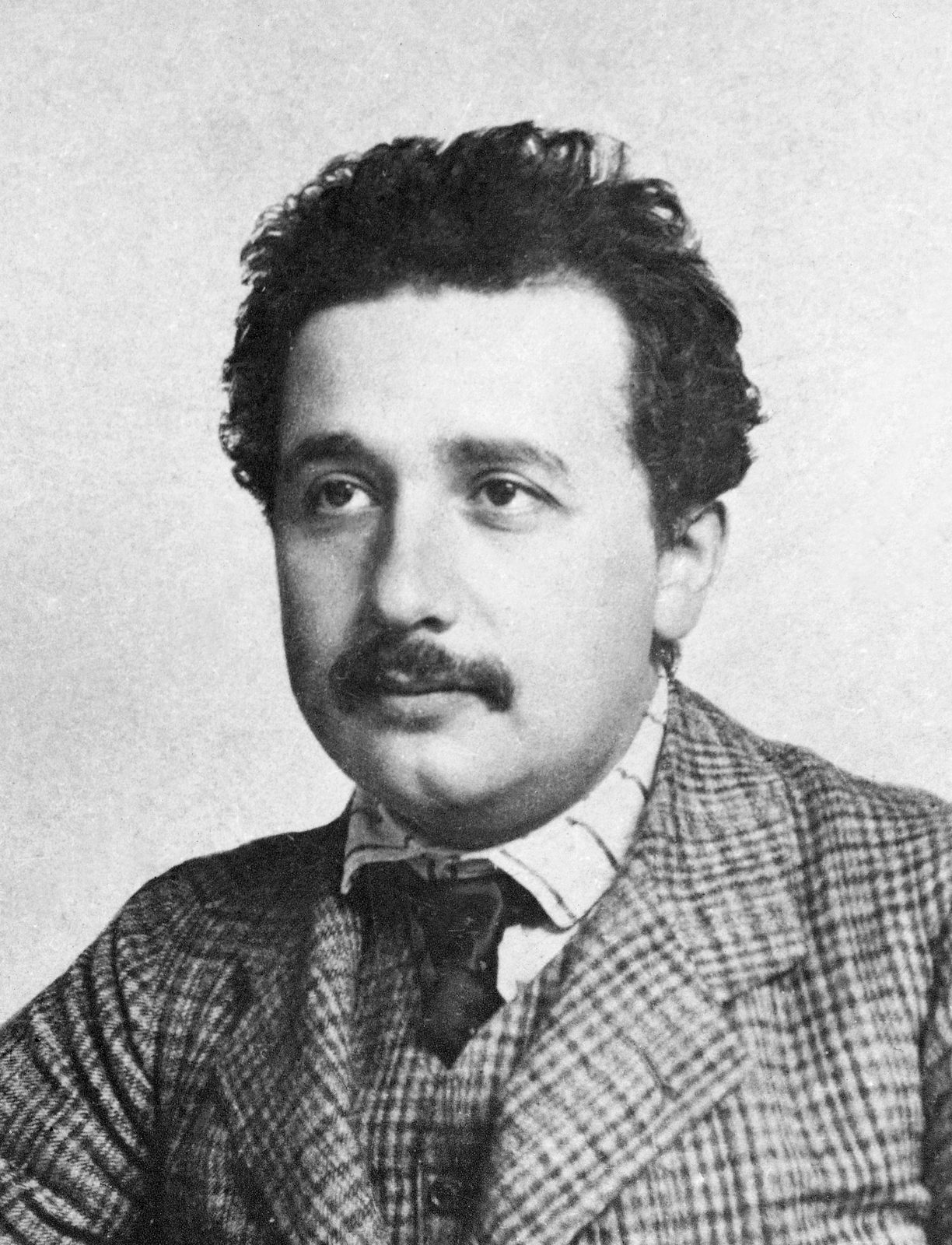
After graduating from ETH Zurich in 1900, Einstein struggled for two years to find an academic position, supporting himself with temporary tutoring and teaching jobs. In June 1902 he was hired as a Technical Expert, Class III, at the Swiss Federal Institute of Intellectual Property in Bern, examining patent applications for a salary of 3,500 Swiss francs a year - work he later called his 'cobbler's trade.' The job was undemanding enough that it left him time and mental energy to pursue his own research, and it was while holding this position, promoted to Technical Expert Class II in 1906, that he produced the papers that would make him famous. He did not leave the patent office for an academic post until 1909, when he became a professor at the University of Zurich.
1905
The Annus Mirabilis
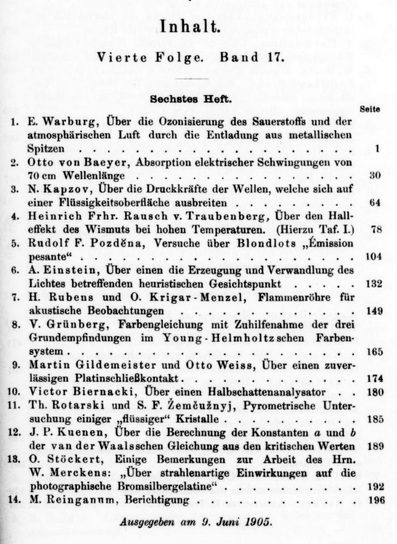
In 1905, without a university affiliation, Einstein sent four papers to the physics journal Annalen der Physik that would each, on their own, have secured a distinguished scientific career. Between March and September of that year he explained the photoelectric effect by proposing that light travels in discrete energy packets, accounted for the erratic Brownian motion of particles suspended in fluid as evidence for the existence of atoms, introduced the special theory of relativity to reconcile mechanics with electromagnetism, and derived the equivalence of mass and energy in the equation E=mc^2. Historians of science refer to 1905 as Einstein's annus mirabilis, or miracle year, a single twelve-month stretch that reshaped physics as thoroughly as any scientist's entire career.
1905, In Detail
The Four Papers of the Miracle Year
Each of Einstein's four 1905 papers addressed a separate, longstanding puzzle in physics, and each is still taught today as foundational.
On a Heuristic Viewpoint Concerning Light
Proposed that light behaves as discrete quanta of energy, explaining the photoelectric effect and helping launch quantum theory.
- Field: Quantum theory
- Later honored by: 1921 Nobel Prize
On the Motion of Small Particles
Explained Brownian motion mathematically, providing strong evidence for the physical reality of atoms and molecules.
- Field: Statistical mechanics
On the Electrodynamics of Moving Bodies
Introduced the special theory of relativity, showing that space and time measurements depend on the observer's motion.
- Field: Special relativity
Does the Inertia of a Body Depend on Its Energy Content?
Derived the mass-energy equivalence relation, later written as E=mc^2.
- Field: Mass-energy equivalence
Einstein's 1921 Nobel Prize in Physics was awarded 'for his services to Theoretical Physics, and especially for his discovery of the law of the photoelectric effect' - not for relativity, which the Nobel committee still considered too controversial to honor outright. In a 1918 divorce settlement negotiated years before he won it, Einstein had already promised his first wife, Mileva Maric, the full value of any future Nobel Prize; when the roughly 121,572 Swedish kronor prize arrived in 1922, he transferred it to her as agreed, and she used part of it to buy a house in Zurich.
1915-1919
Bending Light, Confirming Gravity
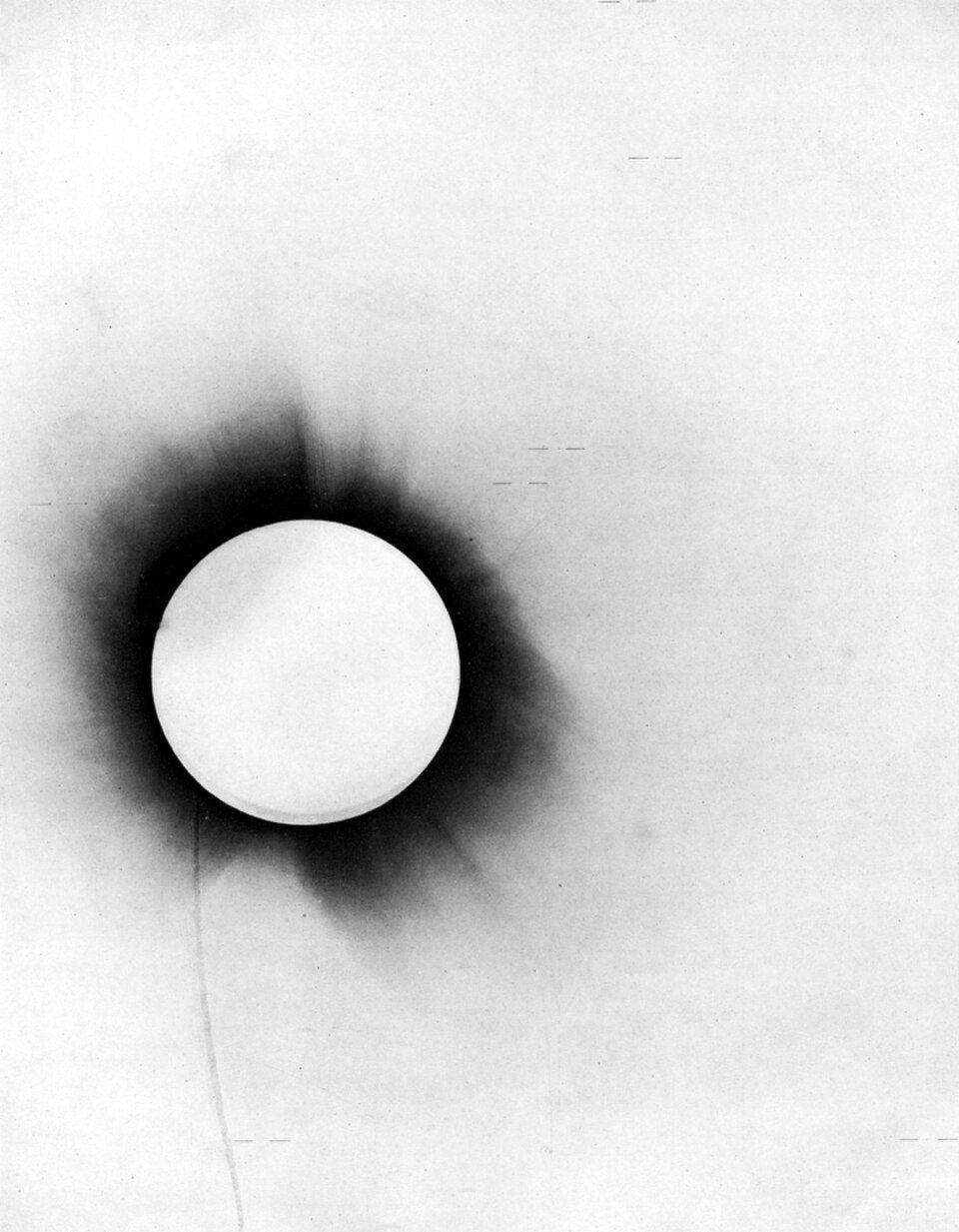
Einstein completed his general theory of relativity in November 1915, reconceiving gravity not as a force acting at a distance but as the curvature of spacetime caused by mass and energy. The theory predicted that light passing near a massive object, such as the Sun, would bend by a specific, calculable amount - a prediction that could only be tested during a total solar eclipse, when stars near the Sun become visible. British astronomers Frank Watson Dyson and Arthur Eddington organized expeditions to the West African island of Principe and the Brazilian town of Sobral to observe the eclipse of 29 May 1919. When the results were announced at a joint meeting of the Royal Society and the Royal Astronomical Society that November, they confirmed Einstein's predicted deflection and contradicted the Newtonian prediction, instantly making Einstein a global celebrity and cementing general relativity as the new standard theory of gravity.
Chronology
A Life in Physics
From a patent office in Bern to the Institute for Advanced Study in Princeton, Einstein's life traced the arc of twentieth-century physics itself.
1933-1940
Exile, and a Warning to Roosevelt
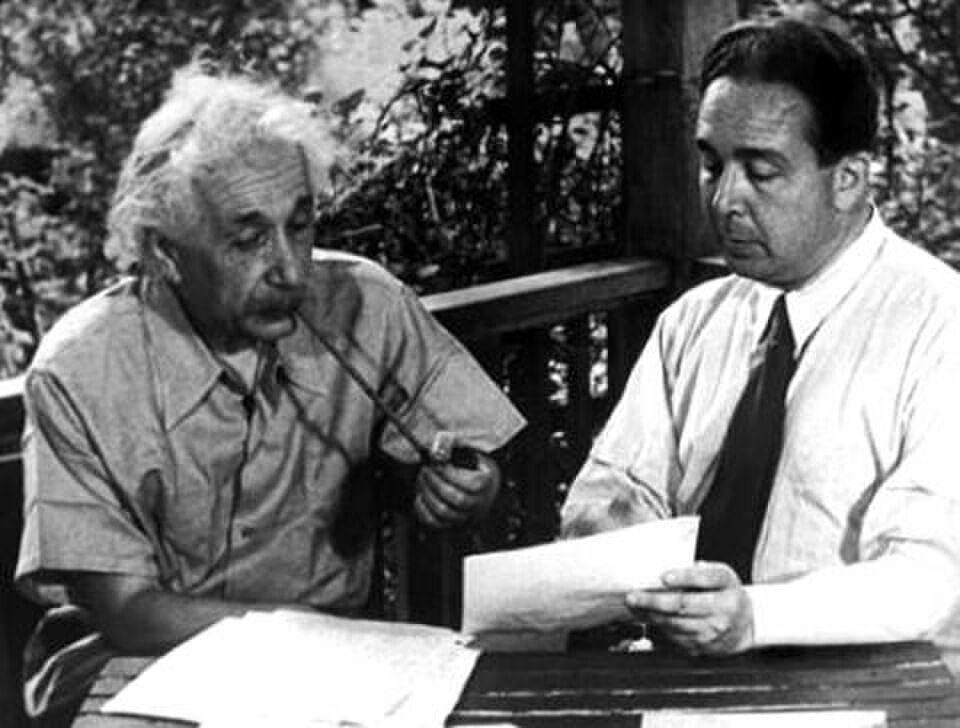
As a Jewish scientist and prominent pacifist, Einstein recognized the danger posed by the Nazi rise to power and left Germany permanently in 1933, accepting a position at the newly founded Institute for Advanced Study in Princeton, New Jersey. On 2 August 1939, at the urging of fellow physicist Leo Szilard, who drafted the letter with help from Edward Teller and Eugene Wigner, Einstein signed a letter to President Franklin D. Roosevelt warning that Nazi Germany could be developing an atomic bomb using newly discovered nuclear chain reactions, and urging the United States to begin its own research. The letter helped prompt the government action that eventually became the Manhattan Project. Einstein renounced his German citizenship in 1896, held Swiss citizenship from 1901 onward, and became a naturalized United States citizen in October 1940, retaining his Swiss citizenship for the rest of his life.
After the death of Israel's first president, Chaim Weizmann, in November 1952, Prime Minister David Ben-Gurion's government offered Einstein the largely ceremonial presidency of Israel. Einstein, moved but certain the role wasn't for him, declined within days, writing that he lacked 'the natural aptitude and the experience to deal properly with people.' Yitzhak Ben-Zvi was elected president instead in December 1952.
Written Works
Books by Albert Einstein
Beyond his research papers, Einstein wrote extensively for general readers, translating relativity and his broader worldview into accessible prose.
After Death
The Strange Afterlife of a Brain
Einstein died in Princeton Hospital on 18 April 1955 of a ruptured abdominal aortic aneurysm, having asked that his body be cremated and his ashes scattered without ceremony. The pathologist who performed his autopsy, Thomas Harvey, removed and kept Einstein's brain without permission, hoping to find a physical explanation for his genius. Harvey dissected the brain into 240 pieces, preserved them in formalin, and carried them with him through several moves across the United States over the following decades, sending occasional samples to researchers, before eventually returning what remained to Princeton in the 1990s.
The episode has become one of the stranger footnotes to Einstein's legacy: a scientist whose life's work concerned the structure of the universe became, after death, the subject of an unauthorized decades-long search for the physical seat of his own genius.
Legacy
Why Number Ten
Michael Hart ranked Einstein 10th in The 100, attributing his place to the theory of relativity's fundamental reshaping of how humanity understands space, time, gravity, and energy. Unlike many figures ranked above him whose influence flowed from a single invention or institution, Einstein's impact rests on a body of theoretical work that redefined the basic framework physicists use to describe reality - a framework whose practical consequences, from nuclear energy to the relativistic corrections that keep GPS satellites accurate, are still felt daily more than a century later.
He died in Princeton in 1955 as the most publicly recognizable scientist in history, an emblem of genius whose name and image remain shorthand for intellectual brilliance to this day.
Related Publications