Charles Darwin

Charles Darwin
Born 12 February 1809 • Died 19 April 1882
Charles Darwin is the English naturalist whose theory of evolution by natural selection, developed over two decades following a nearly five-year survey voyage aboard HMS Beagle, became the organizing foundation of modern biology. Published in 1859 as On the Origin of Species, his argument that all living species descend from common ancestors through a slow process of variation and selection overturned the prevailing view of fixed, separately created species and reshaped fields far beyond biology, from geology to philosophy to social thought. Michael Hart ranked him 16th among history's most influential people.
Rank
#16
Influence
85
Field
Scientist
Historical Perspective
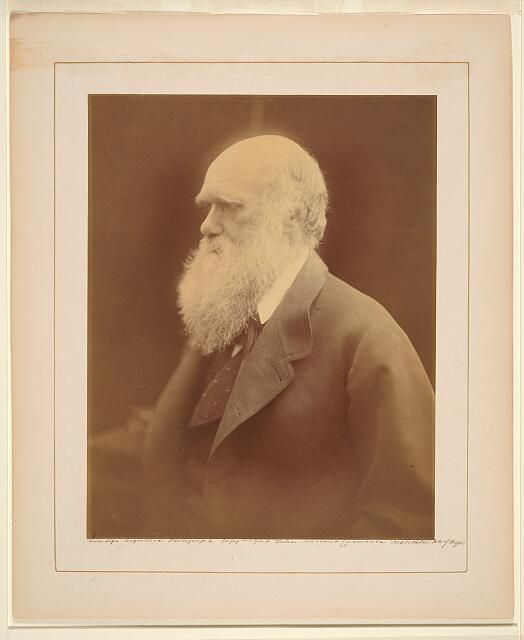
Born on 12 February 1809 in Shrewsbury, England, to a wealthy and well-connected family, Charles Darwin initially trained in medicine at Edinburgh and then for the clergy at Cambridge, showing far more enthusiasm for beetle-collecting and natural history than for either profession. At 22, that interest led to his defining opportunity: an invitation to join HMS Beagle as a self-funded naturalist and companion to Captain Robert FitzRoy on a survey voyage that departed Plymouth on 27 December 1831 and was meant to last two years but stretched to nearly five, returning on 2 October 1836. Across South America, the Galapagos Islands - where Darwin spent 35 days in September and October 1835 observing the archipelago's finches, mockingbirds, and giant tortoises - and stops in Australia and South Africa, Darwin collected specimens and geological observations that quietly convinced him species were not fixed but changed over time. He spent the next two decades developing a mechanism to explain that change - natural selection - without publishing, until a letter arrived in 1858 from the naturalist Alfred Russel Wallace, working independently in the Malay Archipelago, describing an almost identical theory. Papers by both men were read jointly to the Linnean Society of London on 1 July 1858, and Darwin rushed his own full argument into print the following year: On the Origin of Species, published by John Murray on 24 November 1859. All 1,250 copies of the first edition, priced at fifteen shillings, sold out on the day of publication. Darwin followed it in 1871 with The Descent of Man, extending natural selection to human ancestry and sexual selection, a far more controversial claim than the original book had made. He died on 19 April 1882 at his home in Downe, Kent, and was buried in Westminster Abbey on 26 April, near Isaac Newton - a mark of the scientific establishment's rapid acceptance of a theory that had begun as a quiet, decades-long private conviction. Michael Hart ranked Darwin 16th in The 100, noting that while other naturalists were converging on similar ideas around the same time, it was Darwin's exhaustive accumulation of evidence that made the theory of evolution scientifically undeniable.
Influence Meter
85
Measured on a 100-point scale
The naturalist who gave biology its unifying theory
1831-1836
Five Years Aboard the Beagle
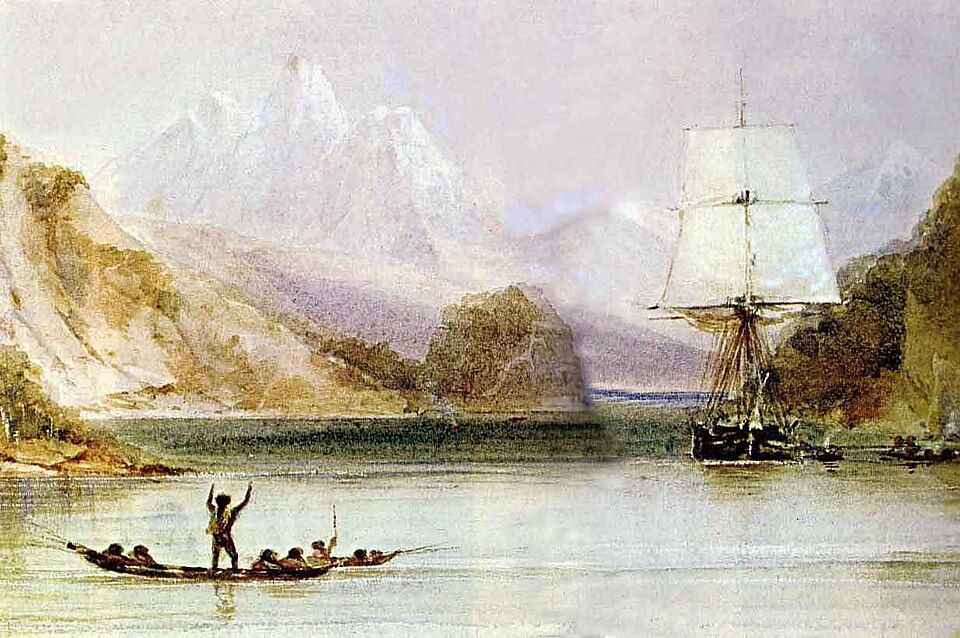
At 22, fresh out of Cambridge and with no formal scientific appointment, Darwin was invited aboard HMS Beagle as an unpaid, self-funded naturalist and gentleman companion to its captain, Robert FitzRoy, for a Royal Navy survey voyage of South America's coastline. The ship sailed from Plymouth on 27 December 1831; a trip planned for two years became almost five, and the Beagle did not return to England until 2 October 1836.
Darwin spent most of the voyage on land, riding across Argentina and Chile, examining fossils, rock strata, and living species, and shipping specimens back to England in quantities that had already made him a name among British naturalists before he ever set foot back home. The most consequential stop came in September and October 1835, when the Beagle spent 35 days surveying the Galapagos Islands - Darwin's observations there of finches, mockingbirds, and giant tortoises that varied subtly from island to island would later become some of the clearest illustrations of natural selection at work.
1858
A Letter From Alfred Russel Wallace
For two decades after returning from the Beagle voyage, Darwin worked privately on a theory of evolution by natural selection, sharing drafts only with a small circle of trusted colleagues while he built an overwhelming case from geology, breeding, and comparative anatomy. That caution ended abruptly in 1858, when a letter reached him from Alfred Russel Wallace, a naturalist working in the Malay Archipelago, laying out an almost identical theory Wallace had arrived at independently. Rather than compete for priority, Darwin's colleagues arranged for papers by both men to be read jointly, in absentia, to the Linnean Society of London on 1 July 1858 - the first public presentation of natural selection as a scientific theory, and the event that finally pushed Darwin to compress twenty years of private research into a book.
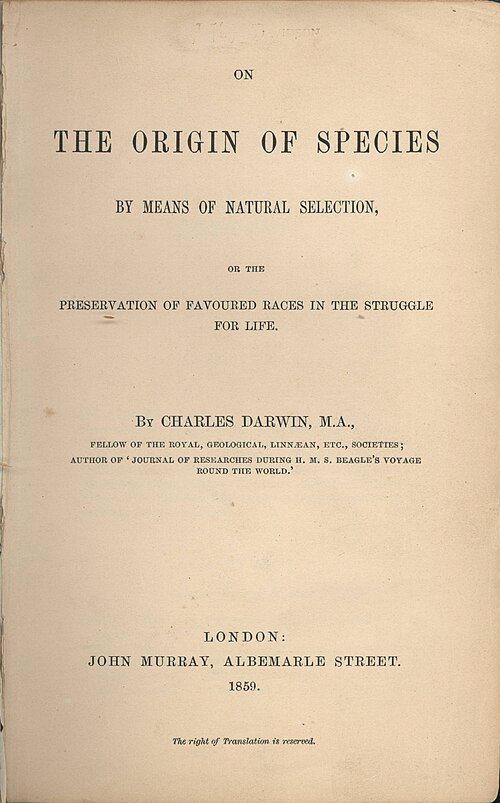
On the Origin of Species was published by John Murray in London on 24 November 1859, priced at fifteen shillings. All 1,250 copies of the first print run sold out on publication day - 500 of them taken directly by Mudie's Circulating Library, guaranteeing the book an immediate, wide readership.
The Argument
Descent With Modification
On the Origin of Species by Means of Natural Selection argued that all living species descend from common ancestors, gradually diverging over immense stretches of time through a process Darwin called natural selection: individuals with traits better suited to their environment survive and reproduce more successfully, passing those traits on, while less-suited variants are weeded out. It directly contradicted the prevailing view - reinforced by natural theology - that species were fixed and separately created, and it did so not with a single decisive proof but with an accumulation of evidence from geology, embryology, animal breeding, and Darwin's own Beagle-era field observations, deliberately built to be as close to undeniable as Victorian science could make it.
Written Legacy
Darwin's Major Publications
Darwin's core theory was built across several major works published over more than three decades.
The Voyage of the Beagle
Darwin's popular travel narrative and scientific journal from the Beagle survey expedition.
- Genre: Travel/Natural History
On the Origin of Species
The foundational statement of evolution by natural selection; sold out its first print run in a day.
- First print run: 1,250 copies
The Descent of Man, and Selection in Relation to Sex
Extended natural selection to human evolutionary ancestry and introduced sexual selection as a driving mechanism.
- Focus: Human origins
The Expression of the Emotions in Man and Animals
Argued that emotional expression has evolutionary continuity between humans and other animals.
- Field: Comparative psychology
Chronology
From Shrewsbury to Westminster Abbey
Darwin's path from an indifferent medical student to the author of modern biology's founding theory spanned five decades.
Reach of the Theory
Natural Selection Beyond Biology
Darwin's mechanism of natural selection, though built to explain the diversity of living species, was quickly applied - and often misapplied - well beyond biology.
Legacy
Why Number Sixteen
Michael Hart ranked Darwin 16th in The 100, crediting him with providing the theoretical foundation - natural selection - on which all of modern biology has since been built, from genetics to ecology to medicine. Hart also noted a qualification unique among the higher-ranked figures on his list: because Alfred Russel Wallace had independently arrived at the same mechanism at almost the same time, Hart judged that some version of evolutionary theory would likely have emerged without Darwin specifically, which he weighed against Darwin's individual originality in placing him below scientists whose specific discoveries seemed less inevitable.
What is not in dispute is the thoroughness with which Darwin made the case. Where Wallace's insight was a flash of inspiration, Darwin's Origin of Species was the product of more than twenty years of patient, methodical evidence-gathering - geology, breeding records, comparative anatomy, and firsthand field observation from the Beagle voyage - assembled specifically to withstand the scrutiny he knew such a challenge to prevailing belief would face. That evidentiary weight is a large part of why the theory took hold so quickly and has remained the organizing framework of biology for over 165 years since.
Related Publications