Euclid

Euclid
Born c. 325 BC • Died c. 265 BC
Euclid (flourished c. 300 BC) was a Greek mathematician who taught in Alexandria, Egypt, in the era of Ptolemy I, and compiled the Elements, a thirteen-book synthesis of Greek geometry and number theory built from a small set of definitions and postulates into hundreds of rigorously proved propositions. Almost nothing certain is known about his life, but his textbook became, alongside the Bible, one of the most reproduced and studied books in Western history, and the standard introduction to mathematics for over two millennia. Michael Hart ranked him 14th among history's most influential people.
Rank
#14
Influence
87
Field
Mathematician
Historical Perspective
Remarkably little is known for certain about Euclid's life. He is thought to have been born around 325 BC and to have died around 265 BC, and he taught mathematics in Alexandria, Egypt, during the reign of Ptolemy I Soter (305-285 BC), likely among the earliest scholars associated with the city's famed Musaeum. Almost all surviving biographical detail comes from the 5th-century-AD philosopher Proclus, writing more than seven centuries after Euclid lived, which leaves even basic facts - his birthplace, his teachers, the exact years he was active - genuinely uncertain among historians. What survives beyond doubt is his work: the Elements, a thirteen-book compilation that took the scattered geometric and arithmetic knowledge of earlier Greek mathematicians, including Eudoxus and Theaetetus, and organized it into a single deductive structure, starting from a handful of definitions and postulates and building outward, through hundreds of rigorously proved propositions, to advanced results in plane geometry, number theory, and three-dimensional solids. Alongside the Elements, several shorter works survive under his name, including Data, Optics - the earliest surviving Greek work on geometric perspective - and Phaenomena, on spherical astronomy; other works attributed to him, such as Porisms and Conics, are lost. Michael Hart ranked Euclid 14th in The 100, crediting the Elements' unmatched, multi-millennium role as the primary textbook through which geometry was taught across the ancient, medieval, and early modern worlds.
Influence Meter
87
Measured on a 100-point scale
A single textbook that taught the world geometry for two thousand years
c. 300 BC
An Almost Unknown Life in Alexandria
Euclid is thought to have flourished around 300 BC, teaching mathematics in Alexandria, the new Egyptian capital founded by Alexander the Great and ruled, after Alexander's death, by his general Ptolemy I Soter. Ptolemy established the Musaeum, a research institution combining a library and a community of scholars, and Euclid is believed to have been among its earliest mathematicians, though the surviving evidence for even this is indirect - it rests largely on Pappus's later remark that a subsequent mathematician, Apollonius, studied with Euclid's own students in Alexandria.
Nearly everything else claimed about Euclid's life traces back to a single source: the philosopher Proclus, writing a commentary on the Elements around 450 AD, more than 700 years after Euclid is thought to have worked. Medieval Arabic and Byzantine scholars, working with even less reliable information, sometimes confused him with the much earlier philosopher Euclid of Megara, an error that persisted in some European texts for centuries. Modern historians generally treat Euclid's biography as almost entirely unrecoverable, which makes the survival and impact of his actual mathematical text all the more striking by comparison.
The Elements
Thirteen Books, One Logical Structure
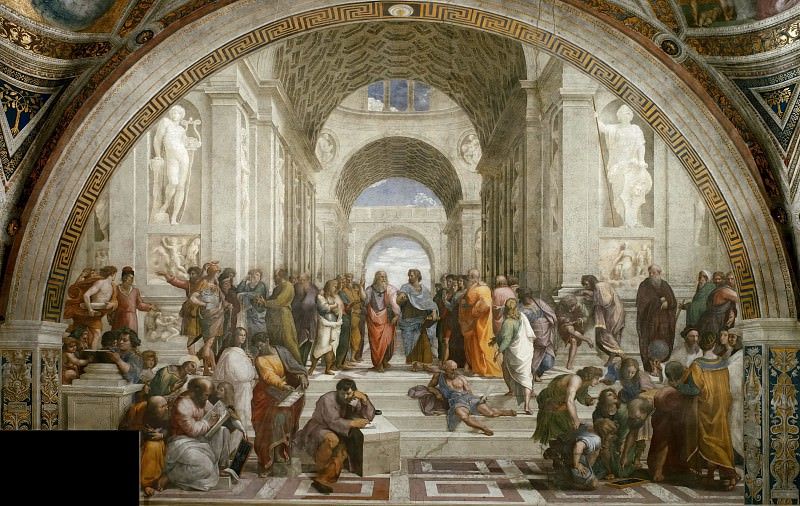
The Elements organizes Greek mathematics into thirteen books grouped into three broad sections: Books 1 through 6 cover plane geometry, including the properties of triangles, parallel lines, and circles; Books 7 through 10 cover number theory and the theory of proportion, including what is now called the Euclidean algorithm for finding the greatest common divisor of two numbers; and Books 11 through 13 cover three-dimensional, solid geometry, culminating in a proof that there are exactly five regular (Platonic) solids. Each book opens with definitions and a small number of postulates, or 'common notions,' treated as self-evidently true, from which every subsequent proposition is proved by strict logical deduction - a structure so influential that 'Euclidean' remains, to this day, the standard term for ordinary flat-space geometry.
According to Proclus, when Ptolemy I asked Euclid whether there was a faster way to learn geometry than working through the entire Elements, Euclid is said to have replied that 'there is no royal road to geometry' - meaning that not even a king could shortcut the discipline of following each proof in sequence. Historians treat the anecdote as of doubtful reliability, since a very similar story is also told about other Greek mathematicians and rulers, but it has survived for over 1,500 years as the most famous line attributed to Euclid.
Attributed Works, In Detail
What Survives of Euclid's Writing
Beyond the Elements, a handful of shorter mathematical and scientific treatises survive under Euclid's name; others are known only by title.
Elements
Thirteen books systematizing plane and solid geometry and number theory into a single deductive structure.
- Status: Fully survives
Data
A companion to the Elements exploring what can be logically deduced (given, or 'data') from an initial geometric configuration.
- Status: Survives
Optics
The earliest surviving Greek treatise on perspective, analyzing vision as straight lines of sight.
- Status: Survives
Phaenomena
Applies spherical geometry to the apparent motion of stars across the celestial sphere.
- Status: Survives
Porisms and Conics
Referenced by later mathematicians such as Pappus but lost; their exact content is reconstructed only indirectly.
- Status: Lost
Chronology
From Alexandria's Founding to the Elements' Legacy
Euclid's own life is poorly documented, but the surrounding chronology of Alexandria and the Elements' transmission is well established.
c. 75-125 AD
The Oldest Surviving Fragment
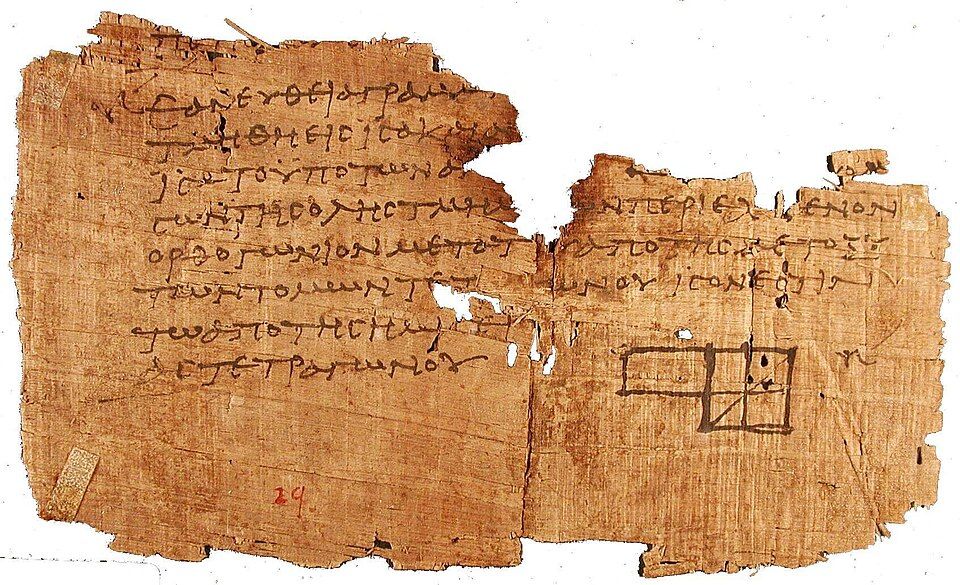
No manuscript written in Euclid's own lifetime survives. The oldest known physical fragment of the Elements' actual text is a scrap of papyrus discovered at Oxyrhynchus, Egypt, during an 1896-97 excavation and now held at the University of Pennsylvania; dated to roughly 75-125 AD, it preserves part of Book II, Proposition 5, together with its accompanying geometric diagram - proof that Euclid's text was already being copied and studied at least three centuries after it was likely written. Every version of the Elements read today descends from a long chain of later manuscript copies, Arabic translations, and eventually printed editions, rather than from any single original.
Written Works
Key Works Attributed to Euclid
Euclid's surviving output ranges from foundational geometry to early studies of optics and astronomy.
Elements
Thirteen books building plane and solid geometry and number theory from first principles.
- Greek
- c. 300 BC
- Treatise
Data
A companion volume on what can be logically derived from given geometric information.
- Greek
- c. 300 BC
- Treatise
Optics
The earliest surviving Greek analysis of vision and perspective as geometric rays.
- Greek
- c. 300 BC
- Treatise
Phaenomena
Applies spherical geometry to the visible motion of stars.
- Greek
- c. 300 BC
- Treatise
Reception
An Imagined Face for an Unrecorded Man
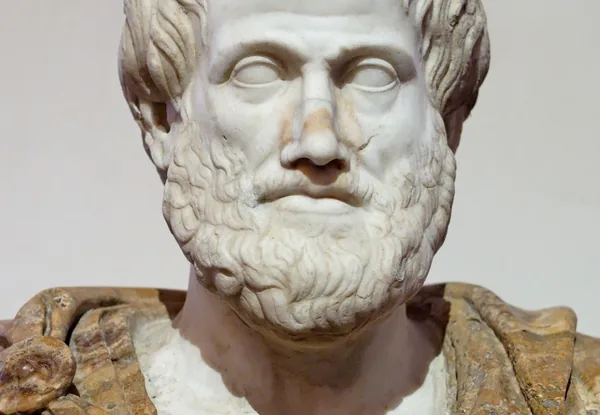
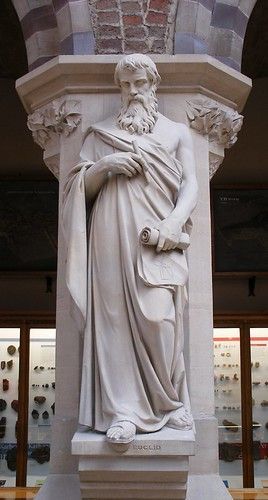
No contemporary portrait or physical description of Euclid survives - not even his ethnicity or exact nationality is documented with certainty, despite centuries of speculation. Every image of Euclid produced since, including 19th-century statues like the one shown in this profile's header and the many engravings and paintings that place him among history's great mathematicians, is an artist's invention, projected onto a name attached to one of the most consequential texts ever written. The disconnect is itself telling: unusually for a historical figure of major influence, it is Euclid's book, not his biography, that has done nearly all of the work of securing his place in history.
Legacy
Why Number Fourteen
Michael Hart ranked Euclid 14th in The 100, crediting the exceptional durability of a single textbook: for well over two thousand years, from ancient Alexandria through the medieval Islamic world and into 20th-century European classrooms, the Elements remained the standard way students were first introduced to formal mathematical proof. Few authors in any field have had their original work used, largely unchanged in method if not in exact wording, for so many centuries after their death.
Even the Elements' one debated postulate - the so-called parallel postulate, which Euclid stated but many later mathematicians suspected might be provable from the others rather than a true independent assumption - became historically productive in its own right. Nineteenth-century mathematicians who explored what happens if that postulate is dropped or altered developed non-Euclidean geometry, later essential to Einstein's general theory of relativity, so that even a 2,000-year-old point of doubt about Euclid's own text ultimately helped open an entirely new branch of mathematics.
Related Publications