Shih Huang Ti

Shih Huang Ti
Born 259 BC • Died 210 BC
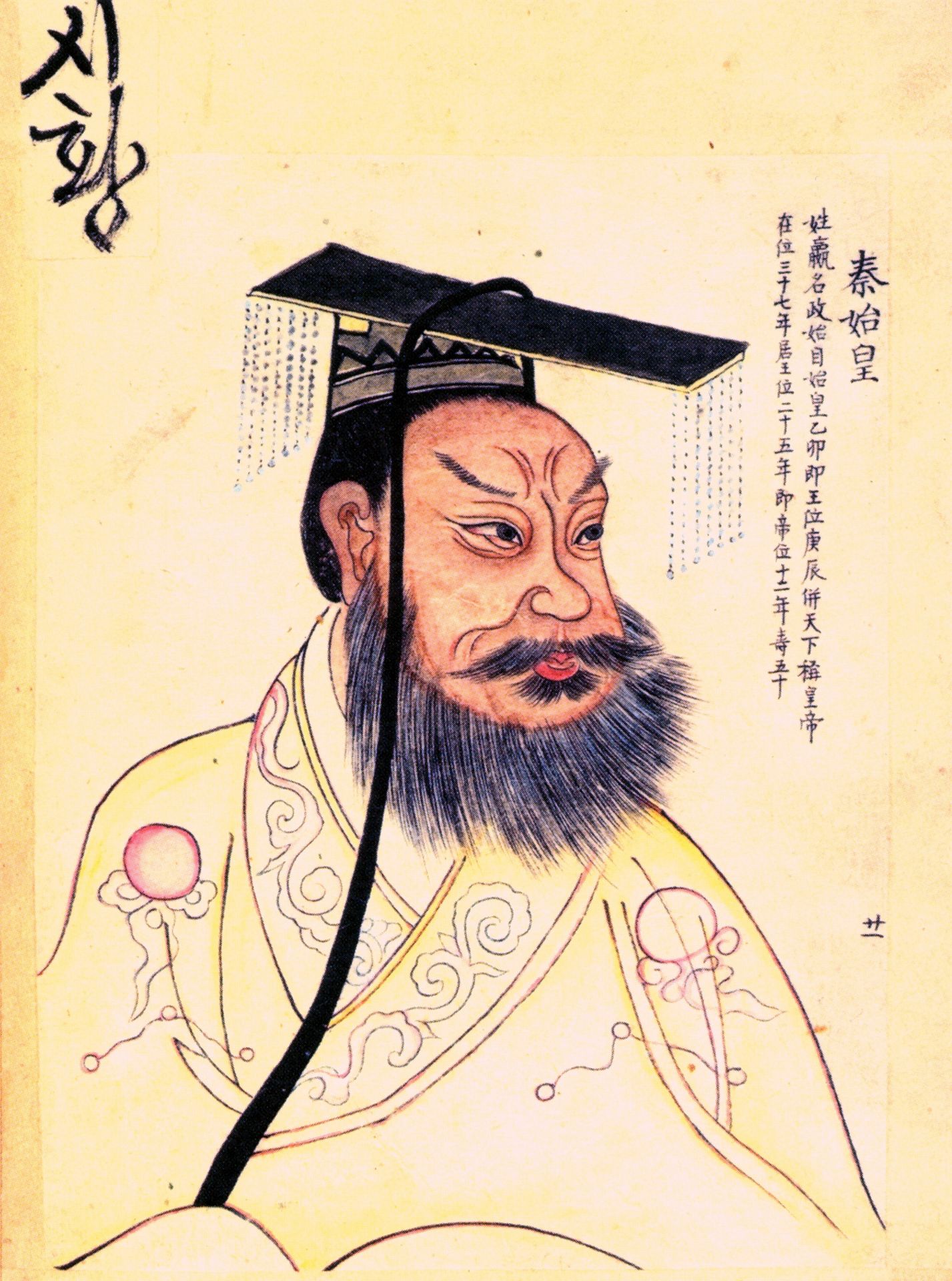
Qin Shi Huang - born Ying Zheng and known to earlier Western scholarship as Shih Huang Ti - became king of the state of Qin at just 13 and, by 221 BC, had conquered the last of China's rival Warring States to become its first unified emperor. In roughly a decade of rule he standardized the empire's script, currency, weights, and roads, linked regional walls into the earliest Great Wall, and commissioned the buried Terracotta Army to guard his tomb - reshaping China so thoroughly that the administrative structure he imposed outlasted his own short-lived dynasty by two millennia. Michael Hart ranked him 17th among history's most influential people.
Rank
#17
Influence
84
Field
Ruler
Historical Perspective
Born in 259 BC as Ying Zheng, the future First Emperor ascended the throne of the state of Qin at the age of 13 in 246 BC, following the death of his father King Zhuangxiang after a reign of only three years. Qin was already the most powerful of China's seven rival Warring States, and over the following decades Zheng's armies conquered the other six one at a time, using a deliberate strategy of allying with distant states while attacking nearby ones: Han fell first in 230 BC, followed by Zhao in 228 BC after the fall of its capital Handan, Wei in 225 BC after Qin forces flooded its capital Daliang, Chu in 223 BC, Yan in 222 BC, and finally Qi in 221 BC, completing the unification of China under a single ruler for the first time in its history. Rather than reuse the existing title of king, Zheng invented a new one - Huangdi, usually translated as 'emperor' - and took the name Qin Shi Huangdi, the First Emperor of Qin, a title every subsequent Chinese monarch would carry for the next two thousand years. In the roughly decade of centralizing rule that followed, advised by his Legalist chancellor Li Si, the First Emperor standardized China's written script, currency, weights and measures, and even the axle width of carts so they would fit the ruts of the empire's new road network, while ordering the destruction of rival philosophical texts in 213 BC and, tradition holds, the live burial of some 460 Confucian scholars the following year. His armies under General Meng Tian also drove the nomadic Xiongnu from the Ordos Plateau and joined existing regional fortifications into a single defensive wall - the ancestor, though not the physical structure, of today's Great Wall, most of which was rebuilt centuries later under the Ming dynasty. Obsessed in his final years with immortality, the emperor died in 210 BC at 49, most likely poisoned by the mercury-laced elixirs his alchemists prescribed him in pursuit of eternal life, and was buried in a vast mausoleum near modern Xi'an guarded by an army of roughly 8,000 life-sized terracotta soldiers that remained undiscovered until 1974. Michael Hart ranked Qin Shi Huang 17th in The 100, crediting him with the political and administrative unification of China - a framework of centralized bureaucratic rule that outlived his own Qin dynasty by fewer than four years but shaped Chinese governance for the two millennia that followed.
Influence Meter
84
Measured on a 100-point scale
The ruler who unified China and defined its imperial template
246 BC
A Boy King in the Strongest State
Ying Zheng was born in 259 BC and inherited the throne of the state of Qin at just 13 years old in 246 BC, after his father, King Zhuangxiang, died following a reign of only three years. Qin was already the most powerful of the seven rival Warring States that had been fighting for supremacy across China for over two centuries, giving the young king an unusually strong hand from the outset of his reign.
Over the following quarter-century, Zheng's court applied a deliberate strategy - allying with distant states while attacking nearby ones - to conquer the remaining six Warring States one at a time. Han fell first in 230 BC, followed by Zhao in 228 BC, Wei in 225 BC, Chu in 223 BC, Yan in 222 BC, and finally Qi in 221 BC, completing a unification of China that no single ruler had achieved before.
221 BC
The First Emperor
With the conquest of Qi in 221 BC, Zheng ruled a unified China for the first time in its recorded history. Rather than adopt the existing title of king used by the rulers he had defeated, he invented a new one - Huangdi, commonly translated as 'emperor' - and took the name Qin Shi Huangdi, the First Emperor of Qin. Every subsequent monarch of China would carry the title Huangdi for the next two thousand years, making it one of the most durable political inventions in world history.
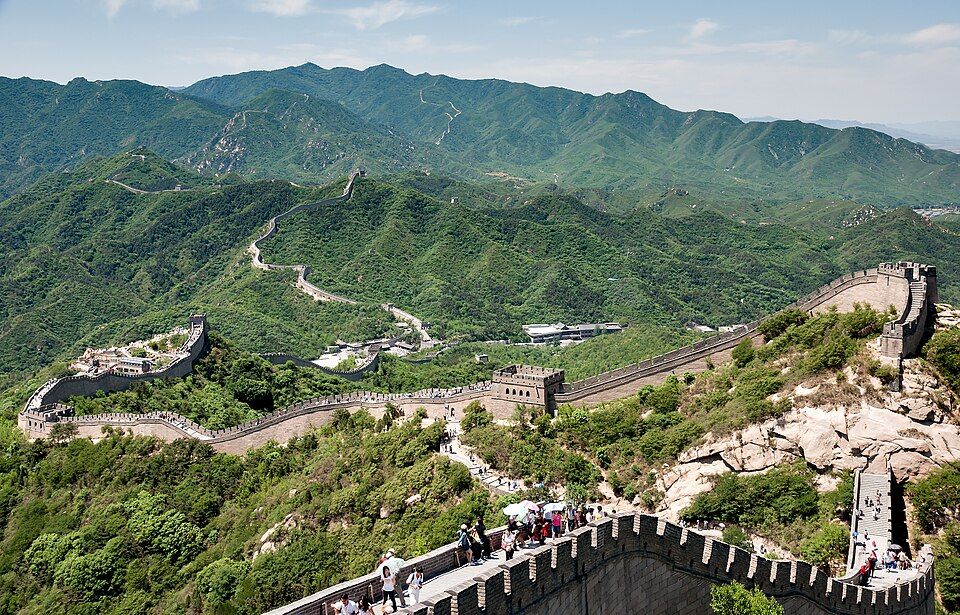
Under General Meng Tian, Qin armies drove the nomadic Xiongnu from the Ordos Plateau and joined existing regional fortifications into a single defensive wall around 220 BC - the conceptual ancestor of the Great Wall of China. The rammed-earth wall Qin Shi Huang built does not survive; most of the stone Great Wall visible today, including the sections at Badaling, was rebuilt more than 1,500 years later under the Ming dynasty.
Frontier Defense
Joining the Walls
Facing repeated raids from the nomadic Xiongnu along China's northern frontier, Qin Shi Huang ordered General Meng Tian to drive them from the Ordos Plateau and then link the separate defensive walls earlier Warring States had built into a single continuous barrier, constructed largely from rammed earth using forced labor. That original Qin-era wall no longer survives in recognizable form; the stone fortifications that draw millions of visitors to sites like Badaling today, shown here, were built more than a millennium and a half later during the Ming dynasty, on a similar frontier line but as an entirely different physical structure.
Centralizing an Empire
The First Emperor's Reforms
In roughly a decade of rule over a unified China, Qin Shi Huang's government imposed standards that outlasted his dynasty by two thousand years.
Standardized Script
Regional variations in Chinese characters were replaced with a single standardized script across the empire.
- Effect: One written language
Standardized Currency
A uniform round bronze coin with a square hole replaced the varied currencies of the former Warring States.
- Coin: Banliang
Standardized Weights and Measures
Uniform weights, measures, and even cart axle widths were imposed so goods and vehicles moved consistently across the empire.
- Scope: Empire-wide
Legalist Code
Governance followed the strict Legalist philosophy advised by chancellor Li Si, enforced through uniform law rather than regional custom.
- Chief advisor: Li Si
Burning of the Books
Rival philosophical texts were ordered destroyed and, by tradition, hundreds of Confucian scholars were buried alive to suppress dissent.
- Scholars buried: c. 460 (tradition)
Chronology
From Boy King to First Emperor
Qin's rise from one of seven rival states to a unified empire took a decade of methodical conquest, followed by an even faster decade of centralizing reform.
The Emperor's Tomb
An Army for the Afterlife
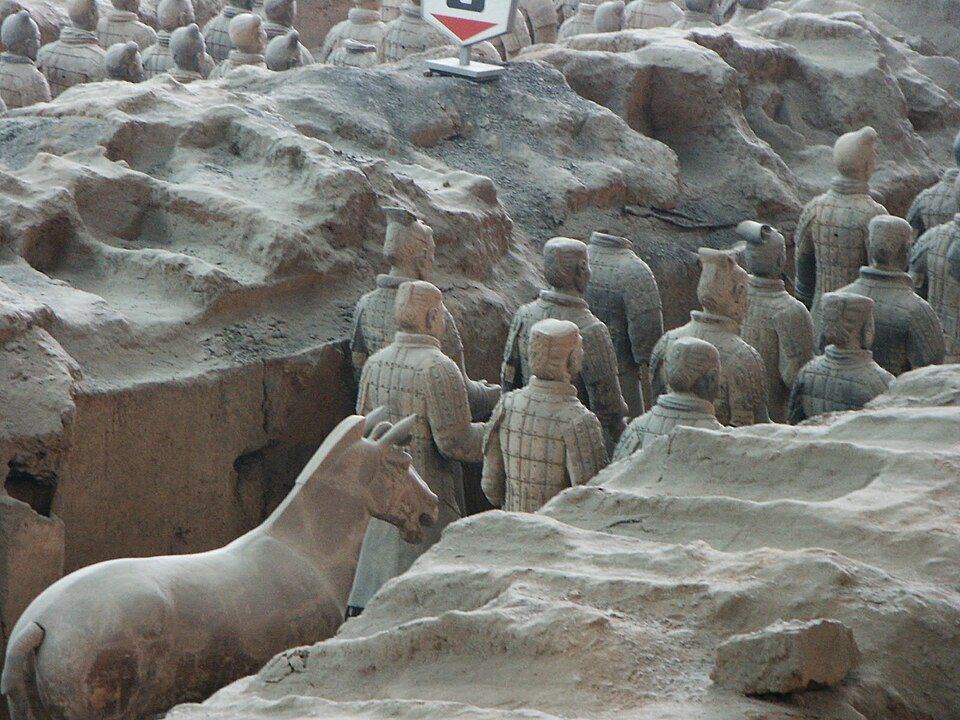
Convinced of his own claim to eternal significance even as he pursued literal immortality, Qin Shi Huang ordered the construction of a vast underground mausoleum near his capital, guarded by a buried army of roughly 8,000 life-sized terracotta soldiers, along with horses and chariots, each reportedly individualized in facial detail. Built at enormous cost by an estimated 700,000 forced laborers, the complex remained hidden for more than two thousand years until local farmers digging a well accidentally discovered it in 1974 - a find now considered one of the most significant archaeological discoveries of the 20th century and, alongside the emperor's political unification of China, the achievement for which he is most widely remembered today.
Final Years
The Search for Eternal Life
Having secured an empire, Qin Shi Huang spent much of his final decade pursuing something no army could conquer: immortality. He consulted alchemists, funded expeditions across land and sea in search of a legendary elixir of life, and, in a habit shared by other rulers across history who sought the same goal, regularly consumed pills formulated with mercury, which ancient Chinese alchemical tradition believed conferred eternal life.
The mercury that was meant to preserve him almost certainly killed him. In 210 BC, while touring his empire, the First Emperor died at age 49, with modern toxicological analysis pointing to chronic mercury poisoning as the most likely cause - an outcome historians have long treated as a stark irony given the scale of the tomb, and its terracotta guardians, he had already built for the death he had spent years trying to avoid.
Enduring Legacy
What Outlived the Qin Dynasty
The Qin dynasty itself collapsed within four years of the First Emperor's death, but several of his innovations proved far more durable than his family's rule.
Legacy
Why Number Seventeen
Michael Hart ranked Qin Shi Huang 17th in The 100, crediting him not with any single invention or idea but with an act of political engineering: the forced unification of China's warring regional states into a single centralized empire, governed by standardized law, script, and currency, under a new title of Huangdi that every subsequent Chinese ruler would claim for two millennia.
That unification proved more durable than the man or the dynasty that achieved it - the Qin collapsed within four years of his death, undone in part by the brutality of the very Legalist methods that had built it - but the administrative template of centralized imperial rule he imposed on China became the default structure of Chinese governance for the two thousand years that followed, making him, in Hart's assessment, one of the most consequential state-builders in human history.
Related Publications