Galileo Galilei

Galileo Galilei
Born 15 February 1564 • Died 8 January 1642
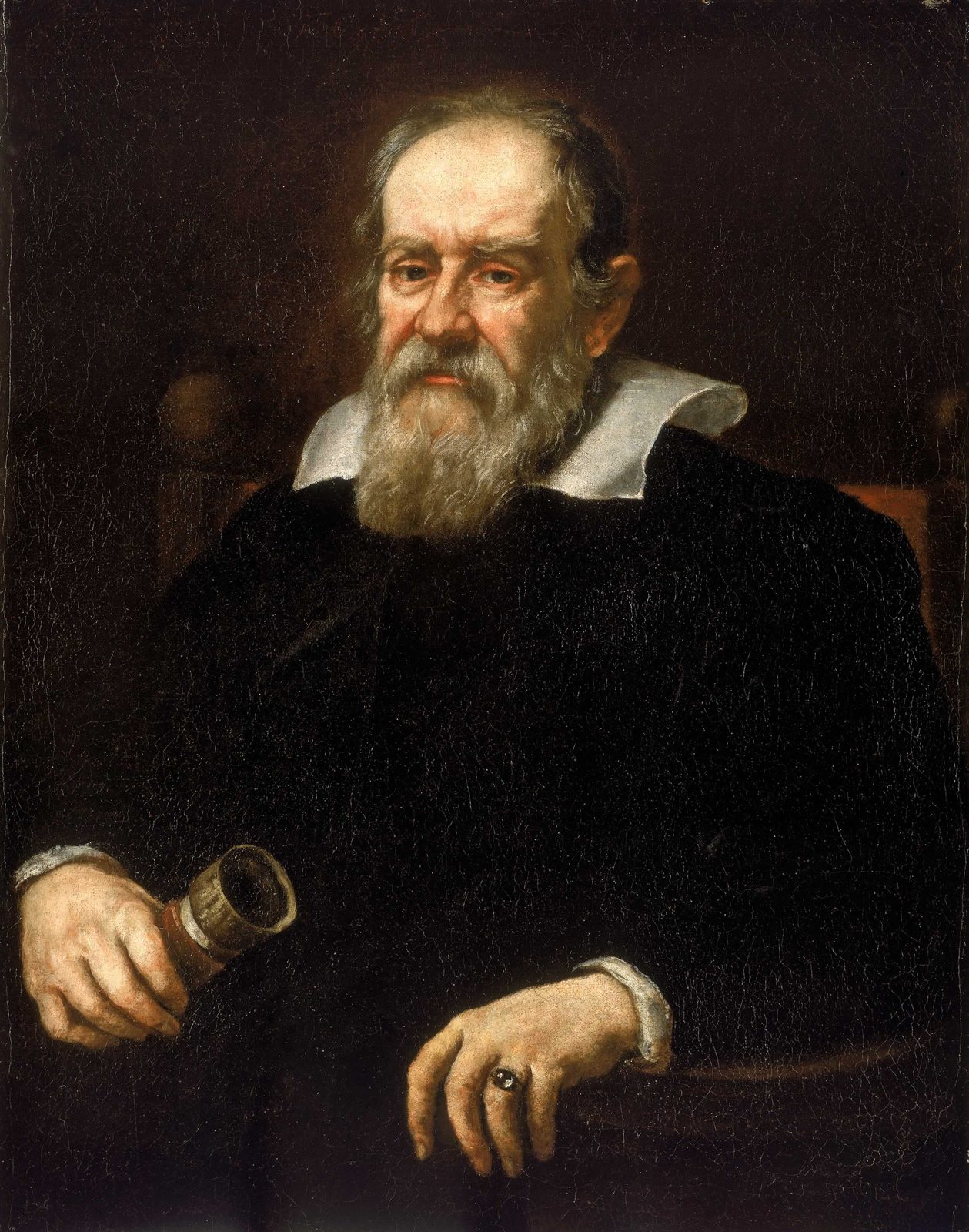
Galileo Galilei (1564-1642) was an Italian astronomer and physicist whose 1609-1610 telescopic discoveries - Jupiter's moons, the phases of Venus, and the mountains of the Moon - provided the observational evidence that turned Copernican heliocentrism from a mathematical hypothesis into a serious challenge to accepted cosmology. His public defense of that view led to a 1633 trial before the Roman Inquisition and house arrest for the rest of his life. Michael Hart ranked him 12th among history's most influential people.
Rank
#12
Influence
89
Field
Scientist
Historical Perspective
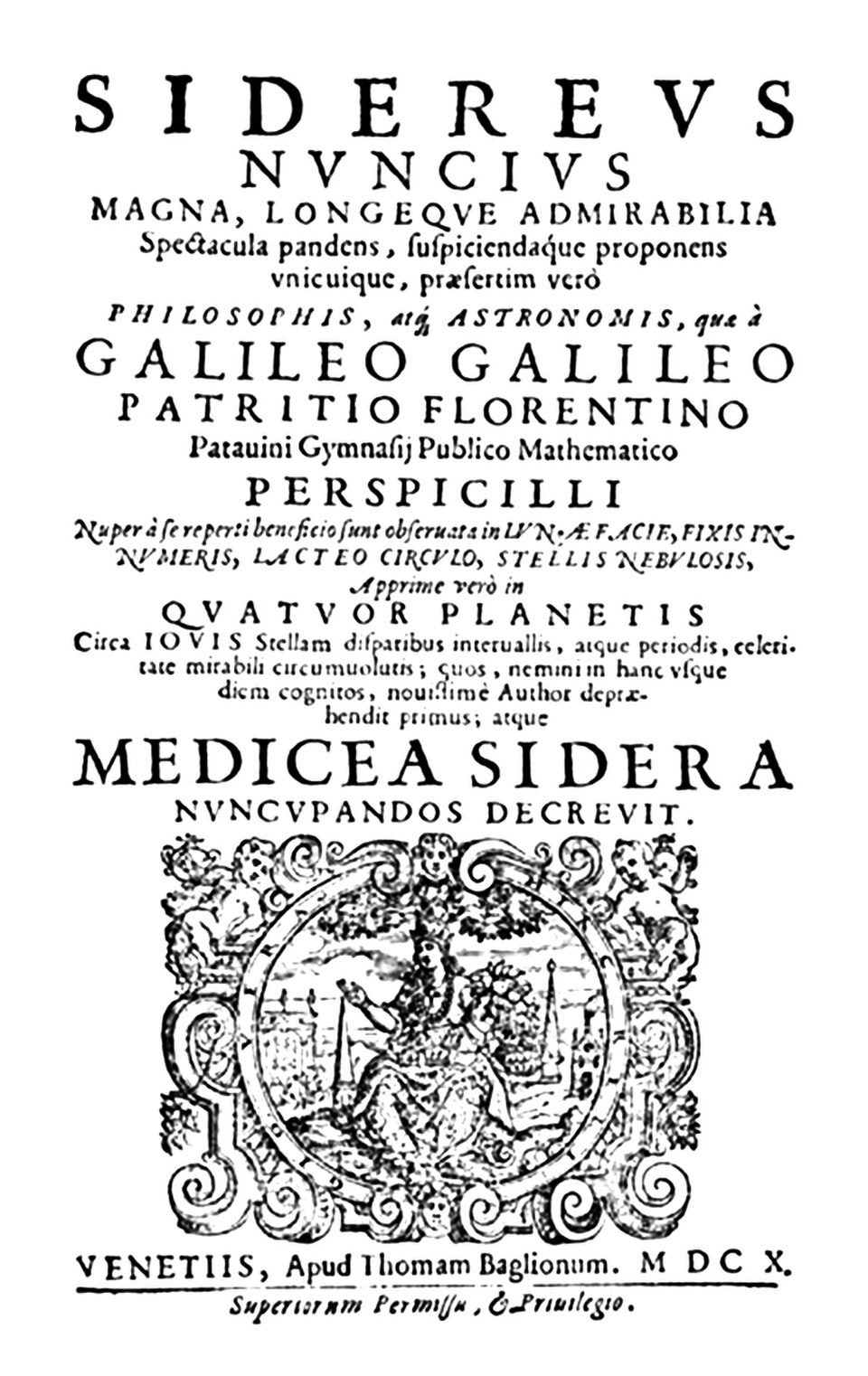
Born on 15 February 1564 in Pisa, in the Duchy of Florence, Galileo Galilei studied medicine before his interests shifted to mathematics and natural philosophy, and he held professorships at Pisa from 1589 and at Padua from 1592 to 1610 - years he later called the happiest of his life. In 1609, after hearing of a Dutch spyglass design, Galileo built and improved his own telescope, and by January 1610 he had discovered four moons orbiting Jupiter, observed the rough, cratered surface of the Moon, and detected countless stars invisible to the naked eye, publishing his findings in March 1610 as Sidereus Nuncius, or The Starry Messenger. Further observations of the changing phases of Venus provided strong evidence against the Earth-centered Ptolemaic model and in favor of the Sun-centered Copernican system. Galileo's public advocacy of heliocentrism, especially in his 1632 Dialogue Concerning the Two Chief World Systems, alarmed the Catholic Church, which had already warned him in 1616 not to defend the theory as physical fact. Summoned before the Roman Inquisition, he was convicted in 1633 of 'vehement suspicion of heresy' and sentenced to house arrest, which he served at his villa in Arcetri, near Florence, until his death. Even under house arrest and after going blind, Galileo completed Two New Sciences in 1638, a foundational text on motion and material strength smuggled to the Netherlands for publication. He died on 8 January 1642. Michael Hart ranked Galileo 12th in The 100, crediting his telescopic discoveries and his role in establishing the modern scientific method.
Influence Meter
89
Measured on a 100-point scale
A telescope that turned Copernican theory into observable fact
1589-1610
The Happiest Years, at Padua
Galileo began his academic career as a professor of mathematics at the University of Pisa in 1589, moving in 1592 to the University of Padua, in the Venetian Republic, where he remained for eighteen years he later described as the happiest and most fruitful of his life. There he conducted early experiments on pendulums and on the motion of falling and rolling bodies, using inclined planes to slow and measure acceleration that would have been too fast to observe in free fall, work that quietly laid the groundwork for the kinematics he would formalize decades later.
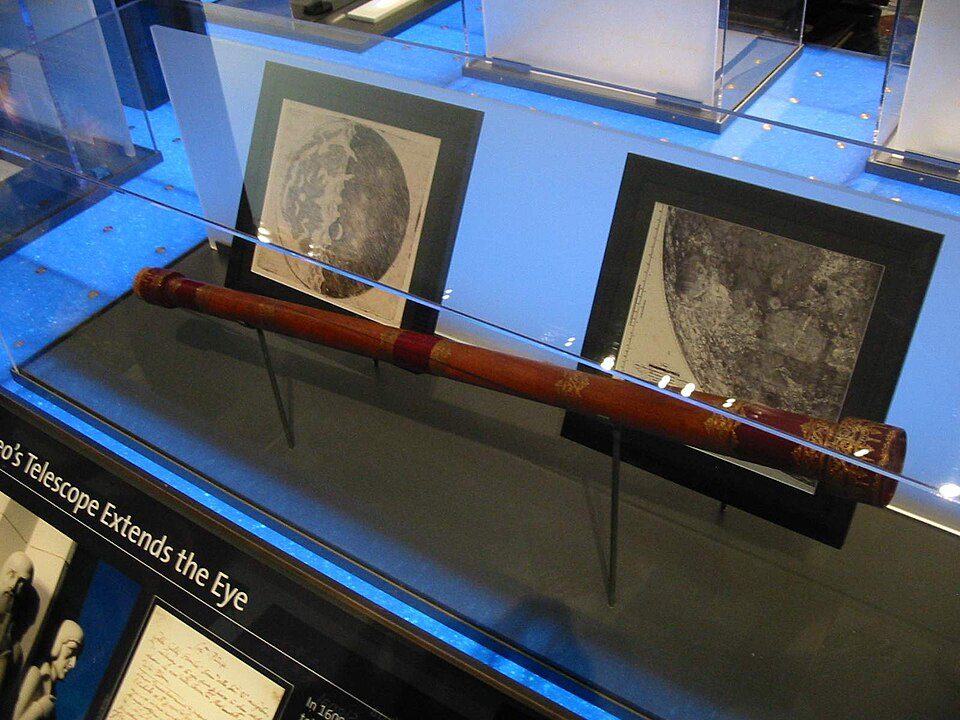
It was also at Padua, in 1609, that Galileo heard reports of a magnifying spyglass recently invented in the Netherlands. Working from description alone, he built his own version within months and steadily improved its magnification, turning what had been a novelty item into a serious scientific instrument - and turning it, crucially, toward the night sky rather than distant ships.
1609-1610
Four New Worlds Around Jupiter
Pointing his improved telescope at the sky in late 1609 and early 1610, Galileo made a rapid series of discoveries that upended assumptions about the heavens. He found that the Moon's surface was rough and mountainous rather than a perfect polished sphere, that the Milky Way resolved into countless individual stars, and, on 7 January 1610, that four small points of light shifted position around Jupiter night after night. By 15 January he had correctly concluded these were not stars but moons orbiting Jupiter - the first celestial bodies discovered to orbit a planet other than Earth, and visible proof that not everything in the heavens circled the Earth.
March 1610
Sidereus Nuncius
Galileo rushed his discoveries into print within weeks, publishing Sidereus Nuncius (The Starry Messenger) in March 1610. The short treatise described the telescope itself, the Moon's mountainous terrain, the resolution of the Milky Way into individual stars, and the four moons of Jupiter, which Galileo named the 'Medicean Stars' in honor of his patron, Cosimo II de' Medici. The book made Galileo an instant celebrity across Europe and secured him a position as court mathematician and philosopher to the Medici in Florence, freeing him from teaching duties to focus on research and writing.
Galileo's observation that Venus shows a full cycle of phases, like the Moon, was especially damaging to the old Earth-centered Ptolemaic model, which could not account for it - while it fit naturally with the Sun-centered Copernican system, in which Venus orbits the Sun inside Earth's own orbit. Combined with his manuscript notes recording Jupiter's moons across dozens of nights in 1610, this evidence gave heliocentrism its strongest empirical backing yet.
1609-1613, In Detail
The Telescopic Discoveries
In roughly four years, Galileo's telescope reshaped the observational basis of astronomy.
The Moon's Surface
Observed mountains, craters, and rough terrain on the Moon, contradicting the idea of a perfect, smooth celestial sphere.
- Method: Chiaroscuro shading analysis
The Moons of Jupiter
Identified four points of light orbiting Jupiter, now known as the Galilean moons: Io, Europa, Ganymede, and Callisto.
- Moons found: 4
Phases of Venus
Observed Venus cycling through phases like the Moon, evidence inconsistent with the Earth-centered Ptolemaic model.
- Supports: Heliocentrism
Sunspots
Tracked dark spots moving across the face of the Sun, showing the Sun itself was not a perfect, unchanging body and rotated on an axis.
- Implication: The Sun is imperfect and rotating
Chronology
From Telescope to Trial
Galileo's public advocacy of the Copernican system brought him increasingly into conflict with Church authorities over two decades.
1633
Before the Roman Inquisition
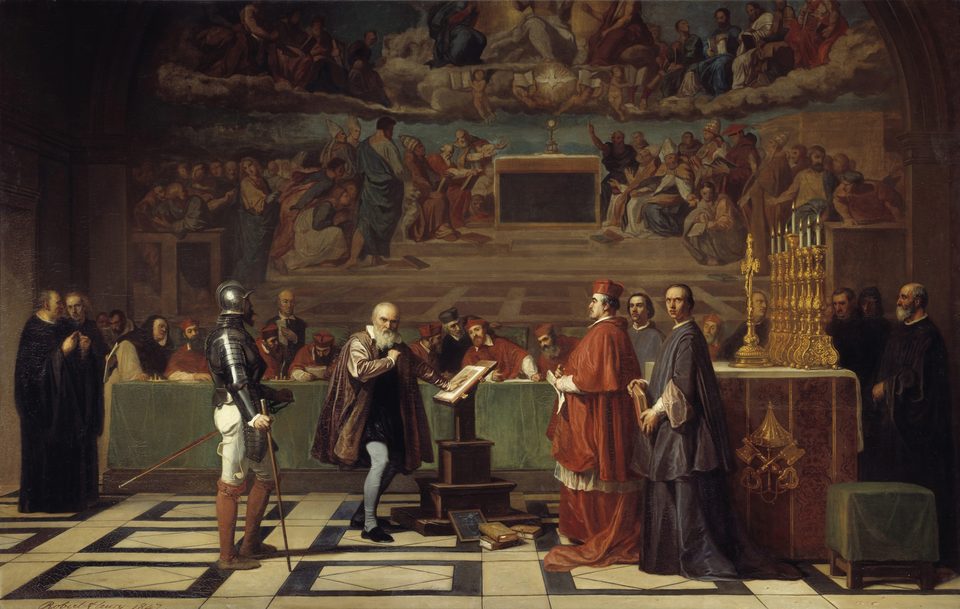
Galileo's 1632 book Dialogue Concerning the Two Chief World Systems, framed as a neutral debate, was widely read as an unmistakable argument for Copernican heliocentrism, directly contradicting the private warning the Church had given him in 1616. Summoned to Rome, Galileo stood trial before the Roman Inquisition in 1633 and, at nearly seventy years old and reportedly under threat of torture, was made to formally renounce the view that the Earth moves around the Sun. He was convicted of 'vehement suspicion of heresy' and sentenced to indefinite imprisonment, quickly commuted by Church and Medici authorities to house arrest, which he served first at a friend's villa and then at his own home in Arcetri, near Florence, for the rest of his life.
House Arrest, 1633-1642
Two New Sciences
Confined to Arcetri and eventually blind, Galileo spent his final years synthesizing decades of earlier research into physics rather than astronomy, since the Inquisition's ban applied specifically to cosmology. The result, Discourses and Mathematical Demonstrations Relating to Two New Sciences, dealt with the strength of materials and with kinematics, the mathematics of motion - including the law that a falling body covers distance proportional to the square of the elapsed time, and the parabolic path of projectiles. Unable to publish in Italy, Galileo had the manuscript smuggled to the Netherlands, where it appeared in 1638, four years before his death.
Two New Sciences is now considered a foundational text of classical mechanics, directly anticipating and enabling the work Isaac Newton would build on a generation later - a fitting final act from a scientist condemned for looking at the sky but remembered equally for how carefully he studied things falling to the ground.
Written Works
Key Works by Galileo Galilei
Galileo's publications moved from pure astronomy to an open defense of Copernicanism and, finally, to the physics of motion.
Sidereus Nuncius (The Starry Messenger)
Announces the telescopic discovery of Jupiter's moons and the true surface of the Moon.
- Latin
- 1610
- Treatise
Il Saggiatore (The Assayer)
A polemical defense of empirical, mathematical natural philosophy against Aristotelian tradition.
- Italian
- 1623
- Polemic
Dialogue Concerning the Two Chief World Systems
A dialogue weighing the Ptolemaic and Copernican models, widely read as favoring Copernicus.
- Italian
- 1632
- Dialogue
Two New Sciences
Foundational work on the strength of materials and the mathematics of motion, written under house arrest.
- Italian
- 1638
- Treatise
On 31 October 1992, more than 350 years after Galileo's conviction, Pope John Paul II formally addressed the 'Galileo case' before the Pontifical Academy of Sciences, acknowledging that Church theologians of the time had erred and calling the affair a 'tragic mutual incomprehension.' Historians note the statement stopped short of a direct apology for the 1633 verdict itself, but it marked the Vatican's most explicit acknowledgment that the Church had been wrong to convict Galileo for defending a scientifically correct model of the solar system.
Legacy
Why Number Twelve
Michael Hart ranked Galileo 12th in The 100, just behind Louis Pasteur, crediting him both with decisive observational evidence for heliocentrism and with helping establish the modern scientific method's emphasis on experiment and mathematical description over inherited authority. His telescope turned an abstract mathematical model into something anyone could look through an eyepiece and verify, while his physics of motion, completed in his final years under house arrest, directly set up the mechanics that Isaac Newton would formalize decades later.
Galileo died in Arcetri on 8 January 1642. He is often said to have died the same year Isaac Newton was born, but the claim rests on a calendar mix-up: Newton's local birth record in England reads 25 December 1642 under the Julian calendar Britain still used, which corresponds to 4 January 1643 on the Gregorian calendar already in use in Galileo's Italy - so the two events, though separated by less than a year, fall in different calendar years once converted to a common system.
Related Publications