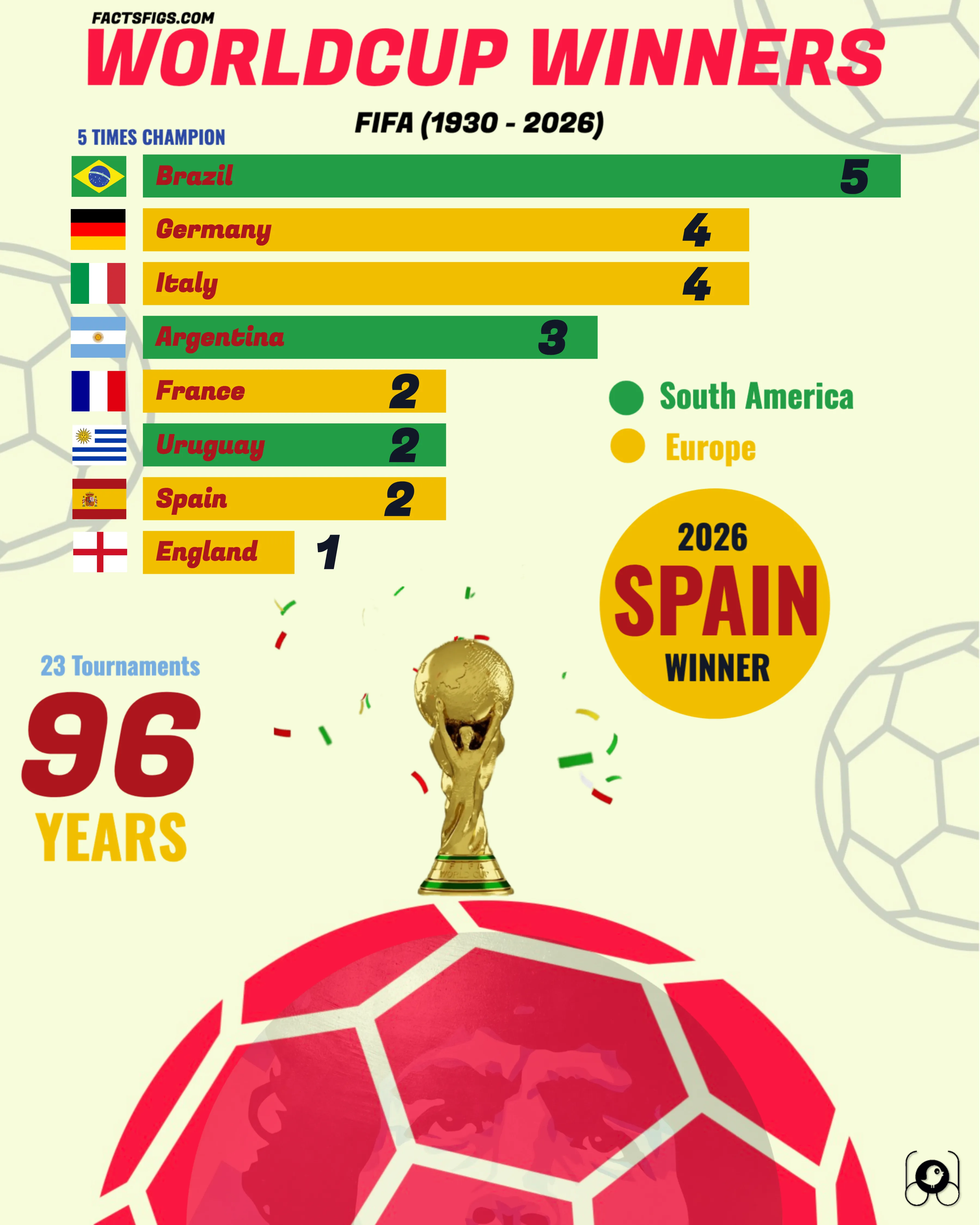
Since the first FIFA World Cup in 1930, only 8 nations have won it — and just 5 of them have won more than once.
! What the Data Shows:
•
Brazil leads outright:5 titles (1958–2002) — the only country with more than 4 wins.
•
Germany and Italy are tied:4 titles each, spanning 60+ year windows.
•
Argentina and France follow:3 titles (most recent 2022) and 2 titles (1998, 2018) respectively.
•
Three one-time winners close the list:Uruguay, England, and Spain each have exactly 1 title.
? Key Numbers:
•
Total Winning Nations:8
•
Total World Cups Played:23
•
Top Title Count (Brazil):5
•
Winning Confederations:2
In nearly a century of competition, World Cup success has stayed concentrated in South America and Europe, with Brazil's 5-title record standing as the benchmark for sustained national dominance in global football.
Continue reading below for the full detailed article →
Overview
Across 22 FIFA World Cup tournaments held since 1930, the trophy has changed hands just 8 times among nations — never once going to a team outside South America or Europe. This horizontal bar breakdown ranks those 8 champions by total titles won, from Brazil's record 5 down to the single-title wins of Uruguay, England, and Spain, mapping out one of sport's most exclusive and enduring hierarchies.
#1 Brazil — 5 World Cup Titles, the Most of Any Nation
Brazil is the only nation to have ever won five FIFA World Cups, a record that has stood untouched since 2002. From Pelé's breakthrough in 1958 to Cafu lifting the trophy in Yokohama, Brazil's five stars were earned across five separate decades — a spread of sustained excellence no other country has matched.
Most World Cup Titles · 5 Trophies
5
Brazil is the only nation to have won the World Cup five times, and no other country has come close to matching that total. The five stars on Brazil's crest span 1958 to 2002 — 44 years and five different decades of football — making Brazil's record the benchmark every other World Cup nation is still chasing.
Every World Cup Ever Played · 23 of 23
23
Brazil is the only nation to have played in every single FIFA World Cup since the tournament began in 1930 — 22 consecutive appearances without ever missing a qualifying cycle. Not even four-time champions Germany or Italy can make that claim, which is part of why Brazil is often called the spiritual home of the World Cup itself.
Pelé's Record · The Only 3-Time Winner
3 Titles
Three of Brazil's five stars belong in part to one man: Pelé won the World Cup in 1958, 1962, and 1970, becoming the only player in history to lift the trophy three times. He was just 17 when he scored twice in the 1958 final against Sweden, and by 1970 he was the on-field leader of a team many still call the greatest ever assembled.
Brazil by the Numbers
Most World Cup Titles 5 Brazil's wins in 1958, 1962, 1970, 1994, and 2002 make it the only country with more than four World Cup titles. Every other nation on this list has topped out at four.
Title-Winning Span 44 YearsBrazil's first title came in the 1958 final in Solna, Sweden, and its fifth arrived in the 2002 final in Yokohama, Japan. That 44-year window is the longest active championship span of any nation that has ever won the World Cup.
Decades With a Title 5 Brazil lifted the trophy in the 1950s, 1960s, 1970s, 1990s, and 2000s — five different decades in all. The only gap in that streak is the 1980s, when Brazil didn't reach a single final.
Runner-Up Finishes 2 Even the most decorated team in World Cup history has felt the heartbreak of a final defeat. Brazil lost as host in 1950 to Uruguay's stunning 2-1 upset at the Maracanã, and again in 1998, falling 3-0 to France in Paris.
Years Since the Last Title 24 Years and CountingBrazil hasn't lifted the World Cup since 2002, the longest title drought in the nation's own history. Every tournament since has ended short of the final for Brazil, leaving the chase for a sixth star as football's most closely watched storyline heading into 2026.
Origins
How a British Field Game Conquered the Planet
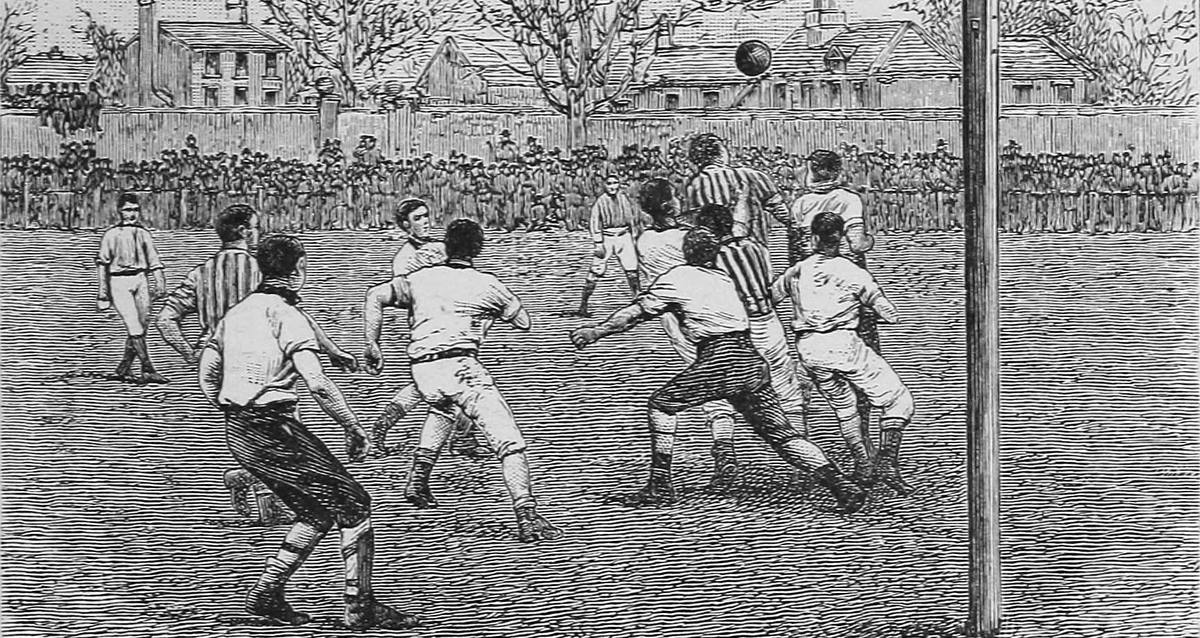
Football's rules were far from settled in the 1800s, when English public schools and universities played wildly different versions of the same rough game. That changed in 1863, when representatives meeting in London agreed on a standardized code and formed the Football Association — the moment historians point to as the true birth of the modern sport. British sailors, railway engineers, and traders carried the game with them wherever they worked, and it took root fast in ports and cities across South America and Europe. By the early 1900s clubs were forming in Buenos Aires, Montevideo, Turin, and Rio de Janeiro, and in 1904 seven national associations met in Paris to found FIFA, the sport's first global governing body. The first World Cup kicked off in 1930, hosted and won by Uruguay in front of a passionate home crowd at Montevideo's Estadio Centenario, with only 13 teams taking part. Fewer than a century later, the tournament has grown to 22 completed editions and will expand to 48 teams in 2026 — proof that a schoolyard argument over rules turned into the planet's most unifying game.
Data Table
FIFA World Cup Winners by Country (1930–2026)
Ranked list of the 8 nations that have won the FIFA World Cup, showing total titles, winning years, and confederation.
Brazil
5
South America
1
5 titles (1958–2002)
Germany
4
Europe
2
4 titles (1954–2014)
Italy
4
Europe
2
4 titles (1934–2006)
Argentina
3
South America
4
3 titles (1978–2022)
France
2
Europe
5
2 titles (1998, 2018)
Uruguay
2
South America
5
2 titles (1930, 1950)
Spain
2
Europe
6
2 titles (2010, 2026)
England
1
Europe
7
1 title (1966)
Rank ties reflect equal title counts (e.g., Germany and Italy are tied at 4 titles each).
South America
How South America Won 10 of 23 World Cups
Brazil · 5 Titles (1958–2002)
Brazil turned the World Cup into a home away from home, breaking through in 1958 when a teenage Pelé inspired a 5-2 win over Sweden under captain Hilderaldo Bellini. Four years later in Chile, captain Mauro Ramos lifted the trophy again after a 3-1 win over Czechoslovakia, and in 1970 Carlos Alberto Torres captained arguably the greatest team ever assembled to a 4-1 demolition of Italy in Mexico City.
The wait for a fourth title stretched 24 years, but Dunga's Brazil finally broke the drought in 1994, beating Italy on penalties after a scoreless 120 minutes in Pasadena. Cafu then captained the 2002 squad to a 2-0 win over Germany in Yokohama, sealing a fifth star that no other nation has matched — and stretching Brazil's championship window across five different decades.
Argentina · 3 Titles (1978–2022)
Argentina's first triumph came on home soil in 1978, when captain Daniel Passarella held the trophy aloft after a 3-1 extra-time win over the Netherlands in Buenos Aires. Eight years later Diego Maradona single-handedly dragged his country to glory in Mexico, captaining the side to a 3-2 win over West Germany in a final still remembered alongside his mesmerizing run through the England defense in the quarterfinal that preceded it. Argentina's long-awaited third star arrived in 2022, when captain Lionel Messi finally lifted the trophy after a penalty shootout win over France in Qatar.
Uruguay · 2 Titles (1930, 1950)
Uruguay wrote football's opening chapter, hosting and winning the very first World Cup in 1930 as captain José Nasazzi lifted the trophy after a 4-2 win over Argentina. Twenty years later Uruguay stunned the football world again, silencing a packed Maracanã crowd with captain Obdulio Varela leading a 2-1 win over host nation Brazil — a result still remembered in Brazil simply as the Maracanazo.
Europe
How Europe Claimed the Other 13 World Cup Titles
Germany · 4 Titles (1954–2014)
West Germany's first title in 1954 is still called the Miracle of Bern — captain Fritz Walter lifted the trophy after a stunning 3-2 comeback win over a Hungary side that had gone unbeaten for four years. Twenty years later, captain Franz Beckenbauer led West Germany past the Netherlands 2-1 on home soil in Munich for a second star.
Lothar Matthäus captained West Germany to a third title in 1990, beating Argentina 1-0 in Rome, and a reunified Germany had to wait until 2014 for a fourth, when captain Philipp Lahm's side beat Argentina 1-0 in extra time in Rio de Janeiro — a 60-year run that makes Germany's title window the longest of any nation on this list.
Italy · 4 Titles (1934–2006)
Italy won its first title on home soil in 1934, with captain Gianpiero Combi leading a 2-1 extra-time win over Czechoslovakia in Rome, then defended it in France in 1938 behind captain Giuseppe Meazza's 4-2 win over Hungary.
Dino Zoff, then 40 years old, captained Italy to a third star in 1982 with a 3-1 win over West Germany in Madrid, and Fabio Cannavaro lifted a fourth title in 2006 after Italy beat France on penalties following a tense 1-1 draw.
France · 2 Titles (1998, 2018)
France delivered its first title in front of a delirious home crowd in 1998, captain Didier Deschamps lifting the trophy after a 3-0 win over Brazil at the Stade de France. Twenty years later captain Hugo Lloris led France past Croatia 4-2 in Moscow for a second star, with a teenage Kylian Mbappé announcing himself on the world stage.
England · 1 Title (1966)
England's only title came on home turf in 1966, when captain Bobby Moore lifted the trophy at Wembley after a dramatic 4-2 extra-time win over West Germany — a final still argued over today because of Geoff Hurst's contested hat-trick goal.
Spain · 2 Title (2010, 2026)
Spain's golden generation finally broke through in 2010, with captain Iker Casillas lifting the trophy after Andrés Iniesta's extra-time strike sealed a 1-0 win over the Netherlands in Johannesburg, capping a tiki-taka era that also produced back-to-back European Championships in 2008 and 2012.
Global Reach
Why the World Cup Is the Planet's Most-Watched Event
No global sporting event pulls in an audience like the World Cup final. Stadiums across host nations sell out to capacity months in advance, and in cities that never fielded a team, bars and public squares still fill with fans wearing colors that aren't even their own — a reach that spans far beyond the 8 nations that have actually lifted the trophy.
Qualifying alone tells the story of the game's scale: more than 200 FIFA member associations enter the race for a place at the tournament, more countries than sit in the United Nations. That number will only grow in 2026, when the finals expand to 48 teams across the United States, Mexico, and Canada — the largest World Cup ever staged.
It's the four-year wait that seems to fuel the obsession. Unlike domestic leagues that play every week, the World Cup asks fans to build anticipation for years between tournaments, and when it finally arrives, the emotion pours out all at once — in packed fan zones, in crowded living rooms, and in the roar that follows every goal scored on the sport's biggest stage.
Data Source and Attribution
The data behind this story was manually compiled from Wikipedia's FIFA World Cup records, cross-checking each nation's title count, winning years, and confederation against the official tournament history. Wikipedia's editors maintain and update these records, and full credit for the source material goes to that ongoing effort.
FactsFigs reviews, cleans, and cross-checks every source dataset before shaping it into a data story. Each visualization is created and designed in FactsFigs Design Studio — an internal tool developed and owned by FactsFigs — and is the original work of a FactsFigs author, not an AI-generated copy of any existing graphic. Individual assets within a visual may or may not be produced with AI tools, but the design of the visual itself is solely FactsFigs' own.
Figures are estimates at the time of publication, provided for information only — nothing here is financial advice or a guarantee of accuracy.