FIFA World Cup 2026 Qualified Teams

By Saif Ur Rahman Published 29 May 2026 Updated 18 Jul 2026

TL;DR - Quick Summary

FIFA 2026 begins the 48-team World Cup era

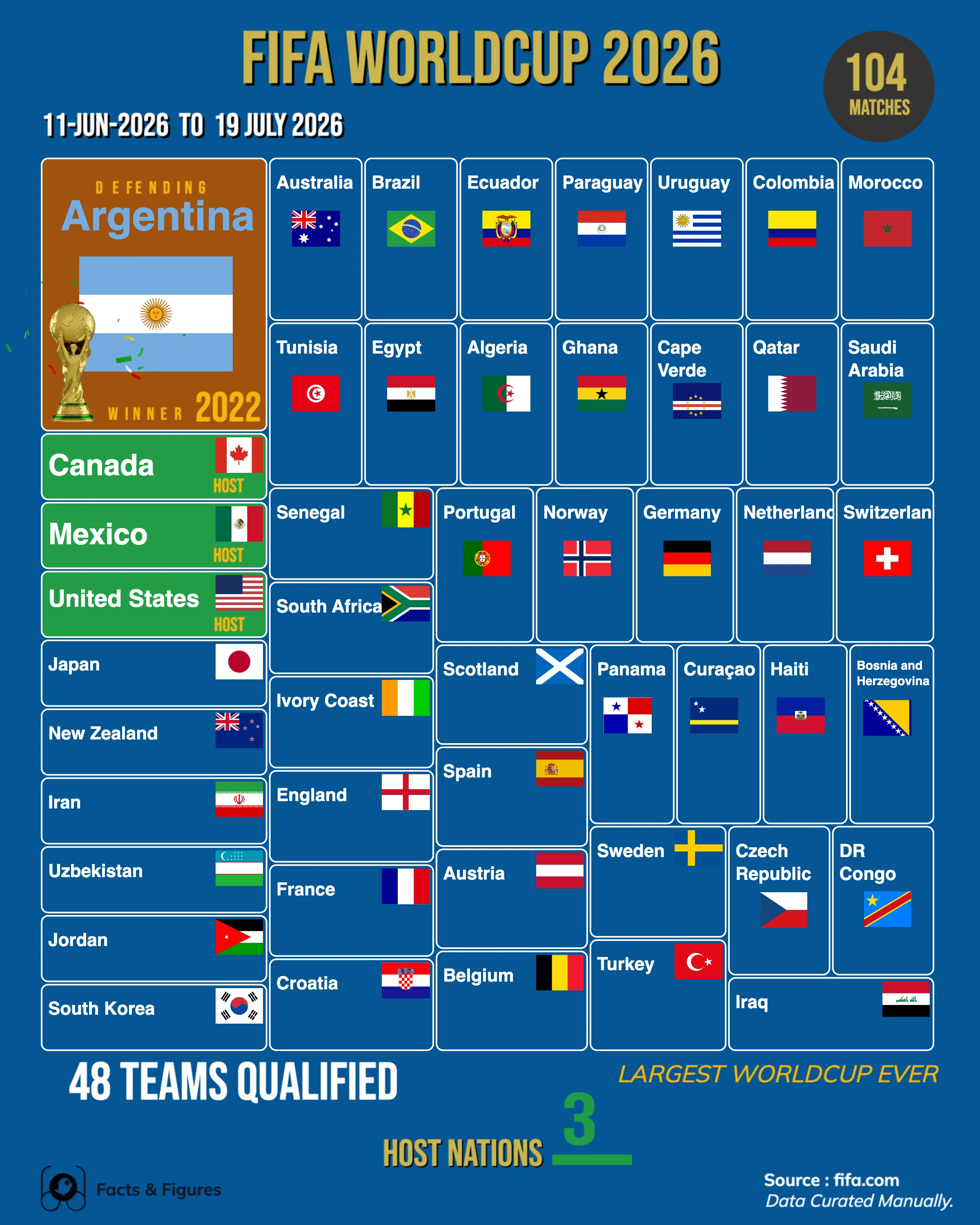
FIFA World Cup 2026 will feature a record 48 qualified teams. The expanded format creates the most globally representative tournament field in World Cup history. Canada, Mexico, and the United States enter automatically as co-host nations.

! Why This Matters:

  • Context: The tournament expands from 32 to 48 teams, opening more qualification slots worldwide.
  • Signal: The 2026 edition becomes the largest FIFA World Cup ever by number of participating nations.
  • Action: Watch how new entrants, returning nations, and tournament veterans perform in the expanded format.

? Key Data:

  • Primary Metric: 48 qualified teams

FIFA 2026 marks a major structural shift for global football, creating a larger, more diverse tournament field across all confederations.

Continue reading below for the full detailed article →

Overview

How 48 Teams Reached the 2026 World Cup

Every one of these 48 nations earned its place through a confederation-based qualifying system, not one global bracket. UEFA's 16 direct places make Europe the largest zone, while the AFC, CAF, CONMEBOL, CONCACAF, and OFC each ran separate multi-year campaigns for their own share of slots. The final two tickets were only settled in March 2026, when DR Congo and Iraq won a six-team inter-confederation play-off. Altogether, teams played roughly 899 qualifying matches worldwide to fill these 45 non-host slots — before the tournament itself expands to 104 matches across 12 groups of four, nearly double the 64 played under the old 32-team format.

Why the 2026 World Cup Has 104 Matches

The 2026 tournament nearly doubles the previous format, growing from 64 matches to 104 across 12 groups of four. FIFA added a new Round of 32 knockout stage to fit in the extra teams, stretching the event to 39 days between the 11 June opener in Mexico City and Toronto and the 19 July final at MetLife Stadium. The United States carries the heaviest share of the load, staging 78 of the 104 matches, while Mexico and Canada each host 13.

US Is Hosting 78/104 Matches

78/104 Matches

The United States shoulders most of the tournament's expanded workload, staging 78 of the 104 matches across 11 cities — nearly three times what Mexico and Canada each host. That includes every match from the quarter-finals onward, plus the final at MetLife Stadium in New Jersey on 19 July 2026, giving the American leg the biggest crowds and latest-stage drama.

How the World Cup Grew to 48 Teams

  • 1982-1994 World Cup Era 24 Teams The field grew from 16 to 24 teams at Spain 1982, a format that lasted four tournaments.
  • 1998-2022 World Cup Era 32 Teams France 1998 introduced the 32-team format FIFA kept for seven straight tournaments, through Qatar 2022.
  • 2026 World Cup 48 Teams FIFA's Council voted 37-0 in January 2017 to expand to 48 teams, adding 40 more matches and slots for Africa and Asia.

Missed Out

Why Denmark, Poland, and Wales Missed 2026

Six teams that played at Qatar 2022 will be watching this tournament from home instead: Cameroon, Costa Rica, Denmark, Poland, Serbia, and Wales. Four of the six are European, and that is the real story behind this list — UEFA's allocation grew only to 16 direct places even though the tournament expanded from 32 to 48 teams overall, so Europe's qualifying groups stayed just as unforgiving as before.

Three of those exits came down to a single play-off match. Denmark lost the UEFA play-off final to Czechia on penalties after a 2-2 draw, Poland lost 3-2 to Sweden, and Wales lost to Bosnia and Herzegovina on penalties after a 1-1 draw — all three winners, Czech Republic, Sweden, and Bosnia and Herzegovina, are now on this 48-team list. Serbia never even reached the play-offs, finishing two points behind Albania in its group, while Cameroon and Costa Rica were eliminated earlier in CAF's and CONCACAF's own qualifying rounds.

Newcomers

4 Nations Reach Their First-Ever World Cup

Four nations will play a FIFA World Cup match for the first time in their history — a direct result of the tournament's jump from 32 to 48 teams, which opened qualifying slots that never existed before across three separate confederations.

🇺🇿 UzbekistanAFCFirst-ever Central Asian nation to qualify for a World Cup
🇯🇴 JordanAFCBuilt on its run to the 2023 AFC Asian Cup final
🇨🇻 Cape VerdeCAFA nation of under 600,000 people that outlasted CAF's traditional powers
🇨🇼 CuraçaoCONCACAFPopulation of about 150,000 — the smallest nation ever to qualify

All four teams enter the expanded 48-team field with zero prior World Cup appearances between them.

Defending Champions

Argentina Returns to Defend Its Third World Cup Title

Argentina walks into the 48-team era as the reigning champion, having beaten France 3-3 (4-2 on penalties) in one of the most dramatic finals the tournament has ever produced, at Lusail Stadium on 18 December 2022. Lionel Messi scored twice in that final and Kylian Mbappé answered with a hat-trick for France, but Argentina held on through the shootout to claim its third World Cup, adding to titles won in 1978 and 1986.

The qualified-teams data puts that consistency in context: 19 total World Cup appearances and 14 straight tournaments without a gap, a run that stretches back to 1974. Only two nations have ever defended the World Cup successfully — Italy in 1934 and 1938, and Brazil in 1958 and 1962 — which is what makes Argentina's title defense in 2026 more than a formality; no team has repeated as champion in over 60 years.

Host Nations

Why Canada, Mexico, and the US Qualify Automatically

Canada, Mexico, and the United States did not have to win a single qualifying match to reach the 2026 World Cup — as co-hosts, all three received automatic entry, the mechanism every host nation has used since the very first tournament in 1930. It is the first time the World Cup has ever been shared by three countries, and the first time it has returned to North America since the United States hosted alone in 1994.

The three hosts are not equal partners on the schedule: the United States stages 78 of the tournament's 104 matches across 11 cities, including every match from the quarter-finals onward and the final itself at MetLife Stadium in New Jersey, while Mexico and Canada each host 13 matches across three and two cities respectively. Opening matches kick off in Mexico City and Toronto on 11 June 2026, and the tournament runs through 19 July.

Hosting guarantees a place in the field, not a path through it. Mexico brings 18 previous World Cup appearances and a best finish of the quarter-finals, the United States reached the semi-finals once, at the inaugural 1930 tournament, and Canada — making just its third appearance — is still searching for its first-ever win at a World Cup after going scoreless across its two prior trips.

Conclusion

Final Takeaway

FIFA World Cup 2026 marks a new era for international football, bringing together a record 48 qualified teams from across the globe. The expanded tournament rewards football development in more regions while preserving the presence of traditional powerhouses. As nations with vastly different qualification histories and tournament records prepare to compete, the 2026 World Cup is set to become the most inclusive, diverse, and globally representative edition in FIFA history.

Data Source and Attribution

Wikipedia - 2026 FIFA World Cup Qualification

The data behind this story comes from Wikipedia's 2026 FIFA World Cup Qualification page, compiled manually by the FactsFigs team from the qualification tables, play-off brackets, and results published there. The dataset is publicly available under Wikipedia's Creative Commons Attribution-ShareAlike license, and full credit for maintaining the underlying qualification records goes to the Wikipedia editing community and FIFA's official reporting.

FactsFigs reviews, cleans, and cross-checks every source dataset before shaping it into a data story. Each visualization is created and designed in FactsFigs Design Studio — an internal tool developed and owned by FactsFigs — and is the original work of a FactsFigs author, not an AI-generated copy of any existing graphic. Individual assets within a visual may or may not be produced with AI tools, but the design of the visual itself is solely FactsFigs' own.

Figures are estimates at the time of publication, provided for information only — nothing here is financial advice or a guarantee of accuracy.

Last verified: 17 July 2026

The charts in this article were built with our own publishing system. See what it does →