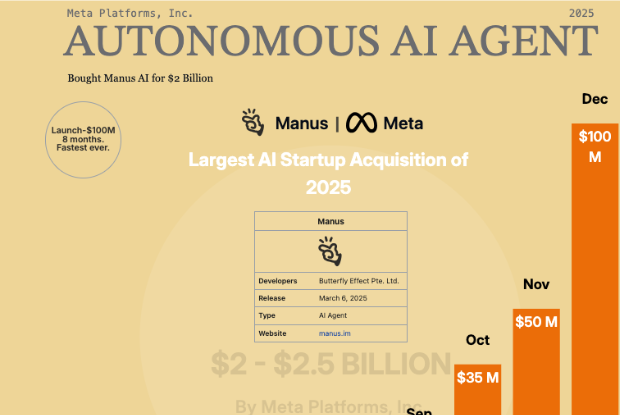
Meta Bought Manus for Over $2 Billion in Ten Days
The AI Agent That Went From Launch to $100M ARR in Nine Months
- Launch: 6 March 2025, invite-only debut with a reported 2M+ waitlist
- April 2025: Benchmark-led Series B at a post-money valuation of nearly $500M
- $100M ARR: Reached in mid-December 2025, roughly nine months after launch
- $2B+: Meta acquisition announced 30 December 2025, agreed in about ten days
- 3rd Largest: Meta's biggest deal after WhatsApp and Scale AI

Visual Intelligence by FactsFigs.com
CNBC
Data Source: CNBC

Why Meta Bought Manus
On 30 December 2025, Meta announced it had acquired Butterfly Effect, the company behind the autonomous AI agent Manus, for a reported sum above $2 billion. It is Meta's third-largest acquisition, behind only WhatsApp and its 2025 stake in Scale AI.
What makes the deal notable is the compression. Manus launched publicly on 6 March 2025. It raised a Benchmark-led Series B in April at a post-money valuation of nearly $500 million. It reached $100 million in annual recurring revenue in mid-December — roughly nine months after launch — and was acquired at more than four times its April valuation weeks later.
The acquisition itself was reportedly agreed in around ten days, which is unusual for a transaction of this size and says something about how competitive the agent market had become.
Manus belongs to a category distinct from chatbots. Rather than generating a response to a prompt, it plans and executes multi-step tasks — the difference between being told how to do something and having it done. That capability is what Meta paid for.
What an AI Agent Actually Does Differently
The distinction between a chatbot and an agent is the whole basis of the deal, and it is worth being precise about.
A conversational model receives a prompt and returns text. If you ask it to research a market and build a spreadsheet, it explains how to do that, or produces content you then move somewhere yourself. The work of execution stays with you.
An agent is designed to carry out the task. It breaks a goal into steps, uses tools such as a browser or a code interpreter, works through the sequence, handles intermediate results and returns a completed output. Manus was built to operate this way from the start.
The commercial argument is that this changes what customers are buying. A chatbot subscription sells assistance; an agent sells completed work, which is a category buyers have historically paid considerably more for.
From Wuhan to Singapore
The company behind Manus is Butterfly Effect, founded in 2022 by Xiao Hong in Wuhan, China. Its earlier product was Monica, a browser-based AI assistant that built the team's experience in consumer AI tooling before Manus existed.
The company later relocated its headquarters to Singapore, which is why it is described variously as Chinese and Singaporean depending on the source — both descriptions capture part of the picture.
That relocation was a meaningful commercial decision rather than an administrative one. A Singapore base changed the regulatory and investment context for a company operating internationally, particularly around a US acquisition of this scale.
Manus debuted on 6 March 2025 as an invite-only product, a launch model that shaped everything that followed.
The Invite-Only Launch That Went Viral
Manus launched behind an invite system, and the scarcity became the marketing. Reports described a waitlist exceeding two million people, with invite codes circulating on secondary markets.
This is a well-worn strategy, but it worked unusually well here because the underlying demonstration was genuinely novel. Videos of the agent completing multi-step tasks autonomously spread widely, and the gap between watching an agent work and reading about one proved substantial.
The company's Discord community grew rapidly in the weeks after launch, and coverage focused on tasks that had previously been considered beyond reliable automation.
Scarcity also served a practical function that is easy to overlook. Agents consume far more compute than chatbots — each task may involve many model calls, browser sessions and tool invocations — so throttling access was an infrastructure necessity as much as a growth tactic.
Nine Months From Launch to $100 Million
Manus reached $100 million in annual recurring revenue in mid-December 2025, roughly nine months after its public launch.
For context, reaching $100 million ARR has historically taken successful enterprise software companies somewhere between five and ten years. Compressing that into under a year places Manus among the fastest revenue ramps recorded in software.
Two caveats belong alongside that figure. ARR is an annualised run rate extrapolated from recent revenue, not money collected over a year — it is a forward projection by construction. And the number, as with most private-company metrics, is company-reported rather than audited.
Even discounted appropriately, the trajectory is exceptional, and it is the clearest explanation for why the valuation moved from roughly $500 million in April to above $2 billion in December.
The Series B and the Backers
In April 2025, Butterfly Effect closed a Series B led by Benchmark, reported at around $75 million, at a post-investment valuation of nearly $500 million.
Benchmark's involvement carried signalling weight beyond the capital. The firm has a long record of early positions in companies that became category-defining, and its participation drew attention from investors who had not been tracking the agent space closely.
The round funded infrastructure scaling above all. Running autonomous agents at consumer volume is compute-intensive in a way that conversational products are not, and capacity was the binding constraint on growth.
Roughly eight months later the company was acquired at more than four times that valuation — a repricing that reflects how quickly the market's view of agent products changed during 2025.
The Criticisms Worth Recording
Manus attracted substantive complaints during its rapid growth, and a record of the year that omits them would be incomplete.
Performance inconsistency was the most common. Users reported long processing times and outputs that were wrong or incomplete — a specific hazard for agents, because an agent that completes a task incorrectly may be worse than one that declines, since the error is embedded in delivered work rather than visible in a response.
Billing generated a second set of complaints, including reports of unexpected charges. Agent products are difficult to price because task costs vary enormously with complexity, and credit-based models that make sense operationally can produce charges users did not anticipate.
Support responsiveness drew criticism as well, and some users characterised the product as overhyped relative to the launch demonstrations. These are the ordinary failure modes of a product scaling faster than its operations — worth noting precisely because the growth figures alone would not reveal them.
Why Meta Moved in Ten Days
The reported ten-day timeline from approach to agreement is remarkable for a transaction above $2 billion. Deals of that size normally involve months of diligence.
Speed of that kind usually indicates competition. An acquirer moves quickly when it believes a target will otherwise go elsewhere, and 2025 saw sustained competition for AI agent capability across every major technology company.
It also fits Meta's pattern through the year. The company committed $14.3 billion for a stake in Scale AI in mid-2025 and recruited aggressively across AI research. Manus extended that from infrastructure and talent into a working consumer product with revenue.
The strategic logic is straightforward. Meta operates consumer platforms at enormous scale but had no agent product; Manus had the product, the team and demonstrated willingness among users to pay for it.
What Happens to Manus Now
Meta stated that Manus will continue operating as an independent subscription service rather than being folded immediately into existing products.
Xiao Hong, the founder, takes a vice president role at Meta, and the Manus team joins Meta's AI organisation. Retaining founders after acquisition is a deliberate choice, and one Meta has not always made.
The stated intent is to integrate Manus capabilities across Meta's consumer and enterprise ecosystem over time while preserving it as a standalone product. That dual approach — keep the product, absorb the capability — is the pattern Meta followed with Instagram and WhatsApp.
Whether it holds is the open question. Independence after acquisition is easier to announce than to sustain, particularly when the acquirer's core products would benefit from the technology being embedded rather than separate.
Where This Ranks Among Meta's Deals
Placing the transaction against Meta's acquisition history gives a sense of the commitment it represents.
WhatsApp at roughly $19 billion in 2014 remains the largest by a wide margin. The 2025 Scale AI investment, reported at $14.3 billion for a 49% stake, is second. Butterfly Effect at over $2 billion is third.
For comparison, Meta paid around $2 billion for Oculus in 2014 and roughly $1 billion for Instagram in 2012. Manus therefore cost approximately what virtual reality did, and about twice what Instagram did in nominal terms.
The comparison is imperfect — a dollar in 2012 is not a dollar in 2025, and the Scale AI figure buys a minority stake rather than a company. But the ranking holds, and two of Meta's three largest commitments were made in AI within a single year.
What the Deal Says About the Agent Market
One acquisition is a limited basis for conclusions, but the price attached to specific facts makes a few things clearer.
Agent products can generate revenue quickly. The prevailing assumption had been that autonomous agents were a research problem some years from commercial viability; $100 million ARR in nine months is a direct counterexample.
Distribution is worth less than capability right now. Meta has consumer reach that Butterfly Effect could never have built independently, and it still paid over $2 billion rather than building the product internally — which implies the capability was the scarce input.
The caution is that revenue trajectory and durability are different questions. Manus grew fast in a period of intense curiosity about agents, and whether that revenue is retained as competing products arrive is not something the 2025 figures can answer.
Conclusion
Meta acquired Butterfly Effect, the developer of Manus, for over $2 billion in a deal announced on 30 December 2025 and reportedly agreed in around ten days — its third-largest transaction after WhatsApp and Scale AI.
The compression is the story. Manus launched on 6 March 2025, raised a Benchmark-led Series B in April at nearly $500 million, hit $100 million in annual recurring revenue by mid-December, and sold at more than four times its April valuation weeks later.
The product's distinction from conversational AI is what commanded the price: Manus executes multi-step tasks rather than describing how to do them, and users demonstrated they would pay for completed work at a rate few expected this early.
The reported problems — inconsistent outputs, unexpected charges, support strain — are the ordinary consequences of scaling faster than operations can follow, and they remain unresolved. Meta says Manus will run independently with its founder as a vice president. Whether independence survives integration is the question the next year answers.
Data Source and Attribution
Acquisition details — the announcement on 30 December 2025, a reported value above $2 billion, the roughly ten-day negotiation, Butterfly Effect's founding in Wuhan in 2022 by Xiao Hong, his appointment as a Meta vice president, and the deal's ranking as Meta's third-largest after WhatsApp and Scale AI — are as reported by CNBC, TechNode and 36Kr. The April 2025 Benchmark-led Series B at a post-investment valuation of nearly $500 million and the $100 million ARR figure reached in mid-December 2025 are as reported in the same coverage; ARR is an annualised run rate and is company-reported rather than audited.
FactsFigs reviews, cleans, and cross-checks every source dataset before shaping it into a data story. Each visualization is created and designed in FactsFigs Design Studio — an internal tool developed and owned by FactsFigs — and is the original work of a FactsFigs author, not an AI-generated copy of any existing graphic. Individual assets within a visual may or may not be produced with AI tools, but the design of the visual itself is solely FactsFigs' own.
Comparison values for WhatsApp, Scale AI, Oculus and Instagram are widely reported deal figures in nominal dollars and are not inflation-adjusted; the Scale AI figure represents a reported $14.3 billion for a 49% stake rather than a full acquisition. User complaints regarding performance and billing reflect published reports and user accounts, not verified totals.
2026-07-20
Weekly Updates
Subscribe for the FactsFigs Weekly Brief
Signals, charts, and data stories delivered every week.
More Intelligence
Other Popular Topics
Additional signals from the FactsFigs intelligence feed.
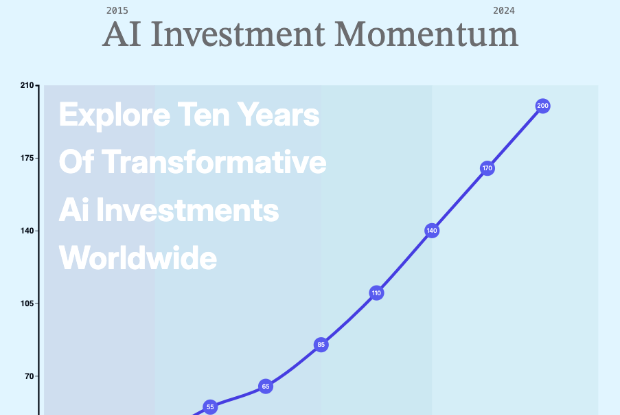
A Decade of AI Investment: The Crash Everyone Forgot

The Offline Economy: $696.7 Billion and 2.4% of GDP