Gaming Slang Explained: 60 Terms From AFK in 1989 to Cooked

By FactsFigs.com Published 23 Nov 2026 Updated 23 Nov 2026
Gaming 1 views
FactsFigs
0 shares
FactsFigs Data Story
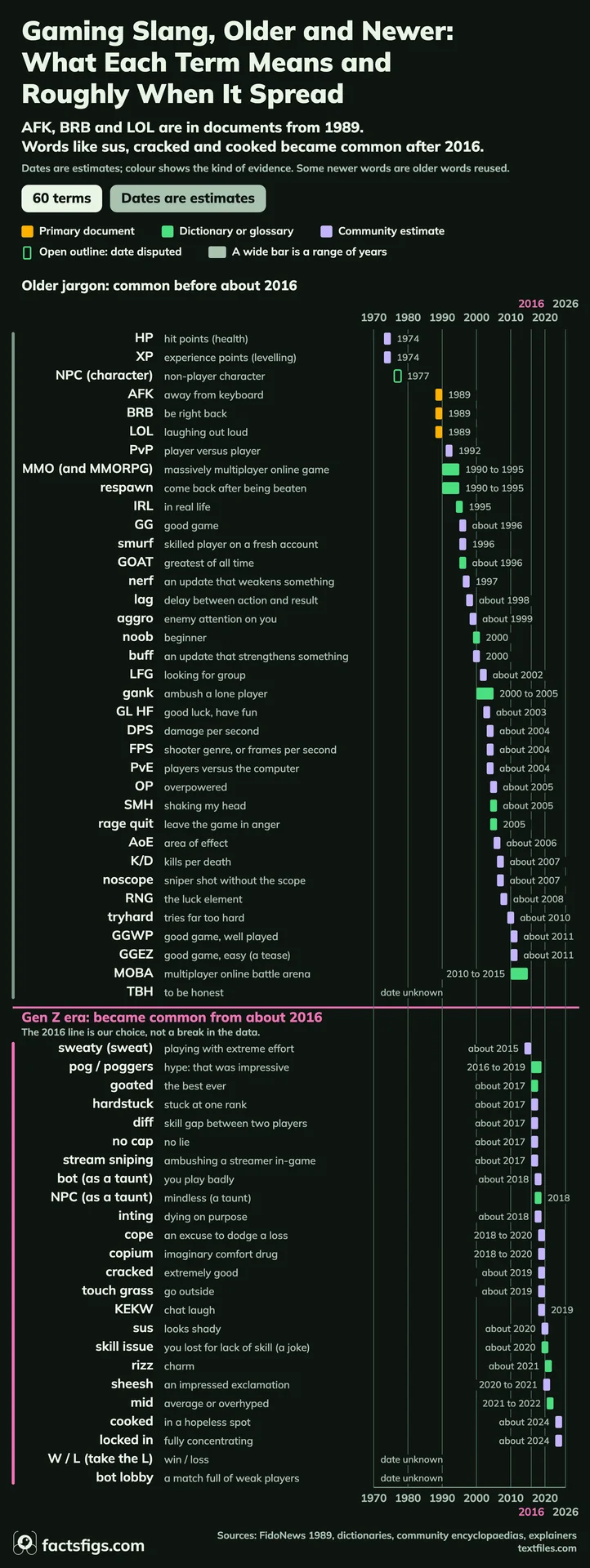
Tall timeline of 60 gaming slang terms, each printed with its meaning, from 1970 to 2026. Older terms such as AFK, BRB and LOL date from 1989 documents or earlier estimates; a line marks about 2016, below which 24 newer terms such as sus, cracked, skill issue, rizz and cooked are placed at estimated years from about 2015 to 2024. Colour shows the kind of evidence, and dates are estimates.

TL;DR: What Do Gamers' Abbreviations and Slang Mean?

AFK, BRB and LOL are 37 years old; sus and cooked are newer

Gamer slang comes in two layers. The older layer reaches back at least to 1989: AFK, BRB and LOL are in documents from that year, and a June 1991 magazine already taught newcomers the shorthand. Those documents record general online chat, not games. The newer layer is 24 words that became common in game chat and on stream from about 2016, among them sus, cracked, skill issue, rizz and cooked. At least eight of the 24 are older words with a new use. Every date outside the 1989 documents is an estimate, and nobody has measured how fast any word spread or how many older people know it. This page decodes all 60 terms.

! What the Two Layers Hold:

  • •
    The Older Layer: 36 terms, from AFK in 1989 to MOBA in 2010 to 2015.
  • •
    The Newer Layer: 24 terms, estimated common from about 2016.
  • •
    The Reused Words: At least 8 of the 24 are older words reused.

? How to Read the Dates:

  • •
    The Dates: Estimates, except the three 1989 documents.
  • •
    The Evidence: Documents, dictionaries and community sources.
  • •
    The Gap: No measure of who knows these words.

Gamer shorthand has two layers, and most of its dates are estimates.

Continue reading below for the full detailed article →

Overview

What This Page Counts: 60 Terms in Two Layers

This page decodes 60 terms that at least two independent sources mention, such as a dictionary, a gaming glossary or an explainer, and sorts them into two groups. Of these, 36 are older terms, common before about 2016. The other 24 are newer, common from about 2016. The split at 2016 is a presentation choice, not a break found in the data. It leaves out slurs, harassment terms, self-harm terms and anything it could not source twice. Taunts such as skill issue and cope are in, explained as what they are: ways to tease. It is not a ranking of the words used most, because no frequency data exists, so terms are ordered by their estimated year. It serves two readers: someone who meets "sus, he's cracked, we're cooked" or "brb afk gg" and wants to decode it, and someone curious how old the shorthand is. Every meaning is in our own words and the ten chat lines are invented.

The Three Numbers Behind the Two Layers

How old the oldest documents are, how many terms are newer and how many are older words reused.

AFK, BRB and LOL in Documents · 1989

1989

A FidoNet newsletter dated 8 May 1989 lists LOL, BRB and AFK, the last as "away from keys". An AppleLink forum log of 3 January 1989 has people typing "brb". That makes the shorthand 37 years old in 2026, by our arithmetic. Both documents record general online chat, not games, so gamers borrowed the shorthand.

Newer Terms Common From About 2016 · 24

24 of 60

Twenty-four of the 60 terms are estimated to have become common in game chat and on stream from about 2016, from pog and goated to cooked and locked in. Their dates run from about 2015 to about 2024, and two have no usable date. The split at 2016 is our presentation choice, not a break in the data.

Newer Words That Are Older Words Reused · 8 of 24

8 of 24

At least eight of the 24 newer words are older words with a new use: sus, cracked, cope, mid, no cap, sheesh, goated and NPC. Dictionary.com's first recorded range for sus is 1935 to 1940 and for cracked 1400 to 1450. Several trace to Black American English and hip-hop, so none can honestly be credited to one generation.

Gaming Slang in Numbers

  • FidoNews, 8 May 1989 · 37 years 37 years Our arithmetic: 2026 minus 1989.
  • COMPUTE! guide for newcomers, 1991 · 35 years 35 years June 1991, issue 130, page 89.
  • Median older term, about 2000 · 26 years 26 years Our median of the 35 older terms with a plot year.

The Older Layer

Gaming Abbreviations: What 36 Older Terms Mean in Chat

The 36 older terms do a handful of jobs in chat. Status words say who is around: AFK means stepped away, BRB means back soon and IRL means offline, while lag is the delay between a button press and the result on screen. Courtesy words open and close matches: GL HF is a friendly start, GG is a polite sign-off and GGWP adds well played. LFG, looking for group, is how a player asks to join a team or recruits one.

Tactics and mechanics make up the biggest set. To gank is to ambush a lone player, and aggro is enemy attention, so having aggro means the enemies are chasing you. HP is how much damage a character can take, XP is the points that raise a level, DPS is damage per second and AoE is an attack that hits an area. OP means overpowered, a nerf is an update that weakens something, a buff strengthens it and RNG is the luck behind drops and hits. K/D is kills for each death, and to respawn is to return after being beaten.

Genres and modes say what kind of game it is: PvP is players against players, PvE is players against the computer, MMO is a huge shared online world, MOBA is a two-team hero-and-base game and FPS is either a shooter or the smoothness of the picture. The rest is social shorthand or teasing. A noob is a beginner, a smurf is a skilled player on a fresh account, tryhard teases someone who tries too hard and GGEZ teases that the match was easy. TBH, SMH, LOL and GOAT work as they do in any chat. For games built around playing with other people, see our ranking of the best Xbox co-op games by store score.

The Evidence

AFK, BRB and LOL Are in Documents From 1989

The earliest document found for all three is FidoNews, volume 6, number 19, dated 8 May 1989, the newsletter of the FidoNet network. It carries a list of chat shorthand that includes LOL, BRB and AFK, and it gives AFK as "away from keys", not the "away from keyboard" people write today.

BRB goes back a little further. In the log of an AppleLink Apple II Development Forum session that began at 10:00 pm Eastern on 3 January 1989, several participants type "brb". That is about four months before FidoNews. The participants are real people, so this page quotes nothing else from the log.

By June 1991 the shorthand was something newcomers had to be taught. COMPUTE! magazine printed "Chat lines: learn the lingo" on page 89 of issue 130, a guide for people new to online chat. It explains BRB, adds that AFK is "away from keyboard" and covers LOL, BTW and ROTFL.

A reader who meets "brb afk gg" today stands where that 1991 reader stood. These are the earliest documents found, not proof of a first use: the 1990 Jargon File and Usenet archives were not read, and an earlier use could still turn up.

The Context

Gamers Use Online Shorthand They Did Not Invent

None of the 1989 and 1991 documents is about games. They record general online chat, typed by modem users on bulletin boards, FidoNet and AppleLink. The accurate sentence is that gamers use shorthand that was already standard in online chat, not that gamers invented it.

A paper in the journal Discourse and Interaction (Kramer, 2013) explains why it suits play. The author studied 1,776 hours of MMORPG chat and put a questionnaire to 324 gamers between 1 and 30 June 2009. The paper argues that chat acronyms save time and also act as an insider code that outsiders cannot decode.

Words born inside games have no citable first use. For GG, LFG, nerf and smurf no document gives a date, and every year on the timeline is a community estimate. Where a word names a game system, the age belongs to the idea: HP and XP are tabletop role-playing terms plotted at 1974, the year Dungeons & Dragons was first published, and the PvP concept is a 1992 player-killing MUD. The timeline plots those concept years for HP, XP and PvP and says so.

The Newer Layer

Gen Z Gaming Slang: 24 Words That Became Common After 2016

The 24 newer terms are estimated to have become common in game chat and on stream from about 2016, with dates running from about 2015 for sweaty to about 2024 for cooked and locked in. They sort into rough groups by what they do. For praise, cracked and goated mean extremely good, pog and sheesh react to an impressive play, rizz is charm and no cap is a way of saying no lie.

Ranked play has its own vocabulary. Hardstuck is being stuck at one rank, diff is the skill gap between two players, inting is dying on purpose to hand the other team an advantage and sweaty describes a player or lobby going all out. Stream chat adds three more: KEKW is a chat laugh, copium is an imaginary comfort drug for bad news and W and L are typed to cheer a win or tease a loss.

Then come the taunts. Skill issue, cope, bot, NPC, touch grass and mid are all ways of teasing: you lost because you are not good enough, you are making excuses, you play like a computer, you act without thinking, go outside or that was only average. They are used between friends and as put-downs, so this page explains them as what they are and does not recommend them. Sus means shady, cooked means in a hopeless spot, locked in means fully concentrating, stream sniping is ambushing a streamer in the game and a bot lobby is a match full of weak players.

None of these dates is firm. Of the 24, ten are medium confidence, 13 low and one unknown, and two have no usable date, so they sit on the timeline with no mark. These are often called Gen Z slang because the words became common among younger players, but no source measured who uses them.

Old Words, New Use

Many New Gaming Words Are Old Words Reused

At least eight of the 24 newer words are older words with a new use, which is why none can be credited to a generation. Sus is a clipped form of suspicious, first recorded in 1935 to 1940 by Dictionary.com. Cracked has older senses of crazy, broken and pirated, and Dictionary.com's first recorded range for the word is 1400 to 1450. Cope is the ordinary verb used as a noun, mid is a clipped middle or mid-grade and sheesh is an older exclamation. Goated adds a suffix to GOAT, a sports and hip-hop word, and the NPC taunt borrows the game character.

Several trace to Black American English and hip-hop: Dictionary.com dates cap for a lie to the early 1900s in Black slang, and linguists quoted by NBC in April 2026 say many words now called Gen Z slang have roots in African American Language that go back centuries.

Sources tie some of the new uses to one place. Among Us, released in 2018, made sus a call-out in chat in 2020, and Know Your Meme credits a second wave of the game's popularity around August 2020. The Fortnite community is named for cracked, though that origin is disputed. Hardstuck, diff and inting come from League of Legends in the examples sources give, and stream sniping spread widely after a PUBG dispute on 26 July 2017. Rizz started with Twitch streamers, and Oxford, which chose it as its 2023 Word of the Year, says it emerged from gaming and internet culture. These are what sources say, not measured findings.

How Words Travel

How New Gaming Words Spread, as the Sources Tell It

No source measured how fast any of these words spread, so this section only repeats what sources say, one word at a time. A game can carry a word: Among Us turned sus into a chat call-out in 2020. Streamers and stream chat can start or spread one. Dictionary.com says a streamer was popularising rizz from at least 2021. KEKW spread through big streamers within weeks of August 2019. The PogChamp emote was used about 814 million times between 9 January 2016 and 6 January 2021.

Several platforms can carry one word. Dictionary.com says skill issue probably started on Twitch, and its sources also name Roblox and Discord as well as the Smash and Street Fighter communities. One game's community can seed a term, as cracked and hardstuck show. Short video can speed a word up: explainers say mid and sheesh spread on TikTok, and a linguist says social media algorithms shape how words such as rizz are formed and spread.

What no source says matters as much. None claims that Discord, Roblox or Fortnite is the main channel for gamer slang as a whole, since each appears only for individual words. None measures speed and none counts how many people use any term. The paths above are what explainers and dictionaries report, not a model of how slang moves.

The Traps

FPS, OP, Mid and Many Other Terms Mean Two Things

A glossary alone can mislead, because 36 of the 60 terms carry another meaning or an older sense in at least one source. FPS is the clearest case: gamers mean either first-person shooter, which is a genre, or frames per second, which is how smooth the picture looks. Context decides. Chat line 5 below uses the second meaning on purpose, since "my fps drops in big fights" is about smoothness and a reader who knows only the genre would misread it.

OP means overpowered in a patch discussion and original poster on a forum. HP is also horsepower, XP a Windows version, DPS dividend per share, BRB a buckling-restrained brace in engineering and SMH a fund ticker. IRL is the Indy Racing League, GOAT an animal and smurf a way of splitting cash deposits into small amounts.

Mid is also the middle lane in League of Legends and Dota, an older sense that must not be mixed up with the put-down. Diff is a file-comparison tool in computing and cracked also means crazy, broken or pirated. Sus is also a UK police "sus law" and a music abbreviation. Cooked can mean drunk or exhausted, and locked in can mean a plan is confirmed. NPC is the game character and, since 2018, a taunt, while bot can be a literal computer-controlled player.

The Full Glossary

Gaming Slang Glossary: 60 Terms, Meanings and Estimated Dates

One row for each of the 60 terms, older jargon first and Gen Z era terms after. The year column gives our estimate and the kind of evidence behind it, and confidence says how far to trust it.

HPOlderHow much damage a character can take before being beatenHealth bars and calls for healingHorsepower; hire-purchase1974, the tabletop concept (community estimate)MediumTabletop role-playing games
XPOlderPoints that raise a character's levelQuest rewards and double XP weekendsA Windows version; extreme programming1974, the tabletop term (community estimate)MediumTabletop role-playing games
NPC (character)OlderA computer-controlled character, such as a shopkeeper or quest giverQuests, shops and guardsA rugby competition; the 2018 taunt, in the Gen Z era rows1977, disputed: 1974 is reported (dictionary)MediumTabletop role-playing games, by the dictionaries' dates
AFKOlderAway from the keyboard: not answering or acting for a whileStepping out of a match, lobby or chat; calling out an idle teammateNone found1989 (document; the 1989 form is "away from keys")HighGeneral online chat, not a game
BRBOlderLeaving for a moment and coming back soonBefore a short break from a match, call or chatBuckling-restrained brace, an engineering term1989 (document)HighGeneral online chat, not a game
LOLOlderThat is funny; now also a softener on a messageAnywhere in chatNone found1989 (document)HighGeneral online chat, not a game
PvPOlderPlayer versus player: real players against each otherNaming a mode, server or fightNone found1992 for the concept; the abbreviation is seen by 2003 (community estimate)MediumMUDs and MMORPGs
MMO (and MMORPG)OlderAn online game where very large numbers of people share one world; the role-playing kind is an MMORPGDescribing a type of gameNone found1990 to 1995 (dictionary)MediumNo game named; a story crediting one developer in 1997 conflicts with the dictionary range
respawnOlderTo come back into the game after being beatenWaiting to return after a defeatNone found1990 to 1995 (dictionary)MediumNo game named
IRLOlderIn real life: offline, rather than in the game or on the internetContrasting online life with offline lifeIndy Racing League1995, with 1993 possible (dictionary)MediumGeneral internet chat, not a game
GGOlderGood game: a sportsmanlike sign-off when a match endsEnd of a match, sent by winners and losersSometimes sarcastic; Google GroupsAbout 1996, within 1994 to 1998 (community estimate)LowOnline multiplayer of the mid-1990s; no document found
smurfOlderA skilled player on a new or low-ranked accountComplaints about lopsided matchesSplitting money into small deposits1996 (community estimate)MediumWarcraft II multiplayer lobbies, by one account
GOATOlderGreatest of all time: the best everPraising a player or a characterThe animal; a UK political nicknameAbout 1996; sources conflict (dictionary)LowSports and hip-hop, not a game term
nerfOlderAn update that makes something weakerBalance patchesBumping a car in racing, an older sense1997 (community estimate)MediumUltima Online players, by a developer's account in journalism
lagOlderA delay between what you do and what happens on screenComplaints about a slow connectionTo fall behind; to insulate pipesAbout 1998, a guess (community estimate)LowOnline multiplayer, a guess
aggroOlderEnemy attention: the enemy is targeting youTank and team talk about who the enemy is chasingViolent trouble, in British slangAbout 1999, a guess (community estimate)LowMMORPGs, by summaries; normal game talk by 2006
noobOlderA beginner; friendly or unkind depending on who says itDescribing or teasing a new playerNone found2000 (dictionary)MediumGamer slang from "newbie"
buffOlderAn update that makes something strongerBalance patches and temporary boostsAn enthusiast; muscular; to polish2000, within the late 1990s to early 2000s (community estimate)LowMMORPGs, by forum users quoted in journalism
LFGOlderLooking for group: someone wants to join a team or recruit playersGroup finders and chat channelsNone found in gaming useAbout 2002 (community estimate)LowMMORPG group play; Xbox made it an official feature in 2016
gankOlderTo attack a lone or weaker player with numbers or by surpriseAmbushes in team gamesOlder slang: to rob or con2000 to 2005 (dictionary)MediumMMORPG players, by a dictionary's slang page

Showing 1-20 of 60

Page 1 of 3

Estimated years are estimates, not first uses. "Document" means a primary document read in full. "Dictionary" means a dictionary or glossary states or implies the era. "Community estimate" means a forum, community encyclopaedia, explainer or user-written entry. Dictionary.com, Cambridge and Oxford Learner's were read directly; Merriam-Webster and the OED could not be read directly, so any date attributed to them is reported. NPC's dates conflict: 1977 is from an archive copy of a Merriam-Webster entry and 1974 is reported for the OED. Derived and ours: nine of the 11 terms with a first-pass date are more than 25 years old, counting a range at its midpoint; the median plot year is about 2000 for the older group and about 2019 for the Gen Z era group. Every meaning is in our own words.

The Decoding Exercise

How to Read a Gaming Chat Line: Ten Invented Examples Decoded

A glossary proves itself when it decodes a line. The ten lines in the next table are invented: no real chat and no real player handle was used, and each line uses only terms from the 60. Read each as a player would type it, then check the plain-English version.

Line 5 uses the second meaning of FPS on purpose, so a reader who knows only the shooter genre will stumble on it. Lines 7 to 10 use the newer words: line 7 pairs cracked with pog, line 8 stacks three taunts, line 9 puts sus beside cooked and line 10 ends on touch grass. Together the ten lines use 29 of the 60 terms.

Decoded

Ten Invented Chat Lines, Decoded

Each line is invented for this page and built only from the 60 terms. The last column names the terms to look up in the glossary table.

1brb 5 min, afk for pizza, gg next roundI will be back in about five minutes; I am away from the keyboard getting pizza; well played, see you next round.BRB, AFK, GG
2lfg 2 more for tonight, noobs welcome, no lag plsLooking for a group: two more players wanted tonight; beginners are welcome; please, no connection delay.LFG, noob, lag
3that new sword was op until the nerf, my xp barely moved lolThat new sword was far too strong until the developers weakened it; my experience points hardly changed; that is funny.OP, nerf, XP, LOL
4got ganked at 10 hp, aggro was on me, respawn is slowSeveral players attacked me; I had 10 health points left; the enemies were chasing me; the wait to come back is long.gank, HP, aggro, respawn
5tbh my fps drops in big fights, lag is bad, smhTo be honest, my screen smoothness (frames per second) falls in large battles; the connection delay is bad; I cannot believe it.TBH, FPS (frames per second), lag, SMH
6gg all, pvp was brutal, my k/d is bad, smhWell played everyone; the player-versus-player mode was tough; my kills-to-deaths score is poor; I cannot believe it.GG, PvP, K/D, SMH
720 and 2 in ranked, absolutely cracked, pogHe finished with 20 kills and 2 deaths: extremely good, and impressive.cracked, pog
8lost to a bot again, skill issue, cope harderYou lost to a weak opponent again; it is a joke that you are just not good enough; stop making excuses.bot, skill issue, cope
9sus, he keeps lurking by the generator, we are cookedHe looks shady, he keeps hanging around the generator and we are in a hopeless spot.sus, cooked
10locked in all night, hardstuck gold, time to touch grassFully focused all night, stuck at the same rank, time to go outside.locked in, hardstuck, touch grass

All ten lines are invented. No real chat, handle or player is quoted. Line 5 uses frames per second, the second meaning of FPS.

What Is Not Known

Nobody Has Measured Who Knows These Words, or How Fast They Spread

A page like this invites a claim about generations, and the evidence does not support one. No credible measure was found of how many older people recognise AFK, GG, LFG, sus or skill issue, or of whether younger people use any of these words more. The few surveys that exist measure a different thing or state no method, so none is used here. The page states no generation gap.

What can be said is narrower. A 1991 magazine already explained BRB, AFK and LOL to newcomers, and Kramer's paper treats chat acronyms as an insider code. Both concern being new to chat, not age. Dictionary dates move too. Dictionary.com added GOAT on 1 September 2020, which we read in its own update post. Three dictionary dates are reported by secondary sources and were not read directly: LOL in the OED in March 2011, nerf as a verb and non-player character in Merriam-Webster in September 2023 and NPC and PC in the OED in December 2024.

NPC shows the problem. Merriam-Webster could not be read directly, but an archive copy of its NPC entry gives 1977 and shows it was last updated on 9 January 2026. The OED, also not read directly, is reported to give 1974. The timeline plots 1977 with an open outline for disputed, and both entries are to be re-checked after the OED's December 2026 update (the OED could not be read directly) and again in March 2027.

The newer evidence is thinner still. Reddit was not read and Google Trends was blocked, and only one forum thread was read in full. Know Your Meme and Urban Dictionary were read through archive copies, and Urban Dictionary only for the date of its earliest entry. The low-confidence dates could move with a closer read of those sources, and slang drifts every few months, so the newer group will date first.

Quick Answers: AFK, GG, LFG, Sus, Cooked, Skill Issue and OP

What does AFK mean in gaming?

AFK means away from keyboard: the player has stepped away and will not answer for a while. A 1989 FidoNews list gave it as "away from keys".

What does GG mean?

GG means good game, a polite sign-off typed when a match ends, won or lost. It is sometimes typed sarcastically.

What does LFG mean?

LFG means looking for group: a player wants to join a team or is recruiting players for one, usually before a raid or a ranked session.

What does sus mean in gaming?

Sus means shady, short for suspicious. It became a chat call-out through Among Us in 2020, and the word itself is much older.

What does cooked mean?

Cooked means in a hopeless spot, as in "we are cooked" after a lost round. It can also mean drunk or exhausted, and it is one of the newest terms here.

What does skill issue mean?

Skill issue is a joking put-down: you lost because you are not good enough, even when something else is to blame. It is used to tease.

What does OP mean in gaming?

OP means overpowered: far stronger than it should be. On a forum, OP can instead mean original poster, the person who started a thread.

Data Source and Attribution

FidoNews 1989 (textfiles.com)

The older dates rest on three primary documents read on 23 November 2026: FidoNews volume 6 number 19 (8 May 1989), the AppleLink Apple II Development Forum conference log of 3 January 1989 and COMPUTE! issue 130, June 1991, page 89. Meanings and ranges also come from Dictionary.com, Cambridge Dictionary and Oxford Learner's Dictionaries, which were read directly, and from Oxford University Press for the 2023 Word of the Year announcement. For the newer terms the sources are community ones: Know Your Meme and Urban Dictionary, read through archive copies and Urban Dictionary only for earliest entry dates, since it is user-written and unreliable, plus Wiktionary quotations, news and magazine explainers and gaming glossaries. Kramer (2013) on MMORPG chat and an Xbox Wire announcement of 13 June 2016 are also used. Merriam-Webster and the OED could not be read directly. Reddit and Google Trends were not read, and only one forum thread was read in full. Every date outside the 1989 documents is an estimate.

Our own arithmetic: AFK, BRB and LOL are 37 years old in 2026 (2026 minus 1989); nine of the 11 terms with a first-pass date are more than 25 years old, counting a range at its midpoint; the median plot year is about 2000 for the older group and about 2019 for the Gen Z era group; and the 2016 split is our presentation choice. Plot years are our guesses from the estimates. Every meaning is in our own words and the ten chat lines are invented. No real players, handles or chat logs are quoted.

Facts from Wiktionary, Know Your Meme and Urban Dictionary are used and none of their text is copied. Wiktionary's share-alike licence, and mixed licences across the other sources, are why no CSV of the glossary is offered. Sources read on 23 November 2026.

FactsFigs reviews, cleans and cross-checks every source dataset before shaping it into a data story. Each visualization is created and designed in FactsFigs Design Studio - an internal tool developed and owned by FactsFigs - and is the original work of a FactsFigs author, not an AI-generated copy of any existing graphic. Individual assets within a visual may or may not be produced with AI tools, but the design of the visual itself is solely FactsFigs' own.

Figures are estimates at the time of publication, provided for information only - nothing here is financial advice or a guarantee of accuracy.

Last verified: 23 Nov 2026. Slang drifts every few months, and the newer terms such as cooked, locked in and sheesh will date first.

The charts in this article were built with our own publishing system. See what it does →