46 years of freefalling prices, and the 2025 shortage that broke the pattern
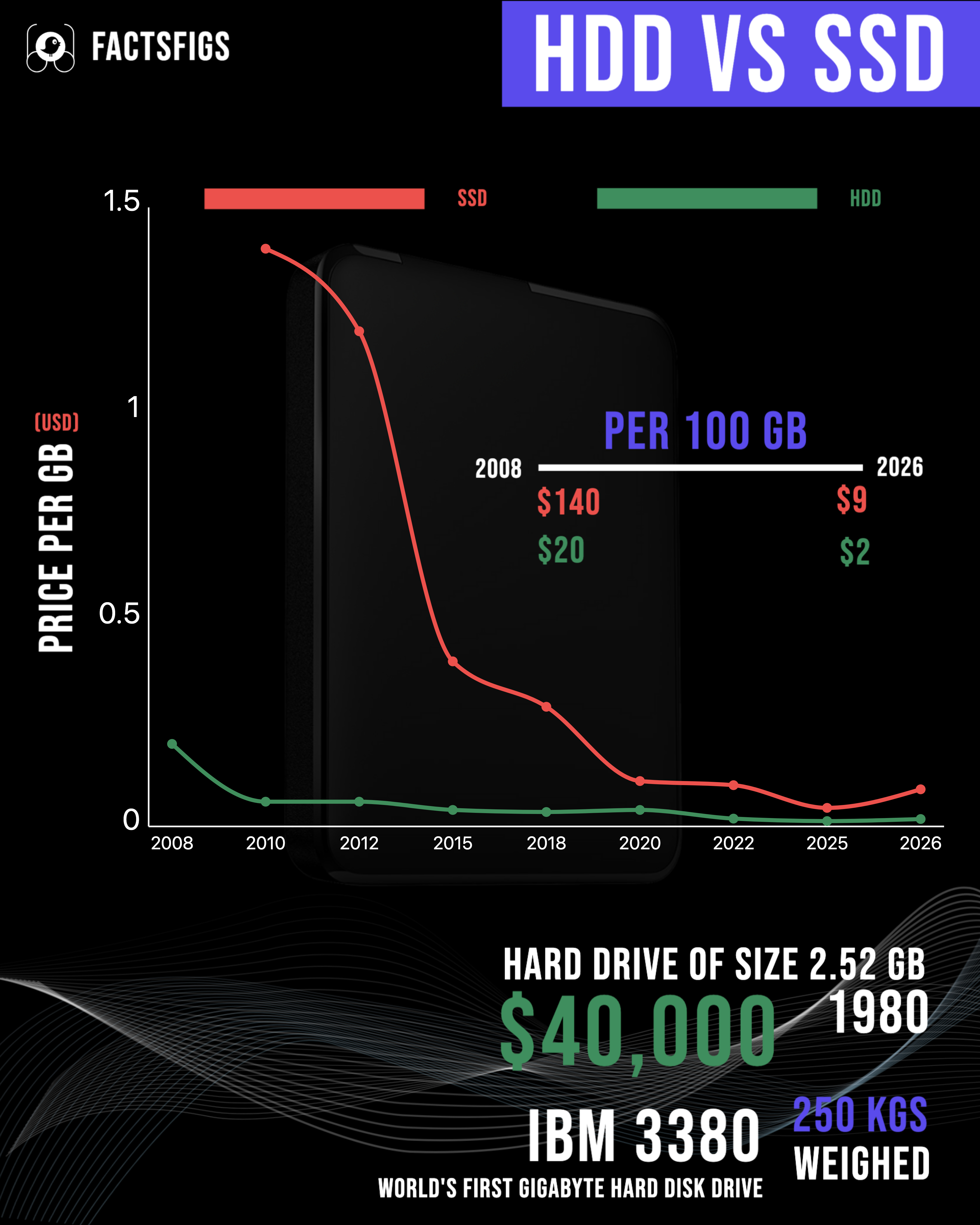
In 1980, a single gigabyte of hard drive storage cost around $20,000. By 2022 that same gigabyte cost less than two cents — a price collapse of more than 10 million times in 42 years.
Then the trend broke. Starting in late 2025, a global NAND flash shortage — driven by chipmakers diverting production to AI servers — sent consumer SSD prices roughly doubling in a matter of months, even as hard drive prices kept falling.
Storage did get dramatically cheaper for nearly half a century. Whether it still is depends entirely on which technology you're buying, and when.
! What the Data Actually Shows:
•
The Long Collapse, 1980-2022:Hard drive storage fell from roughly $20,000 per gigabyte in 1980 to about $0.019 per gigabyte by 2022, a decline tracked consistently across four decades of published pricing data.
•
The 2025 Reversal:A NAND flash shortage tied to AI datacenter demand pushed consumer SSD prices from around $45 to nearly $90 per terabyte within a few months of late 2025, and enterprise SSD prices climbed 257% between Q2 2025 and Q1 2026.
•
HDDs Didn't Follow SSDs Up:Hard drive prices rose only about 35% over the same window that enterprise SSD prices rose 257%, widening the cost gap between the two technologies to roughly 16 times by early 2026.
? The Numbers Behind the Story:
•
1980 vs. 2022:$20,000 per GB to $0.019 per GB (HDD)
•
Late 2025 SSD Move:$45 to $90 per TB, a doubling in months
•
Q2 2025 to Q1 2026:Enterprise SSD +257%, HDD only +35%
Digital storage got relentlessly cheaper for almost half a century, driven by steady gains in how densely data could be packed onto a disk or a flash chip. That trend didn't reverse because the underlying technology stopped improving — it reversed because the chipmakers that make NAND flash found a more profitable buyer in AI datacenters, and consumer SSDs got squeezed by the same supply crunch that once made them cheap.
Continue reading below for the full detailed article →
Overview
Why the 46-Year Price Collapse Suddenly Stalled
Digital storage has spent nearly all of its history getting cheaper, and by a staggering margin. A gigabyte of hard drive space that cost roughly $20,000 in January 1980 cost about $0.019 by 2022 — a decline of more than ten million times, driven by decades of steady gains in how much data a physical disk platter or a flash chip could hold. Solid-state drives joined that decline late, entering the mainstream consumer market around 2010 at roughly $1.40 per gigabyte before falling below dime-a-gigabyte territory by 2022. Then, starting in late 2025, the pattern broke: a global shortage of NAND flash memory, driven by chipmakers redirecting production toward AI servers, sent SSD prices climbing sharply while hard drive prices kept falling. This piece traces both halves of that story — the near-half-century collapse, and the reversal that followed it.
The Three Numbers That Explain This Storage Reversal
Digital storage spent 46 years getting relentlessly cheaper, then the pattern broke in a matter of months. These are the three figures that carry the whole story: how far prices fell before 2022, how sharply enterprise SSD prices spiked once a global chip shortage hit, and how little that shortage touched hard drives, which are built on an entirely different, unaffected supply chain.
$20,000 to $0.019 · The 42-Year Collapse
$0.019 per GB
A gigabyte of hard drive storage cost about $20,000 in January 1980. By 2022, published pricing data put the same gigabyte at roughly $0.019 — under two cents. That is a decline of more than ten million times across 42 years, driven almost entirely by steady increases in how much data a single disk platter could physically hold.
257% Enterprise SSD Price Spike, 2025-2026
257%
Enterprise-grade 30TB SSDs cost about $3,062 in the second quarter of 2025. By the first quarter of 2026, the same drives cost nearly $11,000 — a 257% increase in under a year. The cause is a global NAND flash shortage, as memory makers redirect production capacity toward the chips used in AI servers instead of consumer and enterprise storage.
35% HDD Rise vs. 257% SSD Rise, Same Window
35%
Hard drive prices rose only about 35% across the same Q2 2025 to Q1 2026 window that saw enterprise SSD prices jump 257%. HDDs run on a mature, unrelated manufacturing process, so the NAND shortage barely touched them — widening the cost gap between the two technologies to roughly 16 times by early 2026.
Storage Costs by the Numbers
87% Cost Drop in HDD Price per GB, 2009-2022 87 %Backblaze's own fleet data shows the average cost per gigabyte of hard drive storage falling from about $0.114 in 2009 to $0.014 by November 2022, an 87% decline across 13 years of continuous operation.
38% Projected NAND Flash Price Jump, Q1 2026 Alone 38 %Market research firm TrendForce projected NAND flash contract prices to rise 33% to 38% quarter-over-quarter in the first quarter of 2026 alone, on top of the increases that began in late 2025.
35% HDD Price Rise Since the Shortage Began 35 %Hard drive prices climbed only about 35% between Q2 2025 and Q1 2026, according to VDURA's analysis of the same period — a fraction of the increase seen in flash-based storage.
The 42-Year Freefall
How Storage Went From $20,000 to Two Cents a Gigabyte
In September 1981, Apple sold its first hard drive, the ProFile, for $3,499. It held 5 megabytes — barely enough for a handful of modern photos — which works out to roughly $700 per megabyte, or about $700,000 per gigabyte in 1981 dollars. Broader market pricing data from the same era, tracking a range of drives rather than one product, put the average closer to $20,000 per gigabyte in January 1980, but both numbers describe the same reality: a gigabyte of storage was priced like a car, not a commodity.
The decline that followed was not gradual. By July 1985 the average had fallen to about $71,000 per gigabyte; by September 1990 it was near $9,000. The pace kept accelerating through the 1990s — $850 per gigabyte in January 1995, then $6.90 by the end of 2000 — as manufacturers packed exponentially more data onto each spinning platter through better magnetic materials and finer read/write heads, the same areal-density gains that drove much of the electronics industry's cost curves downward.
By December 2005, a gigabyte of hard drive storage cost about 52 cents. Backblaze, the cloud backup company that buys tens of thousands of drives for its own datacenters, tracked the average across its fleet falling from $0.114 in 2009 to just $0.014 by November 2022 — an 87% drop in thirteen years. Solid-state drives entered the picture around the same time, starting at roughly $1.40 per gigabyte in late 2010 and falling below $0.10 per gigabyte by 2022, following the same downward curve as everything else in digital storage.
The Shortage
Why SSD Prices Suddenly Reversed in Late 2025
The reversal traces back to a single component: NAND flash, the memory chip that stores data inside every SSD. Beginning in late 2025, memory manufacturers — Samsung, SK Hynix, and Micron among them — started redirecting production capacity away from conventional NAND and DRAM toward High Bandwidth Memory, the specialized chips used in AI accelerators. Hyperscale cloud companies placed open-ended purchase orders for that capacity, absorbing available supply regardless of price and leaving less conventional flash for everyone else.
The effect on consumer pricing was fast and steep. A 1TB consumer SSD that cost around $45 in late 2025 was priced near $90 within a few months, roughly doubling. NAND wafer pricing tracked by Kingston rose 246% between the first quarter of 2025 and the first quarter of 2026, and Samsung raised its own contract prices 30% to 60% compared with September 2025 levels. Market research firm TrendForce projected contract prices for NAND flash to climb another 33% to 38% quarter-over-quarter in the first quarter of 2026 alone.
Enterprise buyers felt it even harder. A 30-terabyte enterprise SSD that cost about $3,062 in the second quarter of 2025 was priced at nearly $11,000 by the first quarter of 2026, a 257% increase in under a year, according to analysis from storage vendor VDURA. Analysts covering the memory industry don't expect meaningful relief before late 2026 or 2027 — new fabrication capacity takes 12 to 18 months to bring online, so the shortage is expected to outlast any short-term demand shift.
Two Technologies, One Shortage
How Hard Drives Avoided the Same Price Shock
Hard drives are built from an entirely different, much older supply chain than SSDs — spinning magnetic platters, read/write heads, and motors, none of which depend on the NAND flash chips at the center of the shortage. That insulation shows up directly in the pricing: hard drive costs rose only about 35% between the second quarter of 2025 and the first quarter of 2026, while enterprise SSD prices rose 257% over the identical stretch.
The gap between the two technologies widened as a result. VDURA's analysis of datacenter storage costs found the SSD-to-HDD price multiple grew from 6.2 times in the second quarter of 2025 to 16.4 times by the first quarter of 2026 — nearly tripling in nine months. Hard drives also still dominate cold and archival storage, the use case where raw cost per gigabyte matters most and where SSDs' speed advantage buys nothing, so demand for hard drives kept manufacturers focused on the volume pricing that has defined the category for years.
None of this means hard drives are cheaper than SSDs outright — a fast consumer SSD still costs several times more per gigabyte than a nearline hard drive built for bulk storage. What changed is the direction of travel: SSD prices had been closing that gap for over a decade, and the 2025 shortage opened it back up almost overnight.
Looking Ahead
When Storage Prices Might Fall Again
The memory industry's own research points to a shortage that outlasts the immediate spike. New NAND fabrication plants take 12 to 18 months to bring online, and the capacity currently being redirected toward AI accelerators shows no sign of reversing — hyperscalers' purchase orders are structured to absorb supply regardless of cost. Storage-industry analysts covering the crisis in early 2026 don't expect prices to meaningfully ease before late 2026, and a full return to 2024 price levels is considered unlikely within the next 18 to 24 months.
Hard drives are a different story. Because their manufacturing is untouched by the NAND shortage, HDD pricing is expected to keep following its long-run trend rather than the SSD spike — meaning the price gap between the two technologies may stay wide, or widen further, for as long as AI datacenter demand keeps outbidding consumer flash buyers for the same factories.
The Full Data Table
HDD and SSD Price per Gigabyte, 1980 to 2026
This table extends the record back to 1980, decades before consumer SSDs existed; the chart above starts at 2008, the point where HDD and SSD prices can be tracked side by side. Figures to 2005 are market averages across many drives, 2008-2022 are consumer retail prices, and the 2025-2026 rows mix consumer SSD retail with nearline HDD and enterprise SSD pricing.
1980
$20,000
—
IBM-3380 First Ever Gigabyte HDD
1990
$9,000
—
—
1995
$850
—
—
2000
$6.90
—
—
2005
$0.52
—
—
2008
$0.20
—
Retail consumer pricing begins tracking separately from SSD
2010
$0.06
$1.40
SSD enters mainstream consumer pricing
2012
$0.06
$1.20
—
2015
$0.04
$0.40
—
2018
$0.035
$0.29
—
2020
$0.04
$0.11
—
2022
$0.019
$0.10
Lowest point in the tracked HDD series
2025
$0.013
$0.045
NAND flash shortage begins in late 2025
2026
$0.018
$0.090
Q1 2026, shortage near its peak
HDD figures for 1980-2005 and SSD figures throughout are nominal USD, not inflation-adjusted.
Conclusion
The Verdict: Cheaper for 46 Years, Then a Sharp Reversal
Digital storage did get relentlessly cheaper for nearly half a century. A gigabyte of hard drive space fell from roughly $20,000 in 1980 to under two cents by 2022, a decline of more than million times driven by steady, unglamorous gains in how densely data could be packed onto a disk. That trend held for SSDs too, once they arrived: a gigabyte of flash storage fell from $1.40 in 2010 to about a dime by 2022.
Whether storage is 'still' getting cheaper now depends entirely on which technology is being asked about. Hard drives kept following the old trend into 2026, rising only modestly even as a global chip shortage rewrote SSD pricing around them. SSDs, by contrast, got dramatically more expensive in a matter of months — proof that a 46-year trend line is a pattern, not a law, and that the same AI boom reshaping other parts of the tech industry reached all the way down to the price of a gigabyte.
The data behind this story is compiled from several published storage-pricing datasets: historical hard drive pricing from 1980-2005 comes from Matt Komorowski's cost-per-gigabyte archive (built on John C. McCallum's long-running hard drive price records); 2008-2022 consumer HDD and SSD retail pricing comes from a DRAMeXchange-sourced tracking table maintained by DigiPen Institute of Technology; hard drive cost-per-gigabyte figures for 2009-2022 also draw on Backblaze's own datacenter fleet data; and 2025-2026 NAND shortage figures come from PreRackIT's analysis (citing storage vendor VDURA) and NAND Research's coverage of TrendForce and Kingston reporting. Full credit for collecting and maintaining the underlying data goes to each of these sources.
FactsFigs reviews, cleans, and cross-checks every source dataset before shaping it into a data story. Each visualization is created and designed in FactsFigs Design Studio — an internal tool developed and owned by FactsFigs — and is the original work of a FactsFigs author, not an AI-generated copy of any existing graphic. Individual assets within a visual may or may not be produced with AI tools, but the design of the visual itself is solely FactsFigs' own.
Figures are estimates at the time of publication, provided for information only — nothing here is financial advice or a guarantee of accuracy.
Last verified: 06 Aug 2026
The charts in this article were built with our own publishing system. See what it does →