TL;DR — Did Google Actually Raise Pixel Pro Prices This Year?
The myth, the matched-tier reality, and what changed instead
The Pixel 11 Pro launched August 12, 2026 at $1,099, and outlets read that as a $100 jump over the Pixel 10 Pro's $999.
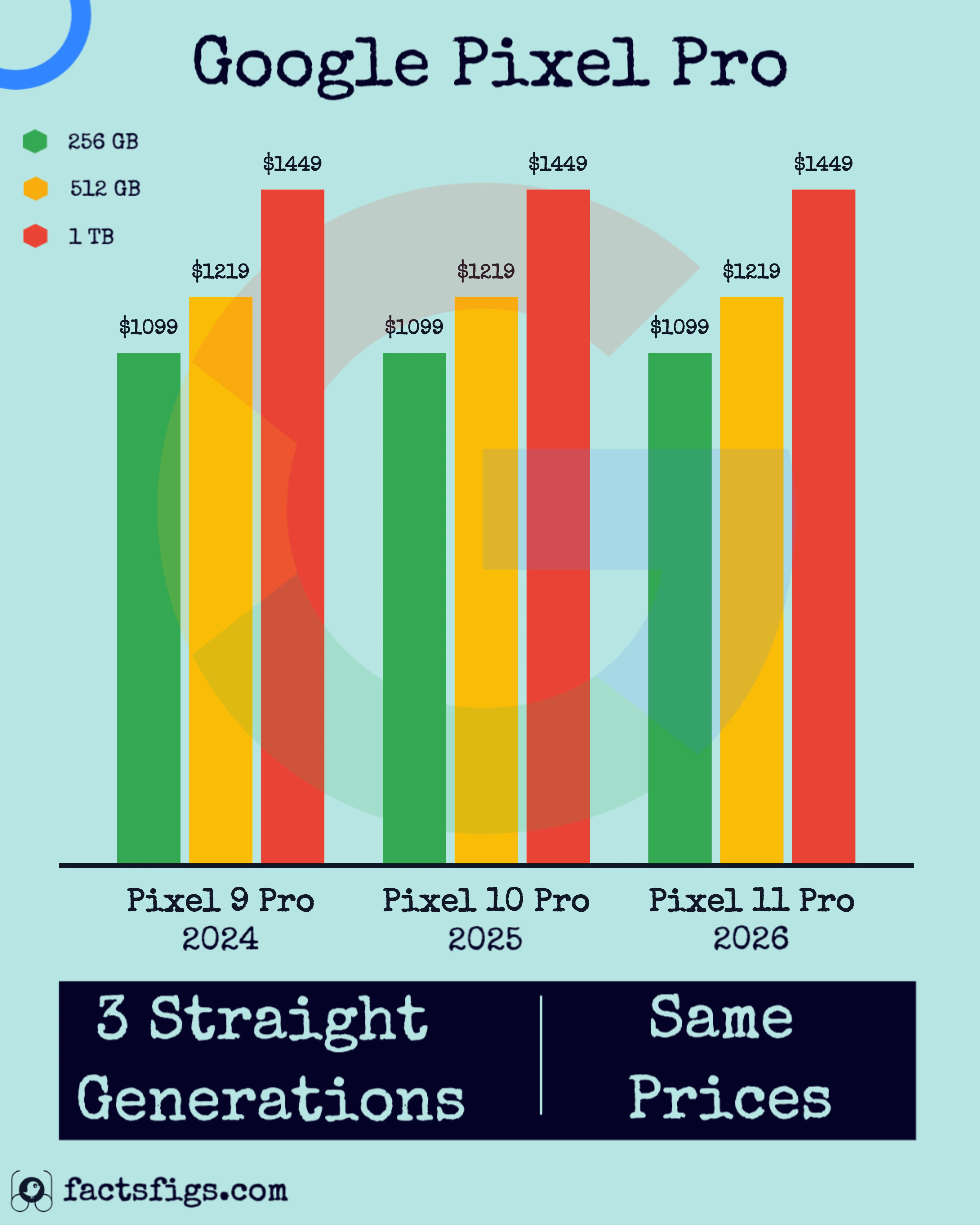
Match the storage tiers instead - 256GB, 512GB, 1TB - and the nominal price hasn't moved in three straight generations, back to the Pixel 9 Pro in 2024.
What did move: the 256GB tier's RAM was quietly cut from 16GB to 12GB, and in inflation-adjusted dollars the flat $1,099 is actually about 6% cheaper than it was in 2024.
! What the Tier-by-Tier Record Actually Shows:
•
The Popular Belief:Multiple launch-day headlines read the Pixel 11 Pro's $1,099 starting price as Google raising the Pro line's price by $100 over the Pixel 10 Pro's $999.
•
What the Matched Tiers Show:256GB has cost $1,099, 512GB has cost $1,219, and 1TB has cost $1,449 for three generations running - the Pixel 9 Pro, 10 Pro, and 11 Pro all landed on the same three numbers.
•
What Actually Changed:128GB was discontinued lineup-wide in 2026, pushing the entry price up to the old 256GB figure, and that same 256GB tier now ships with 12GB of RAM instead of the 16GB every Pixel Pro carried since 2024.
? The Numbers Behind the Myth:
•
256GB Tier, 2024-2026:$1,099, unchanged across three generations
•
256GB Tier RAM, 2026:12GB, down from 16GB every prior generation
•
Real 256GB Price, 2024 to 2026:Fell roughly 6% once inflation is factored in
Google didn't reprice the Pixel Pro line this year - it discontinued the cheapest storage option and let the next tier up become the new floor. The dollar figure at every tier that still exists hasn't moved since 2024, and adjusted for inflation, it's actually gotten a little cheaper. The one place a buyer is quietly getting less is RAM, not price.
Continue reading below for the full detailed article →
Overview
Why 'Same Price' and 'Price Hike' Are Both True
Google's Pixel 11 Pro launched on August 12, 2026 at $1,099, and the headline math wrote itself: $1,099 is $100 more than the Pixel 10 Pro's $999 starting price a year earlier. Android Headlines' own coverage captured both sides of the story in the same paragraph - 'Google did raise prices this year, as we had expected,' followed two sentences later by 'Technically, it's the same price as the Pixel 10 Pro 256GB model.' Both statements are true, and the gap between them is the entire story: the $999 Pixel 10 Pro started at 128GB, a tier Google discontinued across the whole 2026 lineup. The $1,099 Pixel 11 Pro starts at 256GB instead, because there's no cheaper option left to buy. Compare the tiers that actually survived the year - 256GB, 512GB, and 1TB - and the nominal price hasn't moved since the Pixel 9 Pro launched in August 2024. What has moved is quieter: the storage floor's RAM, and, once inflation is factored in, the real cost of owning one.
The Three Numbers That Settle the Pixel Pro Price Question
Every Pixel Pro launch since 2024 gets read against the year before it, and this year's $1,099 sticker looks like proof Google raised prices again. Track the number that actually matters, though, and the picture flips: the price at every storage tier Google still sells hasn't changed in three generations. What has changed sits one level down, in the RAM spec nobody puts in a headline, and in what that flat sticker price is actually worth once three years of inflation are stripped out. These are the three numbers that decide whether 'Google raised prices' or 'same price, different floor' is the honest read.
3 Generations · 256GB Tier Held at $1,099
$1,099
The Pixel 9 Pro launched at $1,099 for 256GB in August 2024. The Pixel 10 Pro matched it in 2025. The Pixel 11 Pro matched it again in 2026, now as the base tier rather than an upgrade. Android Authority reported Google's own media briefing made the same case directly: 2026 pricing is 'in line with the 256GB Pixel 10 Pro,' not a fresh increase.
256GB RAM Cut · 16GB to 12GB in 2026
12GB
Every Pixel 9 Pro and Pixel 10 Pro storage tier shipped with 16GB of RAM, no exceptions. The Pixel 11 Pro breaks that pattern only at the cheapest tier: 256GB configurations now carry 12GB, while 512GB and 1TB keep 16GB. The $1,099 price held, but the entry-level Pro buyer is getting a lower RAM spec than the same tier offered a year earlier.
6% Real Decline · 256GB Tier Since 2024
6%
$1,099 has been the 256GB tier's nominal price since 2024, but a dollar in 2024 isn't worth a dollar in 2026. Applying published US CPI figures - roughly 6.52% cumulative inflation from 2024 to 2026 - the 2024 price is equivalent to about $1,171 today, and the 2025 price to about $1,136. The unchanged $1,099 sticker is, in real terms, a price cut of roughly 6% since 2024.
The Pixel 11 Pro's 256GB Tier, by the Numbers
$1,099 · 256GB Price, Unmoved Since 2024 $1,099 The Pixel 9 Pro, 10 Pro, and 11 Pro have all launched their 256GB configuration at exactly $1,099 - the number the '$100 price hike' framing compares against a discontinued tier, not against this one.
128GB · The Storage Tier That Disappeared 128GB Google discontinued the 128GB configuration across the entire 2026 Pixel lineup, removing the $999 entry point the year-over-year comparison actually depends on.
12GB · The 256GB Tier's New RAM Floor 12GB Down from 16GB in both the Pixel 9 Pro and Pixel 10 Pro, the RAM cut at the cheapest Pixel 11 Pro tier is the trade-off the flat price doesn't advertise.
The Headline Myth
Why 'Google Raised Prices' Made Every Launch Story
When the Pixel 11 Pro launched on August 12, 2026, the number that led nearly every headline was $1,099 - a hundred dollars above the Pixel 10 Pro's $999 starting price from a year earlier. Android Headlines' own launch coverage captured the reflex directly: 'Google did raise prices this year, as we had expected.' Digital Trends ran a similar comparison, and Android Authority covered the same jump. On its face, a like-for-like year-over-year read, the story checks out - last year's cheapest Pixel Pro cost $999, this year's costs $1,099.
The same coverage complicated its own headline within a sentence or two. Android Headlines followed its price-hike line with 'Technically, it's the same price as the Pixel 10 Pro 256GB model.' Digital Trends went further, stating outright that the Pixel 11 Pro's $1,099 price 'matches what Google charged for a 256GB Pixel 10 Pro.' Both framings ran in the same articles, because both are true - the entry price went up, and the entry price at a matching storage tier didn't move at all. (Digital Trends also reported that the larger Pro XL and Fold models took a genuine $100 increase at matched tiers this year, a claim that, unlike the Pro figures below, comes from a single source and hasn't been independently corroborated here.)
The Matched-Tier Test
What Happens When You Compare the Same Storage
Line up the storage tiers that exist in all three generations and the picture is uneventful in the best way. The 256GB Pixel Pro has cost $1,099 every year since the Pixel 9 Pro launched in August 2024. The 512GB tier has cost $1,219 for the same three years. The 1TB tier has cost $1,449 for the same three years. Every matched storage tier landed on the exact same dollar figure in 2024, 2025, and 2026 - not a rounded approximation, the identical number three times running.
What changed in 2026 wasn't a price at any tier; it was which tier is cheapest to buy. Google discontinued the 128GB configuration across the entire Pixel 11 lineup, so the floor that used to sit at $999 simply isn't for sale anymore. The $1,099 256GB tier, previously the mid-range upgrade, became the base model by default. Compare a $999 phone to a $1,099 phone and it looks like inflation; compare the $1,099 phone Google still sells to the $1,099 phone it sold last year, and nothing happened to the price at all.
What the 'Same Price' Framing Hides
Why the Base Tier Now Ships With Less RAM
Every Pixel 9 Pro and every Pixel 10 Pro shipped with 16GB of RAM, regardless of storage tier - 128GB, 256GB, 512GB, or 1TB, the memory was identical across the board. The Pixel 11 Pro breaks that consistency for the first time, and only at the cheapest configuration: the 256GB tier now carries 12GB of RAM, a 4GB cut, while the 512GB and 1TB tiers keep the 16GB that's defined the Pro line since 2024. Android Authority and Android Headlines both confirmed the drop independently in their launch-day coverage.
That's the detail the price comparison alone misses. A buyer paying $1,099 for the 256GB Pixel 11 Pro is paying the exact figure the 256GB Pixel 10 Pro cost a year ago, for a phone with less memory than that same configuration offered in 2025. 'Same price' is accurate as far as the dollar figure goes; it just isn't the whole trade. Anyone who wants the 16GB the Pixel 9 Pro or Pixel 10 Pro used to carry at this tier now has to move up to 512GB and pay an extra $120 to get it.
The Real-Dollar Check
Why a Flat Price Is Actually a Quiet Discount
A dollar figure that hasn't moved on paper still moves in practice, once inflation is factored in. US CPI data puts cumulative inflation from 2024 to 2026 at roughly 6.52%, and the trailing 12-month rate as of July 2026 at about 3.4%, the closest available approximation for the 2025-to-2026 stretch. Applying those figures to the 256GB tier's unchanged $1,099 sticker: the 2024 Pixel 9 Pro's $1,099 is equivalent to roughly $1,171 in 2026 dollars, and the 2025 Pixel 10 Pro's $1,099 works out to about $1,136.
Set those numbers against the Pixel 11 Pro's actual, unadjusted $1,099 and the flat nominal price turns into a real decline of roughly 6% since 2024. Google didn't cut the price outright - the receipt says exactly what it said two years ago - but it also didn't raise the price fast enough to keep pace with the cost of everything else, which functions as a discount in every practical sense. It's the mirror image of the RAM cut: one trade-off works in the buyer's favor, the other doesn't, and the sticker price alone shows neither.
Every storage tier Google has sold across three Pixel Pro generations, with nominal launch prices and their 2026-dollar equivalents after inflation.
Pixel 9 Pro
2024
128GB
Yes
$999
16GB
$1,064.16
Base tier at launch; on sale 2024-09-04
Pixel 9 Pro
2024
256GB
No
$1,099
16GB
$1,170.66
—
Pixel 9 Pro
2024
512GB
No
$1,219
16GB
$1,298.49
—
Pixel 9 Pro
2024
1TB
No
$1,449
16GB
$1,543.47
—
Pixel 10 Pro
2025
128GB
Yes
$999
16GB
$1,032.97
Base tier at launch; on sale 2025-08-28
Pixel 10 Pro
2025
256GB
No
$1,099
16GB
$1,136.37
—
Pixel 10 Pro
2025
512GB
No
$1,219
16GB
$1,260.85
—
Pixel 10 Pro
2025
1TB
No
$1,449
16GB
$1,498.87
—
Pixel 11 Pro
2026
256GB
Yes
$1,099
12GB
$1,099.00
128GB discontinued lineup-wide, making 256GB the new base; on sale 2026-08-20. RAM cut to 12GB at this tier only (was 16GB in both prior generations)
Pixel 11 Pro
2026
512GB
No
$1,219
16GB
$1,219.00
—
Pixel 11 Pro
2026
1TB
No
$1,449
16GB
$1,449.00
—
Nominal prices are official US launch prices at each announce date. Real (2026) figures apply published US CPI inflation multipliers: 6.52% cumulative for 2024→2026, 3.4% trailing 12-month for 2025→2026, from in2013dollars.com and Trading Economics.
Conclusion
The Verdict: Same Price, Different Floor, Less RAM
Judged by the literal claim in half the launch-day headlines - Google raised the Pixel Pro's price by $100 - the myth doesn't hold up. At every storage tier Google still sells, 256GB, 512GB, and 1TB, the price has been identical for three straight generations, 2024 through 2026. What actually happened in 2026 was a restructuring, not a repricing: Google discontinued the 128GB tier lineup-wide, and the next cheapest configuration, already priced at $1,099 for two years running, became the new floor by default.
That doesn't make the 'nothing changed' framing complete either. The 256GB tier's RAM dropped from 16GB to 12GB this year, a real spec cut hiding behind a price tag that looks unchanged, and in inflation-adjusted terms that unchanged price is actually a roughly 6% real-terms decline since 2024. Whether the Pixel 11 Pro XL and Pixel 10 Pro Fold saw genuine matched-tier increases this year, as one outlet has reported, remains a single-sourced claim outside the scope of what's confirmed here. For the standard Pro model, the honest answer is that Google didn't raise the price - it changed what the price buys.
The data behind this story comes from Pixel Pro launch pricing and specifications reported by Android Headlines, Android Authority, Digital Trends, TechNerdiness, Tom's Guide and GSMArena at each generation's announcement, cross-checked against Google's own official Pixel 11 launch page at blog.google, which confirms the Pixel 11 Pro's $1,099 starting price and 256GB base storage directly. Inflation-adjusted figures use US CPI data from in2013dollars.com and Trading Economics. The dataset is manually compiled from these public sources, and full credit for the underlying pricing and specification record goes to the outlets and statistical sources that published it.
FactsFigs reviews, cleans, and cross-checks every source dataset before shaping it into a data story. Each visualization is created and designed in FactsFigs Design Studio — an internal tool developed and owned by FactsFigs — and is the original work of a FactsFigs author, not an AI-generated copy of any existing graphic. Individual assets within a visual may or may not be produced with AI tools, but the design of the visual itself is solely FactsFigs' own.
Figures are estimates at the time of publication, provided for information only — nothing here is financial advice or a guarantee of accuracy.
Last verified: 18 Aug 2026
The charts in this article were built with our own publishing system. See what it does →