Are Folding Phones Getting Cheaper? Launch Prices, 2019-2026

By Saif Ur Rahman Published 13 Sept 2026 Updated 13 Sept 2026
FactsFigs Data Story
Eight Brands, Seven Years, One Price Band
FactsFigs

Facts & Figures

Visual Intelligence

TL;DR - Are Folding Phones Getting Cheaper?

Barely in cash, substantially in real terms - and the cash figure is astonishingly consistent across the industry

Sixteen book-style folding phones have launched since 2019, from Samsung, Apple, Google, Huawei, Honor, Xiaomi, OnePlus and Oppo. Thirteen of them launched between $1,699 and $2,000. All twelve that carried a US price did, without exception. Samsung's own line moved from $1,980 in 2019 to $1,899 in 2026 - down 4.1% in cash, but down 26.6% once adjusted for inflation.

! What the Data Actually Shows:

  • The Popular Belief: Folding phones have been stuck at around two thousand dollars since they appeared, and Apple has entered at a premium.
  • How Consistent It Actually Is: Eight brands, seven years, and thirteen of sixteen launches inside a $301 band. Every device with a US list price is in it.
  • The Three Exceptions Explain Themselves: Huawei's 2019 Mate X at about $2,600, Honor's Magic V2 at about $2,170 and Xiaomi's China-only Mix Fold 4 at about $1,280 - none of them sold in America.
  • What Inflation Did to the Band: US prices rose 30.61% between 2019 and 2026. Holding a number still across that span is a real-terms cut of more than a quarter.

? The Numbers Behind the Question:

  • Devices Tracked: 16 book-style folds from 8 brands, 2019 to 2026
  • The Band: $1,699 to $2,000 - 13 of 16 launches, and 12 of 12 US-priced ones
  • Samsung's Real Change: -26.6% since 2019, against -4.1% in cash
  • Apple's Entry: $1,999, mid-band, and $587 below the 2019 opening price in real terms

Two things are true at once. The cash price of a folding phone has been remarkably stable - so stable that eight competing companies arrived at nearly the same number over seven years. And that stability is itself a price cut, because the money lost more than a quarter of its value underneath it.

Continue reading below for the full detailed article →

Overview

Eight Companies, Almost the Same Number

Samsung opened the folding phone category in September 2019 with a device that cost $1,980. Seven years later the field includes Apple, Google, Huawei, Honor, Xiaomi, OnePlus and Oppo, and sixteen book-style folds have carried a launch price. What is striking is how little that price varies. Thirteen of the sixteen launched between $1,699 and $2,000, and of the twelve that carried an official US price, every single one did. Competing companies, different suppliers, different years, and a $301 spread. The three exceptions make the point rather than spoiling it: Huawei's original Mate X at roughly $2,600, Honor's Magic V2 at roughly $2,170, and Xiaomi's Mix Fold 4 at roughly $1,280 all reached buyers in euros or yuan and never carried a US list price at all. Underneath that consistency, something is moving. Cumulative US inflation between 2019 and 2026 was 30.61%, so the $1,980 that bought the first Galaxy Fold is $2,586 in today's terms. Measured that way Samsung's line has come down 26.6%, and the whole band has been quietly sliding with it.

The Three Numbers That Answer the Question

Asked in cash, folding phones have barely moved and eight competing companies have somehow agreed on the same number. Asked in what that money is worth, the whole band has been falling the entire time. These three figures hold both answers - how tight the agreement is, how far the real price has dropped, and where Apple's entry sits against the phone that started it all.

Every US-Priced Fold in One Band

12 of 12

Twelve of the sixteen folding phones tracked here carried an official US launch price, and all twelve landed between $1,699 and $2,000. That covers Samsung's eight generations, both Google Pixel Folds, the OnePlus Open and Apple's iPhone Duo - four companies, seven years, and a spread of $301 between the cheapest and the dearest.

Real Fall Across Seven Years

26.6%

Samsung's line is the only one long enough to measure a trend, and it runs from $1,980 in 2019 to $1,899 in 2026. In cash that is a fall of 4.1%. Restated in 2026 dollars it is a fall from $2,586 to $1,899, or 26.6%, because US prices rose 30.61% over the same period while the phone's price tag did not.

Apple's Entry, Below Where It Started

$587

The iPhone Duo launches at $1,999, which puts it mid-band rather than at the top of it, and $587 below what the original Galaxy Fold cost in equivalent money. Against this year's Samsung fold Apple is $100 more expensive, and that is the comparison the launch coverage made. Against the category's own history it is not a premium entry at all.

The $1,699 to $2,000 Band by the Numbers

  • Sixteen Devices, Eight Brands Samsung, Apple, Google, Huawei, Honor, Xiaomi, OnePlus and Oppo, from 2019 to 2026.
  • Three Outliers, None Sold in the US Huawei at about $2,600, Honor at about $2,170 and Xiaomi at about $1,280 all launched in euros or yuan.
  • $1,280 to $2,600 Overall The full range doubles once phones that never had a US price are included.

The Agreement

Eight Competing Companies, One Price

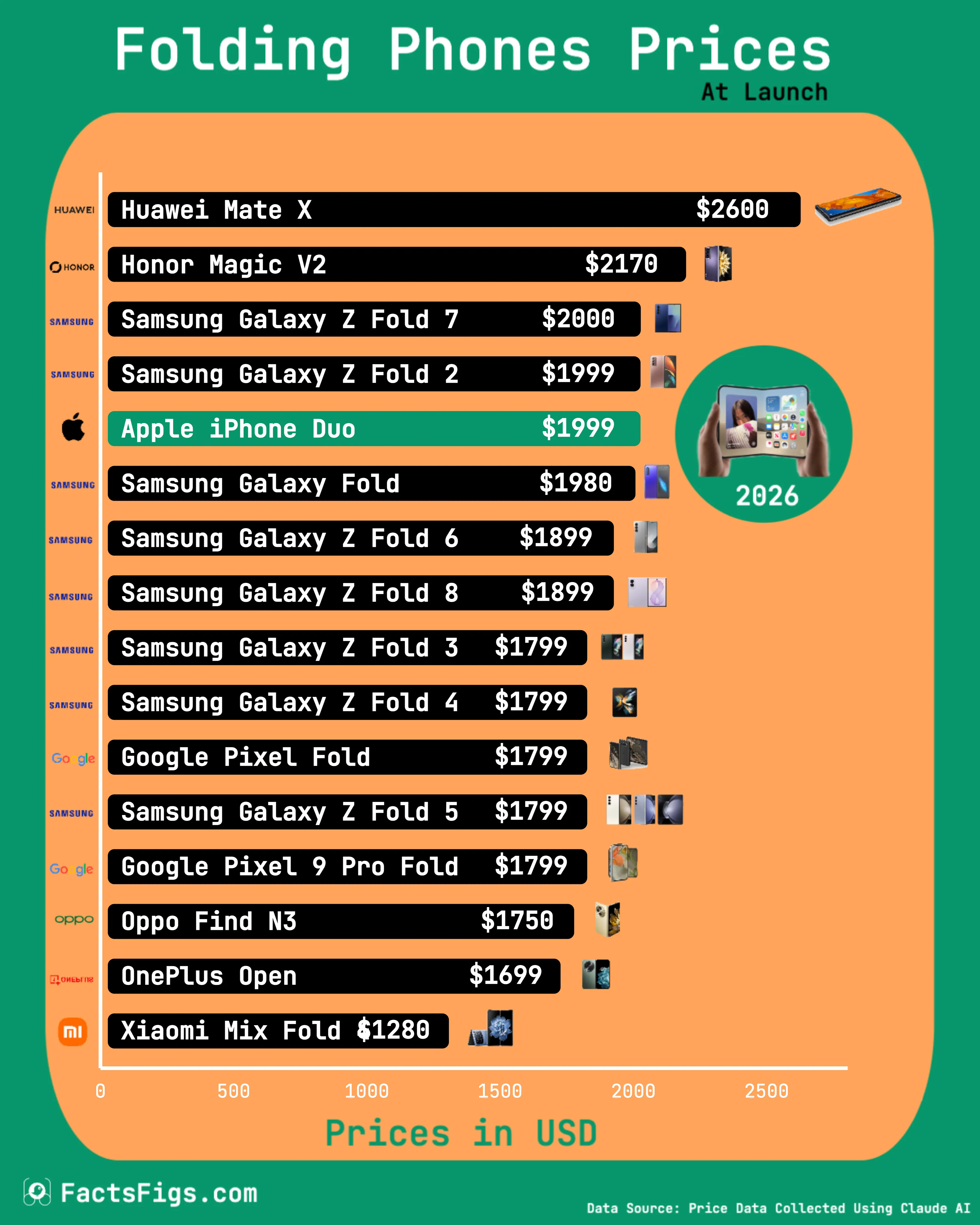
Line up every book-style fold by launch price and the clustering is hard to miss. OnePlus Open at $1,699. Oppo Find N3 at $1,750. Both Google Pixel Folds, three Samsung Z Folds and nothing else at $1,799. Samsung's Z Fold 6 and Z Fold 8 at $1,899. The original Galaxy Fold at $1,980, the Z Fold 2 and Apple's iPhone Duo at $1,999, and the Z Fold 7 at $2,000.

Thirteen of Sixteen Inside $301

That is thirteen launches from six companies sitting inside a band narrower than the price of a mid-range phone. Among devices that carried an official US price the agreement is total: twelve of twelve. These are competitors with different display suppliers, different hinge designs and different years of component costs, arriving at nearly the same figure - which says the number is set by what the market will bear for a folding phone rather than by what any one of them costs to build.

The exceptions are worth naming precisely, because all three point the same way. Huawei's original Mate X launched in February 2019 at €2,299, roughly $2,600 - the first mover, pricing before anyone knew what the category was worth. Honor's Magic V2 reached Europe in January 2024 at €1,999, about $2,170. Xiaomi's Mix Fold 4 went on sale in China in July 2024 at ¥8,999, about $1,280. None of the three ever carried a US list price.

The Adjustment

What Thirty Percent Inflation Did to a Flat Number

US consumer prices rose 30.61% between 2019 and 2026, most of it concentrated in 2021 and 2022, when annual inflation hit 4.70% and then 8.00%. Run each launch price through the consumer price index and the picture inverts. The original Galaxy Fold's $1,980 becomes $2,586 in 2026 terms. The Z Fold 3's $1,799 in 2021 becomes $2,217. The Z Fold 5's $1,799 two years later becomes $1,971 - the same cash figure, $246 less in real money, purely because of when it was charged.

The Cheapest Fold Samsung Has Ever Launched Is the Newest One

Measured in 2026 dollars the series falls almost without interruption: $2,586, then $2,579, $2,217, $2,053, $1,971, $2,023, $2,073, and finally $1,899. The only two upward steps are 2024 and 2025, when Samsung raised the cash price by $100 and then another $101 while inflation was running slower than it had been. The Z Fold 8 at $1,899 is the lowest real launch price in the category's history, and it is 26.6% below where the category started.

The Same Trick Apple Has Used for Years

Holding a nominal price while inflation runs is a quiet price cut, and it is a pattern FactsFigs has found before in this project. Our look at eighteen years of iPhone launch prices found Apple leaving headline figures untouched for long stretches and letting inflation do the work, while introducing new tiers above them rather than raising the base. Samsung's folds show the same mechanism in a category only seven years old.

The Newcomer

Apple Arrived Mid-Band, Not Above It

Apple announced the iPhone Duo on 9 September 2026 at $1,999 for 256GB, with pre-orders from 16 October and sale from 23 October. The immediate comparison was to Samsung's current fold, and on that comparison Apple is $100 more expensive. It is a fair comparison and it is also the narrowest one available.

Fifth of Sixteen, and Level With a 2020 Samsung

Ranked against the whole field, $1,999 comes fifth of sixteen - behind Huawei and Honor, level with the Galaxy Z Fold 2 from 2020, and a dollar under the Z Fold 7 from 2025. Six of Samsung's own eight generations launched above $1,999 once adjusted for inflation, including every fold Samsung shipped between 2019 and 2022. Whatever else is true of Apple's pricing, the foldable is not an outlier upward.

Which Does Not Make It Cheap

The iPhone Duo is still a two-thousand-dollar phone, roughly twice the entry price of a conventional flagship, and $1,999 only buys the 256GB model - the 2TB configuration reaches $3,199. The point is narrower than it sounds. Apple did not enter this category at a premium to its history; it entered at the number eight other companies had already converged on.

The Full Data Table

Sixteen Folding Phones at Launch, 2019-2026

Book-style folds only, base storage tier, ranked by launch price. Where a phone never carried a US price the native figure is shown with an approximate conversion. The adjusted column restates each price in 2026 dollars using the US consumer price index.

Huawei Mate XFeb 2019€2,299$2,600 approx.$3,396No
Honor Magic V2Jan 2024€1,999$2,170 approx.$2,311No
Samsung Galaxy Z Fold 7Jul 2025$2,000$2,000$2,073Yes
Samsung Galaxy Z Fold 2Sep 2020$1,999$1,999$2,579Yes
Apple iPhone DuoOct 2026$1,999$1,999$1,999Yes
Samsung Galaxy FoldSep 2019$1,980$1,980$2,586Yes
Samsung Galaxy Z Fold 6Jul 2024$1,899$1,899$2,023Yes
Samsung Galaxy Z Fold 8Aug 2026$1,899$1,899$1,899Yes
Samsung Galaxy Z Fold 3Aug 2021$1,799$1,799$2,217Yes
Samsung Galaxy Z Fold 4Aug 2022$1,799$1,799$2,053Yes
Google Pixel FoldJun 2023$1,799$1,799$1,971Yes
Samsung Galaxy Z Fold 5Aug 2023$1,799$1,799$1,971Yes
Google Pixel 9 Pro FoldAug 2024$1,799$1,799$1,916Yes
Oppo Find N3Oct 2023$1,750$1,750$1,918No
OnePlus OpenOct 2023$1,699$1,699$1,862Yes
Xiaomi Mix Fold 4Jul 2024¥8,999$1,280 approx.$1,363No

The Limits

What a Launch Price Cannot Tell You

Launch price is the cleanest number available for a comparison like this and it is not what most people pay. Carrier credits, trade-in offers and the steep discounting folds attract within months all sit outside it - Samsung's own store was selling the Z Fold 7 at $1,500 before the Fold 8 was announced. A series of launch prices tracks what a category asks, not what it settles for.

Three Prices Here Are Converted, Not Listed

Huawei, Honor and Xiaomi never sold these phones in the United States, so their figures are euro and yuan prices with an approximate dollar conversion attached. That stacks exchange-rate movement on top of inflation adjustment, and the Honor conversion in particular is an estimate rather than a published US figure. Those three are also the three outliers, so the widest claims in this story rest on its least certain numbers. The band itself does not depend on them.

Book-Style Folds Only, Base Tiers Only

Clamshell flips are excluded throughout. Xiaomi's Mix Flip, Samsung's Z Flip line and Motorola's Razr all sell for roughly half these prices, and mixing the two form factors would compare different products. Every figure is also the entry storage configuration: the iPhone Duo runs to $3,199 at 2TB and the Z Fold 8 to $2,499 at 1TB, so a comparison of ceilings would not land where this one does.

Samsung Split Its Own Line This Year

In 2026 Samsung shipped both a Z Fold 8 at $1,899 and a Z Fold 8 Ultra at $2,099. Treating the cheaper model as the successor to a single flagship line is a judgement, and a reasonable person could argue the Ultra is the real continuation - in which case the real fall since 2019 becomes 18.8% rather than 26.6%. The direction does not change. The size of it does.

The Verdict

Yes, and Almost Entirely by Standing Still

Folding phones are getting cheaper, and the mechanism is worth naming precisely, because it is not the one people assume. Nobody cut the price. Samsung's cash figure moved from $1,980 to $1,899 across seven years, a fall of 4.1%, and it went up in three of those years. What did the work was inflation: 30.61% cumulative, against a number that refused to follow it.

The Agreement Is the Real Story

The more surprising finding is how little the number varies between companies. Eight brands entered this category at different times with different supply chains, and thirteen of their sixteen launches landed inside $301 of each other. Every device that carried a US price is in that band without exception. A price that consistent across competitors is not a cost calculation; it is a shared read on what a folding phone is worth, and it has been sliding in real terms the entire time it has held.

What Would Change the Answer

Two things. If Samsung's Ultra line becomes the flagship and the cheaper Fold becomes a second tier, the series needs re-basing and the fall looks smaller. And if the memory-price pressure Samsung cited in 2026 pushes the next generation well past $2,000 in cash, a single year could undo several years of quiet real-terms decline. The trend is clear through 2026; it is not a law.

Data Source and Attribution

The launch prices behind this story were collected individually from the announcement coverage of each device, because no single published dataset tracks folding phone launch prices across manufacturers and years. Samsung's own newsroom supplied the original Galaxy Fold's $1,980; CNBC the Galaxy Z Fold 2, the Z Fold 6 and Huawei's Mate X; SlashGear the Z Fold 3; XDA Developers the Z Fold 5 and its confirmation that the Z Fold 4 carried the same price; SamMobile the Z Fold 7 and Z Fold 8; TechCrunch the Pixel 9 Pro Fold; 9to5Google the OnePlus Open; GSMArena the Honor Magic V2's European price; Gizmochina the Xiaomi Mix Fold 4's Chinese price; Oppo's own newsroom the Find N3; and Variety and MacRumors the iPhone Duo's price and specifications. Prices for Huawei, Honor and Xiaomi are euro and yuan figures with approximate dollar conversions, since none of those devices carried a US list price. The inflation adjustment uses US Bureau of Labor Statistics consumer price index data, which puts cumulative inflation from 2019 to 2026 at 30.61%. Every adjusted figure and every share in this story is a FactsFigs calculation from those sourced launch prices.

FactsFigs reviews, cleans, and cross-checks every source dataset before shaping it into a data story. Each visualization is created and designed in FactsFigs Design Studio - an internal tool developed and owned by FactsFigs - and is the original work of a FactsFigs author, not an AI-generated copy of any existing graphic. Individual assets within a visual may or may not be produced with AI tools, but the design of the visual itself is solely FactsFigs' own.

Figures are estimates at the time of publication, provided for information only - nothing here is financial advice or a guarantee of accuracy.

Last verified: 13 Sep 2026

The charts in this article were built with our own publishing system. See what it does →