

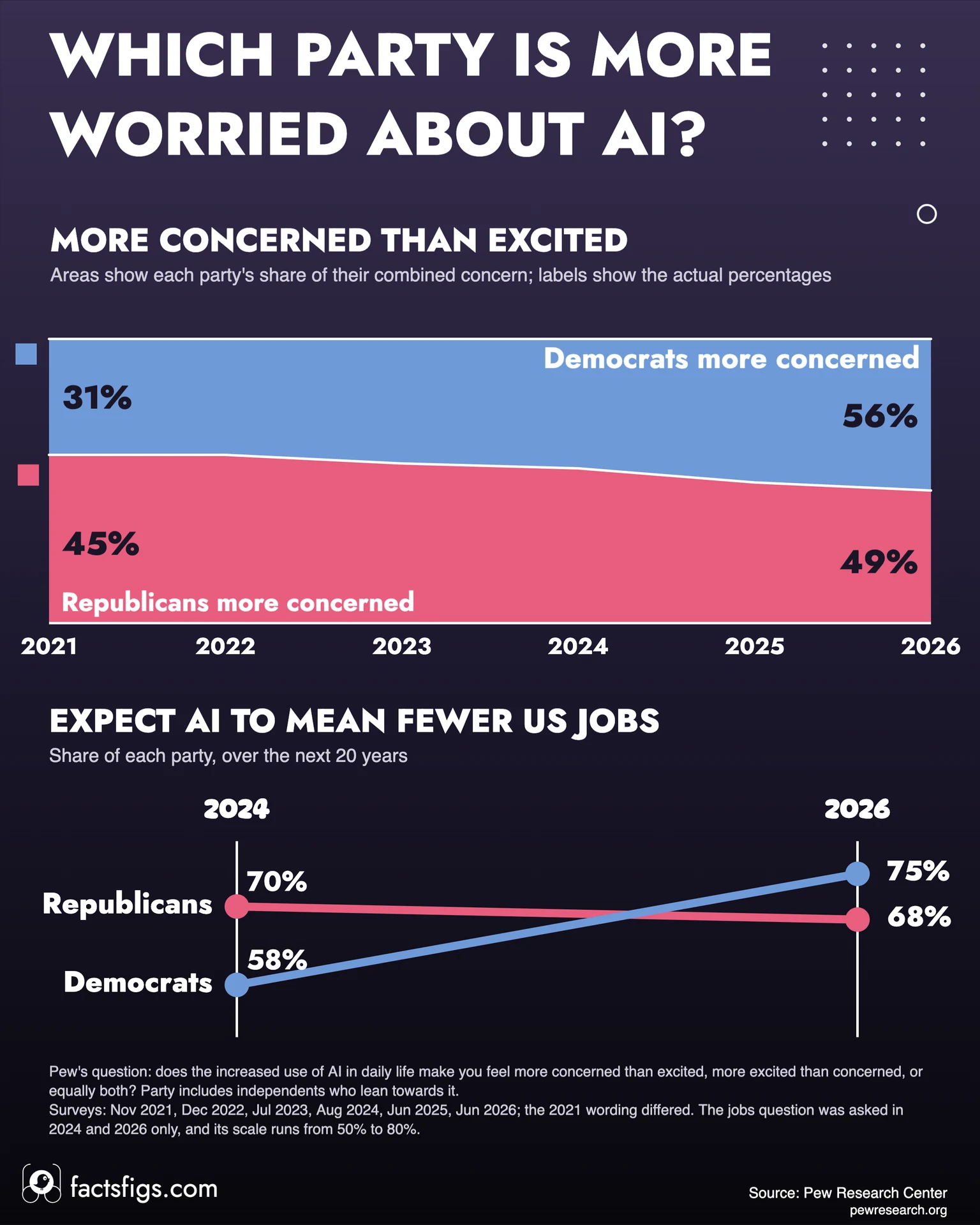
56%
In November 2021, 31% of Democrats said AI made them more concerned than excited. In June 2026 it was 56%, up 10 points from 46% in 2023.

Facts & Figures
Visual Intelligence
Pew Research Center's six surveys, November 2021 to June 2026
Republicans used to be the more concerned party about AI. In June 2026 Democrats were. Pew Research Center has asked US adults the same question since November 2021: does the increased use of AI in daily life make you feel more concerned than excited, more excited than concerned or equally both? In 2021, 45% of Republicans and 31% of Democrats said more concerned than excited. In June 2026 the figures were 49% and 56%. The parties did not swap places in one move. Both jumped between 2022 and 2023. Democrats then kept rising and Republicans fell back, while across all adults the share has stayed near half since 2023.
Across all US adults the share more concerned than excited has barely moved since 2023: 52%, 51%, 50% and 52%. The total hides two opposite moves of about 10 points, one in each party.
Continue reading below for the full detailed article →
Overview
Pew Research Center surveys the same panel of US adults, the American Trends Panel, mostly online. In each wave it has asked whether the increased use of artificial intelligence in daily life makes people feel more excited than concerned, more concerned than excited or equally concerned and excited. The latest survey ran from 22 to 28 June 2026 and reached 3,488 adults, with a margin of error of 1.8 percentage points for all adults. Earlier waves took place in November 2021, December 2022, July and August 2023, August 2024 and June 2025. The 2021 question opened with a longer description of AI computer programs, and Pew still plots it in the same trend. In this post, "worried" means choosing "more concerned than excited", because that is the answer Pew counts. Republicans and Democrats include independents who lean towards each party, which together cover about 94% of adults.
Democrats' concern kept rising and Republicans' fell back from a 2023 peak. The order reversed on the jobs question too.
56%
In November 2021, 31% of Democrats said AI made them more concerned than excited. In June 2026 it was 56%, up 10 points from 46% in 2023.
49%
Republican concern went from 45% in 2021 to a peak of 59% in 2023 and has fallen to 49%, 4 points above where it began.
75%
In June 2026, 75% of Democrats and 68% of Republicans expected AI to lead to fewer US jobs over 20 years. In 2024 it was 58% and 70%.
The Flip
In June 2026, Democrats. Pew found that 56% of Democrats said AI's growing role in daily life makes them more concerned than excited, against 49% of Republicans. That is a 7-point gap, and Pew describes it as the first time Democrats have been more likely than Republicans to say so.
Four years earlier the order was the other way round. In November 2021, 45% of Republicans and 31% of Democrats were more concerned than excited, a 14-point lead for Republicans that was the same in December 2022. It shrank slowly after that, to 13 points in 2023 and 9 in 2024. In June 2025 the two parties were level, at 50% for Republicans and 51% for Democrats.
The 2025 reading is best treated as a tie. The pages we read do not give margins of error for the party groups, but they are wider than the 1.8 points for all adults, and a one-point difference sits well inside any plausible margin. The 7-point gap in 2026 is the reading Pew treats as the reversal, and without the party margins we cannot say exactly how far it sits outside chance.
The Republican Line
Not entirely. Republican concern rose from 45% in December 2022 to a peak of 59% in July and August 2023, then fell to 55%, 50% and 49% in the next three surveys. That is a 10-point drop from the peak, but 49% is still 4 points above the 45% of 2021. About half of Republicans in June 2026 felt more concerned than excited.
The Republicans who stepped back did not become enthusiasts. The share who said they were more excited than concerned stayed between 9% and 11% in every survey from 2023 to 2026, and was 10% in June 2026. What grew was the middle answer, equally concerned and excited, which went from 31% in 2023 to 40% in 2026.
Pew says the movement is concentrated at the ends of the ideological spectrum. Concern among conservative Republicans dropped by 14 points between 2023 and 2026, while moderate and liberal Republicans did not change significantly. The pages we read do not give the conservative Republican figures themselves.
The Democratic Line
Much more. Democrats were the less concerned party until 2024, with 31% more concerned than excited in both 2021 and 2022. Their share jumped to 46% in 2023, stayed there in 2024 and rose to 51% in 2025 and 56% in 2026. The rise since 2021 is 25 points, more than six times the Republicans' 4.
The other answers moved the opposite way. Democrats who chose equally concerned and excited fell from 40% in 2023 to 34% in 2026, and those who were more excited than concerned fell from 12% to 9%. In 2021, 21% of Democrats were more excited than concerned. In 2026 it was 9%, against 10% of Republicans.
Pew says the change is largely driven by the ends of the ideological spectrum, and for Democrats that means liberals. Liberal Democrats went from 45% to 63% more concerned between 2023 and 2026, while moderate and conservative Democrats did not change significantly.
The 2023 Step
Yes, in one step. Between the December 2022 survey and the July to August 2023 survey, the Republican share rose from 45% to 59% and the Democratic share from 31% to 46%, increases of 14 and 15 points. Across all adults the share went from 38% to 52%. No other change in the series comes close.
The pattern since then is easy to miss in the headline number. Across all adults the share has been 52%, 51%, 50% and 52% in the last four surveys, almost a flat line. The Democratic rise and the Republican fall of about 10 points each fit that total. A flat average can hide two groups moving in opposite directions.
Pew's analysis does not say what caused the 2023 step, and the two surveys are eight months apart, so we cannot tell when in that window it happened. The data records what people said, not why they said it.
The Jobs Question
Pew also asked, in 2024 and 2026, whether AI will lead to more jobs, fewer jobs or not make much difference in the US over the next 20 years. In August 2024, 70% of Republicans and 58% of Democrats expected fewer jobs. By June 2026 the Republican figure was 68% and the Democratic figure 75%. The order flipped here too, and by more: Democrats rose 17 points while Republicans changed little.
Across all adults, the share expecting fewer jobs rose from 64% to 71%, so most of that rise came from Democrats. Few people in either party expect more jobs. In 2026 7% of Republicans and 4% of Democrats did, the reverse of 2024. A further 11% and 8% said it would not make much difference.
These are all adults, not only workers. Our earlier post on the same worry among US workers, from a YouGov survey, found it concentrated among workers under 45. The two surveys ask different questions of different groups and should not be merged.
A Second Poll
Quinnipiac University's national poll, released on 30 March 2026, points the same way. It asked whether AI will do more good or more harm in people's day-to-day lives. 59% of Democrats and 52% of Republicans said more harm, with 55% of all adults. For education the figures were 70% and 61%, and for health care 52% and 42%.
Quinnipiac also asked how excited people are about AI. 38% of Republicans said very or somewhat excited, against 31% of Democrats and 35% of all adults.
This is one survey, so it shows the 2026 direction but not whether the order has flipped over time, and it uses different questions from Pew's. Where the two agree is on the direction in spring and summer 2026: Democrats were more likely to say AI would do harm and less likely to say they were excited.
Survey by Survey
Each survey's share of Republicans and Democrats who said AI's increased use in daily life makes them more concerned than excited, which party was ahead and by how many points, with the middle answer and the share of all adults. Sort any column to reorder the rows.
| 2021 | Nov 1-7 | 45 | 31 | Republicans by 14 | 40 | 48 | 37 |
| 2022 | Dec 12-18 | 45 | 31 | Republicans by 14 | 41 | 50 | 38 |
| 2023 | Jul 31-Aug 6 | 59 | 46 | Republicans by 13 | 31 | 40 | 52 |
| 2024 | Aug 12-18 | 55 | 46 | Republicans by 9 | 35 | 42 | 51 |
| 2025 | Jun 9-15 | 50 | 51 | Democrats by 1 | 39 | 39 | 50 |
| 2026 | Jun 22-28 | 49 | 56 | Democrats by 7 | 40 | 34 | 52 |
Source: Pew Research Center, American Trends Panel. Republicans and Democrats include independents who lean towards each party. The lead is calculated by FactsFigs from Pew's published figures; 2025 is a one-point difference, which is within any plausible margin. The 2021 question was introduced with a longer description of AI computer programs.
Reading It Carefully
It measures a feeling, not a position on AI policy. More concerned than excited is a reaction to AI's growing use in daily life. It does not say a person wants AI restricted or opposes it, and the middle answer, equally concerned and excited, was chosen by 37% of all adults in 2026.
It is one pollster's trend, and party here includes people who lean towards a party. The party groups are smaller than the full sample, so their margins of error are wider than the 1.8 points for all adults, and the pages we read do not state them. The 2021 question opened with a longer description of AI computer programs. Pew plots it in the same trend, but the different wording could affect that first point.
It covers US adults and ends in June 2026, and it does not explain itself. Pew notes that AI has become a midterm election issue, with candidates in both parties debating data centres, regulation and jobs. That is context, not a cause, and these surveys cannot show whether it moved either party.
The data behind this story comes from Pew Research Center's American Trends Panel, as published in "Democrats are now more worried than Republicans about AI and its impact on jobs." Pew Research Center, Washington, D.C. (16 September 2026) https://www.pewresearch.org/short-reads/2026/09/16/democrats-are-now-more-worried-than-republicans-about-ai-and-its-impact-on-jobs/. FactsFigs uses Pew's published figures with attribution under Pew's terms of use, calculates the gap between the parties and redraws the results in its own design. Pew has not reviewed or endorsed this analysis, and no data download is offered. The Quinnipiac figures are from the Quinnipiac University Poll released on 30 March 2026.
FactsFigs reviews, cleans and cross-checks every source dataset before shaping it into a data story. Each visualization is created and designed in FactsFigs Design Studio, an internal tool developed and owned by FactsFigs, and is the original work of a FactsFigs author, not an AI-generated copy of any existing graphic. Individual assets within a visual may or may not be produced with AI tools, but the design of the visual itself is solely FactsFigs' own.
Figures are survey estimates at the time of publication, provided for information only; nothing here is a forecast or a guarantee of accuracy.
Last verified: 16 Nov 2026
Related Publications
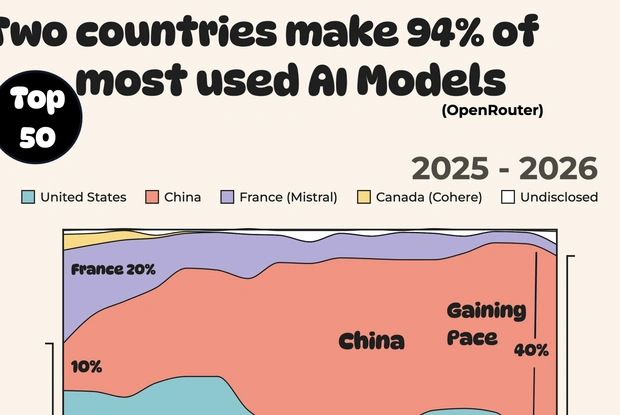
US and Chinese companies trained 94% of OpenRouter's 50 most-used AI models in May 2026, up from 76%. China rose from 10% to 40%.
12 Nov 2026
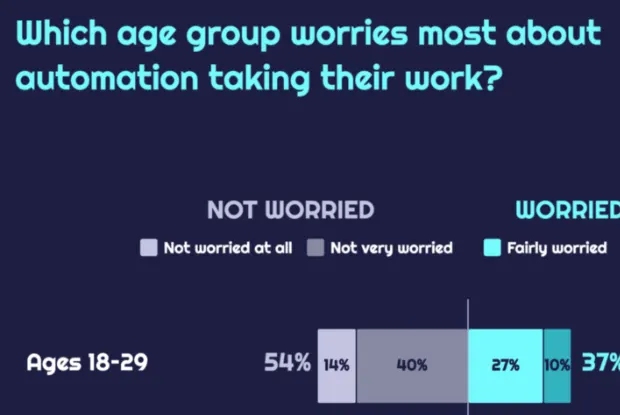
Under-45s worry most that their work could be automated, at 37% and 38%. Workers over 65 barely worry: just 7%.
11 Nov 2026
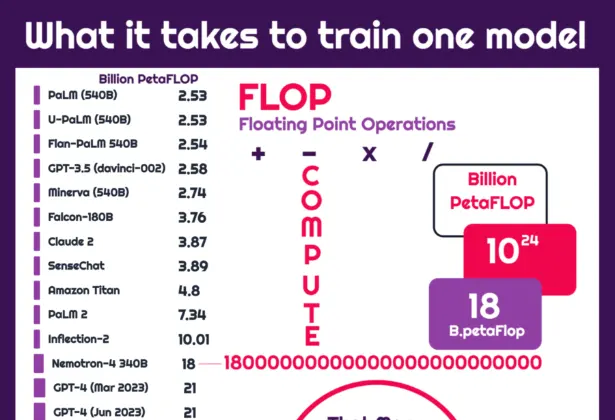
Epoch AI estimates put 24 AI training runs between 2.53 and 940 billion petaFLOP, a 371-fold spread, measured as arithmetic done, not quality.
26 Oct 2026

PHP2Shell scored 9.8, and so did 97 other PHP core flaws. On the newer CVSS v4.0 scale it scores 9.2 and ranks second of fifteen. Same flaws, two answers.
24 Oct 2026