TL;DR — Which Kingdom Hearts Game Actually Sold the Most?
The best-reviewed entry isn't the sales runner-up — repackaged old content is
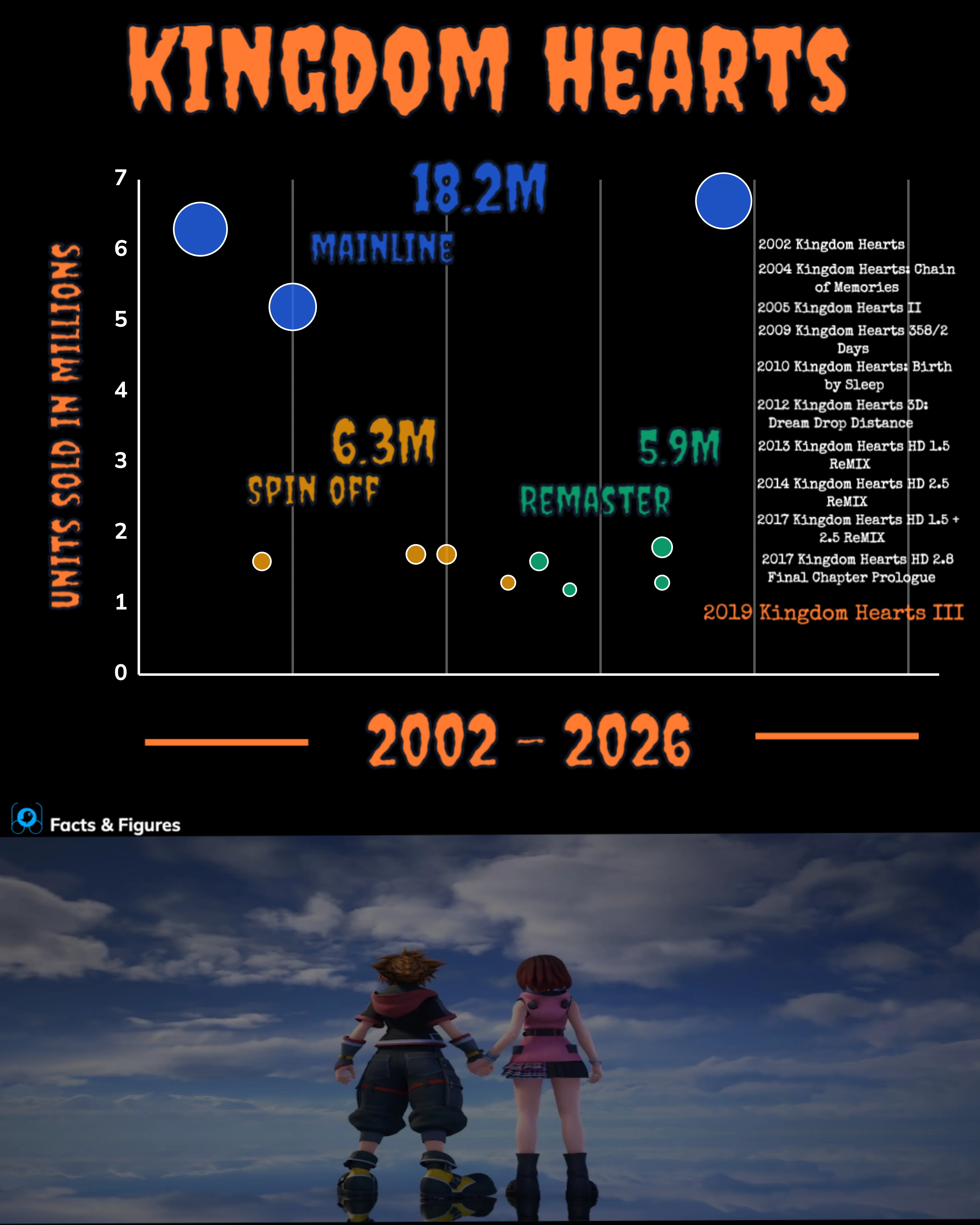
Eleven tracked Kingdom Hearts releases add up to 30.4 million lifetime units, led by Kingdom Hearts III's 6.7 million.
Kingdom Hearts II carries the series' best Metacritic score — 87 per TheGamer, 88.5 averaged by CBR — yet its own 5.2 million units rank third among the three mainline games.
Four HD remaster and compilation re-releases, built from already-published content, combined for 5.9 million units — enough on their own to edge past Kingdom Hearts II.
! What the Sales Record Actually Shows:
•
The Popular Assumption:The best-reviewed game should also outsell its mainline neighbors.
•
What the Sales Say:Kingdom Hearts II sits third at 5.2 million, behind Kingdom Hearts (6.3M) and Kingdom Hearts III (6.7M).
•
What Actually Outsells It:Four HD remaster/compilation re-releases combined for 5.9 million units — more than KH2 sold alone.
? The Numbers Behind the Outlier:
•
Mainline Total:18.2 million units — 59.9% of the tracked franchise total
•
Spin-off Total:6.3 million units across four handheld original-story titles
•
Remaster/Compilation Total:5.9 million units, edging past Kingdom Hearts II's 5.2 million
Kingdom Hearts' sales record doesn't reward critical reputation the way the mainline trilogy's Metacritic scores would predict. Kingdom Hearts II is the series' best-reviewed game, but it sells fewer copies than either mainline neighbor and only barely edges out a cluster of remastered old content critics rated lower than any of the three.
Continue reading below for the full detailed article →
Overview
A Franchise Built on Eleven Releases and One Long Wait
Eleven Kingdom Hearts releases with a confirmed sales figure add up to 30.4 million lifetime units, tracked by VGChartz through March 2022 — and the shape of that total doesn't match the franchise's own critical consensus. Kingdom Hearts III, which arrived in January 2019 after a thirteen-year wait since Kingdom Hearts II, is the single best-selling entry at 6.7 million units. Kingdom Hearts II, which both TheGamer's and CBR's Metacritic-based rankings call the best game in the series outright, ranks third among the three mainline titles at 5.2 million — trailing the 2002 original's 6.3 million too. What edges past Kingdom Hearts II isn't a better-reviewed game at all: it's four HD remaster and compilation re-releases, repackaging already-published content between 2013 and 2017, which combined for 5.9 million units. What follows breaks all eleven titles down by category, then works through why the best-reviewed game and the best-selling game were never the same title, and what this dataset's 30.4 million leaves out of Square Enix's own, larger totals.
The Three Numbers That Explain Kingdom Hearts' Real Outlier
Three figures carry this story. Kingdom Hearts III is the outright best-seller, the number most people guess first. Kingdom Hearts II is the number that breaks the pattern — the series' highest-rated game, yet not the second-best seller among the three mainline entries. And the four HD remasters, combined into one figure, are the number nobody expects: repackaged old content, scored lower on Metacritic than any mainline game, edging past Kingdom Hearts II's own total on volume alone.
Best-Selling Entry · 6.7M
6.7M Units
Kingdom Hearts III is the franchise's best-selling single release, at 6.7 million lifetime units per VGChartz's tracked total as of March 2022 — about 22% of every unit this dataset counts. It launched January 25, 2019 on PlayStation 4 and Xbox One, closing a wait of more than thirteen years since Kingdom Hearts II's 2005 debut.
Best-Reviewed, Not Best-Selling · 5.2M
5.2M Units
Kingdom Hearts II carries the highest Metacritic average in the series — 87 per TheGamer's ranking, 88.5 across CBR's comparison — both calling it the best Kingdom Hearts game outright. None of that moved its sales rank: at 5.2 million lifetime units, it trails Kingdom Hearts (6.3M) and Kingdom Hearts III (6.7M), placing third among three mainline entries.
Four Remasters Combined · 5.9M
5.9M Units
HD 1.5 ReMIX, HD 2.5 ReMIX, HD 2.8 Final Chapter Prologue, and HD 1.5 + 2.5 ReMIX — four re-releases of already-published content, none scored above 76 on Metacritic — combined for 5.9 million lifetime units between 2013 and 2017, enough to edge past Kingdom Hearts II's 5.2 million and outsell the series' most acclaimed original entry.
Kingdom Hearts III by the Numbers
6.7M Units, a New Franchise Record 6.7 M6.7 million lifetime units make Kingdom Hearts III the highest-selling release tracked here, ahead of the 2002 original's 6.3 million and Kingdom Hearts II's 5.2 million.
22% of All Tracked Franchise Sales 22 %One release accounts for more than a fifth of the 30.4 million units this dataset tracks across all eleven titles combined.
A 13-Year Wait Since Kingdom Hearts II 13 YearsKingdom Hearts III launched January 25, 2019, more than thirteen years after Kingdom Hearts II's December 2005 release — the longest gap between any two mainline entries in the series.
Origins
How an Unlikely Disney Crossover Became an Eleven-Title Franchise
Kingdom Hearts started as an improbable pitch: a Final Fantasy-style action RPG built around Disney's animated worlds, greenlit by Square (before its 2003 merger with Enix) and Disney Interactive. Director Tetsuya Nomura's game launched in Japan on March 28, 2002 for PlayStation 2, casting a Disney-world-hopping teenager named Sora alongside Donald Duck and Goofy against shadow creatures called Heartless. It sold 6.3 million lifetime units, per VGChartz, and an odd-looking crossover became the identity of a franchise still adding entries 24 years later.
What followed wasn't a straightforward sequel line. Kingdom Hearts II arrived in December 2005, still on PS2, but the thirteen-year wait for Kingdom Hearts III pushed Square Enix to fill the gap with handheld spin-offs — on Game Boy Advance, Nintendo DS, PSP, and 3DS — that carried the story forward rather than standing outside it. By the time Kingdom Hearts III launched in January 2019, the series had also repackaged nearly all of that handheld content into four HD remaster collections, turning an eleven-title, five-platform history into the sales record this post tracks.
Mainline
The Three Mainline Games That Carry 60% of Sales
The three numbered entries — Kingdom Hearts, Kingdom Hearts II, and Kingdom Hearts III — are the only titles here carrying the main numeral, and together account for 18.2 million of the 30.4 million tracked units, or 59.9% of the total. All three released on PlayStation hardware, with a thirteen-year gap between the second and third entries alone.
Kingdom Hearts (2002) · 6.3M Units
The original launched in Japan on March 28, 2002 for PlayStation 2, pairing Disney's worlds with an original cast built around Sora, Donald, and Goofy. It sold 6.3 million lifetime units and set the template every later entry — spin-off or remaster — has built on since.
Kingdom Hearts II (2005) · 5.2M Units
Kingdom Hearts II followed in December 2005, also on PS2, and is the entry critics rate highest: 87 on Metacritic per TheGamer, 88.5 averaged by CBR. Its 5.2 million lifetime units still make it the smallest-selling of the three mainline games — the series' clearest case of reputation and sales rank pointing in different directions.
Kingdom Hearts III (2019) · 6.7M Units
Kingdom Hearts III didn't arrive until January 25, 2019 on PlayStation 4 and Xbox One, closing a wait of more than thirteen years that became one of gaming's most-referenced development sagas. It became the franchise's best-selling release at 6.7 million units — proof the long wait didn't cost the series its audience.
Spin-offs
The Four Spin-Offs That Filled the Gap Between Mainline Games
Between Kingdom Hearts II's 2005 launch and Kingdom Hearts III's 2019 arrival sat a gap Square Enix filled with four original-story spin-offs, each carrying the plot forward on a different handheld. Combined, they account for 6.3 million units, 20.7% of the tracked total.
Chain of Memories (2004) · 1.6M Units
Released on Game Boy Advance in November 2004, Chain of Memories swapped real-time combat for a card-based battle system, bridging the story between the first two mainline games. It sold 1.6 million units and was later remade as Re:Chain of Memories, a title VGChartz lists with no confirmed figure and this dataset excludes.
358/2 Days (2009) · 1.7M Units
358/2 Days launched on Nintendo DS in May 2009, telling Roxas's story through a mission-based structure built for local multiplayer. It sold 1.7 million units, edging out Chain of Memories despite arriving five years into the DS's life.
Birth by Sleep (2010) · 1.7M Units
Birth by Sleep, a PSP prequel following three protagonists through the same story, launched January 2010 and matched 358/2 Days at 1.7 million units. CBR calls it the highest-rated spin-off in the series.
Dream Drop Distance (2012) · 1.3M Units
Dream Drop Distance moved to Nintendo 3DS in March 2012, putting Sora and Riku through a Mark of Mastery exam that set up Kingdom Hearts III directly. Its 1.3 million units are the lowest of the four spin-offs.
Remasters
The Four Remasters That Combined to Outsell Kingdom Hearts II
Between 2013 and 2017, Square Enix repackaged nearly every prior release — mainline and spin-off alike — into four HD collections rather than building new games. None scored above 76 on Metacritic, yet together they moved 5.9 million units, 19.4% of the total — enough to edge past Kingdom Hearts II's 5.2 million on volume alone.
HD 1.5 ReMIX (2013) · 1.6M Units
HD 1.5 ReMIX launched on PS3 in September 2013, bundling a remastered Kingdom Hearts Final Mix with Re:Chain of Memories and cutscenes from 358/2 Days. It sold 1.6 million units, matching Chain of Memories' original release almost exactly.
HD 2.5 ReMIX (2014) · 1.2M Units
HD 2.5 ReMIX followed on PS3 in December 2014, bundling Kingdom Hearts II Final Mix with Birth by Sleep Final Mix and cutscenes from Re:coded — the lowest-rated release in the franchise at 66. It sold 1.2 million units, the smallest of the four remasters.
HD 2.8 Final Chapter Prologue (2017) · 1.3M Units
HD 2.8 arrived on PS4 in January 2017, pairing a remastered Dream Drop Distance with the prequel short 0.2 Birth by Sleep -A Fragmentary Passage- and cutscenes from the mobile title χ Back Cover. It sold 1.3 million units.
HD 1.5 + 2.5 ReMIX (2017) · 1.8M Units
HD 1.5 + 2.5 ReMIX, released on PS4 in March 2017, combined both prior PS3 collections into one package. It's the best-selling remaster at 1.8 million units, outselling three of the four spin-off titles it helped repackage.
The Disconnect
Kingdom Hearts 2: Best Reviewed, Not Best Selling
Kingdom Hearts II's critical standing isn't close. TheGamer's Metacritic-based ranking puts it at 87, calling it "easily the best game in the series overall"; CBR's comparison averages it at 88.5, also ranking it first. Both place Kingdom Hearts III second (83 and 85.75) and the original third (85 and 82.5). None of that order matches lifetime sales, where Kingdom Hearts III leads at 6.7 million, the original follows at 6.3 million, and Kingdom Hearts II — the game both outlets rank first — trails at 5.2 million.
Timing explains more of the gap than quality does. Kingdom Hearts sold as a genuinely new idea in 2002, with no prior audience to disappoint; Kingdom Hearts III arrived after thirteen years of anticipation and a far larger install base than the PS2 ever reached. Kingdom Hearts II launched into an audience that hadn't yet grown to its 2019 size — a release-window disadvantage no critical acclaim could offset after the fact.
The Gap
What the 30.4 Million Tracked Here Leaves Out
This dataset's 30.4 million units are a floor, not a franchise total. Square Enix's own reported total has climbed with every update since the 2022 snapshot underlying this dataset — 36 million in March 2022, 37 million in early 2025, 38 million by November 2025, and 39 million as of August 16, 2026, confirmed alongside the Kingdom Hearts IV release-window announcement. That leaves roughly 8.6 million units this dataset can't attribute to any single title: Square Enix hasn't published a fresh per-title breakdown since 2022, so the newer growth likely spans organic sales on titles already counted here plus titles this dataset deliberately excludes.
Three of those exclusions carry no confirmed figure at all: Melody of Memory (2020), Re:Chain of Memories, and Re:coded are all listed on VGChartz's franchise page without a sales number, and the free-to-play mobile spin-offs χ, Union χ, and Dark Road have no "units sold" to report since neither carries a purchase price. A fourth, Kingdom Hearts Collection [I~III] — an October 8, 2026 re-release bundling HD 1.5 + 2.5 ReMIX, HD 2.8, and Kingdom Hearts III + Re Mind as native ports for PS5, Xbox Series X|S, Switch 2, and PC — hasn't shipped yet, so it has no figure to report either.
In August 2026, Disney confirmed Kingdom Hearts had crossed $1 billion in retail revenue, without a matching unit count — and announced Kingdom Hearts IV, due in a late-2027 window with a Pixar Coco-themed world, alongside a separately announced Kingdom Hearts anime series for Disney Channel and Disney+. Neither has a sales figure yet, and neither is part of the 30.4 million this post tracks.
The Full Data Table
All 11 Kingdom Hearts Titles, Ranked by Lifetime Sales
Every commercially-sold Kingdom Hearts release with a confirmed VGChartz unit-sales figure, its category, release year and platform, and its share of the 30.4 million units this dataset tracks.
Kingdom Hearts III
Mainline
2019
PlayStation 4 / Xbox One
6.7
22.0%
Kingdom Hearts
Mainline
2002
PlayStation 2
6.3
20.7%
Kingdom Hearts II
Mainline
2005
PlayStation 2
5.2
17.1%
Kingdom Hearts HD 1.5 + 2.5 ReMIX
Remaster/Compilation
2017
PlayStation 4
1.8
5.9%
Kingdom Hearts 358/2 Days
Spin-off
2009
Nintendo DS
1.7
5.6%
Kingdom Hearts: Birth by Sleep
Spin-off
2010
PlayStation Portable
1.7
5.6%
Kingdom Hearts: Chain of Memories
Spin-off
2004
Game Boy Advance
1.6
5.3%
Kingdom Hearts HD 1.5 ReMIX
Remaster/Compilation
2013
PlayStation 3
1.6
5.3%
Kingdom Hearts 3D: Dream Drop Distance
Spin-off
2012
Nintendo 3DS
1.3
4.3%
Kingdom Hearts HD 2.8 Final Chapter Prologue
Remaster/Compilation
2017
PlayStation 4
1.3
4.3%
Kingdom Hearts HD 2.5 ReMIX
Remaster/Compilation
2014
PlayStation 3
1.2
3.9%
Units sold and shares are drawn from VGChartz's tracked estimates as of March 2022; ties are broken by release year. Melody of Memory, Re:Chain of Memories, Re:coded, and the free-to-play mobile spin-offs are excluded for lack of a confirmed unit-sales figure or purchase price; Kingdom Hearts Collection [I~III], announced for October 8, 2026, is excluded as unreleased.
Conclusion
The Real Outlier Isn't a Sales Number, It's a Review Score
Line up Kingdom Hearts' eleven tracked releases by units sold and the outlier isn't a surprise hit or a flop — it's Kingdom Hearts II, a game every major ranking calls the best in the series, sitting third among three mainline entries and barely ahead of four remaster collections built from lower-rated material. Kingdom Hearts III's 6.7 million and the original's 6.3 million aren't hard to explain: one had thirteen years of anticipation behind it, the other had no prior audience to disappoint.
What's harder to explain away is that repackaging old content, none of it scored above 76 on Metacritic, moved more units than the series' most acclaimed original game. That's not a story about Kingdom Hearts II underperforming — it sold over five million copies and still anchors most "best RPG" lists written since. It's a story about what actually drives lifetime sales in a long-running franchise: install base and timing, more reliably than the review score on the box.
The unit-sales figures behind this story come from VGChartz's Kingdom Hearts franchise sales page, tracking lifetime shipment estimates for all eleven commercially-sold titles used in this dataset as of March 2022, unchanged since Square Enix has not published a newer per-title breakdown. Full credit for collecting and maintaining that underlying sales data goes to VGChartz. Metacritic-aggregate rankings cited throughout come via TheGamer's and CBR's published critic-score comparisons. The franchise's aggregate total was pulled forward to Square Enix's current confirmed figure of 39 million units, reported August 16, 2026 by MyNintendoNews alongside the Kingdom Hearts IV release-window announcement; the $1 billion revenue milestone and the Kingdom Hearts Collection [I~III] re-release both come via MyNintendoNews's and Square Enix's own August 2026 reporting.
FactsFigs reviews, cleans, and cross-checks every source dataset before shaping it into a data story. Each visualization is created and designed in FactsFigs Design Studio — an internal tool developed and owned by FactsFigs — and is the original work of a FactsFigs author, not an AI-generated copy of any existing graphic. Individual assets within a visual may or may not be produced with AI tools, but the design of the visual itself is solely FactsFigs' own.
Figures are estimates at the time of publication, provided for information only — nothing here is financial advice or a guarantee of accuracy.
Last verified: 17 Aug 2026
The charts in this article were built with our own publishing system. See what it does →