

64%
The review's typical result across 46 studies, from lower yields. By food: milk 51% more, pig meat 73%, beef 83%, lamb 126%, chicken 195% and fruit 108%.

Facts & Figures
Visual Intelligence
It depends on what you count: better on the same land and on pesticides, no clear difference in warming gases for the same food, and worse on land.
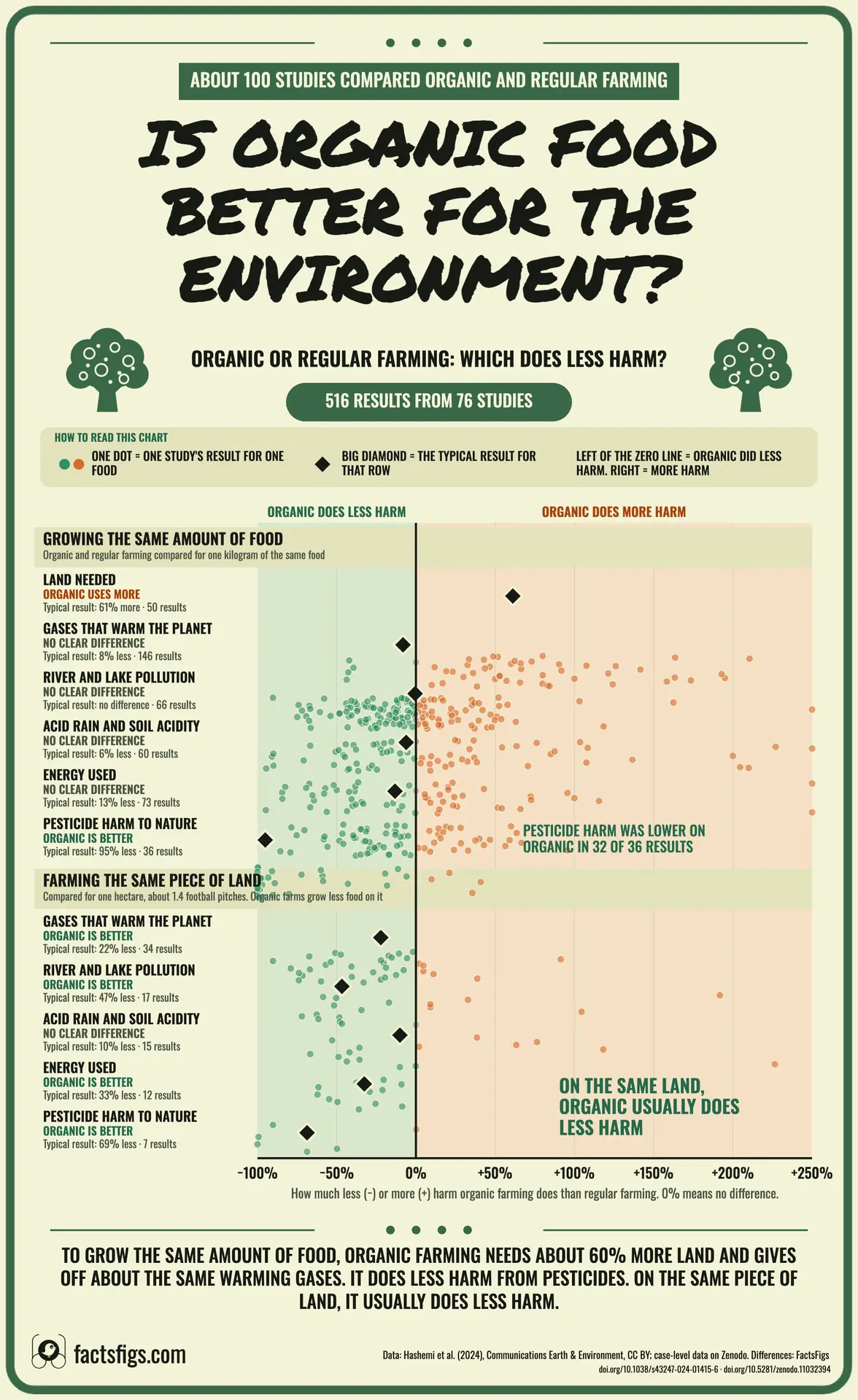
A 2024 review of 100 studies found that on the same piece of land, organic farming gave off fewer warming gases, polluted rivers and lakes less and used less energy. For the same amount of food, those differences were no longer clear, and organic farming needed about 64% more land. Organic farming usually did less harm from pesticides. What you eat matters far more than how it is farmed: a kilogram of beef from a beef herd has about 100 times the carbon footprint of a kilogram of peas.
Choosing organic can help the land it is grown on, but it does not by itself shrink the climate footprint of the food you eat.
Continue reading below for the full detailed article →
Overview
Fatemeh Hashemi and colleagues collected 100 studies that measured the environmental harm of organic and regular food, and published the comparison in Communications Earth & Environment in 2024. Each study adds up what a food costs the environment across its production. Results can be stated for the same amount of food (one kilogram) or for the same piece of land (one hectare, about 1.4 football pitches), and the choice changes the answer, so this page shows both. The review's authors published their results table openly. FactsFigs picked out every result with both an organic and a regular value, 516 of them from 76 studies, and plotted each one.
How much more land organic food needs, and how much less it warms the planet on the same land and for the same amount of food.
64%
The review's typical result across 46 studies, from lower yields. By food: milk 51% more, pig meat 73%, beef 83%, lamb 126%, chicken 195% and fruit 108%.
22%
Warming gases from organic farming were about 22% lower per hectare across 59 studies, a clear difference.
6%
Across 125 studies the typical difference was 5.7% lower for organic food, which the review could not tell apart from chance.
The short answer
Sometimes, and it depends on what is counted. On the same piece of land, organic farming usually does less harm. But organic fields grow less food, so for the same amount of food the picture changes: warming gases, acid pollution and river pollution are no longer clearly lower, and organic farming needs more land. The one harm where organic wins both ways is pesticides.
When the question is how to feed people, the same amount of food is the fairer comparison, because it asks what it costs to grow what we actually eat. The same piece of land matters for the farmer and the field. Both are real.
The definition
Our World in Data, which published a refresh of its organic farming analysis in September 2026, defines organic agriculture as farming without synthetic inputs, such as man-made fertilisers and pesticides, and without genetically modified organisms. It is not chemical-free: natural substances such as copper sulphate are allowed in some standards. For livestock, animals must eat certified organic feed and antibiotics are restricted.
Land
Yes, in almost every comparison. Across 46 studies the review found organic food needed 64% more land for the same amount of food, a clear difference it attributes mainly to lower yields. In our extraction of the results, 45 of 50 comparisons show more land for organic, and the typical result is 61% more.
The gap varies by food. The review's figures are 51% more land for milk, 73% for pig meat, 83% for beef, 126% for lamb, 195% for chicken, 80% for eggs, 86% for vegetables, 48% for grain and cereals and 108% for fruit. Land matters because, as Our World in Data notes, the spread of farmland over the centuries has displaced about a third of the world's previously forested land.
Climate
On the same piece of land, yes: the review's typical result was 22% fewer warming gases across 59 studies, a clear difference. For the same amount of food, there is no clear difference: 5.7% lower across 125 studies, which could be chance. The results show why. Of 146 comparisons for the same amount of food, 90 favour organic and 53 favour regular farming, with a spread from 90% lower to well above 100% higher.
Our World in Data explains the pattern this way: organic farming avoids man-made fertiliser, whose manufacture and the nitrous oxide it releases drive much of the warming from regular crops. But organic farms still need nutrients from manure or compost, which also release nitrous oxide, may plough the soil more and need more land. We did not review that explanation at its source.
Water pollution
The same flip appears. On the same piece of land, pollution of rivers and lakes from fertiliser and manure runoff (known as eutrophication) was about 47% lower on organic farms across 24 studies, a clear difference. Acid rain and soil acidity were 38% lower, which was not a clear difference across 23 studies. For the same amount of food, river and lake pollution was 3.8% higher and acid pollution 0%, and neither was a clear difference. For river and lake pollution the review ties the higher organic figures mainly to lower yields.
Where organic wins
On pesticides, yes. The review generally found less harm from pesticides on organic farms, because regular farming uses synthetic pesticides. In our results 32 of 36 comparisons for the same amount of food favour organic, with a typical result of 95% less harm. The review notes exceptions, including studies on fish, pig, olive, apple, grape, tomato, bean, rice and wheat bread, partly from copper sulphate and lower yields.
Biodiversity is harder to judge from these studies. The review found studies of biodiversity in only three cases, all on milk. Our World in Data adds that other research tends to find more species on organic fields, with the benefit shrinking when whole farms or landscapes are compared.
What you eat
By a wide margin. In the Poore and Nemecek 2018 data on 38 foods, as published by Our World in Data, a kilogram of beef from a beef herd produces 99.5 kilograms of greenhouse gases and a kilogram of peas 1.0, about 100 times as much. Our World in Data notes that organic and regular versions of the same food usually differ by 5% to 10%, and in extreme cases 50%, in either direction.
So choosing chicken over beef changes a diet's footprint far more than choosing organic over regular chicken. For the bigger picture on emissions, see how warming tracks the CO2 already emitted.
A world of organic farms
Our World in Data summarises a modelling study of England and Wales by Laurence Smith and colleagues: switching entirely to organic farming would lower emissions from farming there, but lower yields would mean importing food, which pushes farmland abroad. Once that is counted, the climate impact of the country's food was higher than today. We did not read that study. Our World in Data also notes that around half the world's people rely on synthetic fertiliser for their food.
The review's authors draw a different lesson for researchers: results change with the unit chosen, so product and diet-level assessments, and more studies outside Europe, are needed.
The results by harm
The review's published typical difference and whether it was clear for each harm, with the number of results, the typical result and the share favouring organic in the data FactsFigs extracted.
| Land needed | Amount of food (1 kg) | +64% | Yes, 46 studies | 50 | +61% | 4 of 50 |
| Warming gases | Amount of food (1 kg) | -5.7% | No, 125 studies | 146 | -8% | 90 of 146 |
| River and lake pollution | Amount of food (1 kg) | +3.8% | No, 51 studies | 66 | -0% | 33 of 66 |
| Acid rain and soil acidity | Amount of food (1 kg) | 0% | No, 52 studies | 60 | -6% | 32 of 60 |
| Energy used | Amount of food (1 kg) | -13% | No, 63 studies | 73 | -13% | 48 of 73 |
| Pesticide harm to nature | Amount of food (1 kg) | Not reported | Lower in most studies | 36 | -95% | 32 of 36 |
| Warming gases | Piece of land (1 hectare) | -22% | Yes, 59 studies | 34 | -22% | 28 of 34 |
| River and lake pollution | Piece of land (1 hectare) | -47% | Yes, 24 studies | 17 | -47% | 11 of 17 |
| Acid rain and soil acidity | Piece of land (1 hectare) | -38% | No, 23 studies | 15 | -10% | 9 of 15 |
| Energy used | Piece of land (1 hectare) | -32% | Yes, 17 studies | 12 | -33% | 12 of 12 |
| Pesticide harm to nature | Piece of land (1 hectare) | Not reported | Lower in most studies | 7 | -69% | 6 of 7 |
A minus sign means organic did less harm. The review's typical differences come from its own analysis, which uses a statistical test to judge whether a difference could be chance; 'No' means it could be. The columns on the right are FactsFigs' counts from the results table, which includes more results than the review's analysis for some harms, so typical results differ by a few points. 'Typical' is the middle result (the median). Results beyond plus 250% are drawn at the edge of the chart.
How this was built
The 2024 review published a table of every study, food and result. FactsFigs read it and kept each harm measure where both an organic and a regular value were given, which left 516 results from 76 of the studies in the table. For each we worked out how much more or less the organic value was than the regular one, as a percentage, using the review's own formula. We dropped 6 results with zero or negative reference values, 7 land use results per hectare and a single biodiversity result. A study can supply several dots, so dots are results, not independent studies.
Whether a result is for the same amount of food or the same piece of land is read from the unit each study used. The review does not publish its own list of results, so our counts and typical results differ from its figures; the text quotes the review where it gives a number and our extraction where it does not. About 74% of the studies are European and none are from Africa, and methods differ between studies, so the results describe mostly European farms.
Hashemi et al. (2024), Communications Earth & Environment Zenodo, supplementary data for the review
The data behind this story comes from Hashemi, F., Mogensen, L., van der Werf, H. M. G. et al. (2024), Organic food has lower environmental impacts per area unit and similar climate impacts per mass unit compared to conventional, Communications Earth & Environment, licensed CC BY 4.0, and its supplementary data on Zenodo (CC BY 4.0). Food carbon footprints are from Poore and Nemecek (2018), as published by Our World in Data, and the definition of organic farming and some background are from Our World in Data's September 2026 article, as attributed in the text. Full credit for collecting and maintaining the data goes to the review's authors.
FactsFigs reviews, cleans, and cross-checks every source dataset before shaping it into a data story. Each visualization is created and designed in FactsFigs Design Studio, an internal tool developed and owned by FactsFigs, and is the original work of a FactsFigs author, not an AI-generated copy of any existing graphic. Individual assets within a visual may or may not be produced with AI tools, but the design of the visual itself is solely FactsFigs' own.
Figures are estimates at the time of publication, provided for information only. Nothing here is financial advice or a guarantee of accuracy.
Last verified: 18 Nov 2026
Related Publications
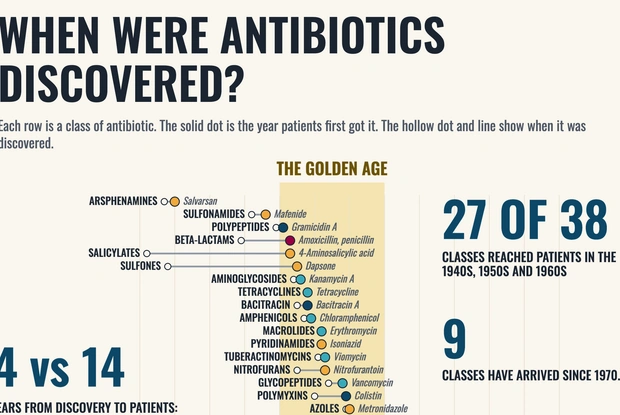
27 of 38 antibiotic classes reached patients in the 1940s to 1960s, 13 in the 1960s alone. Only 9 have arrived since 1970.
17 Nov 2026
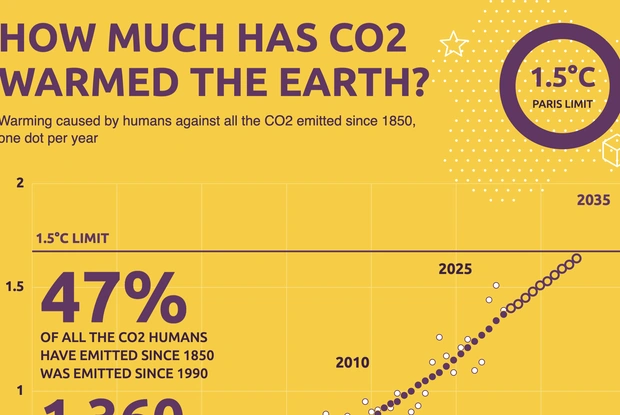
Humans have warmed the Earth by 1.37°C, tracking the 2,780 billion tonnes of CO2 emitted since 1850, 47% of it since 1990.
16 Nov 2026
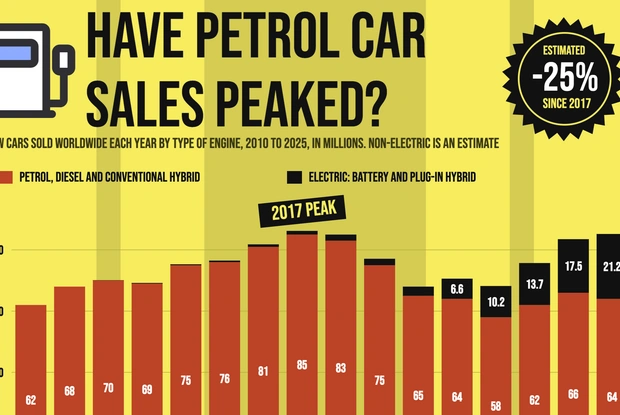
The IEA dates the peak of conventional car sales to 2017. An estimated 25% fewer were sold in 2025; China is about half the fall.
14 Nov 2026
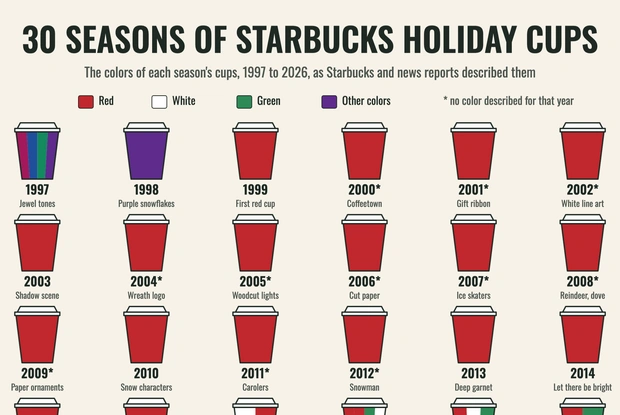
Starbucks has made a holiday cup every season since 1997. Red was the main color in 19 of 30, and since 2017 it has shared the set.
12 Nov 2026