

71%
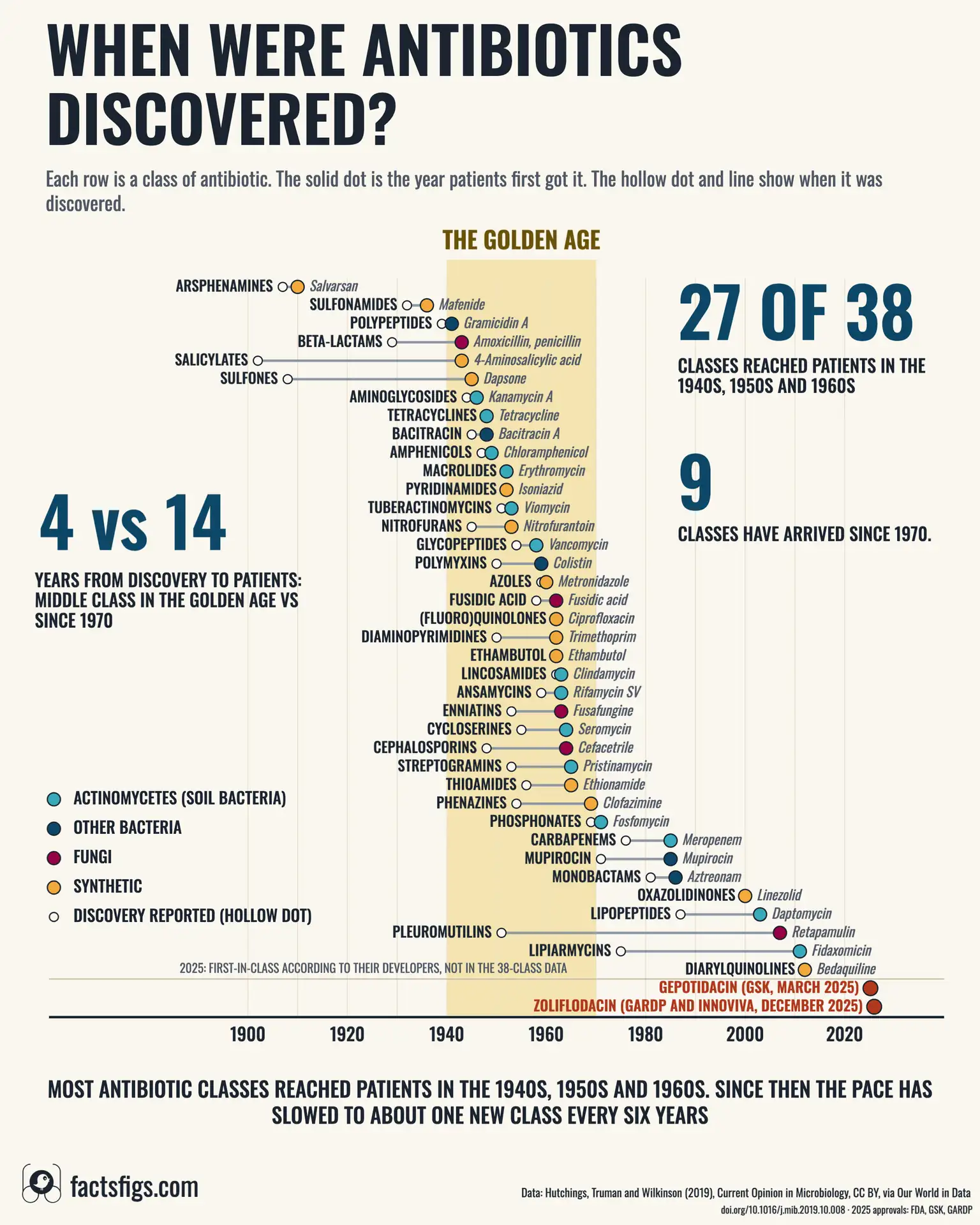
Eight reached patients in the 1940s, six in the 1950s and 13 in the 1960s, which is more than the 9 that have arrived in the 55 years since 1970.

Facts & Figures
Visual Intelligence
Almost all the antibiotics we use were found and developed in three decades, 1940 to 1969. Few new classes have followed.
The first antibiotic, salvarsan, reached patients in 1910. Of the 38 classes in clinical use, 27 arrived between 1940 and 1969, 13 of them in the 1960s alone. Since 1970 only 9 more have arrived, and the newest in the data is from 2012. In the dataset a typical class took about 4 years from discovery to patients in the golden age and about 14 since. Two drugs approved in the United States in 2025 are called first-in-class by their developers.
Most of the antibiotics doctors rely on today were developed before 1970, and the bacteria they target have had decades to adapt.
Continue reading below for the full detailed article →
Overview
The data come from a 2019 review by Matt Hutchings, Andrew Truman and Barrie Wilkinson, published in Current Opinion in Microbiology, and are charted by Our World in Data. The authors list every class of antibiotic used in medicine, 38 in all, where a class is defined by its origin, structure or the way it works. Two years matter for each class: when its discovery was first reported in the scientific literature, and when it was first used on patients. This page dates a class by the second, because that is when it could start to save lives. A class is a family of related drugs, so 38 classes cover far more than 38 drugs.
How many classes arrived in the golden age, how few have arrived since and how much longer new ones take to reach patients.
71%
Eight reached patients in the 1940s, six in the 1950s and 13 in the 1960s, which is more than the 9 that have arrived in the 55 years since 1970.
9
The newest in the data are the lipiarmycins in 2011 and the diarylquinolines in 2012. Eight of the 9 arrived in or after 1985.
14 yrs
The middle class took 4 years in the golden age, across 27 classes, and 14 years among the 7 classes since 1970 with known dates, a small group.
The first drugs
The first antibiotic used on patients was salvarsan, an arsenic compound from Paul Ehrlich's laboratory, deployed against syphilis in 1910. The sulfonamides, which grew out of work on dyes, followed in 1936. Alexander Fleming observed penicillin on a contaminated Petri dish in 1928, and the dataset records the beta-lactam class as reported in 1929 and first used by patients in 1943.
That gap is the point of the timeline. For most drugs, the year of discovery and the year of arrival are different dates, and the second is the one that mattered to patients. Between 1910 and 1939 only two of the 38 classes reached them.
The golden age
Hutchings and colleagues date the golden age from the 1940s to the 1960s. In the dataset it is easy to see: eight classes arrived in the 1940s, six in the 1950s and 13 in the 1960s, 27 of the 38 in all, or 71%. Our World in Data describes the same dataset as almost two-thirds. The share depends on where the age is said to end: it is 68% to 1965 and 71% to 1969.
The authors credit Selman Waksman, who began a systematic search of soil microbes in the late 1930s and found that the filamentous bacteria called actinomycetes produced many antimicrobial compounds. They write that during this period new classes were being discovered almost yearly from soil samples, and that a finite number of classes from easy-to-grow bacteria meant that rediscovering known compounds soon became a problem.
From lab to patient
In the dataset the middle class took 4 years from the first report of its discovery to the first use on patients in the golden age, across 27 classes, and 14 years among the 7 classes since 1970 with known dates. The seven is a small group, so the contrast is indicative, not exact. Twelve of the 36 classes with both dates reached patients within two years of discovery, and 12 took ten years or more.
The extremes are long. The pleuromutilins took 56 years, from 1951 to 2007, the salicylates 41 and the sulfones 37. Hutchings and colleagues note that fidaxomicin, discovered in 1975, is the newest natural-product class to reach the clinic, in 2011 in the dataset, and that daptomycin, discovered in 1987, was introduced in 2003. For a few classes the paper's text gives different discovery years from the dataset, but the medians stay the same on either set.
The sources
Of the 38 classes, 14 come from actinomycetes, soil bacteria, 5 from other bacteria and 5 from fungi, which makes 24 from living organisms. The other 14 are synthetic, made in the laboratory. The authors report that actinomycetes make 64% of all the known natural-product antibiotic classes, a wider count than the 38 classes in clinical use.
The newest natural-product class to reach patients, the fidaxomicin family, came from a rare actinomycete and was discovered in 1975, before daptomycin. Of the 9 classes since 1970, 7 are natural products and 2, the oxazolidinones and the diarylquinolines, are synthetic.
All 38 classes
Each class of antibiotic in clinical use, where it comes from, an example drug, the year its discovery was first reported and the year patients first got it.
| Arsphenamines | Synthetic | Salvarsan | 1907 | 1910 | 3 |
| Sulfonamides | Synthetic | Mafenide | 1932 | 1936 | 4 |
| Polypeptides | Other bacteria | Gramicidin A | 1939 | 1941 | 2 |
| Beta-lactams | Fungi | Amoxicillin, penicillin | 1929 | 1943 | 14 |
| Salicylates | Synthetic | 4-Aminosalicylic acid | 1902 | 1943 | 41 |
| Sulfones | Synthetic | Dapsone | 1908 | 1945 | 37 |
| Aminoglycosides | Actinomycetes | Kanamycin A | 1944 | 1946 | 2 |
| Tetracyclines | Actinomycetes | Tetracycline | 1948 | 1948 | 0 |
| Bacitracin | Other bacteria | Bacitracin A | 1945 | 1948 | 3 |
| Amphenicols | Actinomycetes | Chloramphenicol | 1947 | 1949 | 2 |
| Macrolides | Actinomycetes | Erythromycin | 1952 | 1952 | 0 |
| Pyridinamides | Synthetic | Isoniazid | 1952 | 1952 | 0 |
| Tuberactinomycins | Actinomycetes | Viomycin | 1951 | 1953 | 2 |
| Nitrofurans | Synthetic | Nitrofurantoin | 1945 | 1953 | 8 |
| Glycopeptides | Actinomycetes | Vancomycin | 1954 | 1958 | 4 |
| Polymyxins | Other bacteria | Colistin | 1950 | 1959 | 9 |
| Azoles | Synthetic | Metronidazole | 1959 | 1960 | 1 |
| Fusidic acid | Fungi | Fusidic acid | 1958 | 1962 | 4 |
| (Fluoro)quinolones | Synthetic | Ciprofloxacin | 1962 | 1962 | 0 |
| Diaminopyrimidines | Synthetic | Trimethoprim | 1950 | 1962 | 12 |
Showing 1-20 of 38
Years come from the dataset behind the Hutchings et al. (2019) review as charted by Our World in Data. Discovery years are not available for two classes, the oxazolidinones and the diarylquinolines. For a few classes the review's text gives different first-described years. The 2025 drugs gepotidacin and zoliflodacin are not in this dataset.
The slowdown
The review points to the science first. The soils and bacteria that were easy to grow had a limited number of classes to give, and from the 1970s the discovery pipeline faltered. It adds that most large drug companies have left natural-product discovery, which is now done mostly by university laboratories and small or medium-sized firms, and that new financial models are needed to encourage development of new antibiotics.
Our World in Data adds an economic reason, citing the research literature: companies moved to more profitable treatments for long-term illness, since antibiotics are used for short courses and sold at low prices. We did not review that source ourselves.
Why it matters
The authors write that antibiotics have extended the average human lifespan by 23 years, and that they made possible cancer treatment, organ transplants and open-heart surgery. Bacteria evolve resistance, so drugs wear out. The Global Research on Antimicrobial Resistance study, published in The Lancet in 2024, estimated that drug-resistant bacteria directly caused 1.14 million deaths in 2021 and were associated with 4.71 million. It projected 1.91 million direct deaths and 8.22 million associated deaths a year by 2050.
These are modelled estimates rather than counts, and the forecast depends on its modelling assumptions. They show why a slow supply of new classes is a concern rather than a footnote.
What is coming
Fewer than hoped. The World Health Organization's October 2025 analysis counted 90 antibacterial agents in clinical development, down from 97 in 2023, of which 50 are traditional antibiotics and 40 are other approaches such as phages and antibodies. Only 15 qualify as innovative. It also found that since July 2017, 17 new antibacterial agents against priority bacteria had been authorised, and only two were a new chemical class.
Two approvals in 2025 stand out. GSK's gepotidacin, approved by the US Food and Drug Administration on 25 March 2025 for urinary tract infections, is described by its maker as a first-in-class antibiotic; the Hutchings review in 2019 noted its mechanism as distinct from the quinolones. On 12 December 2025 the agency approved zoliflodacin for gonorrhoea, which its developers GARDP and Innoviva call first-in-class, and gepotidacin for the same infection the day before. These are developers' descriptions. They are not in the dataset, and whether the review's authors would count each as a new class is not established here.
How this was built
The classes, example drugs, sources and years are from the dataset behind the Hutchings et al. review. The spreadsheet itself is not published, so FactsFigs read the years from the exact positions of the dots in Our World in Data's two published charts, cross-checking against the review's text where it gives years. The years for each class were consistent between the two charts. We ordered the rows by the year patients first got each class.
The counts and medians are our own arithmetic on those years. The 2025 approvals come from the FDA, GSK and GARDP, the pipeline counts from the WHO, and the death estimates from the Institute for Health Metrics and Evaluation's summary of the Lancet study. The data end in 2012, so a new class counted by a different definition could change the totals.
Hutchings, Truman and Wilkinson (2019), Antibiotics: past, present and future Our World in Data, The Golden Age of Antibiotics
The data behind this story comes from Hutchings, M. I., Truman, A. W. and Wilkinson, B. (2019), Antibiotics: past, present and future, Current Opinion in Microbiology 51, 72 to 80, licensed CC BY 4.0, as charted by Our World in Data. Statements about 2025 approvals come from the US Food and Drug Administration, GSK and GARDP; pipeline counts from the World Health Organization; resistance deaths from the Institute for Health Metrics and Evaluation's summary of the Global Research on Antimicrobial Resistance study. Full credit for collecting and maintaining the data goes to the authors.
FactsFigs reviews, cleans, and cross-checks every source dataset before shaping it into a data story. Each visualization is created and designed in FactsFigs Design Studio, an internal tool developed and owned by FactsFigs, and is the original work of a FactsFigs author, not an AI-generated copy of any existing graphic. Individual assets within a visual may or may not be produced with AI tools, but the design of the visual itself is solely FactsFigs' own.
Figures are estimates at the time of publication, provided for information only. Nothing here is financial advice or a guarantee of accuracy.
Last verified: 17 Nov 2026
Related Publications
Humans have warmed the Earth by 1.37°C, tracking the 2,780 billion tonnes of CO2 emitted since 1850, 47% of it since 1990.
16 Nov 2026

The IEA dates the peak of conventional car sales to 2017. An estimated 25% fewer were sold in 2025; China is about half the fall.
14 Nov 2026
Starbucks has made a holiday cup every season since 1997. Red was the main color in 19 of 30, and since 2017 it has shared the set.
12 Nov 2026
Texas has the most veterans and Alaska the highest share. The national total has fallen 35% since 2000 in the VA model.
12 Nov 2026