

13%
In the EU in 2022, against 3.2% in the richest fifth, four times as often.

Facts & Figures
Visual Intelligence
The poorest fifth, in every country with a figure, and income matters more than living alone.
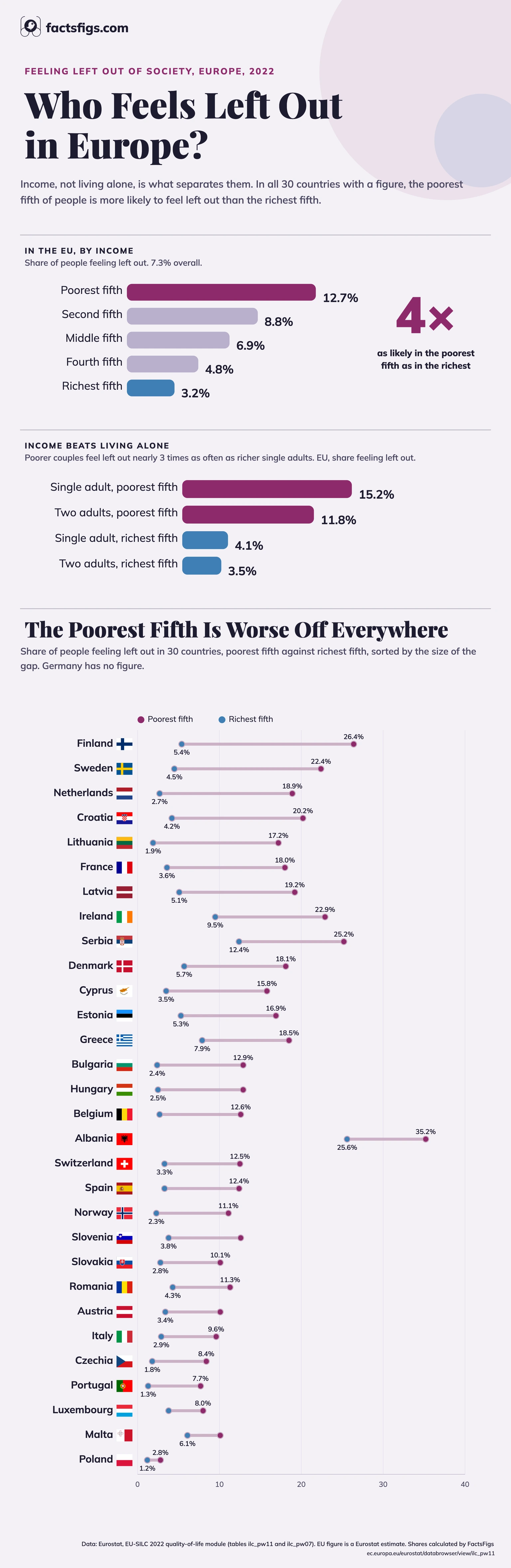
In 2022 about 7.3% of people in the EU said they felt left out of society, but the share was 12.7% in the poorest income fifth and 3.2% in the richest. The poorest fifth was worse off in all 30 countries with a figure, and also less likely to have someone to rely on in all 31 with data. Single adults feel left out more often than couples (10.4% against 6.8%), but income explains more: couples in the poorest fifth (11.8%) feel it nearly three times as often as single adults in the richest (4.1%).
The figures show who reports feeling left out. They do not say why, and they are not a measure of loneliness.
Continue reading below for the full detailed article →
Overview
The figures come from Eurostat, the European Union's statistics office, and its 2022 quality-of-life survey of people aged 16 and over, part of the EU-SILC income and living conditions survey. Eurostat's table is titled "persons feeling left out from society" and gives the share of people who do. The survey also asks whether a person has someone to rely on in case of need, which Eurostat describes as being able to ask family, relatives, friends or neighbours for moral, material or financial help. We split both by income fifth, which divides people in each country into five equal groups by household income, and by household type. The EU figures are Eurostat estimates. The 2022 survey did not give a figure for Germany on feeling left out. These are answers to survey questions, not a count of lonely people, and they are not the same thing as loneliness.
How much more often the poorest fifth feel left out, and why living alone is not the cause.
13%
In the EU in 2022, against 3.2% in the richest fifth, four times as often.
100%
The poorest fifth is more likely to feel left out in every country with a figure, from Finland (26.4% against 5.4%) to Poland (2.8% against 1.2%).
12%
Couples in the poorest fifth feel left out at 11.8%, single adults in the richest at 4.1%.
The short answer
People on low incomes. In the EU in 2022, 12.7% of people in the poorest fifth said they felt left out of society, against 8.8% in the second fifth, 6.9% in the middle, 4.8% in the fourth and 3.2% in the richest. That is four times as often at the bottom as at the top, and the step down is steady across the five groups. Overall, 7.3% of people in the EU feel left out.
The pattern holds in every country with a figure. Of 30 countries, including four outside the EU (Albania, Norway, Serbia and Switzerland), the poorest fifth is more likely to feel left out than the richest fifth in all 30. Germany has no figure for feeling left out.
Country by country
It varies, but never reverses. The widest gaps are in Finland (26.4% of the poorest fifth against 5.4% of the richest), Sweden (22.4% against 4.5%) and the Netherlands (18.9% against 2.7%). The narrowest are in Poland (2.8% against 1.2%), Malta (10.1% against 6.1%) and Luxembourg (8.0% against 3.8%). The median gap is about 10 points.
Compare the gap inside a country, not one country with another. Overall, Ireland (17.2%) and Finland (15.1%) report much more feeling left out than Czechia (4.2%) or Poland (1.7%), which may reflect how people in different countries answer rather than how isolated they are. The ranking of countries is therefore not shown.
Living alone
A little, but income counts for much more. In the EU, 10.4% of single adults feel left out against 6.8% of households with two adults. Yet two-adult households in the poorest fifth feel left out at 11.8%, nearly three times the 4.1% of single adults in the richest fifth. Single adults in the poorest fifth are the most likely of all, at 15.2%.
Where people live matters even less: 7.5% in cities, 7.4% in towns and suburbs and 7.0% in rural areas. Education follows income: 10.7% among people with lower secondary education or less, 6.7% with upper secondary and 4.8% with a degree.
Someone to rely on
Less often. In the EU in 2022, 84.1% of people in the poorest fifth said they had someone to rely on in case of need, rising by income to 92.8% in the richest fifth. The poorest fifth is less likely to have someone in all 31 countries with data.
Living alone makes no difference to this: 88.4% of single adults have someone to rely on, 88.5% of two-adult households and 87.9% of households with three or more adults. By age the share is lowest at 50 to 64 (87.4%) and highest at 16 to 24 (91.1%).
Age
Only the oldest. Among people aged 75 and over 9.0% feel left out, against 6.4% at 16 to 24 and between 6.8% and 7.6% in the age groups in between. Women (7.5%) and men (7.0%) are close.
What the data leaves out
We cannot say why poorer people feel more left out, and this is not the same as loneliness: it is how people answered one survey question. We have not been able to read the exact wording of the question or its answer scale, so we describe it only as Eurostat's table does.
Eurostat's own article says the share of people without someone to rely on rose from 7.7% in 2018 to 11.2% in 2022 across the EU. Most of that comes from two countries. In Romania the share with someone fell from 81.7% to 70.7%, and in Germany from 92.4% to 79.7%. Germany's survey was folded into a redesigned large household survey, the microcensus, in 2020, which Eurostat and the German statistics office describe as a break in the time series, and we found no explanation for Romania. Without the two, we estimate the EU share barely moved, from about 92.8% to 91.3%. We therefore do not report a trend.
30 countries, 2022
Every country with a figure, sorted by the size of the gap in feeling left out, with the share of the poorest and richest income fifth who feel left out and who have someone to rely on.
| EU27 (Eurostat estimate) | 12.7 | 3.2 | 9.5 | 84.1 | 92.8 |
| 🇫🇮 Finland | 26.4 | 5.4 | 21.0 | 94.8 | 98.3 |
| 🇸🇪 Sweden | 22.4 | 4.5 | 17.9 | 93.6 | 98.0 |
| 🇳🇱 Netherlands | 18.9 | 2.7 | 16.2 | 92.1 | 97.4 |
| 🇭🇷 Croatia | 20.2 | 4.2 | 16.0 | 88.4 | 94.0 |
| 🇱🇹 Lithuania | 17.2 | 1.9 | 15.3 | 93.4 | 98.3 |
| 🇫🇷 France | 18.0 | 3.6 | 14.4 | 84.0 | 95.1 |
| 🇱🇻 Latvia | 19.2 | 5.1 | 14.1 | 81.0 | 93.1 |
| 🇮🇪 Ireland | 22.9 | 9.5 | 13.4 | 91.0 | 97.1 |
| 🇷🇸 Serbia | 25.2 | 12.4 | 12.8 | 80.9 | 94.7 |
| 🇩🇰 Denmark | 18.1 | 5.7 | 12.4 | 93.2 | 96.6 |
| 🇨🇾 Cyprus | 15.8 | 3.5 | 12.3 | 92.9 | 98.0 |
| 🇪🇪 Estonia | 16.9 | 5.3 | 11.6 | 85.2 | 94.1 |
| 🇬🇷 Greece | 18.5 | 7.9 | 10.6 | 85.0 | 92.3 |
| 🇧🇬 Bulgaria | 12.9 | 2.4 | 10.5 | 93.0 | 96.9 |
| 🇭🇺 Hungary | 12.9 | 2.5 | 10.4 | 90.8 | 96.4 |
| 🇧🇪 Belgium | 12.6 | 2.7 | 9.9 | 86.9 | 98.5 |
| 🇦🇱 Albania | 35.2 | 25.6 | 9.6 | 73.4 | 95.5 |
| 🇨🇭 Switzerland | 12.5 | 3.3 | 9.2 | 93.7 | 98.6 |
| 🇪🇸 Spain | 12.4 | 3.3 | 9.1 | 88.4 | 96.6 |
Showing 1-20 of 31
Percentages of people aged 16 and over, 2022. Gap is the poorest fifth minus the richest fifth, in percentage points. The EU row is a Eurostat estimate. Germany has no figure for feeling left out. Albania, Norway, Serbia and Switzerland are not EU members.
How this was built
We took Eurostat's EU-SILC 2022 tables on feeling left out (ilc_pw11) and having someone to rely on (ilc_pw07), each split by income fifth, household type and degree of urbanisation, and the age and education versions (ilc_pw10 and ilc_pw06). The first chart is the EU aggregate by income fifth, the second crosses household type with the poorest and richest fifth, and the dumbbell chart compares the poorest and richest fifth in every country that has both figures. Eurostat flags the EU aggregate as an estimate.
Our World in Data published a data insight on loneliness on 26 November 2026 using Gallup World Poll data, which shows the same direction worldwide. That data is not available to reuse, so this page uses Eurostat's open figures only and does not repeat Gallup's.
Eurostat, EU-SILC 2022 quality-of-life module: persons feeling left out from society (ilc_pw11) Eurostat, EU-SILC: persons having someone to rely on in case of need (ilc_pw07) Eurostat Statistics Explained: Quality of life indicators, social interactions
The data behind this story comes from Eurostat, which publishes the EU-SILC survey results on income and living conditions that national statistical offices collect. Full credit for collecting and maintaining the data goes to Eurostat and the national offices. This page is not endorsed by Eurostat or the European Union.
FactsFigs reviews, cleans, and cross-checks every source dataset before shaping it into a data story. Each visualization is created and designed in FactsFigs Design Studio, an internal tool developed and owned by FactsFigs, and is the original work of a FactsFigs author, not an AI-generated copy of any existing graphic. Individual assets within a visual may or may not be produced with AI tools, but the design of the visual itself is solely FactsFigs' own.
Figures are estimates at the time of publication, provided for information only. Nothing here is financial advice or a guarantee of accuracy.
Last verified: 26 Nov 2026
Related Publications
Women lead in higher-education enrolment in 124 of 148 UN member states, and worldwide 46.5% against 40.9%. Men still lead in 24, mostly where few people enrol.
24 Nov 2026
Electricity use per person in Asia rose 2.9 times from 2000 to 2024, while the rest of the world's fell 10.5%. China grew 6.7 times and Japan's fell.
22 Nov 2026
About 2.1 billion people lacked safely managed drinking water in 2024, and ten countries hold 1.3 billion of them. India has the most, at 342 million.
20 Nov 2026
Organic farming does less harm on the same land, but for the same amount of food only pesticide harm clearly favours it, and it needs 64% more land.
18 Nov 2026