Chargers Record: 66 Seasons on .500, Then a 1-8 Start

By Saif Ur Rahman Published 17 Nov 2026 Updated 17 Nov 2026
Sports World 4 views
FactsFigs
0 shares

TL;DR: How Far Has the Chargers' Record Strayed From .500?

Fifty years on the line, and a 1-8 start in 2026

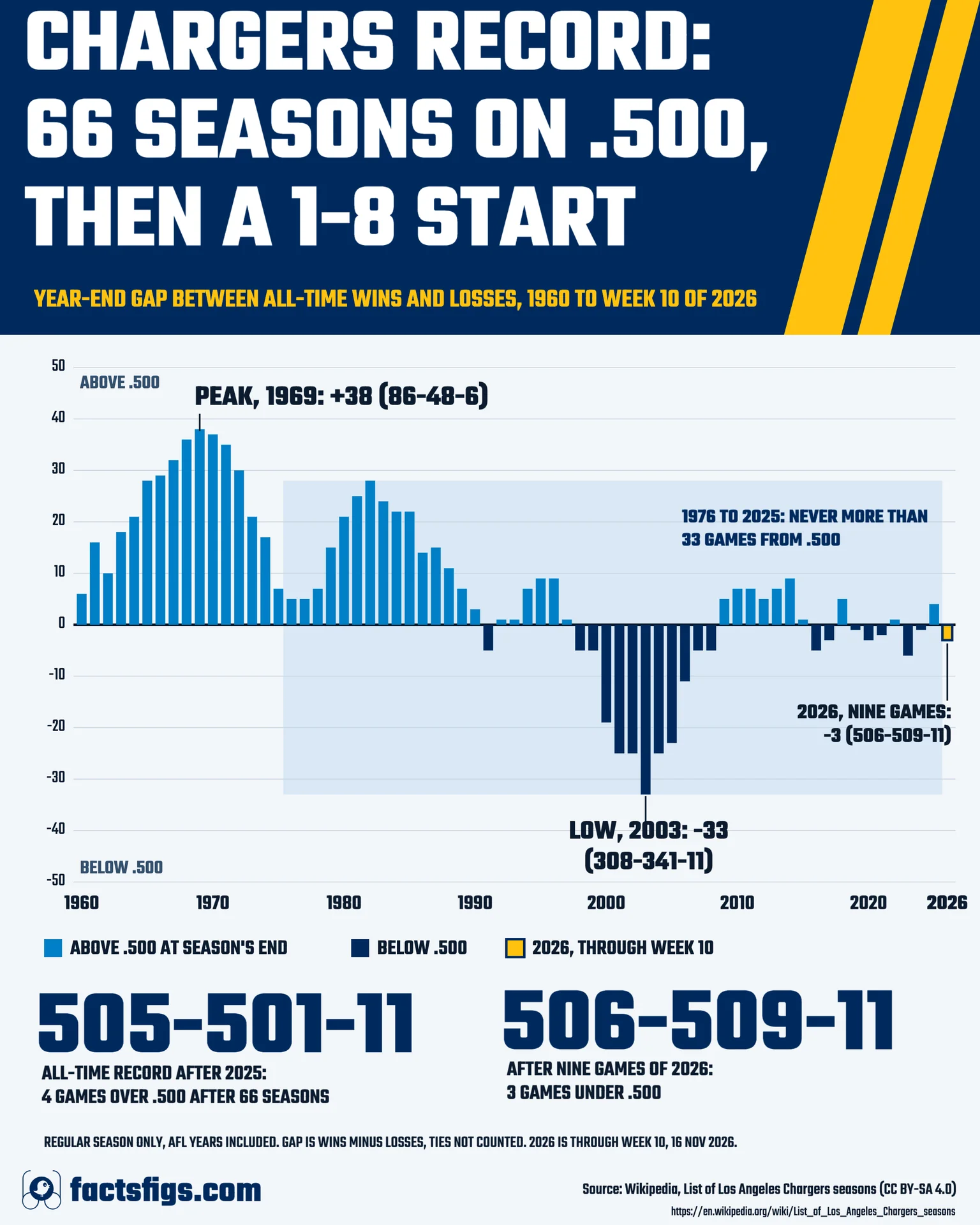
The Los Angeles Chargers ended 2025 with an all-time regular-season record of 505-501-11 after 66 seasons, four games over .500. At the end of every season since 1976 the gap between their wins and losses has stayed between 33 games under (2003) and 28 over (1982). A 1-8 start to 2026, through Week 10, makes the record 506-509-11, three games under .500. It is the seventh time the franchise has crossed the line since 2015. Only regular-season games are counted, and the AFL years are included.

! What the Data Shows:

  • •
    Never Far From .500: Between 33 games under and 28 over since 1976.
  • •
    A Peak in the AFL Years: +38 in 1969, at 86-48-6.
  • •
    1-8 Pushes It Under: 506-509-11 after nine games of 2026.

? Key Numbers:

  • •
    Record After 2025: 505-501-11, four games over
  • •
    Record After Week 10, 2026: 506-509-11, three games under
  • •
    2026 Points Per Game: 16.0 scored, 26.6 allowed
  • •
    Wins Needed to Recover: 6 of the last 8 games

Three games under .500 is not a deep hole for a franchise that has lived within 33 games of the line for fifty years, and 2025 climbed out of a smaller one with an 11-6 record. What makes 2026 unusual is not the gap. It is how fast it opened: eight losses in nine games.

Continue reading below for the full detailed article →

Overview

A Record Told Across 66 Seasons, Not One

The Chargers record is usually told one season at a time. Add the seasons up and a different picture appears: a franchise that has stayed close to .500 for half a century. This post tracks the gap between the Chargers' all-time wins and losses at the end of every season from 1960 to 2025, then adds the first nine games of 2026. The question is how far the franchise has ever strayed from even, and what a 1-8 start does to a line that has barely moved.

Three Numbers Behind the Chargers Record

The peak, the low point and the current gap show how narrow the franchise range is and where 2026 sits inside it.

38: The Peak Over .500, in 1969

38 games

The Chargers' all-time gap between wins and losses peaked at plus 38 after the 1969 season, when the franchise stood at 86-48-6 from its AFL years. It fell through the 1970s to plus 5 in 1976 and has not come within nine games of that peak since. The highest since is plus 28, in 1982.

33: The Low Point Under .500, in 2003

33 games

The low point came after the 2003 season, when the Chargers stood at 308-341-11, 33 games under .500. The franchise had finished below .500 at each of the 11 season ends from 1998 to 2008, and 2009 brought the first year-end back above the line, at plus 5, on a 375-370-11 record.

3: Under .500 Now, After Nine Games

3 games

After nine games of 2026 the Chargers are 1-8, which puts the all-time record at 506-509-11, three games under .500 and lower than any season end since 2023, which finished at minus 6. They have scored 144 points and allowed 239, which a formula for expected wins turns into about 2.1 wins, against 1.

The 2026 Season by the Numbers

  • 1-8 Record to Week 10 The first win came on 16 November, 23-20 at Baltimore.
  • -95 Point Differential 144 points scored and 239 allowed in nine games.
  • 8 Games Left Weeks 11 to 18, with the Jets at home on 22 November.

The Long Run

The Record Has Sat on .500 for Fifty Years

The Chargers played 1960 in Los Angeles, moved to San Diego for 1961 and returned to the Los Angeles area in 2017. Counting the AFL years, the franchise began 86-48-6 through 1969, a gap of plus 38 games. The 1970s took most of it back: plus 17 in 1974, plus 7 in 1975 and plus 5 in 1976.

From 1976 on, the gap at every season's end has stayed between minus 33 and plus 28. The high was plus 28 after 1982, at 171-143-11, and the low was minus 33 after 2003, at 308-341-11. The franchise has finished below .500 at 19 of its 66 season ends: 1991, 1998 to 2008, 2016, 2017, 2019 to 2021, 2023 and 2024.

The year-end record has never shown more than 33 games of daylight in either direction across the last fifty years. That is a narrow channel for a team that has had a 14-2 season, in 2006, and a 1-15 one, in 2000.

The Recent Pattern

A Franchise That Keeps Crossing the Line

Since 2015 the sign of the all-time gap has changed six times between one season end and the next: below .500 in 2016 and 2017, above in 2018, below from 2019 to 2021, above in 2022, below in 2023 and 2024 and above again in 2025. No other ten-year stretch in the franchise's history has flipped as often.

The 2025 finish was 505-501-11, four games over. Two 11-6 seasons did the work, each moving the gap by five games: from minus 6 after 2023 to minus 1 after 2024, then to plus 4 after 2025. When the record sits just under the line, one good year has been enough to cross it.

The 2026 Start

What a 1-8 Start Does to the Record

Eight losses and one win turn plus 4 into minus 3. The Chargers lost to Arizona 26-14, Las Vegas 26-14, Buffalo 24-16, Seattle 30-23, Denver 23-17, Kansas City 22-6, the Rams 24-9 and Houston 44-22, then won 23-20 at Baltimore on Monday 16 November for their first victory. Wikipedia's season page says the 0-8 start was the franchise's worst since 2000.

The scores say the team is not just unlucky. It has scored 16.0 points a game and allowed 26.6, a differential of minus 10.6, against plus 5.9 in 2024 and plus 1.6 in 2025. A standard formula that estimates wins from points scored and allowed puts those 144 and 239 points at about 2.1 wins in nine games, so luck explains roughly one win.

The detail is lopsided in the same direction. The Chargers scored 17 or fewer in 6 of 9 games, allowed 24 or more in 6, lost three games by 14 or more and went 1-3 in games decided by 8 points or fewer. In the AFC West, the Chiefs and Broncos are 7-2 and the Raiders 4-6, according to ESPN.

The Way Back

Six Wins in Eight Games Restore the Line

Eight games remain, Weeks 11 to 18. The gap changes by the number of wins minus the number of losses, so without a tie it moves in even steps from minus 3 and cannot land exactly on zero. A 6-2 finish would make the season 7-10 and the all-time record 512-511-11, one game over .500. A 5-3 finish would leave it at 511-512-11, one game under.

That bar is high for this team, which is 1-8, but it is not an unfamiliar one. In 2024 the Chargers went from 5-12 to 11-6, which moved the gap from minus 6 to minus 1, and in 2025 another 11-6 year carried it from minus 1 to plus 4. The franchise record responds to one good season.

The Limits

What the Gap Cannot Show

The gap counts wins minus losses and ignores ties, which count as half a win and half a loss in the NFL's own percentages. Seasons are different lengths: 14 games through 1977, 16 from 1978 to 2020, 17 since, with 9 in the strike year of 1982 and 15 in 1987. A cumulative line also moves slowly by design, so it says little about how a single season felt.

It does not explain the 1-8 start either. The scores show weak scoring and weak defense together, but reasons such as injuries, play-calling and a change of offensive coordinator were not checked and are not claimed here. One source error is also worth knowing: Wikipedia's all-time NFL table lists the Chargers at 505-517-11, which is wrong. This post uses the season-by-season list, which sums to 505-501-11 in 1,017 games.

The Verdict

Three Games Under Is a Hole One Year Can Fill

The Chargers record has spent fifty years inside a band of 61 games, and a 1-8 start has moved it three games under .500. By the franchise's own history, that is shallow. The low was 33 games under, and the record crossed .500 six times in the last ten season ends.

What has changed is the pace. It took the franchise the first nine games of a season to give back seven games of the gap. If the Chargers finish 6-2, the line is back above .500 by a game. If they do not, 2026 will end as the 20th season end below it.

The Full Data Table

Chargers Record by Season, 1960 to Week 10 of 2026

Every season of the franchise's regular-season record, with the running all-time record and the gap between wins and losses after it. 2026 runs through Week 10, played 16 November 2026.

196010-410-4-0+6.714
196112-222-6-0+16.786
19624-1026-16-0+10.619
196311-337-19-0+18.661
19648-5-145-24-1+21.650
19659-2-354-26-4+28.667
19667-6-161-32-5+29.648
19678-5-169-37-6+32.643
19689-578-42-6+36.643
19698-686-48-6+38.636
19705-6-391-54-9+37.620
19716-897-62-9+35.604
19724-9-1101-71-10+30.582
19732-11-1103-82-11+21.554
19745-9108-91-11+17.540
19752-12110-103-11+7.516
19766-8116-111-11+5.510
19777-7123-118-11+5.510
19789-7132-125-11+7.513
197912-4144-129-11+15.526

Showing 1-20 of 67

Page 1 of 4

Season record is wins-losses, with ties added when there were any. All-time win % counts ties as half a win. AFL seasons (1960 to 1969) are included. The 2026 row is nine games.

Data Source and Attribution

Wikipedia: List of Los Angeles Chargers seasons ESPN: Chargers 2026 schedule

The data behind this story comes from Wikipedia's List of Los Angeles Chargers seasons, read on 17 November 2026, with the 2026 results taken from Wikipedia's 2026 season page and checked against ESPN's schedule and standings. The dataset is available under CC BY-SA 4.0, and full credit for collecting and maintaining the underlying records goes to Wikipedia's contributors. The running totals, gaps, points per game and expected wins are FactsFigs calculations.

FactsFigs reviews, cleans, and cross-checks every source dataset before shaping it into a data story. Each visualization is created and designed in FactsFigs Design Studio - an internal tool developed and owned by FactsFigs - and is the original work of a FactsFigs author, not an AI-generated copy of any existing graphic. Individual assets within a visual may or may not be produced with AI tools, but the design of the visual itself is solely FactsFigs' own.

Figures are estimates at the time of publication, provided for information only - nothing here is financial advice or a guarantee of accuracy.

Last verified: 17 Nov 2026

The charts in this article were built with our own publishing system. See what it does →