TL;DR: Did the UFC's Finish Bonus Change How Fights End?
Three flat months, then a jump that has since eased
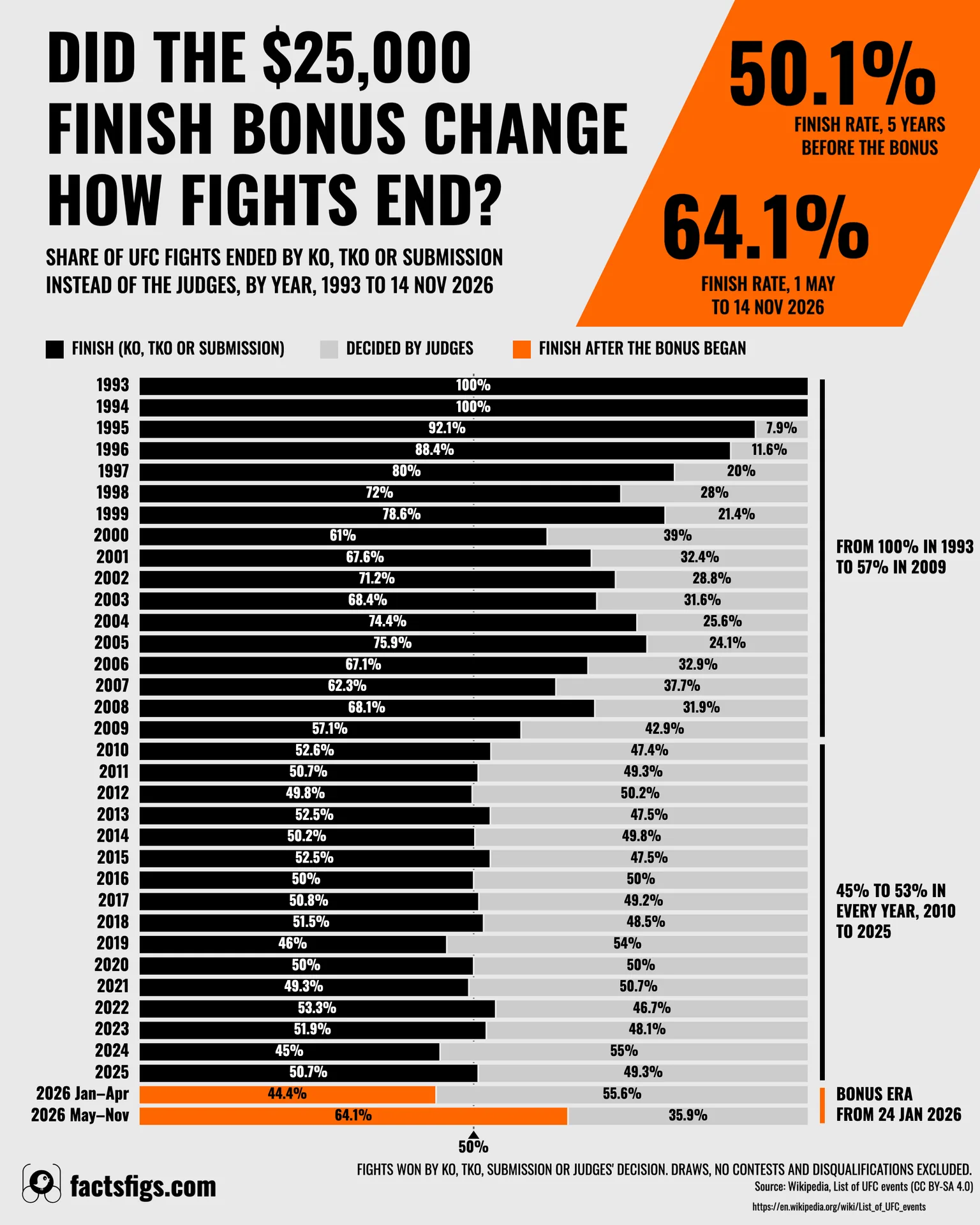
On 24 January 2026 the UFC began paying $25,000 to every fighter who records a finish without winning one of the larger bonuses. In the five years before that, 50.1% of decided UFC fights ended in a KO, TKO or submission. From 24 January to 30 April the rate was 44.4%. From 1 May to 14 November it was 64.1%, across 337 fights on 27 cards.
The rise is too large to be chance, but the data shows timing, not cause. The last four cards, from 24 October to 14 November, finished 48.1% of their fights.
Only fights with a winner are counted, called decided fights here: won by KO, TKO or submission (a finish) or by the judges' decision. Draws, no contests and disqualifications are left out.
! What the Data Shows:
•
The Rise Came Late:Three months at 44.4%, then 64.1% from 1 May.
•
Knockouts Drove It:KO and TKO share rose from 32.4% to 44.5%; submissions barely moved.
•
The Last Four Cards Slipped:48.1% from 24 October to 14 November, on 52 fights.
? Key Numbers:
•
Five-Year Baseline:50.1% of 2,503 fights
•
24 Jan to 30 Apr 2026:44.4% of 162 fights
•
1 May to 14 Nov 2026:64.1% of 337 fights
•
Every Year, 2010 to 2025:Between 45.0% and 53.3%
For sixteen years the finish rate stayed inside a band about eight points wide, and in 2026 it left that band. A bonus changes what fighters are paid for, so it is the obvious suspect. The numbers show when the rate moved and by how much, and they also show it moving back, so the cause is still open.
Continue reading below for the full detailed article →
Overview
A Bonus Is a Rule Change You Can Date
Most changes in how fights end have no start date: judging habits drift, divisions fill up and styles spread. A pay rule does. At UFC 324 on 24 January 2026 the UFC began paying $25,000 to every fighter who records a finish without winning one of the $100,000 awards. That gives a clean question: did the share of fights ending in a finish, a KO, TKO or submission rather than a judges' decision, change afterwards? This post counts every decided UFC fight since the first card in 1993, 8,902 fights on 798 cards, and sets 2026 against what came before. The answer is a rise that arrived in May, not in January.
Three Numbers That Frame the Bonus Question
The new rate, the old rate and the latest four cards show how large the change is and how little time has passed.
64.1%: Finish Rate Since 1 May
64.1%
From 1 May to 14 November 2026, 216 of 337 decided UFC fights ended in a KO, TKO or submission, across 27 cards. That is 14.0 points above the five-year baseline and above every full year from 2009 to 2025, the highest of which was 57.1% in 2009. Next Fight's count, on a different cut, reported 66.3% from May.
50.1%: The Five-Year Baseline
50.1%
Between 24 January 2021 and 23 January 2026, 1,255 of 2,503 decided fights ended in a finish, across 210 cards. The 95% interval runs from 48.2% to 52.1%. Knockouts made up 32.4% of fights and submissions 17.7%. Every full year from 2010 to 2025 landed between 45.0% and 53.3%, so the baseline is steady.
48.1%: The Last Four Cards
48.1%
UFC 333 on 24 October, the 31 October and 7 November cards and UFC 334 on 14 November produced 25 finishes in 52 decided fights. That is a small sample, and four cards can land well away from the true rate, so it does not prove the rise is over. It does show the 64.1% period was not uniform.
The May to November Cards by the Numbers
337 Fights Counted27 cards from 1 May to 14 Nov 2026.
14.0 Points Above Baseline64.1% against 50.1%.
56.0% Ended in Round 1Share of finishes in round 1, up from 48.5%.
The Rule Change
What the UFC Changed on 24 January
ESPN reported on 24 January 2026 that the UFC was doubling its fight night bonuses to $100,000 and adding a $25,000 bonus for every athlete who records a finish but does not win one of the $100,000 awards. The new structure took effect at UFC 324 in Las Vegas, and ESPN tied the change to the promotion's seven-year, $7.7 billion U.S. broadcast deal with Paramount Skydance.
Cageside Press added a detail ESPN did not carry. After UFC 324, Dana White told reporters that the locker-room bonuses, checks of $5,000 to $25,000 that went to fighters on a card depending on how they fought, were going away and that finishes would now earn $25,000. A fighter who misses weight is not eligible for the finish award. The old checks were discretionary and the new one pays for one outcome, ending the fight.
Neither report gives a total bonus pool, and ESPN notes that the UFC decides all bonus winners internally at each event, so nobody outside the company can say how many $25,000 checks were paid. This post treats the change as a shift in what gets rewarded, not as a pay rise.
The Long Run
How Fights Went From 100% Finishes to 50%
The first UFC card, in November 1993, produced eight decided fights and eight finishes. Through the 1990s the finish rate stayed between 72% and 100% in every year, and from 2000 to 2005 it held between 61% and 76%. The early samples are small and noisy: 1993 has 8 fights and 1994 has 31, so one result moves the percentage by several points.
The slide came while the sport grew. The count of cards a year rose from 6 in 1999 to 19 in 2008, 31 in 2012 and 46 in 2014, and the finish rate fell from 68.1% in 2008 to 57.1% in 2009 and 52.6% in 2010. From 2010 to 2025 every full year landed between 45.0% (2024) and 53.3% (2022). This data does not say why it fell.
That makes 2010 to 2025 the right yardstick for a rule change: a band about eight points wide that held for sixteen years with no year outside it. The five-year window used for the comparison, 24 January 2021 to 23 January 2026, finished 50.1% of 2,503 decided fights, with a 95% interval of 48.2% to 52.1%.
The Break
Three Months of Nothing, Then a Jump
From 24 January to 30 April 2026, 13 cards produced 72 finishes in 162 decided fights, a 44.4% rate. That is below the baseline but not by enough to count: the 95% interval, 37.0% to 52.1%, still contains 50.1%. The first six cards of 2026, a cut some outlets quoted, finished 31 of 75 fights, or 41.3%. If the bonus changed behaviour, the first three months did not show it.
From 1 May to 14 November, 27 cards produced 216 finishes in 337 decided fights, a 64.1% rate with a 95% interval of 58.8% to 69.0%. In a two-proportion test that sits 4.8 standard errors above the baseline and 4.2 above the January to April stretch, far outside what chance usually produces. Next Fight's count on its own cut, 43.7% before May and 66.3% after, tells the same story.
The spread from card to card was wide. Nine of the 27 cards from May finished 75% or more of their fights, topped by Buckley vs. Malott on 17 October at 92%. Of the 13 earlier cards one reached 75%, Adesanya vs. Pyfer on 28 March, and the 25 April card finished only 15%. Even after May, the 12 September card finished 31%.
The Mix of Finishes
The Extra Finishes Were Mostly Knockouts
Knockouts and TKOs went from 32.4% of decided fights in the baseline (811 of 2,503) to 44.5% from May (150 of 337), a gain of 12.1 points. Submissions went from 17.7% (444 fights) to 19.6% (66 fights), a gain of 1.9 points. Knockouts account for about 86% of the 14.0-point rise in the finish rate.
Fights also ended sooner. The median finish came 4:31 into the fight from May, against 5:28 in the baseline, and 56.0% of finishes happened in round 1, against 48.5%. The median is elapsed fight time, with each earlier round counted as a full five minutes.
The Checks
What Does Not Explain the Jump
A different mix of weight classes could raise the rate if heavier divisions took more of the card, because heavyweight and light heavyweight fights finish more often than women's strawweight bouts. They did not. Applying each division's own baseline rate to the May to November mix predicts 51.0%, against 64.1% observed.
One card was unusual. UFC Freedom 250, held at the White House on 14 June, had only 7 decided fights, and all seven were finishes. Without it the May to November rate is 63.3% (330 fights), so the jump does not rest on one event.
It is not a summer effect either. From 2021 to 2025 the May to October months finished between 41.7% (June) and 53.7% (September) of their fights. In 2026 the same months ran from 54.0% (September) to 73.4% (August), and every month except September was above 60%.
The Latest Cards
The Last Four Cards Fell Back to 48%
The four most recent cards, UFC 333 on 24 October, the Fight Nights of 31 October and 7 November and UFC 334 on 14 November, produced 25 finishes in 52 decided fights, or 48.1%. That is back inside the old range. It is also only 52 fights, and the three cards before them finished 79%, 82% and 92% of theirs, the highest run of the year.
The fair reading is that the rate rose, stayed high through mid-October and has since eased. A fade and a blip cannot be told apart yet. Another two months of cards would settle it.
The Limits
What This Comparison Cannot Show
The data shows when finishing rose and by how much. It does not show why. The bonus began on 24 January but the rise began in May, a gap of about three months that the bonus alone does not explain. Matchmaking, which fighters were booked, referee instructions and how cards were built could all have moved in 2026, and none of them was tested here.
As far as the public reports go, the bonus is also a swap rather than extra money: the locker-room checks ended and a payment for finishing took their place. Fighters who read it that way have a reason to go for the finish, which fits a knockout-led rise, but this post cannot see their motives. A comparison with promotions that did not change their pay would be stronger evidence. Next Fight says other promotions stayed flat, a claim this post has not checked.
Two smaller limits. Draws, no contests and disqualifications are left out, and four The Ultimate Fighter finale cards from 2007 to 2010 have no listed results on Wikipedia and are missing. The early years also rest on few fights: 8 in 1993 and 31 in 1994.
The Verdict
A Real Jump, With the Cause Still Open
After sixteen years inside a band about eight points wide, the UFC finish rate left it in May 2026 and reached 64.1%, with knockouts supplying most of the gain. The $25,000 finish bonus is the obvious suspect and it came first, but the three-month gap, the easing over the last four cards and the lack of a comparison group keep it a suspect, not a verdict.
More cards will settle it. If the rate returns to about 50% through the first months of 2027, 2026 will look like a stretch rather than a change. If it stays in the 60s, the bonus gains weight.
The Full Data Table
UFC Finish Rate by Year, 1993 to 14 November 2026
Every decided UFC fight since the first card, grouped by calendar year, with 2026 split at the 24 January bonus start. Decided means won by KO, TKO, submission or the judges' decision. The last row is the five-year baseline used in the post.
Finish rate is KO/TKO plus submission. Draws, no contests and disqualifications are excluded. The 95% range is a Wilson interval. Cards counts only cards with at least one decided fight. Rates are FactsFigs calculations from Wikipedia fight results.
The data behind this story comes from Wikipedia's List of UFC events and the 798 event pages it links to, read on 15 November 2026. The dataset is available under CC BY-SA 4.0, and full credit for collecting and maintaining the underlying fight results goes to Wikipedia's contributors. The bonus rules come from ESPN's report of 24 January 2026 and Cageside Press's report of 25 January 2026. The rates and intervals are FactsFigs calculations.
FactsFigs reviews, cleans, and cross-checks every source dataset before shaping it into a data story. Each visualization is created and designed in FactsFigs Design Studio - an internal tool developed and owned by FactsFigs - and is the original work of a FactsFigs author, not an AI-generated copy of any existing graphic. Individual assets within a visual may or may not be produced with AI tools, but the design of the visual itself is solely FactsFigs' own.
Figures are estimates at the time of publication, provided for information only - nothing here is financial advice or a guarantee of accuracy.
Last verified: 15 Nov 2026
The charts in this article were built with our own publishing system. See what it does →