Do Transfer Fees Actually Predict Success? Soccer

By Saif Ur Rahman Published 15 Aug 2026 Updated 15 Aug 2026

TL;DR — Do Transfer Fees Actually Predict Success?

A weak link, one spectacular reversal, and two record fees that still haven't won the big one

Twenty-five years of record-breaking transfers show fee size and trophy count are only weakly related. Across the 12 deals old enough to judge fairly, spending 63% more bought clubs about 6% more silverware on average. The sport's two most expensive transfers ever, Neymar and Mbappé at PSG, still haven't delivered the Champions League title both moves were built around.

! What the Data Actually Shows:

  • The Popular Belief: Record fees get read as guaranteed success — pay more, win more, case closed.
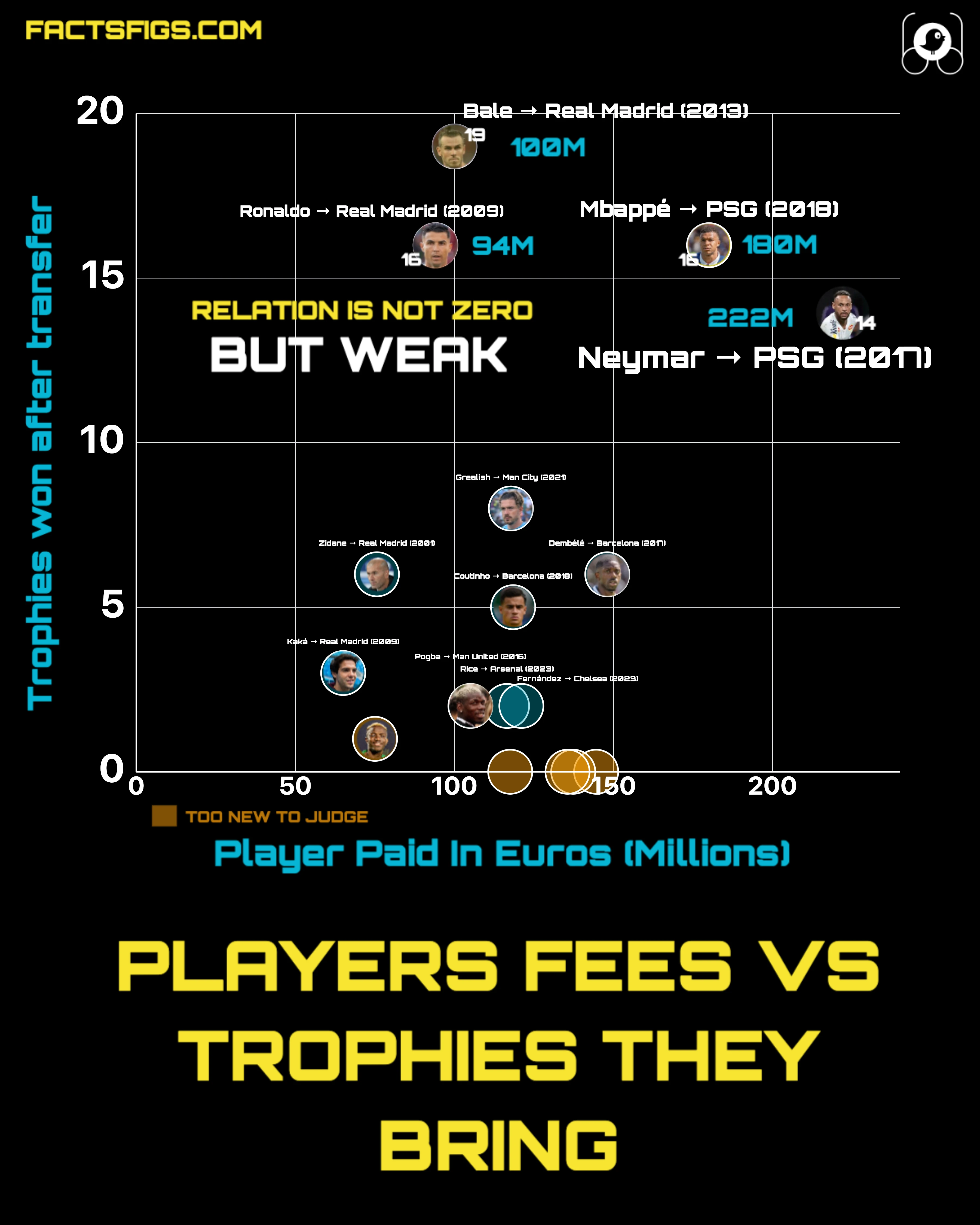
  • What the Correlation Actually Is: Across 12 transfers with at least three full seasons at the buying club, fee and trophy count correlate at only r ≈ 0.36 — weak and positive, not proof of cause and effect.
  • The Sharpest Reversal: Ousmane Dembélé was written off as a flop after his €148M-with-add-ons move to Barcelona, then won the 2025 Ballon d'Or a year after leaving for roughly a third of that fee at PSG.
  • Five Deals Too New to Judge: Isak, Wirtz, Rogers, and Anderson (2025-26) and Osimhen (2025) haven't completed a full season yet — their trophy tallies aren't real evidence either way.

? The Numbers Behind the Myth:

  • Sample Size: 12 of 17 record transfers (2001-2023), restricted to ≥ 3 full seasons at the buying club
  • Correlation Coefficient: r ≈ 0.36 (weak positive)
  • Spend Gap vs. Trophy Gap: 63% more spend bought about 6% more trophies, on average
  • World Record Fee: €222M — Neymar to PSG, 2017, still unbeaten nine years later

Money buys talent, not a guaranteed trophy. The data shows a weak positive relationship at best — clubs that spend dramatically more win only marginally more, and the two most expensive transfers in football history still haven't landed the trophy they were bought to win.

Continue reading below for the full detailed article →

Overview

Why Bigger Fees Don't Guarantee Bigger Trophy Hauls

Since Zinedine Zidane's world-record €75.6M move from Juventus to Real Madrid in 2001, football's transfer market has treated the record fee as a promise: pay enough, and the trophies follow. Twenty-five years and sixteen more nine-figure deals later — from Cristiano Ronaldo's €94M switch in 2009 to Morgan Rogers' €137.3M move to Chelsea in 2026 — that promise has rarely been tested against the actual results. This story checks it directly, tracking all 17 of football's most expensive transfers since 2001 against the trophies each player delivered at their new club. Restricting the analysis to the 12 deals old enough to judge fairly, at least three full seasons of tenure, the fee-to-trophy correlation comes out weak and positive: r ≈ 0.36, nowhere near strong enough to call spending a reliable predictor. Ousmane Dembélé's arc makes the case hardest to ignore — written off as a flop after his €148M-with-add-ons move to Barcelona, he won the 2025 Ballon d'Or a year after leaving for a fraction of that fee. Meanwhile Neymar and Mbappé, the two biggest fees in the sport's history, still haven't won PSG the one trophy both moves were built around.

The Three Numbers That Test the Transfer-Fee Myth

Every record transfer gets read as a trophy guarantee, but the record itself says otherwise. Across the 12 deals old enough to judge fairly, fee size and trophy count move together only weakly. Spending far more bought only a little more silverware on average, and the two biggest fees ever paid still haven't won the one trophy they were signed to deliver. These three numbers are the ones that actually decide whether the myth holds.

Weak Positive Correlation · r ≈ 0.36

0.36

Across the 12 record-fee transfers with at least three full seasons at their buying club, fee and trophy count move together only weakly — a Pearson correlation of roughly 0.36 on a scale where 1.0 would mean a perfect link and 0 would mean no relationship at all. That's a signal, not a rule: far too weak to call spending a reliable predictor of silverware.

63% More Spend, 6% More Trophies

63%

Splitting the same 12 transfers by fee shows the ceiling effect clearly. The pricier half of the group cost 63% more on average — €151.2M against €92.7M — yet averaged only 8.5 trophies to the cheaper half's 8.0, a gain of roughly 6%. Spending dramatically more bought barely half a trophy of extra return.

€222M, Still Zero Champions Leagues for PSG

222M

Neymar's 2017 move from Barcelona to PSG remains the world-record transfer fee nine years later at €222M, and Kylian Mbappé's €180M arrival a year later is still the second-biggest in history. Between them, the two most expensive transfers ever made never delivered PSG a Champions League title, the one trophy the club signed them both to win.

The Correlation Numbers That Test the Myth

  • Sample Restricted to 12 of 17 Deals 71 % Five of the 17 record transfers happened in 2025-26 and haven't completed a full season yet. Counting their near-zero trophy tallies alongside a 25-year-old deal would mechanically drag any correlation toward zero, so the fee-to-trophy analysis is restricted to the 12 transfers with at least three full seasons on the books.
  • Correlation Coefficient (r ≈ 0.36) 36 A Pearson correlation of 0.36 across the 12 established transfers is positive but weak — it explains only about 13% of the variation in trophy counts (r² ≈ 0.13), leaving the other 87% down to squad fit, injuries, and factors a fee alone can't predict.
  • Extra Spend for the Pricier Half 63 % Splitting the 12 established transfers by fee, the top-spending half cost €151.2M on average against €92.7M for the bottom half — 63% more money for the same-sized group of six players.
  • Extra Trophies for That Spend 6 % The pricier half of the sample averaged 8.5 trophies to the cheaper half's 8.0 — about 6% more silverware in exchange for 63% more money, the clearest single number against the always-pay-more logic.

25 Years of Record Fees

How the Transfer Record Climbed From €75M to €222M

A football stadium filled with fans under floodlights at night.

Zinedine Zidane's €75.6M move from Juventus to Real Madrid in 2001 opened football's era of nine-figure transfer fees, a record that stood for eight years until Cristiano Ronaldo's €94M switch to the same club in 2009. The ceiling kept climbing through the 2010s — Gareth Bale's €100M arrival in 2013, Paul Pogba's €105M return to Manchester United in 2016 — before Neymar's €222M move from Barcelona to Paris Saint-Germain in 2017 reset the record by a margin no transfer has come within €40M of since. Kylian Mbappé's €180M arrival at PSG a year later remains the closest challenger. The market cooled through the early 2020s before a fresh wave of nine-figure deals hit in 2023 (Declan Rice, Enzo Fernández) and again in 2025-26, when four separate transfers — Alexander Isak, Florian Wirtz, Morgan Rogers, and Elliot Anderson — each cleared €115M inside twelve months, the tightest cluster of record-scale fees the sport has seen since Neymar and Mbappé arrived in Paris.

The Method

Why Only 12 of the 17 Transfers Count Toward the Verdict

Excluding the Deals That Haven't Had Time to Prove Anything

Five of the 17 transfers on this list happened in 2025 and 2026 — Victor Osimhen's move to Galatasaray, Alexander Isak's and Florian Wirtz's arrivals at Liverpool, and Morgan Rogers' and Elliot Anderson's moves to Chelsea and Manchester City. All five carry a trophy count of zero or one, not because the transfers failed, but because none of the buying clubs has completed a full season with the new signing yet. Counting those alongside a 25-year-old deal like Zidane's would mechanically drag any correlation toward zero regardless of quality, so this analysis isolates the 12 transfers with at least three full seasons on the books.

That narrower sample, spanning 2001 through the 2023 arrivals of Declan Rice and Enzo Fernández, still averages €121.9M in fee and 8.25 trophies won per player at their new club. Running a Pearson correlation across those 12 data points produces r ≈ 0.36 — positive, meaning bigger fees do trend toward more trophies, but weak. A correlation that size explains only about 13% of the variation in trophy counts (r² ≈ 0.13), leaving the other 87% down to factors a transfer fee alone can't predict: squad fit, injuries, managerial changes, and simple luck in cup draws.

Correlation Isn't Causation Here Either

Part of the weak positive signal likely runs backward. Clubs capable of paying €100M-plus fees — Real Madrid, Manchester City, PSG — are usually already positioned to win trophies before the signing even arrives. Gareth Bale's 19 trophies at Real Madrid reflect a club that was winning Champions Leagues in the years before and after his transfer, not proof that his fee alone bought that success. The data can show that big spenders and big winners overlap; it can't show which one caused the other.

The Sharpest Reversal

How Ousmane Dembélé Went From 'Flop' to Ballon d'Or

Barcelona · €148M All-In, and a 'Spectacular Failure' Label

Barcelona paid Borussia Dortmund a €105M base fee for Ousmane Dembélé in 2017, with performance-linked add-ons pushing the total toward roughly €148M — a fee that, at the time, trailed only Neymar's world record. Injuries defined his six seasons at the club more than goals did; press coverage repeatedly labeled the move a spectacular failure, and Barcelona's six major trophies with him on the books undersold the price tag by most reckonings.

Barcelona sold Dembélé to Paris Saint-Germain in 2023 for around €50M, a fraction of what they'd paid Dortmund six years earlier. It read, at the time, like a club cutting its losses on an expensive mistake.

PSG · The Same Player, a Different Story

Two years after that discount move, Dembélé won the 2025 Ballon d'Or, football's individual player-of-the-year award, as the on-field leader of a PSG side built around him. The same talent that Barcelona's €148M fee couldn't fully unlock became the best player in the world at a club that paid roughly a third of that price — the clearest single case in this dataset that fee size and player quality aren't the same measurement.

The Priciest Cautionary Tale

Why the Two Biggest Fees Ever Never Won PSG a Champions League

Neymar · €222M, Still the World Record Nine Years Later

Paris Saint-Germain signed Neymar from Barcelona for €222M in 2017, a fee no club has come within €40M of matching since. The move was built around one target: delivering PSG's first Champions League title. Neymar won 14 trophies in Paris, but none of them was the one the fee was spent to win.

Kylian Mbappé arrived a year later for €180M from Monaco, the second-biggest transfer fee in football history. Together the two deals cost PSG €402M — more than the annual revenue of most top-flight clubs — and Mbappé himself went on to win 16 trophies in Paris across six seasons, an even better trophy count than Neymar's.

The Trophy Arrived a Year After He Left

Mbappé left PSG for Real Madrid in 2024. The following season, 2024-25, PSG won the Champions League for the first time in the club's history — without either of the two most expensive transfers the club had ever made still on the roster. It's the single starkest data point against the idea that record fees buy the specific trophy they're aimed at.

Value for Money

Where a Smaller Fee Outperformed the Record-Breakers

Osimhen · €75M for an Immediate Title

Victor Osimhen's €75M move from Napoli to Galatasaray in 2025 is the cheapest deal on this list by a wide margin, roughly half of what Liverpool paid for Alexander Isak the same year. It's also the fastest to pay off: Osimhen fired Galatasaray to the 2024-25 Süper Lig title and won the league's Golden Boot in the same season, delivering silverware before four of the five priciest transfers in the dataset had even taken the field.

Compare that to the rest of the 2025-26 wave. Isak's €144.5M move to Liverpool, Wirtz's €117.5M arrival at the same club, Rogers' €137.3M switch to Chelsea, and Anderson's €135.5M move to Manchester City add up to roughly €535M in combined fees, and as of this writing none of the four has produced a single trophy. Liverpool, carrying both Isak and Wirtz, finished the 2025-26 season in fifth place with no silverware at all.

The Same Caveat Applies in Both Directions

Osimhen's fast start doesn't prove cheap fees are smarter any more than Isak and Wirtz's trophy-less season proves the opposite. All five of these 2025-26 deals are still inside their first year, the same window this analysis excludes from its correlation for exactly this reason: a single season, in either direction, isn't enough data to judge a transfer by.

The Full Data Table

All 17 Record Transfers, Fee vs. Trophies (2001-2026)

Every transfer FactsFigs found described as a world-record or near-record fee since Zidane's 2001 move, with the trophies each player won at the buying club through the 2025-26 season.

Zinedine Zidane2001Juventus → Real Madrid75.662002 UCL-winning volley
Cristiano Ronaldo2009Man United → Real Madrid9416Incl. 4 straight UCLs, 2014-18
Kaká2009AC Milan → Real Madrid653Injury-hit, never repeated Milan form
Gareth Bale2013Tottenham → Real Madrid100195 UCLs, yet often booed by his own fans
Paul Pogba2016Juventus → Man United1052Injury-plagued, left on a free in 2022
Neymar2017Barcelona → PSG22214Still the world record; never won PSG a UCL
Ousmane Dembélé2017Dortmund → Barcelona105 (+~43 add-ons)6Called a 'spectacular failure'; won 2025 Ballon d'Or after leaving for PSG
Kylian Mbappé2018Monaco → PSG18016Left 2024, a year before PSG's first-ever UCL
Philippe Coutinho2018Liverpool → Barcelona118.45106 apps/26 goals; sold to Aston Villa for ~€20M
Jack Grealish2021Aston Villa → Man City117.782023 treble; loaned to Everton in 2025
Declan Rice2023West Ham → Arsenal116.52Incl. ending a 22-year title drought, 2025-26
Enzo Fernández2023Benfica → Chelsea1212
Victor Osimhen2025Napoli → Galatasaray7512024-25 Süper Lig title + Golden Boot; far outperformed the fee
Alexander Isak2025Newcastle → Liverpool144.50Liverpool finished 5th in 2025-26, no silverware
Florian Wirtz2025Leverkusen → Liverpool117.50Same season/team as Isak, above
Morgan Rogers2026Aston Villa → Chelsea137.30Weeks old at publication; too new to judge
Elliot Anderson2026Nottingham Forest → Man City135.50Weeks old at publication; too new to judge

Trophy counts run through the 2025-26 season. Dembélé's fee shown as base + estimated performance add-ons; the ≈€148M all-in figure is used in the correlation analysis above.

The Verdict

Fees Buy Talent, Not a Guaranteed Trophy

The data gives the transfer-fee myth partial credit and takes most of it back. Across the 12 record deals old enough to judge, fee size and trophy count do move in the same direction — r ≈ 0.36 is positive, not zero — but the relationship is too weak to call spending a reliable strategy. Paying 63% more bought clubs only about 6% more silverware on average, and plenty of individual deals run flatly against the trend: Pogba and Rice both cost more than €100M and have two trophies each, while Bale's €100M fee came with 19.

Dembélé's arc from Barcelona 'flop' to PSG Ballon d'Or winner, and Neymar and Mbappé's combined €402M failing to win PSG the Champions League it was spent on, are the two data points that undercut the myth hardest. Both suggest the same thing: a transfer fee measures what a club was willing to pay for a player's ceiling, not what that player, or that club, will actually do with him.

Part of the weak correlation that does exist may run in reverse — clubs already built to win are the ones with the resources to pay record fees in the first place, so some of the fee-to-trophy link likely reflects the buying club's existing strength rather than the individual signing's impact. Whichever direction the causation runs, the headline number holds: record fees are not the trophy guarantee the transfer market's own hype suggests.

Data Source and Attribution

Wikipedia — Most Expensive Transfers Premier League — Arsenal's 2025-26 Title

The transfer-fee figures behind this story come from Wikipedia's List of Most Expensive Association Football Transfers, cross-checked against contemporary reporting from ESPN, Sky Sports, France 24, Footballtransfers.com, and Goal.com for each individual deal. Trophy counts and on-field outcomes at each buying club were compiled from official club, league, and news sources, including Real Madrid's own club history pages, the Premier League, and reporting on Galatasaray's 2024-25 title and PSG and Liverpool's 2025-26 seasons. The underlying transfer record is continuously updated by Wikipedia's editors and cross-referenced sports outlets, and full credit for collecting and maintaining it goes to those sources.

FactsFigs reviews, cleans, and cross-checks every source dataset before shaping it into a data story. Each visualization is created and designed in FactsFigs Design Studio — an internal tool developed and owned by FactsFigs — and is the original work of a FactsFigs author, not an AI-generated copy of any existing graphic. Individual assets within a visual may or may not be produced with AI tools, but the design of the visual itself is solely FactsFigs' own.

Figures are estimates at the time of publication, provided for information only — nothing here is financial advice or a guarantee of accuracy.

Last verified: 07 Aug 2026