TL;DR — Which Country Has Won the World Cup at 60, 50 and 20 Overs?
India for the men, Australia and England for the women
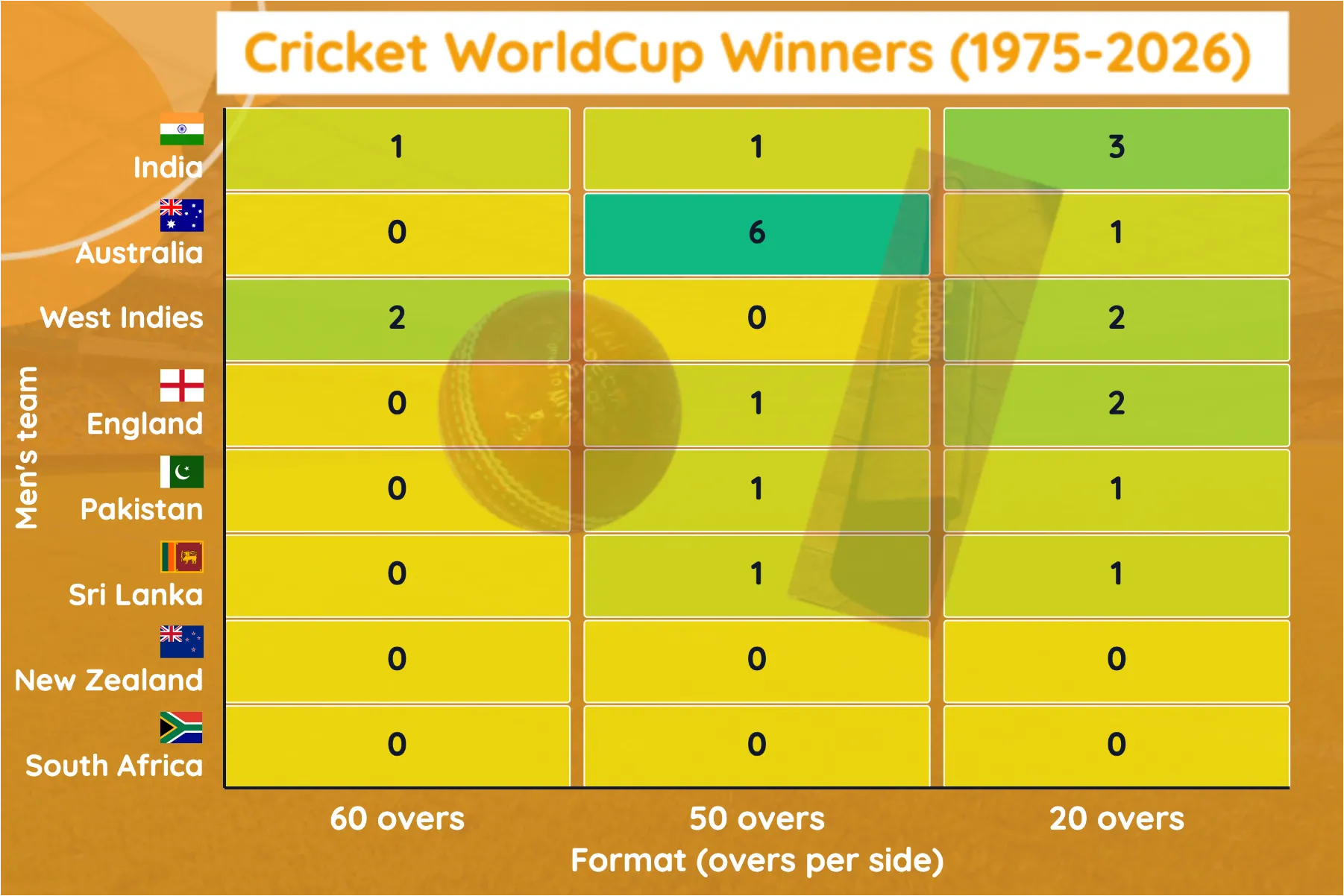
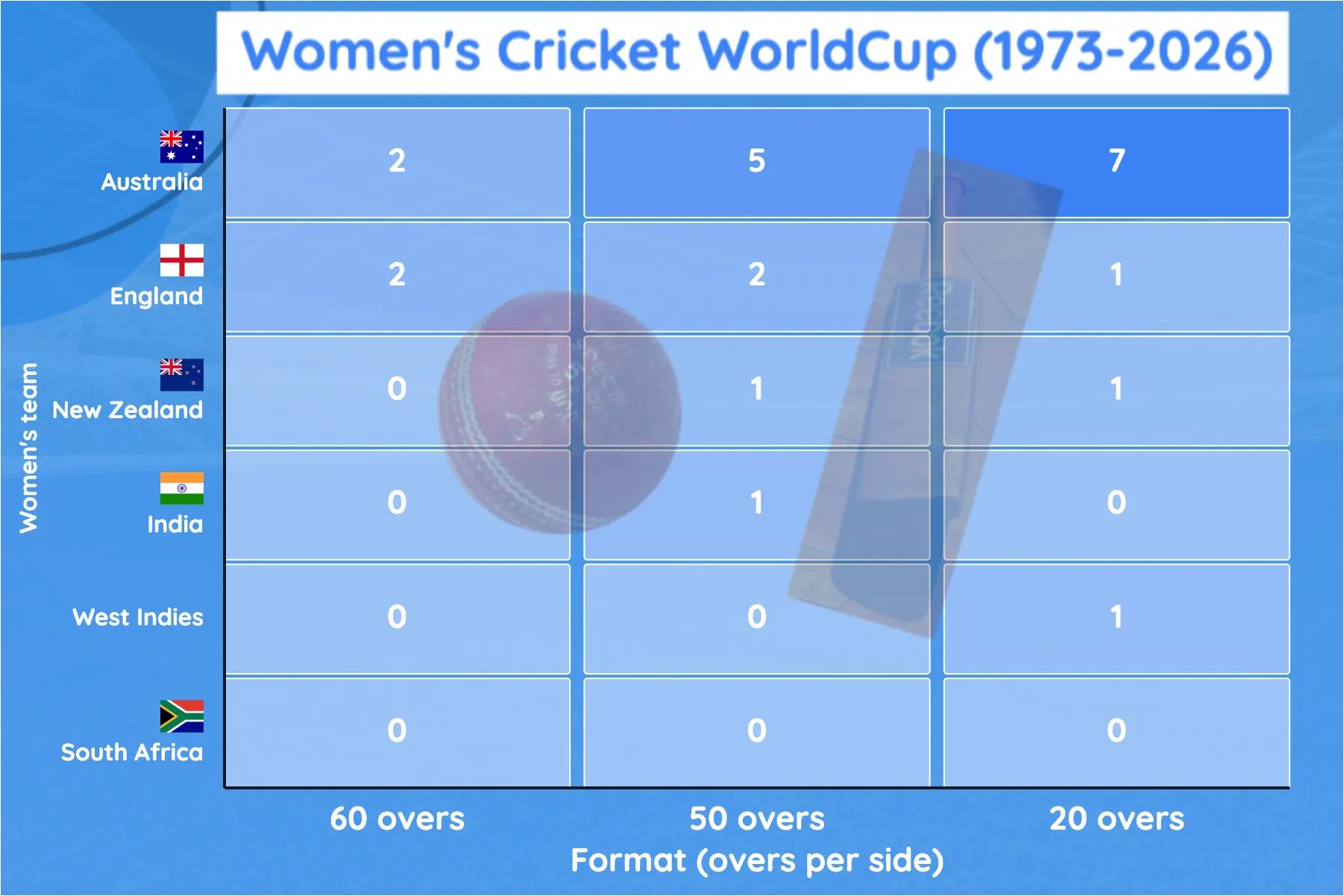
India is the only men's team to win a World Cup at 60 overs (1983), 50 overs (2011) and 20 overs (2007, 2024 and 2026). Among women, Australia and England are the only two with titles at all three lengths.
The men's answer is nearly structural: only three men's World Cups were played at 60 overs, and the West Indies, who won two, have never reached a 50-over final.
Champions Trophy, Test Championship and Under-19 events are out, and every count is as of 7 October 2026.
! What the Data Shows:
•
One men's team, three formats:India has 1 title at 60 overs, 1 at 50 overs and 3 at 20 overs.
•
The zeros define the grid:Australia has none at 60 overs and the West Indies none at 50, so neither can join India.
•
Women reverse the concentration:Australia holds 14 of 23 women's titles (61%) but 7 of 23 men's (30%).
•
South Africa never converted:Four World Cup finals lost across men's and women's events, no title.
? Key Numbers:
•
Editions Counted:46 (23 men's, 23 women's)
•
Distinct Winners:6 men's, 5 women's
•
Australia at 50 Overs:6 of 10 editions (60%)
•
Top Share at Men's T20:India, 3 of 10 (30%)
The words “World Cup” cover three games, and the winners change with the game's length. Counted by format, the men's board has one three-format winner, India; the women's has two, Australia and England.
Continue reading below for the full detailed article →
Overview
Why One Name Covers Three Different Games
Ask which country has won the cricket World Cup and the answer hangs on a number the question leaves out: how many overs each side bats. The men's tournament was played at 60 overs a side in 1975, 1979 and 1983, cut to 50 from 1987, and joined by a 20-over World Cup in 2007. The women's tournament, which began in 1973, has run at all three lengths too. This post counts titles by length and keeps men's and women's tallies apart across 46 World Cups: 13 men's one-day, 10 men's T20, 13 women's one-day and 10 women's T20. The Champions Trophy, the World Test Championship and Under-19 events are left out because none of them is a World Cup.
The Three Numbers Behind the Format Split
India is the only men's team with a World Cup title at every length. It won at 60 overs in 1983, eight years after its debut, waited until 2011 for its only 50-over title, and has taken three of the ten T20 World Cups, more than any other nation.
All Three Formats · Only India, Among Men
3 formats
India's men won at 60 overs in 1983, at 50 overs in 2011 and at 20 overs in 2007, 2024 and 2026: five titles across three lengths. The West Indies, the only other team with a 60-over title, won at 20 overs twice but have never won or even reached a 50-over final, so no second men's team can join.
Australia at 50 Overs · 6 of 10 Titles
6 of 10
Australia won the 50-over World Cup in 1987, 1999, 2003, 2007, 2015 and 2023, six of the ten editions played at that length, a 60% rate. At 60 overs it won none, losing the 1975 final by 17 runs, and at 20 overs it has one title in ten, the 2021 win in Dubai, 14 years after the format began.
Australia in Women's Cups · 14 of 23 Titles
14 of 23
Australia has won 14 of the 23 women's World Cups, 61%: 7 of 13 one-day editions and 7 of 10 T20 tournaments, which is 70%. In the men's game the same country holds 7 of 23, or 30%. England follows in the women's game with 5 titles, New Zealand has 2, and India and the West Indies have one each.
India by the Numbers
Five Titles, Three Formats1983 at 60 overs, 2011 at 50 overs, and 2007, 2024 and 2026 at 20 overs.
Eight Years to a First TitleIndia debuted in 1975 and won in 1983, the third men's World Cup.
Three Lost FinalsAustralia beat India at 50 overs in 2003 and 2023, and Sri Lanka beat it at 20 overs in 2014.
First to Defend a T20 TitleThe 2026 win made India the first men's team to retain the T20 World Cup.
The Format Change
Why Three Men's Finals Were Played at 60 Overs
The 1975, 1979 and 1983 men's World Cups were played at 60 overs a side. The first 50-over edition came in 1987, hosted by India and Pakistan, and every tournament since has kept that length. Wikipedia, citing a 1999 book, attributes the cut to shorter daylight hours on the subcontinent, so treat the reason as reported rather than settled. That leaves 3 editions at 60 overs, 10 at 50, and 10 at 20 overs since the first T20 World Cup in 2007.
Each length has had a different cast of winners. The 60-over era produced two champions, the West Indies in 1975 and 1979 and India in 1983, with all three finals played at Lord's. The 50-over era has five: Australia, Pakistan, Sri Lanka, India and England. The T20 era has six, those five plus the West Indies. A headline that says “World Cup winners” quietly mixes three games, and the list of winners changes every time the game does.
Winning at all three lengths starts with a 60-over title, and only two men's teams have one. The West Indies won in 1975, beating Australia by 17 runs, and again in 1979, beating England by 92. India won in 1983, making 183 and then bowling the West Indies out for 140 to win by 43 runs. Before a single 50-over final is considered, the all-formats club is a two-team race.
The West Indies then fail the second test. They have won none of the 10 men's 50-over World Cups and have never reached one of those finals, though they did win two T20 titles, in 2012 and 2016. India passes it: it beat Sri Lanka by 6 wickets at Wankhede Stadium in Mumbai in 2011. The claim rests on structure rather than a tight count, because no data correction could add a second men's name when the only rival with a 60-over title has no 50-over one.
Titles at 60, 50 and 20 overs
India: 1, 1 and 3. West Indies: 2, 0 and 2. Australia: 0, 6 and 1. Only one of those rows has no zero.
India
India's Five Titles Across Three Lengths, 1983 to 2026
India's route into the club was uneven. At 60 overs it won in 1983, its third World Cup and eight years after its 1975 debut, beating the two-time champion West Indies at Lord's. At 50 overs it has a single title in ten editions, the 2011 final at home, and two final defeats, both to Australia: by 125 runs in 2003 and by 6 wickets in Ahmedabad in 2023.
The T20 game has treated India far better. It won the first World Twenty20 in 2007, beating Pakistan by 5 runs in Johannesburg, lost the 2014 final to Sri Lanka, then won in Bridgetown in 2024 by 7 runs over South Africa and in 2026 by 96 runs over New Zealand, 255/5 to 159 all out. Three titles in ten editions is the most of any men's team at that length.
Wikipedia records two firsts for the 2026 win: India became the first team to win the men's T20 World Cup as host and the first to defend the title. It came at the Narendra Modi Stadium in Ahmedabad, the ground where Australia beat India in the 2023 one-day final. How to describe a home-soil win has its own wrinkle, covered in the note on “first host to win” below.
Why Australia Owns 50 Overs but Needed 14 Years for T20
Australia is India's mirror image. It has six of the ten men's 50-over titles, 60%: 1987, 1999, 2003, 2007, 2015 and 2023, including a 125-run win over India in 2003 behind 359/2. Six is also 6 of all 13 men's one-day World Cups (46%), but that figure counts three 60-over editions in its denominator. Format by format, 6 of 10 is the fair rate.
At 60 overs Australia has nothing. It lost the 1975 final to the West Indies by 17 runs, all out for 274 chasing 292. At 20 overs it has one title in ten, the 2021 win in Dubai, which came 14 years and seven editions after the format began, and it lost the 2010 final to England by 7 wickets.
Put the two modern lengths side by side and Australia holds 60% of the 50-over titles but 10% of the T20 ones. That 50-point swing is the widest of any men's team between the two formats; India's is 20 points, in the opposite direction.
Concentration
Why T20 Is the More Open Men's Format
Two measures agree. At 50 overs the leading nation, Australia, holds 60% of the titles, and the 10 editions have had 5 different winners. At 20 overs the leading nation, India, holds 30%, and the 10 editions have had 6 different winners. A lower peak and more distinct champions make T20 the flatter board, and the gap is clear once the 60-over editions are separated out. Left inside the one-day total, they pull Australia down to 46% and blur the contrast.
Waiting times point the same way. England needed 44 years and 12 editions from its 1975 debut to win a 50-over World Cup, in 2019, a final tied after a Super Over and settled on boundary count against New Zealand. It needed three years to win the T20 version, in 2010. Five of the six T20 winners won within seven years of their first appearance; Australia, at 14, is the exception.
Ten editions is a small sample, and the data cannot say why T20 has been more open, only that it has been.
Women's World Cups
The Women's World Cup Began Two Years Before the Men's
The women's tournament is the older one. The first was played in England in 1973, two years before the men's first in 1975, a point the ICC's own history confirms. It had no final: seven teams, including Young England and an International XI, played a round robin and England won on points, 20 to Australia's 17. The 1978 edition in India was also settled on points, Australia taking it on 6 to England's 4 after beating England by 8 wickets in the deciding match at Hyderabad.
The women's game had its own 60-over era: 1973, 1982, 1988 and 1993, four editions to the men's three. The first final came in 1982 in Christchurch, where Australia beat England by 3 wickets. The one-day game later moved to 50 overs, but sources disagree on when, and on how long the 1978 edition was. The note on source conflicts below shows that neither question changes the answer.
Women's World Cups, 1973 to 2026
Two Teams Fill All Three Columns of the Women's Grid
The same grid for the women's tournament gives a different answer. Australia and England have both won at 60, 50 and 20 overs, so where the men's game has one team at every length, the women's has two. Australia's row is the heaviest on either chart: 2 titles at 60 overs, 5 at 50 and 7 at 20. South Africa's row is zero in all three columns.
Australia and England
How Australia Won 14 of 23 Women's World Cups
Australia's 14 titles are 61% of the 23 women's World Cups, against 7 of 23 (30%) in the men's game. By format they are 2 at 60 overs (1982 and 1988, both over England), 5 at 50 overs (1978, 1997, 2005, 2013 and 2022) and 7 at 20 overs (2010, 2012, 2014, 2018, 2020, 2023 and 2026).
T20 runs against the men's pattern. Australia holds 7 of the 10 women's T20 titles, 70%, the highest top-nation share of the four tournaments. Only England in 2009, the West Indies in 2016 and New Zealand in 2024 have beaten it to the trophy. In the men's game T20 is the flatter format; in the women's game it is the most concentrated.
England's 5 titles split 2 at 60 overs (1973 and 1993), 2 at 50 overs (2009 and 2017) and 1 at 20 overs (2009). Its four T20 final defeats, in 2012, 2014, 2018 and 2026, all came against Australia, the last at Lord's with England as host.
Three more nations have won. New Zealand beat Australia by 4 runs in the 2000 final at Lincoln and won the 2024 T20 title over South Africa. The West Indies beat Australia by 8 wickets in the 2016 T20 final in Kolkata. India won its first, in 2025, beating South Africa by 52 runs in Navi Mumbai, 47 years after its 1978 debut.
South Africa
Four World Cup Finals, No Trophy: South Africa's Record
South Africa is the only nation to have reached a World Cup final and never won one. It has lost four: the 2024 men's T20 final to India by 7 runs in Bridgetown, the 2023 women's T20 final to Australia by 19 runs in Cape Town as host, the 2024 women's T20 final to New Zealand by 32 runs in Dubai, and the 2025 women's 50-over final to India by 52 runs in Navi Mumbai.
In the men's game South Africa has never reached a 50-over final, and its one men's final ended 7 runs short, 169/8 chasing 177. New Zealand's men have lost four finals without a title, in 2015, 2019, 2021 and 2026, but its women have won two, so New Zealand as a nation sits outside this list. Counting national teams only, six of the 26 to play a men's World Cup have won one, and five of the 14 to play a women's.
The Full Data Table
All 46 Men's and Women's World Cup Winners, 1973 to 2026
Winner, runner-up and result for every World Cup edition, with the overs per side it was played at. Compiled from Wikipedia, whose contributors' text and data are available under CC BY-SA 4.0.
Men's ODI
1975
60-over
West Indies
Australia
West Indies won by 17 runs
Men's ODI
1979
60-over
West Indies
England
West Indies won by 92 runs
Men's ODI
1983
60-over
India
West Indies
India won by 43 runs
Men's ODI
1987
50-over
Australia
England
Australia won by 7 runs
Men's ODI
1992
50-over
Pakistan
England
Pakistan won by 22 runs
Men's ODI
1996
50-over
Sri Lanka
Australia
Sri Lanka won by 7 wickets
Men's ODI
1999
50-over
Australia
Pakistan
Australia won by 8 wickets
Men's ODI
2003
50-over
Australia
India
Australia won by 125 runs
Men's ODI
2007
50-over
Australia
Sri Lanka
Australia won by 53 runs (Duckworth-Lewis)
Men's ODI
2011
50-over
India
Sri Lanka
India won by 6 wickets
Men's ODI
2015
50-over
Australia
New Zealand
Australia won by 7 wickets
Men's ODI
2019
50-over
England
New Zealand
Match tied after Super Over; England won on boundary countback
Format is overs per side as recorded on Wikipedia, which lists the 1978 women's edition at 50 overs. The 1973 and 1978 women's editions had no final, and the winner is the points-table leader. Source: Wikipedia contributors, CC BY-SA 4.0; the page and revision ID behind every row are in the downloadable file.
Scope
What Counts as a World Cup in This Count
In: the men's one-day World Cup (1975 to 2023), the men's T20 World Cup (2007 to 2026), and the women's one-day (1973 to 2025) and T20 (2009 to 2026) World Cups. Out: the Champions Trophy, the World Test Championship and Under-19 events, since none is a World Cup. The exclusion changes a headline. Per Wikipedia, South Africa won the 1998 Champions Trophy and the 2025 World Test Championship, so including them would erase its place as the one finalist without a title.
A title is the champion as officially recorded, which for the 1973 and 1978 women's editions means the points-table winner. Only national teams count as nations; composites such as East Africa in 1975 and the International XI are left out. Two finals carry a caveat: the 2007 men's final was cut to 38 overs by rain and decided by Duckworth-Lewis, Australia winning by 53 runs, and the 2019 final was tied after a Super Over, England winning on boundary count. Both stay in the 50-over column, the length they were scheduled at.
Methodology
Four Source Conflicts, and None Changes the Answer
1997 women's final · 5 wickets, not 7
An ICC media release says Australia won by seven wickets. Wikipedia's scorecard has Australia on 165/5 chasing 164, five wickets in hand, and the arithmetic supports five. This post uses 5. The winner is not in dispute.
1978 women's overs · 50 or 60
Wikipedia lists the 1978 edition at 50 overs a side, as does a second sports reference. The ICC's women's history says it was played in the same format as 1973, which would make it 60. This post follows Wikipedia and flags it. Only the column changes: Australia's 1978 title would move from 50 overs to 60.
Move to 50 overs · 1997 or 2000
The ICC says the women's tournament moved to 50 overs a side in 2000. Wikipedia's 1997 scorecards already show 50-over limits, and the data here follows them. On the ICC's dating, Australia's 1997 title would move to the 60-over column, and Australia would still hold titles at all three lengths.
First host to win · 1996 or 2011
The ICC calls India's 2011 win just the second by hosts on home soil. Wikipedia calls Sri Lanka's 1996 win the first by a host, as co-host with the final in Pakistan, and India 2011 the first team to win a final in its own country. Both fit the same facts and differ on how to treat a co-host. No count here depends on it.
None of the four touches a winner, a runner-up, a year or a venue. The headline survives them all: even if 1978 were a 60-over edition, Australia would still hold 60-over titles from 1982 and 1988, so the women's answer is unchanged.
What Changes Next
What the 2027 World Cup Could Change
Every count here is as of 7 October 2026. The next men's World Cup, dated by Wikipedia to 2 October to 21 November 2027 in South Africa, Zimbabwe and Namibia, will turn each “13 editions” into 14 and each “10 at 50 overs” into 11, and may move Australia's rate off 6 of 10. The next women's events are the T20 World Cup in 2028 and the one-day World Cup in 2029.
It could change the headline in exactly one way. A West Indies win would give them titles at 60, 50 and 20 overs and make India one of two. No other result can add a name, because no other men's team has a 60-over title. Until then the answer by format is the West Indies and India at 60 overs, Australia at 50, India at 20, and for all three at once, India among the men and Australia and England among the women.
The data behind this story comes from Wikipedia's Cricket World Cup, Men's T20 World Cup, Women's Cricket World Cup and Women's T20 World Cup pages and the 46 edition pages beneath them, read on 7 October 2026. The dataset is available under CC BY-SA 4.0, and full credit for collecting and maintaining it goes to Wikipedia's contributors. Results were cross-checked against ICC match reports, read but not copied.
FactsFigs reviews, cleans, and cross-checks every source dataset before shaping it into a data story. Each visualization is created and designed in FactsFigs Design Studio — an internal tool developed and owned by FactsFigs — and is the original work of a FactsFigs author, not an AI-generated copy of any existing graphic. Individual assets within a visual may or may not be produced with AI tools, but the design of the visual itself is solely FactsFigs' own.
Figures are estimates at the time of publication, provided for information only — nothing here is financial advice or a guarantee of accuracy.
Last verified: 7 Oct 2026
The charts in this article were built with our own publishing system. See what it does →