How Much of the PHP Web Cannot Take the PHP2Shell Patch?



Facts & Figures
Visual Intelligence
How Much of the PHP Web Cannot Take the PHP2Shell Patch?
About a third of WordPress installs run a branch the PHP project never shipped a fixed release for.
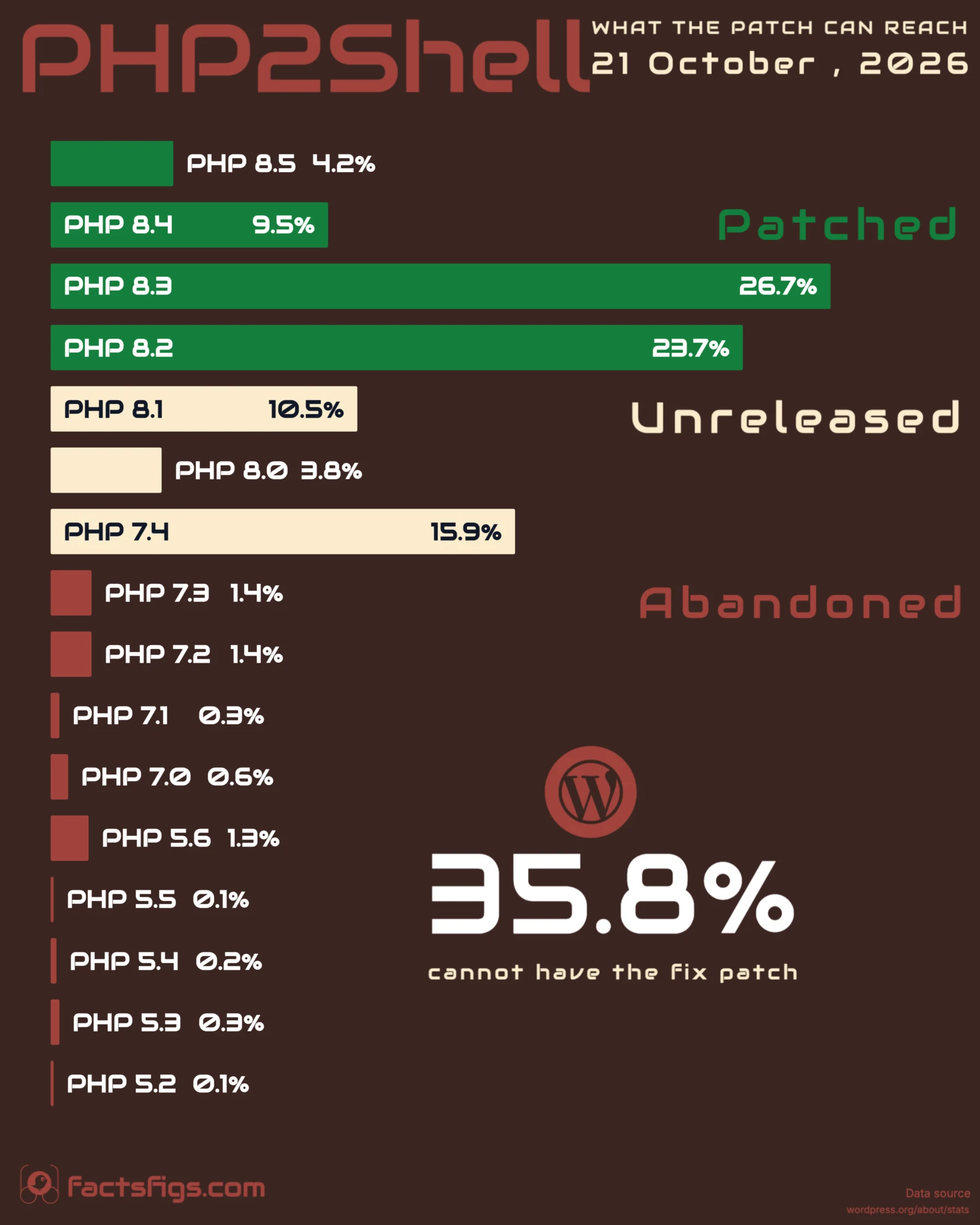
PHP2Shell was patched on 21 October 2026 in PHP 8.5.12, 8.4.27, 8.3.36 and 8.2.35. Every branch below 8.2 got something less than that, or nothing. On WordPress.org’s own update check-ins, 35.8 per cent of installs are on a branch with no official patched release. Of that, 30.2 per cent sit on 7.4, 8.0 or 8.1, where the security team published source backports but cut no release, and 5.7 per cent are on branches that got nothing at all. The number moves a lot depending on who is counting, and that spread is the more useful finding.
! What the three groups mean:
- • Official patched release: 8.2 and above. Update and you are done. 64.1 per cent of installs.
- • Source backport only: 7.4, 8.0 and 8.1. Source code exists, no release. Whether you are patched depends on your distribution. 30.2 per cent.
- • Nothing from the PHP project: 7.3 and below. No fix at any level. 5.7 per cent.
Continue reading below for the full detailed article →
How to read it
A Version Number Cannot Tell You If You Are Patched
The chart ranks every PHP version WordPress installs report, and the colour is the only thing that matters: did the PHP project ship a fixed release for that branch. PHP 8.3 and 8.2 dominate and both got one. PHP 7.4 is the largest branch that did not, at 15.9 per cent of all installs on its own, more than 8.4 and 8.5 combined.
The middle group is the part most coverage misses. For 7.4, 8.0 and 8.1 the security team published source backports but cut no release. Whether a site on 8.1 is exposed depends entirely on whether its distribution rebuilt the package, and the version string will not tell you either way. A fixed package keeps its old number.
So the honest label for the two lower groups together is “cannot get a patch from php.net”, not “unpatched”. And the top group is not “safe” either, because nobody publishes how many sites on a supported branch have actually updated since 21 October.
The disagreement
Three Counts of the Same Thing, From 35.8 to 93.2 Per Cent
WordPress.org is one sample. It measures installs that check in for updates, which skews toward sites that are maintained. Run the same question past two other sources and the answer moves further than most of the figures quoted this week.
W3Techs, surveying sites where it can identify a PHP version, puts the share with no official patched release at 48.4 per cent as of 22 October 2026. The Joomla project’s opt-in statistics endpoint, covering 3,292,304 sites that volunteered, puts it at 93.2 per cent.
None of these is wrong. They are three different populations: everyone who checks in for a WordPress update, everyone W3Techs can fingerprint, and everyone who opted into Joomla telemetry. The spread between them is the finding, and it is why this post publishes all three rather than averaging into a single number that would describe no real population at all.
The long tail
PHP 7.4 Reached End of Life in 2022 and Still Runs a Sixth of WordPress
One branch dominates the unpatchable side of this chart. PHP 7.4 is on 15.9 per cent of WordPress installs, more than PHP 8.4 and 8.5 combined, and it stopped receiving security support in November 2022. Four years later it is still the second most common PHP version on WordPress after 8.3 and 8.2.
That is why the source backport matters so much here. The PHP security team published fixed source for 7.4, 8.0 and 8.1 without cutting releases, which hands the decision to whoever packages PHP for each host. Distributions with long-term support contracts rebuild it. Shared hosts on their own builds may not. Nothing in the version string distinguishes the two.
Below 7.4 the picture is simpler and worse. PHP 7.3 and everything older received no fix at any level, and that is 5.7 per cent of installs: a floor that no amount of vendor backporting will lift, because there is nothing to backport from.
The check that does not work
Why a Version Number Settles This for Two Thirds of the Web and No More
For the 64.1 per cent of installs on 8.2 and above, the version string is a complete answer. PHP 8.2.35, 8.3.36, 8.4.27 and 8.5.12 carry the fix, anything lower on those branches does not, and the number on the box is the number that matters. That is the entire population for which checking is simple.
For the 30.2 per cent on 7.4, 8.0 and 8.1 it settles nothing. A distribution that rebuilt its package from the published source shipped the fix without changing the version, so two servers reporting the identical 8.1 patch number can sit on opposite sides of this flaw. The answer is in the vendor’s package changelog, not in PHP’s, and there is no way to read it off the running process.
For the remaining 5.7 per cent there is nothing to check at all. No fix was produced at any level, so the question stops being whether a site is patched and becomes how long the branch has left. PHP 5.6 alone, out of security support since the end of 2018, is still on 1.3 per cent of WordPress installs, which is eight years of running a language version that has had no security releases to miss.
The dataset
Every PHP Version WordPress Reports, and What It Got
Share of WordPress installs running each of sixteen PHP versions on 22 October 2026, with what the PHP project shipped for that branch after the PHP2Shell patch: an official release, source code only, or nothing. Shares are rounded to one decimal place, so adding the rows gives 35.9 per cent with no official patched release against the 35.8 per cent the unrounded source returns.
| PHP 8.5 | 4.2% | Official patched release |
| PHP 8.4 | 9.5% | Official patched release |
| PHP 8.3 | 26.7% | Official patched release |
| PHP 8.2 | 23.7% | Official patched release |
| PHP 8.1 | 10.5% | Source backport only |
| PHP 8.0 | 3.8% | Source backport only |
| PHP 7.4 | 15.9% | Source backport only |
| PHP 7.3 | 1.4% | Nothing from the PHP project |
| PHP 7.2 | 1.4% | Nothing from the PHP project |
| PHP 7.1 | 0.3% | Nothing from the PHP project |
| PHP 7.0 | 0.6% | Nothing from the PHP project |
| PHP 5.6 | 1.3% | Nothing from the PHP project |
| PHP 5.5 | 0.1% | Nothing from the PHP project |
| PHP 5.4 | 0.2% | Nothing from the PHP project |
| PHP 5.3 | 0.3% | Nothing from the PHP project |
| PHP 5.2 | 0.1% | Nothing from the PHP project |
Quick Answers
Which PHP versions got a PHP2Shell patch?
PHP 8.5.12, 8.4.27, 8.3.36 and 8.2.35, released on 21 October 2026. The security team also published source backports for 7.4, 8.0 and 8.1, but cut no release for them. Branches at 7.3 and below received nothing.
I am on PHP 8.1. Am I patched?
It depends on your distribution rather than on PHP. A source backport exists, so a vendor that rebuilt its package has shipped the fix, and the version string will still read 8.1. Check your distribution’s changelog rather than the PHP version.
Why do different sources give such different numbers?
Because they count different populations. WordPress.org counts installs that check in for updates, W3Techs counts sites where it can identify a version, and Joomla counts sites that opted into its statistics. They give 35.8, 48.4 and 93.2 per cent respectively for the same question.
Is PHP 7.4 still widely used?
Yes. It is the single largest branch with no official patched release, at 15.9 per cent of WordPress installs, which is more than PHP 8.4 and 8.5 combined. It reached end of life in November 2022.
Data Source and Attribution
WordPress.org PHP version statistics The PHP Foundation security release post W3Techs PHP version survey
The chart is built from the WordPress.org statistics API, read on 22 October 2026. It reports the share of WordPress installs on each PHP version, on a single denominator, and the shares sum to 100. The endpoint publishes no as-of date and no licence.
Patch status per branch is ours, assigned from the PHP Foundation’s own release post: official release for 8.2 and above, source backport only for 7.4, 8.0 and 8.1, nothing below that.
The W3Techs figure of 48.4 per cent is quoted as of 22 October 2026 under its terms, which permit quotation with a dated reference and a link but not republication of its tables. The chart and the table on this page therefore use WordPress.org data only.
Three versions below 0.1 per cent of installs are omitted from the chart and included in every total. Where samples disagree, all three are published rather than reconciled.
The table reproduces the chart’s own sixteen figures. No CSV is offered: the WordPress.org endpoint publishes no licence and no as-of date, and the series is rolling rather than a fixed release, so a dated file would stop matching the source it names.
2026-10-24
Related Publications
More from FactsFigs
Who Found PHP2Shell: Humans or AI?
A timeline of one PHP flaw. Humans documented the weakness class in 2004 and found the bug in 2024 without an exploit. Three AI-assisted teams built one in 2026.
22 Oct 2026
AI Companies Ranked by Valuation: Two Hold 89% of the Value
Anthropic, OpenAI, Databricks and Mistral AI ranked by latest announced valuation. Two hold 89.4% of the combined value, and first is at most 40x fourth.
07 Oct 2026
Who Leads AI Infrastructure Investment? Big Tech Capex Ranked
Amazon, Microsoft, Alphabet, Meta and Oracle filed $723.1B of capex in two fiscal years. None breaks out AI, and the top two swap with leases.
06 Oct 2026
US Data Center Construction Spending After ChatGPT?
US data center construction spending hit $158.6bn in the 46 months after ChatGPT, 3.37 times the 46 before, in real dollars.
05 Oct 2026