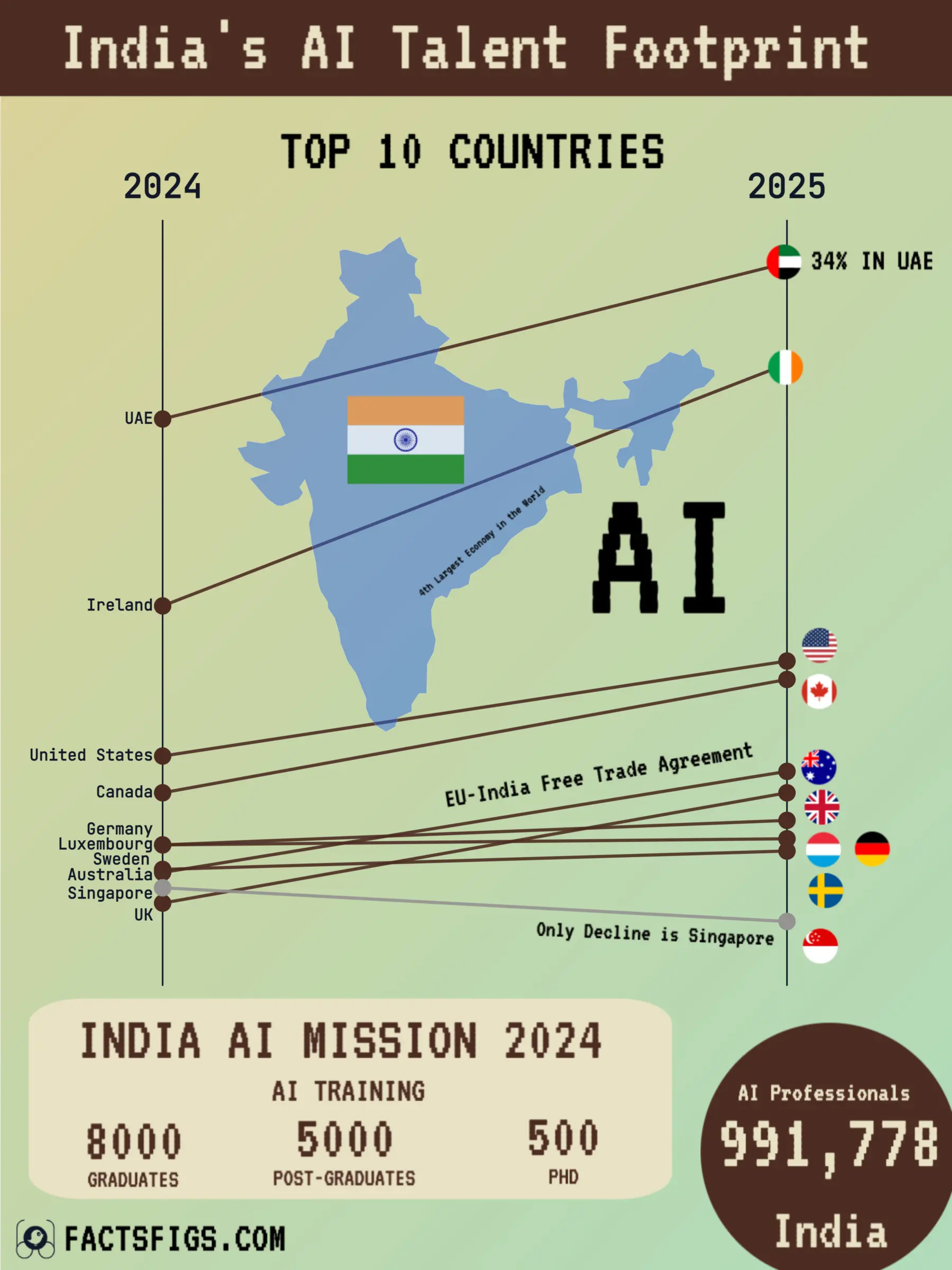
India's share of the AI workforce keeps widening across dozens of countries, and it rose again in almost every destination on the chart between 2024 and 2025
India is a top-five country of education for AI professionals in 33 of the 46 foreign destinations covered by interface and Revelio Labs, and that share grew again in 22 of those 33 between 2024 and 2025.
Among the ten countries charted here, nine saw their share rise, led by Ireland's jump from 22.4% to 30.3% and the United Arab Emirates' rise from 28.5% to 33.6%. Singapore was the one exception, slipping from 13.2% to 12.1%.
In the United States, the share of AI professionals who took their first degree in India reached 20.6% in 2025, up from 17.5% a year earlier. China is not part of this comparison at all: Revelio's professional-profile sources do not cover it closely enough to include.
! What the Chart Actually Shows:
•
A Widening Base:India ranks among the top five countries of education for AI professionals in 33 of 46 foreign destinations tracked, and the share widened further in 22 of those 33 between 2024 and 2025.
•
The Fastest Movers:Ireland's share jumped 7.9 percentage points, from 22.4% to 30.3%, the largest single-year gain of the ten countries charted. The UAE followed at 5.1 points, from 28.5% to 33.6%.
•
One in Five in the United States:The American AI workforce went from 17.5% India-educated to 20.6% in a single year, a rise of 3.1 points. That is the largest AI workforce on the chart moving at the same pace as much smaller ones.
•
One Honest Exception:Singapore's share fell from 13.2% to 12.1%, the only decline among the ten countries in the chart, and it stays in the story instead of getting quietly dropped.
•
A Coverage Gap, Not a Finding:China does not appear on the chart because Revelio's professional-profile sources have limited reach there, an acknowledged gap in the underlying data rather than evidence that China's own AI workforce is small.
? The Numbers Behind the Story:
•
Top-5 Origin Countries:33 of 46
•
Share Rising, 2024 to 2025:22 of 33
•
US Share Educated in India, 2025:20.6%
•
Highest Share of Any Country, 2025:UAE at 33.6%
•
Largest Single-Year Gain:Ireland, 7.9 points
This is a supply story, not a ranking or a warning. One country's graduates are showing up in a growing share of the AI workforce across dozens of destinations, not because any other country lost ground in this dataset, but because the number of people trained there keeps climbing. The clearest sign of that is how broad the movement is: the share rose in 22 of the 33 destinations where India already ranks among the top five countries of education.
Continue reading below for the full detailed article →
Overview
Why India's Share of the World's AI Workforce Keeps Widening
One chart anchors this story. It tracks how much of each destination country's AI workforce was educated in India, comparing 2024 against 2025 across the ten countries where that share is largest, drawn from the 46 foreign destinations where Revelio Labs' data clears a 1,000-person threshold. What it shows is not a ranking of who is winning AI, and it is not a brain-drain story either. It is a supply story: one country's graduates are turning up in a widening share of the AI workforce almost everywhere interface has data to check, and in most of the places where that was already true, the share grew again in a single year.
The Three Numbers That Frame India's AI Talent Story
Three figures anchor this piece: the highest share India reaches in any country, the largest single-year jump, then how far the same pattern has travelled inside the biggest AI workforce on the chart. Together they show a share rising fastest in the places already furthest along.
20.6% · The US AI Workforce Educated in India
20.6%
One in five AI professionals in the United States took their first university degree in India, up from 17.5% in 2024. That is a rise of 3.1 percentage points in a single year, and it is the largest AI workforce on the chart moving at the pace of far smaller ones. Canada sits just behind at 20.0%, up from 16.3%.
33.6% · UAE's AI Workforce Educated in India
33.6%
The United Arab Emirates has the highest share of any country tracked here, up from 28.5% in 2024 to 33.6% in 2025, a gain of 5.1 percentage points. A third of the country's identified AI professionals earned their first degree in India, the largest such share among the 33 destinations interface tracks.
+7.9pp · Ireland's Rise, 2024 to 2025
7.9pp
Ireland's share moved from 22.4% to 30.3% in a single year, a rise of 7.9 percentage points, the largest single-year gain of any country on the chart. Only the UAE's 5.1-point rise comes close, and both sit far ahead of the third-fastest mover, Canada, at 3.7 points, more than double the median gain across the ten countries charted.
India's AI Talent Reach by the Numbers
Top-5 Origin in 33 of 46 Destinations 33 of 46 India ranks among the top five countries of education for AI professionals in 33 of the 46 foreign destinations interface and Revelio Labs track.
Share Rising in 22 of Those 33 22 of 33 Where India already places top five, its share of the local AI workforce widened again between 2024 and 2025 in two out of every three destinations.
12 of 33 Destinations at 10% or More 12 of 33 Twelve of the tracked destinations now draw at least a tenth of their AI workforce from India, and four of those sit above 20%.
15 of 33 Still Below 5% 15 of 33 The tail is long. Almost half the tracked destinations draw less than a twentieth of their AI workforce from India, which is why this reads as a steep curve rather than a global average.
Methodology
Why This Piece Writes 'Educated in India,' Not 'Indian'
The figure behind every chart and every row in this piece is a country of education, not a nationality. Revelio Labs builds its dataset from public professional profiles, roughly 616 million people across the global workforce as of its September 2025 snapshot, from which it identifies about 1.6 million technical AI professionals. For each of them, interface's analysis records where they earned their first university degree, tracked over a movement window running from April 2024 through September 2025.
A Proxy, Not a Nationality
Studying in India does not require Indian citizenship, and holding Indian citizenship does not require studying there. interface's own note on the data puts the scale of that gap in context: roughly 8% of OECD bachelor's students study outside their home country, so any national total already mixes citizens who studied at home, citizens who studied abroad and non-citizens who studied domestically. That is why this piece writes 'educated in India' throughout rather than 'Indian' or 'Indian-born,' even where the shorter phrase would read more naturally.
The same caveat applies everywhere else in this piece, and it is why the dataset's biggest blind spot, covered further down, is a coverage gap rather than a finding: professional-profile platforms are not used evenly around the world.
The Fastest Movers
Ireland and the UAE Lead the Gains, 2024 to 2025
Nine of the ten countries in the hero chart saw India's share of their AI workforce grow in a single year, and the size of the gains varies a lot. Ireland moved the most, from 22.4% to 30.3%, a rise of 7.9 percentage points. The United Arab Emirates was close behind at 5.1 points, from 28.5% to 33.6%, already the highest share of any country tracked here in both years.
Canada rose 3.7 points (16.3% to 20.0%), the United Kingdom 3.6 points (12.7% to 16.3%), Australia 3.3 points (13.7% to 17.0%) and the United States 3.1 points (17.5% to 20.6%). Luxembourg, Germany and Sweden moved less than a single point each, a reminder that a widening share means something different in a market that already had a large India-educated base than in one still building one.
The Exception
Singapore Is the Only Decline in the Chart
Singapore's share fell from 13.2% to 12.1%, a drop of 1.1 percentage points and the only decline among the ten countries charted. It would have been easy to leave Singapore out of a piece built around a rising trend, and that is exactly why it stays in. A single-year drop in one country does not undo a rise recorded in nine others, but a chart that only ever shows increases invites the reasonable question of what got left out.
Singapore's own AI workforce is smaller than the United States' or India's, which makes a single year's reading more sensitive to hiring swings at a handful of companies than the same movement would be in a bigger market. That is a reason for caution reading too much into one country's single-year number, not a reason to remove it from the comparison.
Across 33 Destinations
The Ten on the Chart Are the Top of a Longer List
The ten countries on the chart are not the whole picture. India ranks among the top five countries of education in 33 destinations in this dataset, and the ten shown are simply the ones where its share is largest. Four of the 33 sit above 20% and twelve at or above 10%, while fifteen are below 5%. The spread runs from the United Arab Emirates at 33.6% down to Brazil at 0.4%. This is not a uniform global shift. It is a steep curve with a small group of countries bunched at the top of it.
Movement below the chart runs the same way. New Zealand rose from 9.3% to 12.0% and Japan from 7.9% to 10.5%, both crossing 10% between the two years, while Saudi Arabia climbed from 3.6% to 5.9%. Eleven of the 33 did fall, and Singapore is not the steepest of them: Finland dropped 1.4 points, from 7.0% to 5.6%, and Estonia fell 1.1 points. So the pattern is wide rather than universal, which is the distinction the full table below sets out row by row.
China Is Absent Because of Data Coverage, Not Talent
China does not appear on the chart, and interface is explicit about why: the Revelio Labs dataset lacks comprehensive coverage of China because of limitations in its underlying sources, which have far lower penetration there than in most of the countries measured here. That is a statement about which data exists, not about how much AI talent China has.
The absence does not inflate anything on the chart. Each figure is a share of that country's entire AI workforce, not a share of the few origins named beside it. For the United States the five listed origins account for 91.4% of the workforce, for Ireland 78.9%, for the UAE 67.8%. The rest sits in a remainder that is simply not broken out. Leaving one country off the display does not hand its people to another, so India's 20.6% in the United States reads 20.6% whether or not China is drawn.
interface's own report points to independent estimates using other sources that put combined tech talent pools in Beijing and Shanghai above 500,000 people. That figure is not built the same way as the 1.6 million AI professionals identified in this dataset, so the two cannot be set against each other, and this piece does not try. What can be said plainly is this: nothing here supports a claim about the size of China's own AI workforce, and nothing here supports a claim that Chinese-trained talent is being replaced by India-trained talent anywhere.
The Verdict
A Supply Story, Not a Ranking or a Warning
The pattern holds up without needing its exceptions edited out. India is a top-five source of AI talent in 33 of 46 tracked destinations, and the share widened again in 22 of those 33 between 2024 and 2025, Singapore's single decline included. It rose in the largest AI workforce on the chart and in some of the smallest, which is what makes this look like supply rather than one country's recruitment drive.
None of that makes it a story about winning or losing. Ireland's 7.9-point jump and the UAE's 5.1-point jump say more about how those two economies are hiring than about any contest between countries. And China's absence from the chart is a reminder that a supply story built on one dataset can only describe what that dataset measures: one country's graduates, turning up in a growing share of the AI workforce almost everywhere there is data to check.
All 33 Tracked Destinations, Share Educated in India (%)
Every country in interface's published series showing what share of the local AI workforce was educated in India, 2024 against 2025, beyond the ten charted in the hero visual above. Rows are ordered by 2025 share, highest first, matching the hero chart's own ordering.
Figures are the share of each country's AI workforce whose first university degree was earned in India, from interface's analysis of Revelio Labs data. China is not part of this series for the same coverage reason detailed above. Shares are rounded to one decimal place and the change column is the difference between the two rounded figures, so it may differ by 0.1 from a calculation on the unrounded source values.
The figures behind this story come from interface's data brief 'Talent in, Talent out: The Shifting Geography of the Global AI Workforce,' published 29 April 2026 by Siddhi Pal, Catherine Schneider and Ruggero Marino Lazzaroni. Every number used here is drawn from that brief's own published charts. The workforce data beneath it is a September 2025 snapshot from Revelio Labs, built from roughly 616 million profiles, from which about 1.6 million technical AI professionals were identified over a movement window running from April 2024 through September 2025.
interface publishes under a Creative Commons Attribution-ShareAlike 4.0 licence, which is why the table above is offered as a CSV download. Anyone reusing it should credit interface and release whatever they build under the same licence. The file is the table exactly as it appears on this page, 33 destinations with their 2024 and 2025 shares.
FactsFigs reviews, cleans, and cross-checks every source dataset before shaping it into a data story. Each visualization is created and designed in FactsFigs Design Studio, an internal tool developed and owned by FactsFigs, and is the original work of a FactsFigs author, not an AI-generated copy of any existing graphic. Individual assets within a visual may or may not be produced with AI tools, but the design of the visual itself is solely FactsFigs' own.
Figures are estimates at the time of publication, provided for information only, nothing here is financial advice or a guarantee of accuracy.
Last verified: 22 Sep 2026
The charts in this article were built with our own publishing system. See what it does →