TL;DR — Is DeepSeek Winning, or Is ChatGPT Just Banned?
140 of 149 tracked countries default to ChatGPT; DeepSeek's two clean wins are both government-forced, not consumer choice.
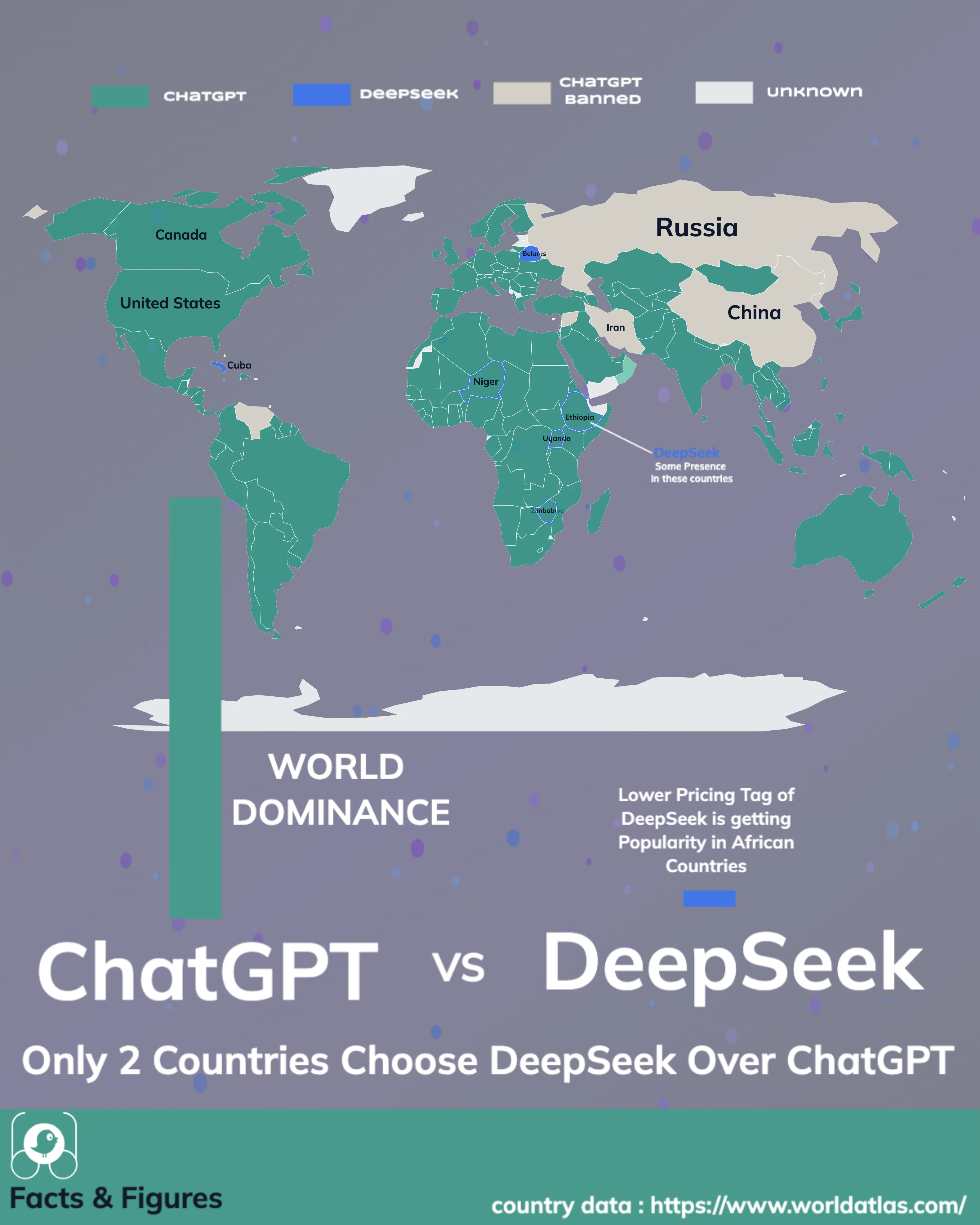
ChatGPT leads by default in 140 of the 149 countries and territories tracked here, a 94% share that barely counts as a contest.
DeepSeek's only two clean, undisputed wins are Belarus and Cuba, and in both cases ChatGPT isn't just losing, it's absent: blocked by the government or never launched there by OpenAI in the first place.
The genuine DeepSeek story is smaller and different: four African countries where it gained real ground on price and phone-level distribution without any ban at all, and it still isn't leading there.
! What 149 Countries Actually Show:
•
The Popular Belief:DeepSeek is out-competing ChatGPT across the developing world on merit, the way one chatbot beats another in a fair fight.
•
What Actually Decides It:Access, not preference. Nearly every country where DeepSeek or a domestic Chinese app has a shot at leading is a country where ChatGPT is government-blocked or was never launched there by OpenAI.
•
DeepSeek's Only Real Wins:Belarus (56%) and Cuba (49%) are the two countries with a clean, sourced DeepSeek majority, both explained by ChatGPT being unavailable rather than users comparing the two and picking DeepSeek.
•
The Exception That Isn't a Ban:Ethiopia, Uganda, Zimbabwe and Niger are the one place DeepSeek gained real ground without a government block, on price and Huawei-linked phone distribution, and ChatGPT still leads in all four.
? The Map's Core Numbers:
•
Default Share:140 of 149 countries (94%) are ChatGPT-led
•
Confirmed DeepSeek Majority:2 countries — Belarus 56%, Cuba 49%
•
Access-Blocked or Excluded:9 countries where ChatGPT is unavailable: China, Russia, North Korea, Iran, Cuba, Syria, Venezuela, Belarus, Hong Kong
•
Gemini's Country Wins:0, despite ranking as the global #2 and fastest-growing major assistant
Ninety-four percent of the world runs on ChatGPT largely because nothing else is offered. Where DeepSeek does show up, in a lead role or just elevated, the map is telling a story about government policy and phone-level distribution economics, not a fair fight between two chatbots.
Continue reading below for the full detailed article →
Overview
Why 94% of the World Defaults to ChatGPT
Type in "is DeepSeek beating ChatGPT" and the confident answer usually points at cost, at open weights, at a wave of developing-world adoption. Mapping all 149 economies Microsoft's AI Economy Institute tracks, plus North Korea and Hong Kong, which its 147-country base leaves out, tells a much flatter story: ChatGPT is the default leader in 140 of them, 94% of the map, and it is not close in almost any of the 140. The interesting nine countries are the ones where it does not lead, and in seven of those nine ChatGPT is either blocked outright by the government, China, Russia, North Korea, Iran, Cuba, Syria, and Venezuela have all restricted the service, or was never made available there by OpenAI's own choice, Belarus and Hong Kong. Only two of the nine, Belarus and Cuba, have a clean, sourced DeepSeek majority; the rest are either genuinely contested between multiple platforms or have no usage data at all. What follows works through the mechanism behind each color on the map: the access vacuum that explains almost every non-ChatGPT country, the two live source conflicts inside China and Russia that do not resolve to a tidy DeepSeek win, the four African countries where DeepSeek is gaining ground for reasons that have nothing to do with bans, and the platform that, despite ranking a clear global number two, does not lead a single country on this map at all.
The Three Numbers Behind Who Actually Leads
A categorical map of 149 countries only needs three numbers to make its point. The overwhelming majority default to ChatGPT, not because it wins every consumer comparison but because it is the platform actually on offer. DeepSeek's list of confirmed wins is short enough to name in one sentence, and both entries owe their status to policy, not preference. And the platform investors treat as ChatGPT's closest rival does not lead a single country here, a gap that says as much about distribution as capability. These three figures are the spine the rest of this story works from.
94% of Countries Default to ChatGPT
94%
Of the 149 countries and territories in this dataset, 140 have ChatGPT as the clear leading platform, a 94% share drawn from Microsoft AI Economy Institute's 147-country base plus North Korea and Hong Kong. That default isn't earned country by country through head-to-head competition; it's simply the baseline everywhere ChatGPT is available and no government has blocked it.
Only 2 Countries Give DeepSeek a Clean Win
2
Belarus (56%) and Cuba (49%) are the only two countries in the dataset with a sourced, undisputed DeepSeek majority, and in both cases the reason is access, not preference. OpenAI has never served Belarus at all, and Cuba's government blocks ChatGPT outright alongside a short list of other US-based AI tools. Neither country ran a fair contest between the two platforms.
Gemini Leads Zero Countries on This Map
0
Despite ranking as the clear global number two chatbot and the fastest-growing of the major assistants through 2025 and 2026 by most trackers, Google's Gemini does not top the usage charts in a single one of the 149 countries and territories covered here, an absence this map states as loudly as any of DeepSeek's genuine gains.
ChatGPT's Global Default, by the Numbers
Countries Tracked · 149 149 147 economies from Microsoft's AI Economy Institute diffusion report, plus North Korea and Hong Kong, which sit outside that base list but have documented ChatGPT access restrictions of their own.
ChatGPT-Led · 140 Countries 140 94% of the map, the default outcome wherever ChatGPT is actually available and no government has blocked it.
Grey, Contested or No Data · 7 Countries 7 Russia and China's leadership is disputed between multiple sources; Iran, Syria, Venezuela, North Korea and Hong Kong have no usable share data at all.
Confirmed DeepSeek Majority · 2 Countries 2 Belarus and Cuba, the only two entries in the dataset with a sourced DeepSeek lead, both explained by ChatGPT being unavailable rather than a fair contest.
The Access Vacuum
How OpenAI's Own Map Draws the Battle Lines
Every country where ChatGPT doesn't sit at the top of this map falls into one of two access categories, and neither is about product quality. Seven governments block ChatGPT outright: China, Russia, North Korea, Iran, Cuba, Syria, and Venezuela have all restricted or banned the service at the national level, according to tracking by nstproxy.com and moveo.ai, and, for Syria specifically, a service-status log kept by UnblockSyria. Two more countries, Belarus and Hong Kong, sit outside OpenAI's own list of served territories entirely, a business decision on OpenAI's side rather than a government order. Between the two categories, that's nine countries where ChatGPT was never really in the running, out of the 149 on this map. In every one of them, whatever platform ends up leading, DeepSeek in Belarus and Cuba, an unresolved multi-way contest in China and Russia, no usable data at all in Iran, Syria, Venezuela, North Korea and Hong Kong, is filling a gap OpenAI left rather than winning a comparison OpenAI actually competed in. That distinction is the one the DeepSeek-adoption headlines usually skip: a platform picking up users in a market its main rival can't legally or commercially enter isn't the same signal as a platform winning users away from a rival sitting on the same app store shelf.
The Confirmed Wins
The Only Two Countries DeepSeek Actually Won
Belarus · 56% and No Competitor on the Shelf
Belarus is the cleanest data point on the entire map. Microsoft's diffusion report puts DeepSeek's share there at 56%, a genuine majority, and the reason isn't mysterious: OpenAI has never added Belarus to its list of served countries, so ChatGPT was never an option for a Belarusian user to reject in the first place. DeepSeek isn't outcompeting ChatGPT in Belarus. It's the only mainstream option on the table.
Cuba tells almost the same story from the other direction. DeepSeek holds a 49% share there per the same Microsoft report, just short of an outright majority but still the clear largest single platform, and ChatGPT's absence is a government decision rather than an OpenAI one: Cuba's government blocks the service outright, alongside a short list of other US-headquartered AI tools.
Two Countries, Same Underlying Cause
Two countries, two different mechanisms for keeping ChatGPT out, a government order in one case, no service commitment in the other, and the same result either way: the only place DeepSeek can win outright is a place where it isn't actually competing against ChatGPT at all.
The Unresolved Conflicts
Why China and Russia Are Painted Grey, Not Red
China · Microsoft Says DeepSeek, Consumer Data Says Doubao
Microsoft's AI Diffusion Report credits DeepSeek with an 89% national "AI market share" inside China, a figure that would make it the country's runaway leader. But consumer app-usage trackers tell a different story: QuestMobile data reported by the South China Morning Post shows ByteDance's Doubao as China's most-used consumer AI app by a wide margin, 155 to 382 million weekly or monthly active users against DeepSeek's 81.6 to 143 million across three separate 2025-2026 readings, with Alibaba's Qwen even passing DeepSeek in one May 2026 snapshot. The two figures are likely measuring different things, model-level infrastructure share versus branded consumer-app usage, but no source resolves which one describes "who's winning" in a way that matches the other. This map marks China grey rather than pick a side.
Russia · Four Sources, Four Different Winners
Russia is messier still. Microsoft's H2 2025 report has DeepSeek leading at 43%. A Russian analytics firm, Bilayn.analitika, put Yandex's homegrown Alisa AI assistant at 67% for Q1 2026, with DeepSeek at 29% and ChatGPT down at 7%. StatCounter data via Alphametic, from May 2026, shows Perplexity leading at 48.07%, the only one of the world's 15 largest economies where that source doesn't have ChatGPT on top. And a TAdviser preference survey puts ChatGPT itself first at 26%, ahead of DeepSeek's 20% and YandexGPT's 12%. Four credible-looking sources, four different leaders, likely because each is measuring something different: web referral share, population telemetry, stated preference, or a broader voice-assistant product bundled into Alisa's number. Grey is the only honest color for a country with that little agreement.
The Genuine Exception
The Real DeepSeek Story Is Playing Out in Africa
Strip out the nine ban-and-exclusion countries and DeepSeek's actual organic growth story is much smaller and much more interesting than the ban list suggests. Ethiopia and Uganda both show DeepSeek pulling an 11-14% share, per Microsoft's data, elevated well above the low single digits typical of the 135 default-ChatGPT countries, and Zimbabwe and Niger get the same qualitative flag from Microsoft and Euronews reporting even without an exact percentage sourced. In none of the four does DeepSeek actually lead; ChatGPT still tops every one of them. What's different about these four is the mechanism: no government ban, no OpenAI exclusion, just price and distribution. DeepSeek's app is free and lighter on data usage than ChatGPT in markets where mobile data is expensive, and reporting on the shift points to Huawei-linked phone distribution putting DeepSeek pre-installed or easily discoverable on handsets already common across parts of East and West Africa. That is the one part of the DeepSeek-in-the-developing-world narrative this dataset actually supports on its own terms: a real, ban-free competitive gain, small enough that it moves a share number and a marker dot rather than the color of the map, but genuine in a way Belarus and Cuba's numbers aren't.
The Notable Absence
The Platform That Never Wins a Single Country
Google's Gemini doesn't lead a single country in this 149-country dataset, a genuinely surprising absence given its standing everywhere else in the conversation. Multiple trackers, including StatCounter's global AI chatbot market share figures, put Gemini as the clear global number two behind ChatGPT and the fastest-growing of the major assistants through 2025 and 2026. None of that growth translates into a single country-level win here.
Growing Everywhere, Leading Nowhere
The likely explanation isn't quality. It's distribution timing and habit: ChatGPT had roughly two years of largely uncontested first-mover advantage as the mainstream consumer chatbot before Gemini reached comparable capability, and switching an established habit is a harder sell than being the default from day one, the same access-shapes-outcomes pattern that explains most of this map's other results, just running in ChatGPT's favor for once instead of against it.
The Full Exception List
All 14 Countries Where ChatGPT Isn't the Default
The other 135 countries in this dataset carry no notes and default to ChatGPT without qualification. These are the 14 that don't, plus Malaysia, still ChatGPT-led today but flagged as a forward-looking watch item.
🇧🇾 Belarus
DeepSeek
—
DeepSeek 56% (Microsoft); ChatGPT unserved by OpenAI
🇨🇺 Cuba
DeepSeek
—
DeepSeek 49% (Microsoft); ChatGPT blocked by government
🇨🇳 China
Grey - no confirmed leader
—
Conflict: Microsoft says DeepSeek 89%; consumer app data shows Doubao leads domestically
🇷🇺 Russia
Grey - no confirmed leader
—
Conflict: 4 sources name 4 different leaders (DeepSeek, Yandex Alisa, Perplexity, ChatGPT)
🇮🇷 Iran
Grey - no confirmed leader
—
ChatGPT blocked by government; no confirmed leader sourced
🇸🇾 Syria
Grey - no confirmed leader
—
ChatGPT blocked by government; no confirmed leader sourced
🇻🇪 Venezuela
Grey - no confirmed leader
—
ChatGPT blocked by government; no confirmed leader sourced
🇰🇵 North Korea
Grey - no confirmed leader
—
ChatGPT blocked; outside Microsoft's 147-country base; no usage data found
Hong Kong
Grey - no confirmed leader
—
OpenAI does not serve; no usage data found; not renderable as a separate map shape
🇪🇹 Ethiopia
ChatGPT
Yes
DeepSeek 11-14% share, elevated but not leading; price + distribution, no ban
🇺🇬 Uganda
ChatGPT
Yes
DeepSeek 11-14% share, elevated but not leading; price + distribution, no ban
🇿🇼 Zimbabwe
ChatGPT
Yes
DeepSeek elevated (named by Microsoft/Euronews), exact share not sourced
🇳🇪 Niger
ChatGPT
Yes
DeepSeek elevated (named by Microsoft/Euronews), exact share not sourced
🇲🇾 Malaysia
ChatGPT
—
Watch item: sovereign DeepSeek infrastructure launched 2025, not yet in usage data
Singapore and French Guiana, both ChatGPT-led with no notes, and Hong Kong above don't render as separate shapes on the map at the 110m topojson resolution used here; their category assignments in the dataset are accurate even though the shapes themselves don't appear on the map graphic.
The Verdict
So Is It Preference, or Just Who's Allowed In?
The honest answer splits the myth in two rather than settling it cleanly either way. For the two countries where DeepSeek actually wins outright, Belarus and Cuba, the myth is simply wrong: nothing about that outcome reflects users comparing chatbots and choosing DeepSeek. Both countries never had ChatGPT to compare against in the first place.
But the myth isn't pure fiction either. Ethiopia, Uganda, Zimbabwe and Niger are a real, if modest, DeepSeek gain that has nothing to do with bans, built on price and phone-level distribution rather than access denial, exactly the kind of organic developing-world traction the DeepSeek-adoption headlines describe. It's just four countries out of 149, and DeepSeek doesn't lead any of them yet.
Add in Malaysia's sovereign DeepSeek infrastructure, launched in 2025 and not yet visible in any usage data, and the map's honest reading is a story running at two speeds: a handful of government decisions doing almost all of the work behind DeepSeek's visible "wins," and a much smaller, slower, genuinely competitive gain happening underneath them in a few African markets that the ban-country headlines tend to blur together with everything else.
The data behind this story comes from Microsoft AI Economy Institute's "Global AI Adoption in 2025 — A Widening Digital Divide" report (published Jan 8, 2026), which supplies the 147-country base dataset and every DeepSeek country-share figure used here, cross-checked against StatCounter's global AI chatbot market share baseline, SCMP and Yahoo Finance reporting on QuestMobile's Doubao-vs-DeepSeek consumer data, Euronews and eMarketer coverage of DeepSeek's developing-world traction, Russian-market reporting from www1.ru, Alphametic's StatCounter-based top-15-GDP breakdown, TAdviser's Russian AI market survey, ChatGPT access-restriction tracking from nstproxy.com and moveo.ai, UnblockSyria's Syria service-status log, and a Cryptonite Ventures item on Malaysia's sovereign AI infrastructure. North Korea and Hong Kong, both outside Microsoft's 147-country base, were added with a grey, no-usable-data classification. Full credit for collecting and maintaining the underlying figures goes to these sources.
FactsFigs reviews, cleans, and cross-checks every source dataset before shaping it into a data story. Each visualization is created and designed in FactsFigs Design Studio — an internal tool developed and owned by FactsFigs — and is the original work of a FactsFigs author, not an AI-generated copy of any existing graphic. Individual assets within a visual may or may not be produced with AI tools, but the design of the visual itself is solely FactsFigs' own.
Figures are estimates at the time of publication, provided for information only — nothing here is financial advice or a guarantee of accuracy.
Last verified: 20 Aug 2026
The charts in this article were built with our own publishing system. See what it does →