Rungrado leads by an estimate and Camp Nou is out for now
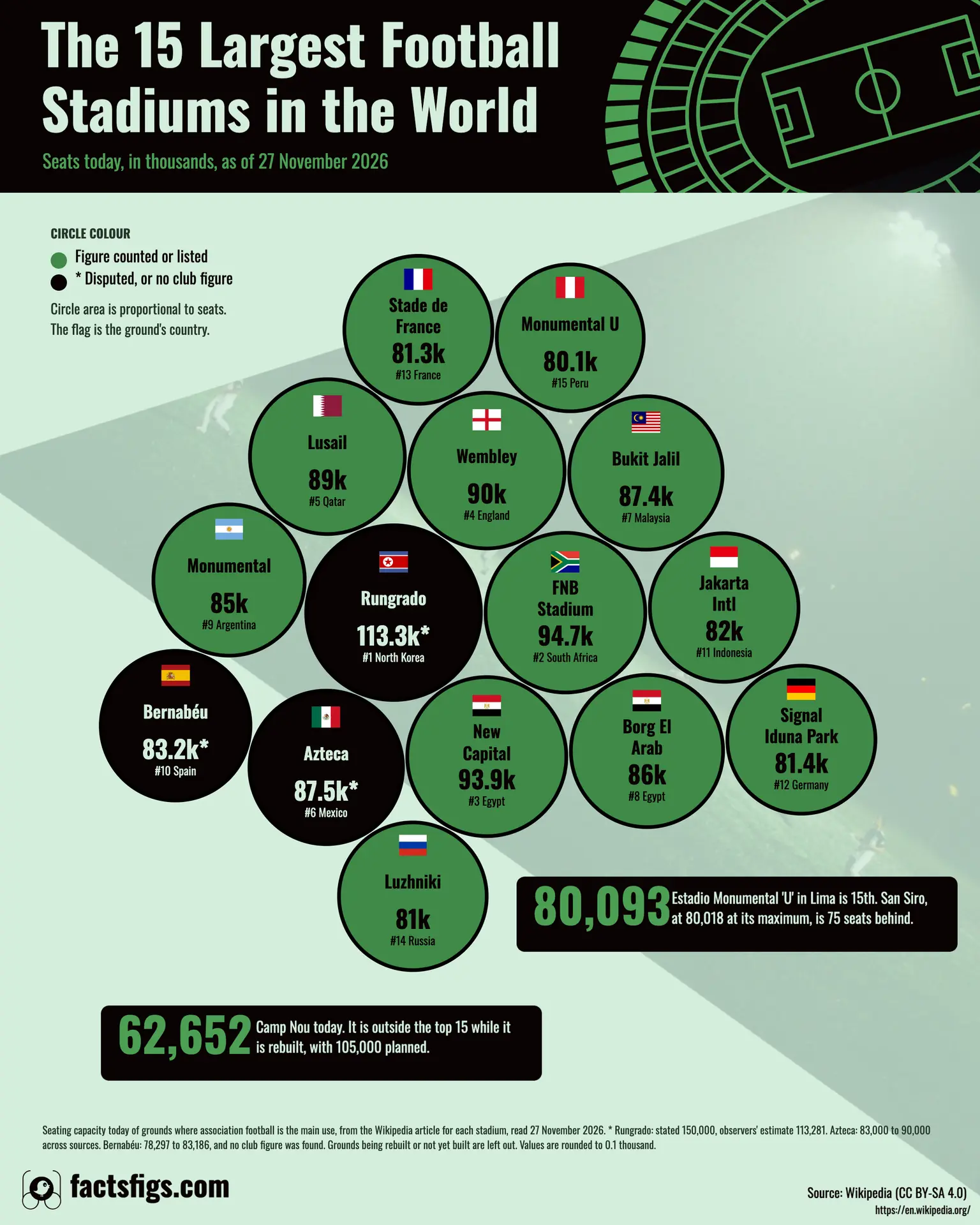
The largest football stadium in the world is Rungrado 1st of May Stadium in Pyongyang, at 113,281 seats, but that figure is an observers' estimate and North Korea's stated capacity is 150,000. The largest with a figure nobody disputes is FNB Stadium in Johannesburg, at 94,736.
Camp Nou, long the largest club ground, holds 62,652 while it is rebuilt, so it is outside the top 15 on 27 November 2026. The 15th ground, Estadio Monumental in Lima, holds 80,093. Europe has five of the 15, Asia four, Africa three, South America two and North America one.
The count covers grounds where association football is the main use. It leaves out Gaelic, rugby, cricket, athletics and American football venues, and grounds being rebuilt or not yet built.
! What the Data Shows:
•
Largest:Rungrado, 113,281 (an estimate).
•
Out for Now:Camp Nou, 62,652 during its rebuild.
•
15th:Monumental U in Lima, 80,093.
? Key Numbers:
•
Seats in the Top 15:1.32 million
•
Largest Region by Seats:Europe, 416,889
•
Gap, First to Second:18,545 seats
•
Gap, Second to 15th:14,643 seats
Rungrado's lead over second place is bigger than the whole spread from second to fifteenth, and it rests on an estimate. Take it away and the ranking is a tight band from 94,736 down to 80,093 seats, where 75 seats decide 15th place.
Continue reading below for the full detailed article →
Overview
Which Football Stadium Is the Largest in the World?
Lists of the biggest football stadiums disagree because they follow different rules. This post uses one rule and states it: the 15 largest grounds where association football is the main use, ranked by seating capacity today, as of 27 November 2026. It leaves out stadiums being rebuilt and stadiums not yet built, which is why Camp Nou is not on the list. Circle area in the chart is proportional to seats.
Three Numbers Behind the Chart
The leader, the best-known absence and the cut-off show how fragile this ranking is.
113,281: Rungrado, an Estimate
113281
Rungrado 1st of May Stadium in Pyongyang is listed at 113,281 seats. That is an observers' estimate made after a 2014 remodel. North Korea built it with an official capacity of 150,000 and has not published a new figure. Nobody has counted the seats independently, so the top place holds only if an estimate is accepted.
62,652: Camp Nou Today
62652
Wikipedia's capacity list still shows Camp Nou at 99,354, but Barcelona has been rebuilding it in phases since June 2023. A licence in early 2026 allowed 62,652 spectators, and the club plans 105,000 when the work ends, expected in 2027. At that size it would rank second on this list, behind only Rungrado.
80,093: The 15th Ground
80093
Estadio Monumental in Lima holds 80,093 and takes 15th place. San Siro in Milan is next at 80,018 at its stated maximum, 75 seats behind, and the Stade des Martyrs in Kinshasa lists 80,000. A figure revised by a few hundred seats, or counted in another configuration, could reorder the bottom of the list.
The Top 15 by the Numbers
15 GroundsFrom 80,093 to 113,281 seats.
1.32 Million SeatsIn the 15 combined.
27 Nov 2026The date of every figure.
The Rule
What Counts as a Football Stadium Here
The list comes from the stadium articles on Wikipedia, read on 27 November 2026. A ground counts when association football is its main use: it is the home of a club or a national team, or it was built for football. Shared grounds count, so Wembley, the Stade de France and FNB Stadium are in, even though they also stage rugby.
Venues built for another sport are out, even where Wikipedia's capacity list includes them: Croke Park in Dublin (82,300, Gaelic games), the Cotton Bowl in Dallas (92,100, college American football), Stadium Australia in Sydney (83,000, rugby league) and Beijing's National Stadium (91,000, used mainly for athletics and ceremonies). Cricket's Narendra Modi Stadium, at 132,000, is out for the same reason.
The Top Five
The Five Largest Football Grounds
Rungrado leads on 113,281, then FNB Stadium in Johannesburg on 94,736 and the New Administrative Capital Stadium in Egypt on 93,940. Wembley is fourth on 90,000 and Lusail in Qatar fifth on 88,966. The gap from first to second is 18,545 seats, more than the 14,643 between second and fifteenth.
Wembley is the largest ground in Europe while Camp Nou is rebuilt. FNB Stadium is the largest in Africa, with Egypt's new stadium close behind: it was completed in late 2023 and hosted its first match in March 2024. Lusail was built for the 2022 World Cup, where it held 88,966 for Argentina against Mexico.
Disputed Figures
Three Capacities Nobody Has Confirmed
Rungrado opened in 1989 with an official capacity of 150,000. After a 2014 remodel that replaced bench seating, observers estimated about 114,000, and Wikipedia lists 113,281 from a 2016 Stadiumdb report. Guinness World Records and Stadiumdb still give 150,000 as the stated figure. No independent count exists, and the stadium also stages mass games and athletics.
Estadio Azteca reopened in March 2026 after a rebuild. Wikipedia lists 87,523, The Score reported 87,500, and IQ Magazine and ESPN Deportes gave about 90,000. The Santiago Bernabéu is listed at 83,186, but a StadiumDB analysis in March 2026 estimated 78,297, and no figure from the club was found. Both stay in the ranking at the listed figure and carry an asterisk.
What Changed
Why Camp Nou and Salt Lake Are Not Here
Camp Nou is the best-known absence. Barcelona began rebuilding it on 1 June 2023 and reopened it in stages from late 2025. A licence in early 2026 allowed 62,652 spectators. Reports in April 2026 said the club aimed for about 80,000 by the end of the year, and the final target is 105,000, which would rank second on this list.
Wikipedia's capacity list still shows Salt Lake Stadium in Kolkata at 85,000, which would rank tenth. Its own article gives 68,000 since 2020, citing the All India Football Federation's 2020 Asian Cup bid book, and that is the figure used here. Shah Alam Stadium in Malaysia, listed at 80,372, has been closed for rebuilding since 2020, according to press reports, and its replacement is planned at 45,000.
By Region
Europe Has the Most Seats, Asia Close Behind
Europe has five of the 15 grounds and 416,889 seats, 32% of the total of 1,315,857. Asia has four grounds and 371,658 seats, 28%. Africa has three grounds and 274,676 seats, South America two and 165,111, and North America one, Estadio Azteca, with 87,523. Egypt is the only country with two grounds in the top 15.
The 14 grounds behind Rungrado average 85,898 seats, and 12 of the 15 hold between 80,000 and 90,000. That is why the circles in the chart look so alike: apart from Rungrado, FNB Stadium and the New Administrative Capital Stadium, the differences are small.
Counting Seats
How a Stadium's Capacity Is Counted
A stadium can have more than one capacity. Signal Iduna Park in Dortmund holds 81,365 for domestic matches but 66,099 for international matches. Wembley is listed at 90,000 for football and 86,000 to 87,000 in the UEFA configuration. Bukit Jalil in Kuala Lumpur shows 87,411 in use against a nominal 90,000.
This post uses the figure each article gives for football, which is the larger configuration where two exist. A ranking by the smaller UEFA or international figures would put Wembley lower and drop Dortmund out of the top 15 altogether.
Not Open Yet
The Stadiums That Are Not Open Yet
Two stadiums under construction would change the top of the list. Morocco's Grand Stade Hassan II, in Benslimane near Casablanca, is planned at 115,000 seats, which would put it ahead of Rungrado's estimate. Press reports give completion as December 2027 or the end of 2028. Saudi Arabia's King Salman International Stadium in Riyadh is planned at 92,760.
They are left out because a stadium that cannot host a match has no capacity to measure. The same goes for the expansion to about 100,000 that River Plate announced in January 2026 for Estadio Monumental in Buenos Aires, due by 2028: the ranking uses the 85,018 it holds today.
The Limits
What This Ranking Cannot Tell You
Every capacity is read from Wikipedia stadium articles, most of which cite Stadiumdb or similar databases, and no figure from a stadium operator was read in full for this post. Capacities change when seats are added or sections close, and several of these grounds are being rebuilt or expanded. The ranking is a snapshot of 27 November 2026, and a rule that counts rugby or athletics grounds would give a different list.
Capacity is also not attendance. Some of the largest grounds, such as Lusail and the New Administrative Capital Stadium, list only a national team as tenant, and the figure says nothing about how often a stadium fills. The post measures seats and nothing else.
The Verdict
The Verdict: A Tight Band Below Rungrado
The largest football stadium in the world is Rungrado on the numbers usually quoted, and the next 14 grounds sit in a band from 94,736 to 80,093 seats. Camp Nou and Salt Lake Stadium are absent because they hold fewer seats today than their reputations suggest.
The ranking will move. Camp Nou could return in 2027, Hassan II could open at 115,000 and Estadio Monumental in Buenos Aires plans to grow. Anyone quoting a largest stadium should state the rule, the date and whether the figure is stated or counted.
The Full Data Table
The 15 Largest Football Grounds, With Seats Today
Each ground, its city and country, its region and the seats listed for football on 27 November 2026. The note column flags disputed figures and other configurations.
1
Rungrado 1st of May Stadium
Pyongyang
🇰🇵 North Korea
Asia
113,281
Observers' estimate; stated figure 150,000
2
FNB Stadium
Johannesburg
🇿🇦 South Africa
Africa
94,736
Also stages rugby
3
New Administrative Capital Stadium
New Administrative Capital
🇪🇬 Egypt
Africa
93,940
National team only; opened 2024
4
Wembley Stadium
London
England
Europe
90,000
86,000 to 87,000 in the UEFA configuration
5
Lusail Stadium
Lusail
🇶🇦 Qatar
Asia
88,966
Built for the 2022 World Cup
6
Estadio Azteca (Estadio Banorte)
Mexico City
🇲🇽 Mexico
North America
87,523
Reopened March 2026; sources give 83,000 to 90,000
Seating capacity from the Wikipedia article for each stadium, read 27 November 2026. Rankings and regional totals are FactsFigs calculations. Grounds being rebuilt (Camp Nou, Shah Alam), under construction (Hassan II, King Salman) or built for another sport are excluded.
The capacities come from the English Wikipedia articles for each stadium and from its list of association football stadiums by capacity, read on 27 November 2026. Wikipedia text is available under CC BY-SA 4.0, and full credit for collecting and maintaining the records goes to its contributors. Where Wikipedia conflicted with other reports, for Rungrado, Estadio Azteca, the Santiago Bernabéu, Camp Nou, Salt Lake Stadium and Shah Alam Stadium, the differing figures are stated in the post. The Salt Lake figure of 68,000 is the one Wikipedia cites from the All India Football Federation's 2020 Asian Cup bid book. The ranking rule, regional totals and gaps are FactsFigs calculations.
FactsFigs reviews, cleans, and cross-checks every source dataset before shaping it into a data story. Each visualization is created and designed in FactsFigs Design Studio - an internal tool developed and owned by FactsFigs - and is the original work of a FactsFigs author, not an AI-generated copy of any existing graphic. Individual assets within a visual may or may not be produced with AI tools, but the design of the visual itself is solely FactsFigs' own.
Figures are estimates at the time of publication, provided for information only - nothing here is financial advice or a guarantee of accuracy.
Last verified: 27 Nov 2026
The charts in this article were built with our own publishing system. See what it does →