

56 yrs
The Chaparral 2J raced with a powered suction fan on 12 July 1970.

Facts & Figures
Visual Intelligence
By lowering the pressure beneath it by one to three per cent. That is all it takes.
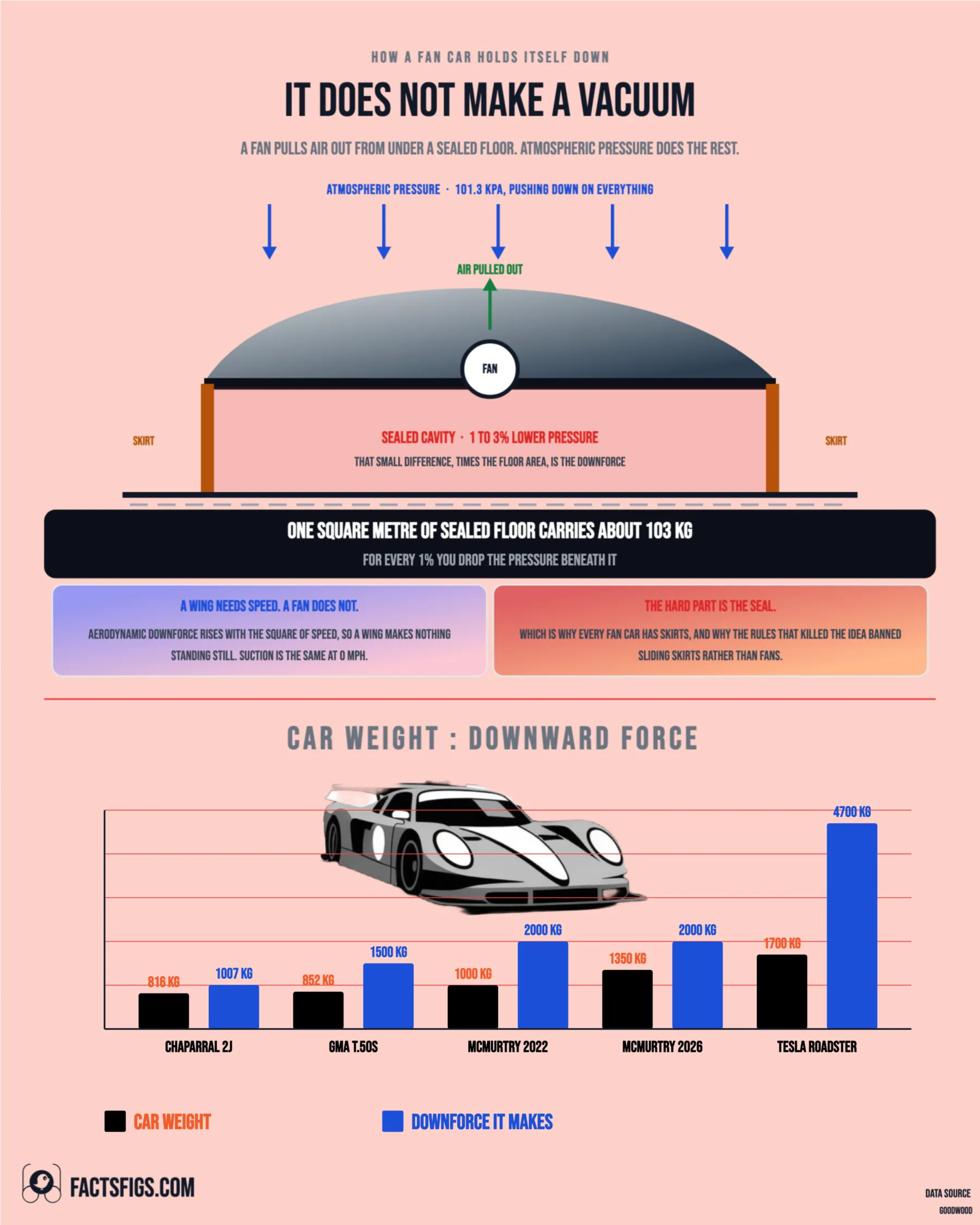
A fan pulls air out from under a floor sealed to the road by skirts. The pressure below drops a little, atmospheric pressure above does not, and the difference across the floor area presses the car down. One square metre of sealed floor carries about 103 kg for every one per cent the pressure drops, so a car of this size needs a drop of only one to three per cent to hold its own weight. Every fan car ever built claims to clear that bar. The idea is 56 years old, and only one has been shown driving inverted.
Continue reading below for the full detailed article →
The sourcing, stated first
Aerodynamic downforce rises with the SQUARE of speed, so a wing that presses down with 500 kg at 150 mph presses with about 125 kg at 75 mph. Quoting kilograms without the speed is meaningless, and most press material does exactly that. A fan is the exception, and it is the whole reason fan cars are interesting: it pulls the same at a standstill as at speed. That is why this page compares downforce against WEIGHT rather than in raw kilograms. The ratio is speed-free, it is comparable across fifty-six years, and it has one meaningful threshold. Above 1.0 a car presses down harder than gravity pulls it, which is the condition for sticking to a ceiling. The mechanism itself is less exotic than the stunts suggest. A fan pulls air out from under a floor sealed to the road, and atmospheric pressure does the work. One square metre of sealed floor carries about 103 kg for every one per cent the pressure beneath it drops, so a car of this size needs a drop of only one to three per cent to lift its own weight. The engineering problem was never making suction. It was sealing the floor, which is why every car here has skirts and why the rules that ended the idea banned sliding skirts rather than fans. One warning that applies to every number here: none of them has been independently tested. They are manufacturers’ claims, one calculated estimate from 1970, and one figure read off a display at the Tesla reveal.
How old the idea is, how much it is worth on track, and how briefly it has been proven.
56 yrs
The Chaparral 2J raced with a powered suction fan on 12 July 1970.
6.1%
How far ahead fan cars finished of the best non-fan rival, across six documented comparisons on the same course.
5 s
The total duration of the only inverted drive anyone has ever demonstrated, by McMurtry in April 2025.
Fifty-six years, not one
The Chaparral 2J raced at Watkins Glen on 12 July 1970 with two fans driven by a snowmobile engine, pulling air from under a car sealed to the track by sliding skirts. It is the first fan car to race, and nothing earlier turned up: a Chevrolet research vehicle tested the idea in 1968 and 1969 but never entered a race.
The 2J ran four events that season and was banned by the SCCA at the end of it. That ban is real, documented, and belongs to the Chaparral. It is not the ban most people are thinking of.
Then the idea went quiet for forty years. Between the Brabham’s single race in 1978 and Gordon Murray’s T.50 in 2020 there is almost nothing, which is itself worth noticing. Suction downforce was not suppressed by physics. It was suppressed by rulebooks, and it came back the moment somebody built a car that did not have to obey one.
The correction
Brabham brought the BT46B to the 1978 Swedish Grand Prix with a fan at the back. Niki Lauda won by half a minute. The car never raced again, and the story everyone tells is that it was banned immediately afterwards.
It was not. The stewards judged it legal, the result stood, and the governing body told Brabham’s designer Gordon Murray it could be run for the remainder of the season. Brabham withdrew it anyway, at Bernie Ecclestone’s request, under pressure from rival constructors. The regulations were reworded for the following year.
Brabham’s defence was that the fan’s primary job was cooling the engine, and that its aerodynamic effect was incidental. Whether anyone believed that is a separate question from whether it was ruled against, and it was not. The car even ran once more in fan form, in a timed trial at Donington in June 1979.
The distinction matters beyond trivia. A technology withdrawn under commercial pressure while legal has a different history from one outlawed on safety or fairness grounds, and only one of those things happened here.
What it is worth on track
Across six comparisons where a fan car and a conventional rival ran the same course, the fan car finished between 1.6 and 6.1 per cent ahead. Lauda won at Anderstorp by 34 seconds. The McMurtry Spéirling took the outright Goodwood hillclimb record in 2022 at 39.08 seconds, beating a time that had stood for 23 years.
Those margins are genuine, but they compare a car against a field, not a mechanism against itself. The Brabham was a good car with a good driver. The McMurtry is a purpose-built electric single-seater weighing under a tonne. How much of the gap is the fan is not something any of these results can tell you.
The measurement that would settle it is simple to describe and nobody has published it: the same car, on the same course, on the same day, with the fans running and then switched off. Fifty-six years, four manufacturers, and not one such figure exists in anything we could read.
The ceiling claim
Every fan car here claims a downforce-to-weight ratio above 1.0, which is the arithmetic condition for holding itself against gravity. Claiming it and doing it are different things.
McMurtry is the only one that has shown it. In April 2025 it ran a Spéirling on a rotating rig, inverted, from a standstill, for about five seconds and roughly a foot of travel, with what it described as independent adjudicators whom it did not name.
Tesla’s Roadster reached a 170 degree pitch on a curved ramp in October 2026, which is close to inverted and is not inverted. The Chaparral never attempted it; the idea that it could was inferred later by writers working from an estimate. Brabham never claimed it at all.
There is also a pattern in McMurtry’s own numbers worth noting. Its claimed downforce has stayed at 2,000 kg while the car has gained weight through development, so the ratio has fallen from 2.0 on the 2022 Goodwood car to 1.48 on the production version. The margin above the ceiling threshold is shrinking as the car becomes a real product.
Every fan car we could document
Downforce figures are as published by the maker unless marked otherwise. A blank is a number that does not exist in any source we could read, rather than one we left out.
| Chaparral 2J | 1970 | fan | 1007 | 1.23 | estimate (calculated from vacuum x skirt |
| Brabham BT46B | 1978 | fan | not published | does not exist | no downforce figure of any kind. The onl |
| McMurtry Spéirling (Goodwood demonstrator, 202 | 2022 | fan | 2000 | 2.00 | claimed (manufacturer) |
| McMurtry Spéirling PURE VP1 (validation protot | 2025 | fan | 2000 | 1.67 | claimed (manufacturer) |
| McMurtry Spéirling PURE (production) | 2026 | fan | 2000 | 1.48 | claimed (manufacturer); not in customer |
| Tesla Roadster (2026): fan suction, ramp hang | 2026 | hybrid | 4700 | 2.76 | claimed (on-screen readout at a product |
| Tesla Roadster (2026): fan suction, cornering | 2026 | hybrid | not stated in kg | 2.00 | claimed |
| Tesla Roadster (2026): whole aero package, hig | 2026 | aero | not stated in kg | 2.00 | claimed |
| Gordon Murray Automotive T.50 | 2022 | hybrid | not published as a kg | does not exist | claimed (manufacturer percentages) |
| Gordon Murray Automotive T.50s Niki Lauda | 2022 | hybrid | 1500 | 1.76 | claimed ('developed for') |
| McLaren F1 (road car) | 1992 | hybrid | does not exist (percen | does not exist | claimed: +5% downforce, -2% drag (McLare |
| Tyrrell 008 (fan test only) | 1977 | fan | does not exist | does not exist | no figures |
| Lotus 79 (comparator, not a fan car) | 1978 | aero | does not exist (no kg | does not exist | '25% more downforce than the Lotus 78' ( |
The Brabham BT46B is in this table with no downforce figure because none was ever published. Its fan was driven off the gearbox, so unlike the Chaparral and the McMurtry its suction rose and fell with road speed rather than working at a standstill.
Where the Roadster sits
The Roadster tops this chart at 2.76, and that figure deserves the least confidence of any on it. It divides a 4,700 kg reading from a screen at the reveal by a target weight of just under 1,700 kg that an executive gave in an interview. Neither number is a published specification.
Tesla also stated a different figure on stage: suction of up to 2 g, which is a ratio of 2.0. Those two numbers describe the same car and do not agree, and Tesla has not reconciled them. We have used both, kept them apart, and labelled which is which.
What the Roadster does bring that the racing cars did not is a road car with four fans and deployable skirts described in a 2025 patent, aimed at customers rather than a rulebook nobody will let it race under. Whether the production car carries any of it is still unannounced.
Goodwood Festival of Speed hillclimb records FIA Formula One Technical Regulations
Downforce and weight figures are as published by each manufacturer, except the Chaparral 2J, whose figure is a calculated estimate made by others from two published inputs, and the Tesla Roadster, whose 4,700 kg comes from an on-screen reading at its October 2026 reveal reported by two outlets.
Nothing on this page has been independently measured. No manufacturer in fifty-six years has published a fans-on against fans-off comparison for the same car, and where a downforce figure carries no speed we have said so rather than assuming one.
The Brabham BT46B account rests on Gordon Murray’s own statements and contemporary records. The popular claim that the car was banned after the 1978 Swedish Grand Prix is not supported: the result stood, the car was ruled legal, and Brabham withdrew it. Sources differ on precisely when and how the rules were subsequently reworded, and we have not found a dated formal ban.
The current Formula One technical regulations were read directly. They prohibit any device bridging the gap between the sprung part of the car and the ground, and require bodywork to be immobile and impervious, which is what rules a fan car out. The word "fan" does not appear. We did not read the rulebooks of other racing series, so this page makes no claim about them.
Related Publications
The highest EPA-rated range peaked at 520 miles in 2022 and has slipped to 512. Meanwhile the median electric car went from 82 miles to 295.
19 Oct 2026
Tesla claims 1.99 seconds for the Plaid, measured with a one-foot rollout. Here is what Car and Driver and MotorTrend actually recorded, for it and fourteen other runs.
19 Oct 2026
Tesla’s Roadster climbed a ramp upside down and flipped over a row of cars. The footage is real, but it is not flight: here is how the suction and thrusters actually work.
18 Oct 2026
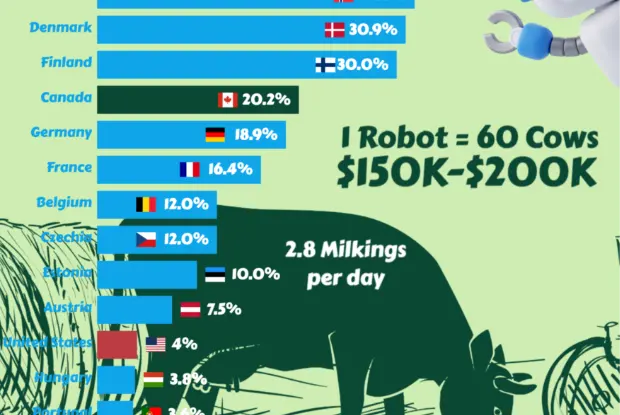
Nearly half of Swedish dairy farms milk with robots; the US manages about 4%. Eighteen countries ranked, with the herd-size and budget arithmetic.
07 Oct 2026