
4700 kg
Tesla’s on screen reading while the car hung from the ramp at a 170 degree pitch.

Facts & Figures
Visual Intelligence
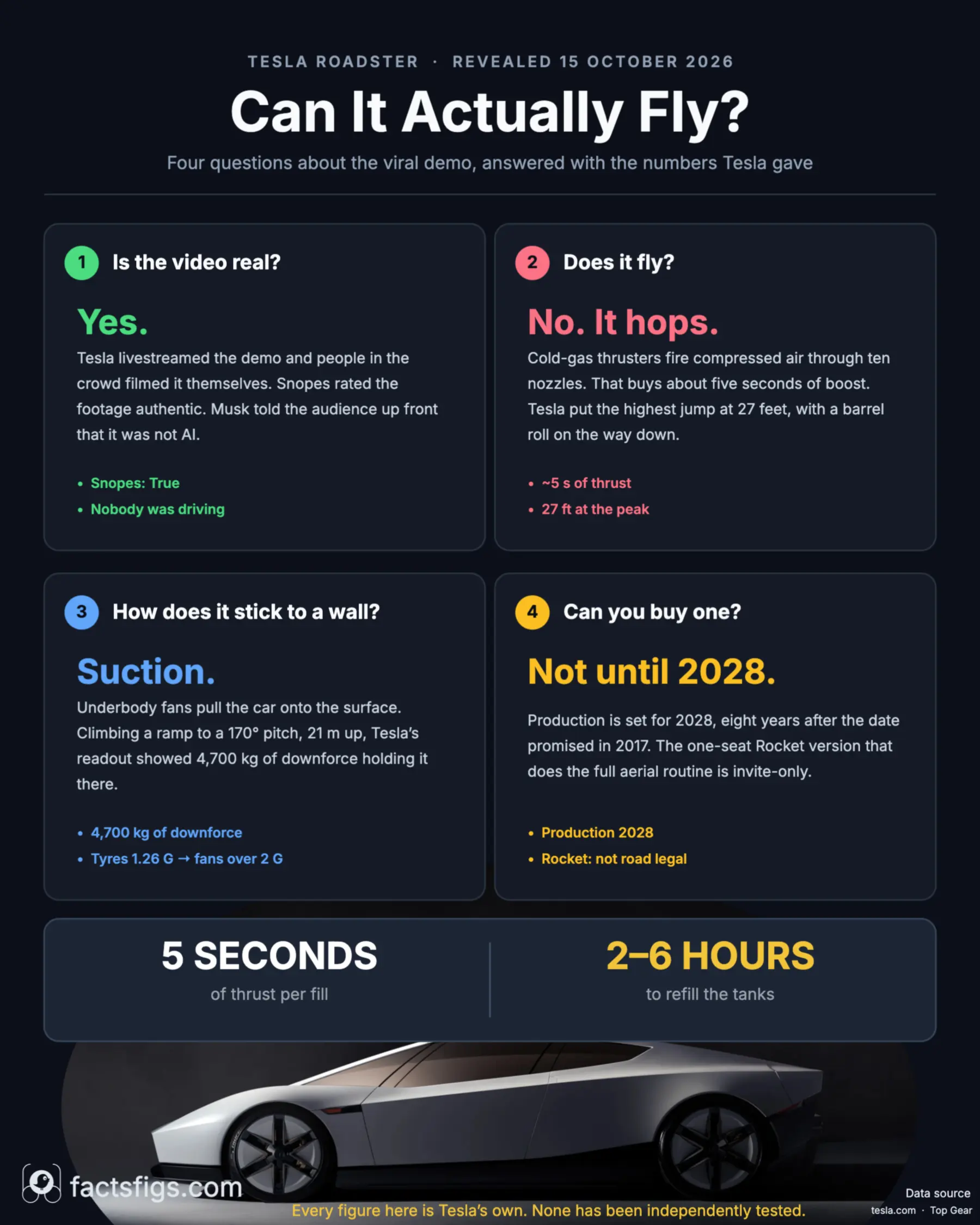
No. It leaves the ground for about five seconds at a time.
The Roadster does not fly in any sustained sense. Cold gas thrusters fire compressed air through ten nozzles, and Tesla vehicle engineering chief Lars Moravy put that at roughly five seconds of boost before the tanks need refilling. Refilling them takes two to six hours today. Tesla wants to bring that down to about 30 minutes. The footage itself is genuine. Tesla livestreamed the event on 15 October 2026, people in the crowd filmed it independently, and Snopes rated the videos authentic.
Continue reading below for the full detailed article →
The sourcing, stated first
This post uses figures Tesla and its executives stated at the 15 October 2026 reveal and in interviews around it. That is the only source of specifications that exists right now, and it matters that you know it: the car is not in production, no independent party has measured any of it, and several headline numbers come from readouts on a screen behind a stage. What has been checked is the footage. Snopes rated the videos authentic, and the reason that question came up at all is the interesting part of this story. AI generated clips of Elon Musk testing flying Teslas had been circulating since March 2026, so when a real demonstration arrived, a large share of the internet assumed it was synthetic. Musk opened by telling the audience it was not AI.
What held it to the ramp, how high it got, and how long the thrust lasts.
4700 kg
Tesla’s on screen reading while the car hung from the ramp at a 170 degree pitch.
27 ft
The highest jump of the demo, with a roll before landing back on its wheels.
5 s
Boost available per fill, per Tesla engineering chief Lars Moravy. Refilling takes two to six hours.
The first question everybody asked
Tesla livestreamed the reveal from SpaceX’s McGregor site in Texas on 15 October 2026, and people in the audience filmed the same stunts on their own phones from their own angles. Snopes examined the clips and rated them authentic, finding nothing to suggest the footage was generated or edited. Top Gear had staff in the room.
The doubt was reasonable, and that is what makes it worth recording. In March 2026 the fact checking site Boatos documented a run of AI generated videos that showed Musk testing Tesla branded flying vehicles. None of those were tied to a real programme. By the time an actual demonstration happened, the format had been so thoroughly faked that a genuine event looked like one more synthetic clip, and Musk opened the presentation by telling the crowd it was not AI.
One detail gets lost in the reposts: nobody was driving. Musk described the car as autonomous for the demonstration, and the seat was occupied by a mannequin rather than a person. Tesla has said the production Roadster will be the only car it still builds for manual driving.
Watch it yourself
Posted by Tesla on 15 October 2026, the evening of the reveal. The car launches off the end of the ramp, rotates, and lands back on its wheels. Nobody is inside it.
Tesla The clip that spread fastest, and the one most often reposted with a claim that it was AI generated.
The part that looks impossible
The car never climbs a wall. It drives up a curved ramp that carries it over to a 170 degree pitch, roughly 21 metres above the ground, which leaves it hanging close to upside down. What holds it there is suction, and the system is the least futuristic thing on the car.
Fans mounted in the rear diffuser area pull air out from under the vehicle. The low pressure that creates presses the car onto whatever surface it is on, and it works the same whether that surface is below the car or above it. While the Roadster hung from the ramp, Tesla’s own display showed 4,700 kg of downforce. Musk said the fans can pull up to 2 G.
The useful comparison is not with other stunts but with tyres. Moravy put ordinary tyre grip at about 1.26 G, which is the real limit on how hard any road car can corner. The fan system is a way around that ceiling, and Tesla says it lifts cornering past 2 G. At low speed the system sucks the car down for traction, and at higher speed the front and rear sections open up to move more air under the floor.
Fan cars are not new. The idea was raced and banned in Formula One in 1978, and the McMurtry Speirling has used it to set hill climb records. A 2025 Tesla patent describes deployable skirts to seal the gap between floor and surface, though Tesla has not said whether production cars will carry them.
What is in the tanks
SpaceX built the thruster system, which is why the word rocket attaches itself to every description of this car. Nothing on the Roadster burns. These are cold gas thrusters, and they work by releasing compressed gas through a nozzle fast enough to produce thrust in the opposite direction. The same principle moves satellites around in orbit and fills a party balloon that has been let go.
Moravy gave the hardware on stage. Two carbon overwrapped pressure vessels, the tank type SpaceX flies on Falcon 9, hold 600 litres between them and carry about 250 kg of compressed air. Ten nozzles do the work: four main thrusters in the rear diffuser for acceleration, and units at each corner that fire downward to cushion a landing. Tesla puts total thrust at over 80 kN, which is enough force to hold more than 8,000 kg against gravity.
Tesla has not published the tank pressure, but it appears in the company’s own interior photographs. A thruster readout on the cabin display reads 5,500 psi, roughly 380 bar.
What those thrusters are for depends on which version you are looking at. On the road going cars they are an acceleration aid, firing backwards to add force the tyres cannot. The aerial routine that went viral belongs to one variant only.
The limit nobody put on a slide
Moravy told Top Gear that the Thrust version’s 200 litre tank holds roughly five seconds of boost, and that refilling it from an external high pressure nitrogen supply currently takes two to six hours. Tesla wants to get that down to about 30 minutes.
Put those two numbers next to each other and the scale of the gap is the story. At the quickest end of the range, every second of thrust costs about 24 minutes of refilling. At the slow end it is closer to 72 minutes. A full tank buys one stunt, or a handful of straight line launches, and then the car is a very fast electric coupe until it has been plugged into something.
There is an unresolved contradiction here that Tesla has not addressed. Musk said on stage that the Roadster can replenish its own tanks with ordinary air and would puff itself up, which does not obviously fit with Moravy describing a connection to an external nitrogen supply. The Top Gear interview was filmed before the reveal, so one may describe what exists now and the other what is planned. Tesla has not explained how the two fit together, and until it does, the refill figures should be read as describing the demonstration cars rather than anything a customer will own.
Three cars, one routine
Tesla is selling the Roadster in three configurations, and they are not trim levels in the usual sense. Performance is the road ready two seater. It gets the suction system and the active aerodynamics but no thrusters at all, which means the car most people could actually buy does not leave the ground.
Thrust adds the rear mounted thrusters and the 200 litre tank for acceleration. It is a two seater, and it is the version those five second and two to six hour figures describe.
Rocket is the one in the footage. It replaces the passenger seat with a 400 litre pressure vessel, bringing the total to 600 litres, and adds thrusters around the perimeter for the full aerial routine. It seats one person, it is sold by invitation only, and Tesla states plainly that it is not approved for use on public roads. The flying car, in other words, is a single seat machine that is not street legal and that you cannot ask to buy.
Claim by claim
The Roadster is not in production and none of these numbers has been independently measured. This table records what was stated, by whom, and on what basis.
| Downforce in the ramp hang | 4,700 kg | Tesla | On screen readout during the demo |
| Suction capability | Up to 2 G | Elon Musk | Stated on stage |
| Tyre grip for comparison | About 1.26 G | Lars Moravy | Stated on stage |
| Total thrust | Over 80 kN | Tesla | Reveal materials |
| Nozzles | 10 | Lars Moravy | Stated on stage |
| Tank capacity | 600 litres across two tanks | Lars Moravy | Stated on stage |
| Air carried | About 250 kg | Lars Moravy | Stated on stage |
| Tank pressure | 5,500 psi | Tesla | Readout in official interior photographs |
| Boost per fill | About 5 seconds | Lars Moravy | Top Gear interview |
| Refill time | 2 to 6 hours, target 30 minutes | Lars Moravy | Top Gear interview |
| Peak jump height | 27 feet | Tesla | Stated after the demo |
| Ramp pitch and height | 170 degrees, about 21 m | Tesla | Demo commentary |
| 0 to 60 mph | 0.81 s live, 1.0 s recorded | Tesla | Stage run, cut short for space |
| Top speed | Over 230 mph | Tesla | Reveal materials |
| Production start | 2028 | Elon Musk | Stated on stage |
Figures as stated on and around 15 October 2026. Tesla has published no curb weight, range, power output or final pricing.
The gaps
The missing numbers are the ones that would let anyone check the claims. Tesla gave no curb weight, which matters because the 4,700 kg downforce reading only means something next to the mass it is holding. It gave no battery capacity and no range figure, after promising 620 miles for the 2017 prototype. It gave no power output. It announced no price for any version, and the reservation amounts that exist are deposits rather than the cost of the car.
The acceleration claim moved during the event itself. A live run showed 0.81 seconds to 60 mph, which Tesla said was cut short because the pad ran out of room, while a recorded run showed a full second. Neither has been repeated by anyone outside the company.
Then there is the date. The Roadster was shown in November 2017 with production promised for 2020, and the target has moved roughly every eighteen months since. Musk now says 2028, which is eight years later than the original commitment and ten years after reservations first opened. That history is not a reason to dismiss the demonstration, which plainly happened. It is a reason to treat the production car as a separate question from the prototype that jumped over a Cybertruck.
Tesla Roadster Snopes fact check on the Roadster videos
Specifications on this page are as stated by Tesla, by chief executive Elon Musk and by vice president of vehicle engineering Lars Moravy at and around the Roadster reveal on 15 October 2026. The boost duration and refill figures come from Moravy’s walkaround interview with Top Gear. The tank pressure is read from a cabin display in Tesla’s own photographs.
The authenticity of the demonstration footage was checked by Snopes, which rated it true on the basis that Tesla livestreamed the event and independent attendees filmed the same stunts. The earlier AI generated clips of Tesla branded flying vehicles were documented by Boatos in March 2026.
No figure here has been independently verified, because the car is not in production and no third party has tested one. Where Tesla has published nothing, this page says so rather than substituting an estimate. FactsFigs will publish a new page rather than revise this one if Tesla releases measured specifications.
Related Publications
Nearly half of Swedish dairy farms milk with robots; the US manages about 4%. Eighteen countries ranked, with the herd-size and budget arithmetic.
07 Oct 2026

Credit cards feature in 39.6% of identity theft reports to the FTC, but state shares run from Wyoming's 26.7% to Florida's 50.1%.
06 Oct 2026
Volunteers have mapped 1,378 US data center buildings in OpenStreetMap. Virginia leads with 291, but count campuses instead and Texas wins.
06 Oct 2026
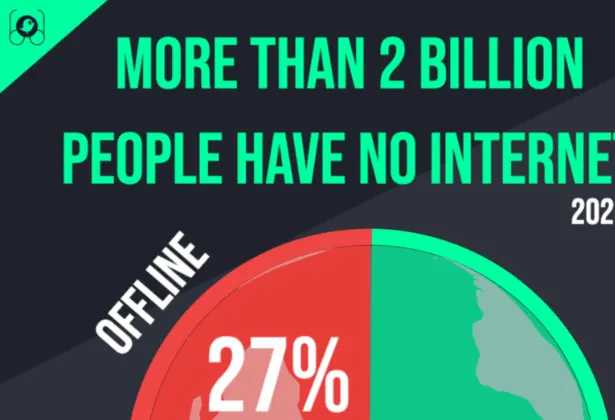
Three quarters of the world was online in 2025. Of the 2.2 billion who were not, roughly 1.9 billion already live under a mobile broadband signal they do not use.
21 Sept 2026