

67% of planets
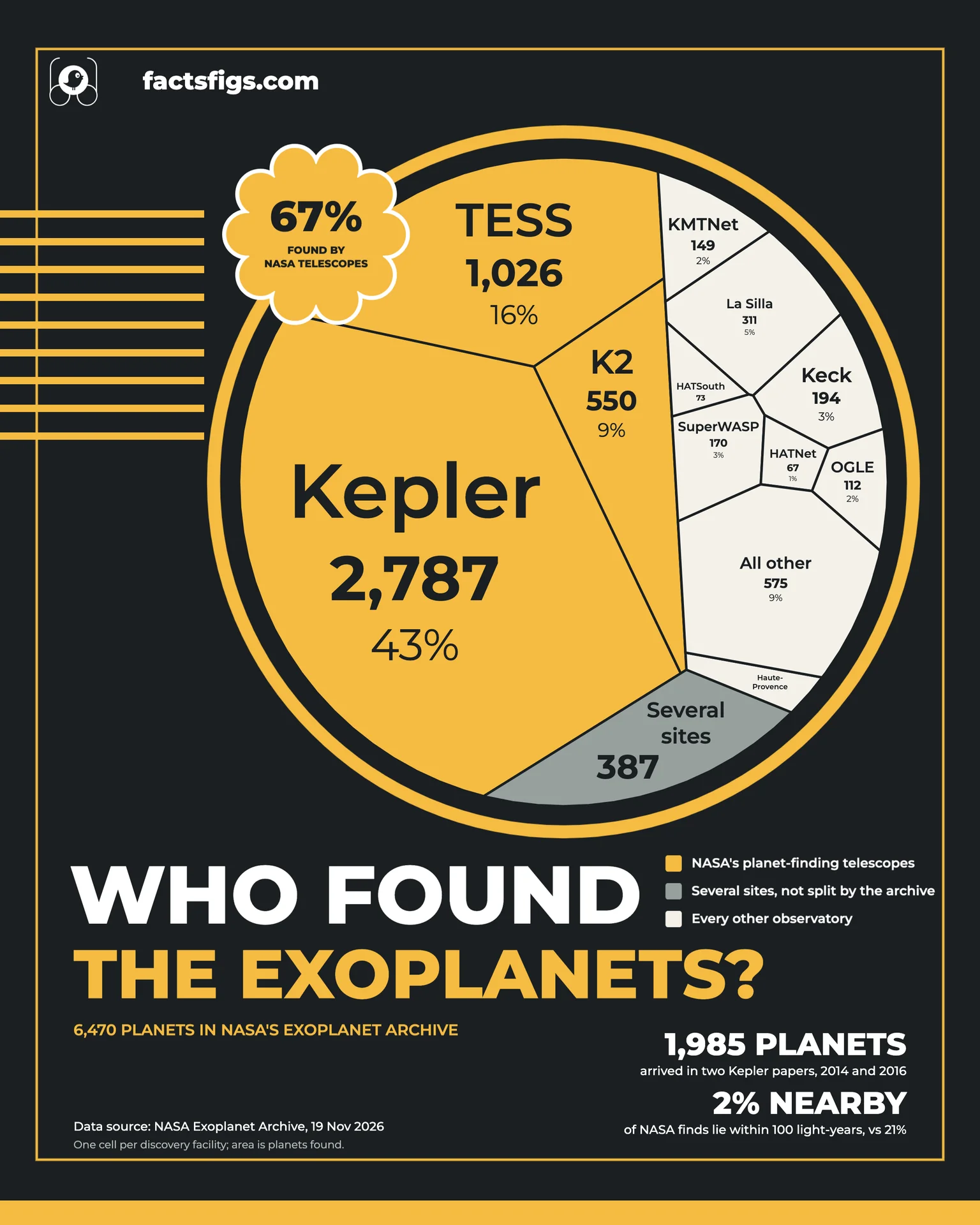
Kepler, TESS and K2 found 4,363 of the 6,470 confirmed planets, 67.4%. Add other NASA telescopes and part-funded ground sites and it is 70.7%.

Facts & Figures
Visual Intelligence
NASA's list holds 6,470 planets from every telescope. Three NASA telescopes found 67% of them.
NASA's Exoplanet Archive, run by Caltech for NASA, listed 6,470 confirmed exoplanets on 19 November 2026. It counts every confirmed planet from any telescope in the world, so the number is not a tally of NASA discoveries. NASA's three planet-finding telescopes, Kepler (2,787 planets), TESS (1,026) and K2 (550), found 4,363 of them, which is 67%. Two Kepler papers alone, published in 2014 and 2016, added 1,985 planets, almost a third of the list. Planets from NASA's telescopes are far away: only 2.2% lie within 100 light-years, against 21% of planets found by other telescopes.
NASA's count is the world's count. Three NASA telescopes found two in three of the planets on it, but they found far-off planets, and almost a third of the list came from just two Kepler papers.
Continue reading below for the full detailed article →
Overview
The NASA Exoplanet Archive is the list behind almost every exoplanet headline. It is run by the California Institute of Technology for NASA. A planet goes on it when a peer-reviewed paper reports it, its mass is at most 30 times Jupiter's and a false positive is judged unlikely. The archive says it follows papers that use both NASA and non-NASA telescopes. So the count measures planets that scientists around the world have confirmed, not planets NASA discovered. NASA's own announcement that the count passed 6,000 on 17 September 2025 says planets are added by scientists worldwide. Its pages still describe planets as "confirmed by NASA", wording that makes the misreading easy. This page asks a narrower question that the archive can answer: which telescope is named as the discovery facility for each of the 6,470 planets? We call a planet a NASA finder's when that field says Kepler, K2 or TESS, and we show other definitions below. The counts change weekly, and everything here is as of 19 November 2026.
How much of the list NASA's telescopes found, how much came in two batches and how near the planets are.
67% of planets
Kepler, TESS and K2 found 4,363 of the 6,470 confirmed planets, 67.4%. Add other NASA telescopes and part-funded ground sites and it is 70.7%.
1985 planets
Rowe et al. 2014 (716 planets in the archive) and Morton et al. 2016 (1,269) add up to 30.7% of the list and 71.2% of Kepler's planets.
2.2% of NASA finds
Only 95 of the 4,349 planets from Kepler, K2 and TESS with a known distance are that near, against 21.3% of the planets found by every other facility.
The count
It depends what you mean by NASA, and the archive cannot give one exact number. The strictest definition counts planets whose discovery facility is one of NASA's three planet-finding telescopes: Kepler 2,787, TESS 1,026 and K2 550. That is 4,363 planets, or 67.4% of 6,470. It is the figure we use, and it means found in data from NASA telescopes, not found by NASA employees.
Add NASA's other space telescopes, Hubble 6, Spitzer 4, the James Webb Space Telescope 3 and the WISE satellite 1, and the count is 4,377. Add the ground observatories NASA helps fund, W. M. Keck Observatory 194 and NASA's Infrared Telescope Facility 1, and it is 4,572, or 70.7%. We keep Keck out of the headline because it is privately owned, with NASA as a partner since 1994.
A further 387 planets are filed under Multiple Observatories or Multiple Facilities with no telescope named, so nobody can split them. The other 1,511 planets, 23.4%, sit under facilities with no NASA role that we found, from La Silla to the Haute-Provence Observatory.
NASA's milestones read the same way. NASA said the count passed 5,000 on 21 March 2022, when a batch of 65 planets was added, and 6,000 on 17 September 2025. Both are counts of the archive, not of NASA missions.
The count
Each row adds one more group of facilities to the one above it, apart from the last two rows, which are the planets we do not count as NASA finds.
| Strict: NASA's three planet-finding telescopes | Kepler, K2, TESS | 4,363 | 67.4% |
| Plus other NASA space telescopes | Hubble, Spitzer, James Webb, WISE | 4,377 | 67.7% |
| Plus ground sites NASA part-funds | W. M. Keck Observatory, NASA Infrared Telescope Facility | 4,572 | 70.7% |
| Not split by the archive, not counted | Multiple Observatories, Multiple Facilities | 387 | 6.0% |
| No NASA role found | 62 other facilities | 1,511 | 23.4% |
Counts are from the NASA Exoplanet Archive composite planetary systems table on 19 November 2026. The grouping is FactsFigs' own. The NASA role in each case is judged from NASA's own pages, and we found no NASA role for the last group.
The telescopes
Kepler is first by a wide margin with 2,787 planets, 43% of all. TESS is second with 1,026, and K2, which reused the Kepler spacecraft after it lost a second reaction wheel in 2013, is third with 550. The biggest non-NASA entry is the 387 planets filed under several sites. The biggest single observatory is La Silla with 311, then Keck with 194, the four SuperWASP survey names together with 170, KMTNet with 149, OGLE with 112 and HATSouth with 73.
Space telescopes from other programmes found few. CoRoT found 35, ESA's Gaia 17 and the CHEOPS satellite 4. NASA's other space telescopes found fewer still: Hubble 6, Spitzer 4 and the James Webb Space Telescope 3.
By method, transit, where a planet dims its star as it passes in front, accounts for 74.2% of all planets. Radial velocity, where a planet makes its star wobble, accounts for 18.6%, microlensing 4.5% and direct imaging 1.5%. All but 30 of the 4,363 planets from Kepler, K2 and TESS were found by transit, which is why NASA's share is so high.
Kepler
Kepler launched on 6 March 2009 and NASA retired the spacecraft on 30 October 2018, but its planets did not arrive evenly. On 26 February 2014 NASA announced 715 new planets verified at once, by a statistical method that checks planets in systems with several. The archive files 716 under that paper, Rowe et al. 2014. On 10 May 2016 NASA announced 1,284 more, each with more than a 99% probability of being a real planet. The archive files 1,269 under Morton et al. 2016.
Together that is 1,985 planets, 30.7% of the archive and 71.2% of everything Kepler found. A chart of discoveries by year is therefore a chart of when papers were published. The archive shows 784 Kepler planets with a discovery year of 2014 and 1,276 with 2016, then a third batch: 301 planets validated by ExoMiner, a machine-learning tool, which NASA announced on 22 November 2021.
Kepler's list is still growing. 461 Kepler planets carry a discovery year after the spacecraft was retired, because its data are still being mined. NASA's count is a measure of when scientists publish, which is why it moves in steps.
The neighbourhood
Mostly not. Planets found by Kepler, K2 and TESS have a median distance of 1,596 light-years, and Kepler's alone 2,504. For planets found by every other facility the median is 309 light-years. Only 95 of the 4,349 NASA-finder planets with a known distance, 2.2%, lie within 100 light-years, against 446 of 2,093, or 21.3%, for the rest.
The famous firsts were not NASA finds either. The first planets, two circling a pulsar, were found in 1992 with the Arecibo Observatory. The first planet around a Sun-like star, 51 Pegasi b, was found in 1995 from the Haute-Provence Observatory. The closest known exoplanet, Proxima Centauri b, 4.24 light-years away, was found in 2016 with the European Southern Observatory.
TRAPPIST-1, seven Earth-sized planets about 40 light-years away, shows how fuzzy credit can be. NASA's release of 22 February 2017 says its Spitzer telescope confirmed two of the planets announced in 2016 and discovered five more. The archive files three of the seven under La Silla Observatory and the other four under Multiple Observatories, and none under Spitzer. Both are real records, kept for different purposes.
Earth-sized planets
The archive's smallest size bin is planets up to 1.25 times Earth's radius. 564 planets have a measured radius that small, 11.6% of the 4,871 planets with a measured radius, and 552 of them, 97.9%, were found by Kepler (426), TESS (64) or K2 (62). On this measure NASA's telescopes found nearly all the Earth-sized planets we can see.
That does not mean 552 rocky planets. A radius alone does not tell you what a planet is made of, and only 113 of the 564 have a mass that was measured, not estimated from the radius. It does not mean habitable either, because the archive's temperature column is a model value, not a surface temperature.
Size is also the weakest number in the archive. Of 6,420 planets with a radius, 4,871 were measured, mostly by transit, and 1,544 were calculated from the planet's mass. Fifty have no radius. We use measured radii only. There is no single agreed cut for Earth-sized; ours is the archive's own 1.25 bin, and other studies use cuts from 1.6 to 2 times Earth's radius.
The limits
The map shows who published, not who tried hardest. The facility is the one named for the discovery, and a planet found in Kepler data by a university team counts as a Kepler planet here. Discovery years are the archive's, and for 1,158 planets the year is earlier than the paper's publication date, so we use them only for the batches above.
The counts change every week. The archive adds planets weekly, drops ones later shown to be false positives, and still lists 58 planets whose status is questioned in the literature, which we kept in. NASA's 6,000 announcement says more than 8,000 further candidates await confirmation, and they are not counted as planets.
Each kind of telescope sees only some planets, so the map tells you who found planets, not how many planets of each kind exist. Space telescopes also had to be launched first, and what that costs per kilogram is in the post below.
Every facility
Ordered by planets found. Where is the facility's usual location, and the NASA role column is our grouping, not the archive's.
| Kepler | Space | 2,787 | 43.1% | 2009 | 2026 | NASA planet-finding telescope |
| Transiting Exoplanet Survey Satellite (TESS) | Space | 1,026 | 15.9% | 2018 | 2026 | NASA planet-finding telescope |
| K2 | Space | 550 | 8.5% | 2014 | 2026 | NASA planet-finding telescope |
| Multiple Observatories | Ground | 355 | 5.5% | 1996 | 2026 | Several sites, not split |
| La Silla Observatory | Ground | 311 | 4.8% | 1999 | 2026 | No NASA role found |
| W. M. Keck Observatory | Ground | 194 | 3.0% | 1998 | 2026 | Ground observatory NASA part-funds |
| KMTNet | Ground | 149 | 2.3% | 2016 | 2026 | No NASA role found |
| SuperWASP | Ground | 122 | 1.9% | 2007 | 2025 | No NASA role found |
| OGLE | Ground | 112 | 1.7% | 2002 | 2026 | No NASA role found |
| HATSouth | Ground | 73 | 1.1% | 2012 | 2021 | No NASA role found |
| Haute-Provence Observatory | Ground | 69 | 1.1% | 1995 | 2025 | No NASA role found |
| HATNet | Ground | 67 | 1.0% | 2006 | 2021 | No NASA role found |
| Paranal Observatory | Ground | 41 | 0.6% | 2004 | 2026 | No NASA role found |
| Roque de los Muchachos Observatory | Ground | 40 | 0.6% | 2011 | 2026 | No NASA role found |
| Lick Observatory | Ground | 36 | 0.6% | 1996 | 2024 | No NASA role found |
| Okayama Astrophysical Observatory | Ground | 36 | 0.6% | 2003 | 2023 | No NASA role found |
| CoRoT | Space | 35 | 0.5% | 2008 | 2022 | No NASA role found |
| Anglo-Australian Telescope | Ground | 34 | 0.5% | 2000 | 2019 | No NASA role found |
| Las Campanas Observatory | Ground | 34 | 0.5% | 2008 | 2026 | No NASA role found |
| MOA | Ground | 34 | 0.5% | 2008 | 2026 | No NASA role found |
Showing 1-20 of 73
Counts are from the NASA Exoplanet Archive composite planetary systems table (DOI 10.26133/NEA13), fetched on 19 November 2026 at 09:33 GMT. The archive changes weekly. SuperWASP appears under four names here, as the archive lists it, and the map merges them. The NASA role column is FactsFigs' own.
NASA Exoplanet Archive Christiansen et al. (2025): the NASA Exoplanet Archive, Planetary Science Journal
The planet counts, discovery facilities, methods, radii and distances are from the NASA Exoplanet Archive's composite planetary systems table (DOI 10.26133/NEA13), fetched on 19 November 2026 at 09:33 GMT. This research has made use of the NASA Exoplanet Archive, which is operated by the California Institute of Technology, under contract with the National Aeronautics and Space Administration under the Exoplanet Exploration Program. The archive's published reference is Christiansen et al. (2025). The batch figures for Kepler come from NASA's releases of 26 February 2014 and 10 May 2016, the milestones from NASA's articles of 21 March 2022 and 17 September 2025, and the TRAPPIST-1 statement from NASA's release of 22 February 2017. The groupings, shares, medians and distance figures are FactsFigs' own arithmetic on the archive's rows. The data was manually collected by FactsFigs. The illustration of the Kepler spacecraft on the map is an artist's concept by NASA/Ames/JPL-Caltech. NASA and Caltech do not endorse this page. Full credit for the planets goes to the teams that found them and to the archive.
FactsFigs reviews, cleans and cross-checks every source dataset before shaping it into a data story. Each visualization is created and designed in FactsFigs Design Studio, an internal tool developed and owned by FactsFigs, and is the original work of a FactsFigs author, not an AI-generated copy of any existing graphic. Individual assets within a visual may or may not be produced with AI tools, but the design of the visual itself is solely FactsFigs' own.
Figures are estimates at the time of publication, provided for information only. Nothing here is financial advice or a guarantee of accuracy.
Last verified: 19 Nov 2026
Related Publications
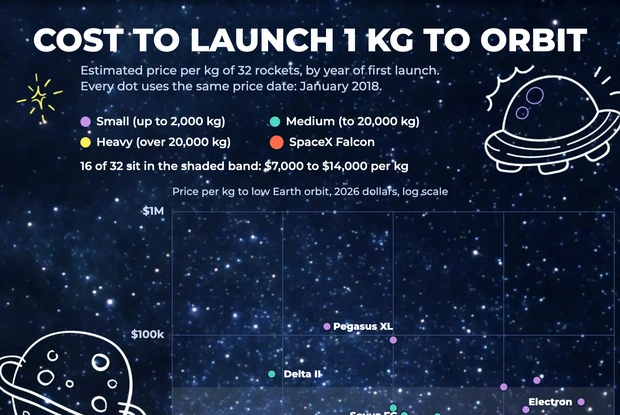
FAA price estimates for 32 rockets show no trend by launch year. Falcon 9 is $3,604 per kg against a $12,719 median, and its list price is down 7% since 2018.
18 Nov 2026
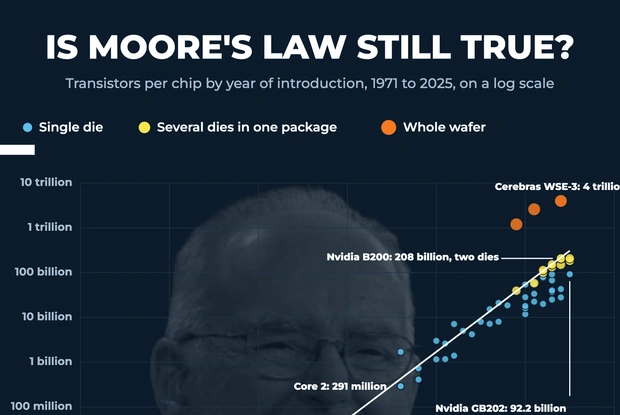
Transistor counts for 63 chips from 1971 to 2025 still follow a doubling every two years for the biggest packages, while single dies slowed to 2.8 years.
17 Nov 2026
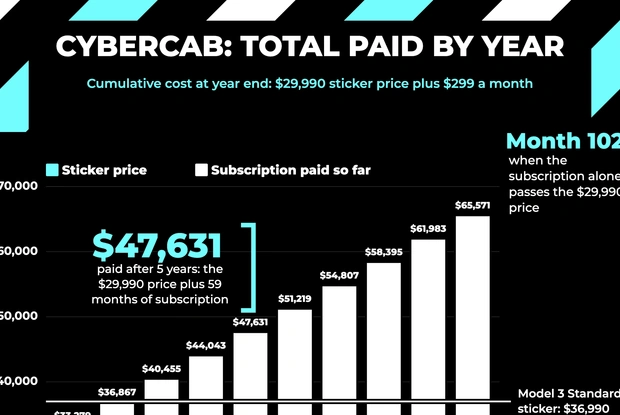
Tesla's Cybercab costs $29,990, under the $30,000 Musk promised, but needs a $299-a-month subscription to run. Total paid after 5 years: $47,631.
15 Nov 2026
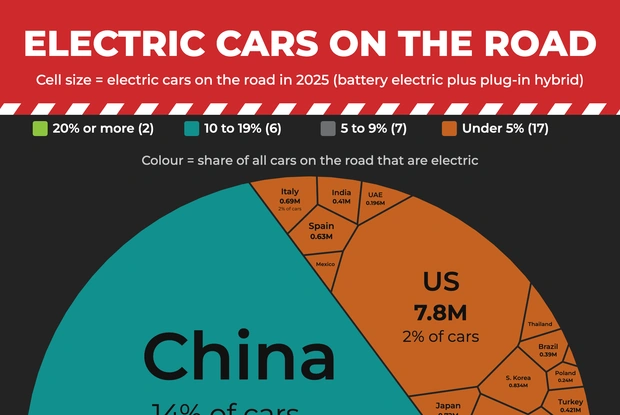
Norway sold 97% electric cars in 2025, but only 36% of its fleet is electric. See why the fleet trails sales and who owns it.
15 Nov 2026