

3 of 32 rockets
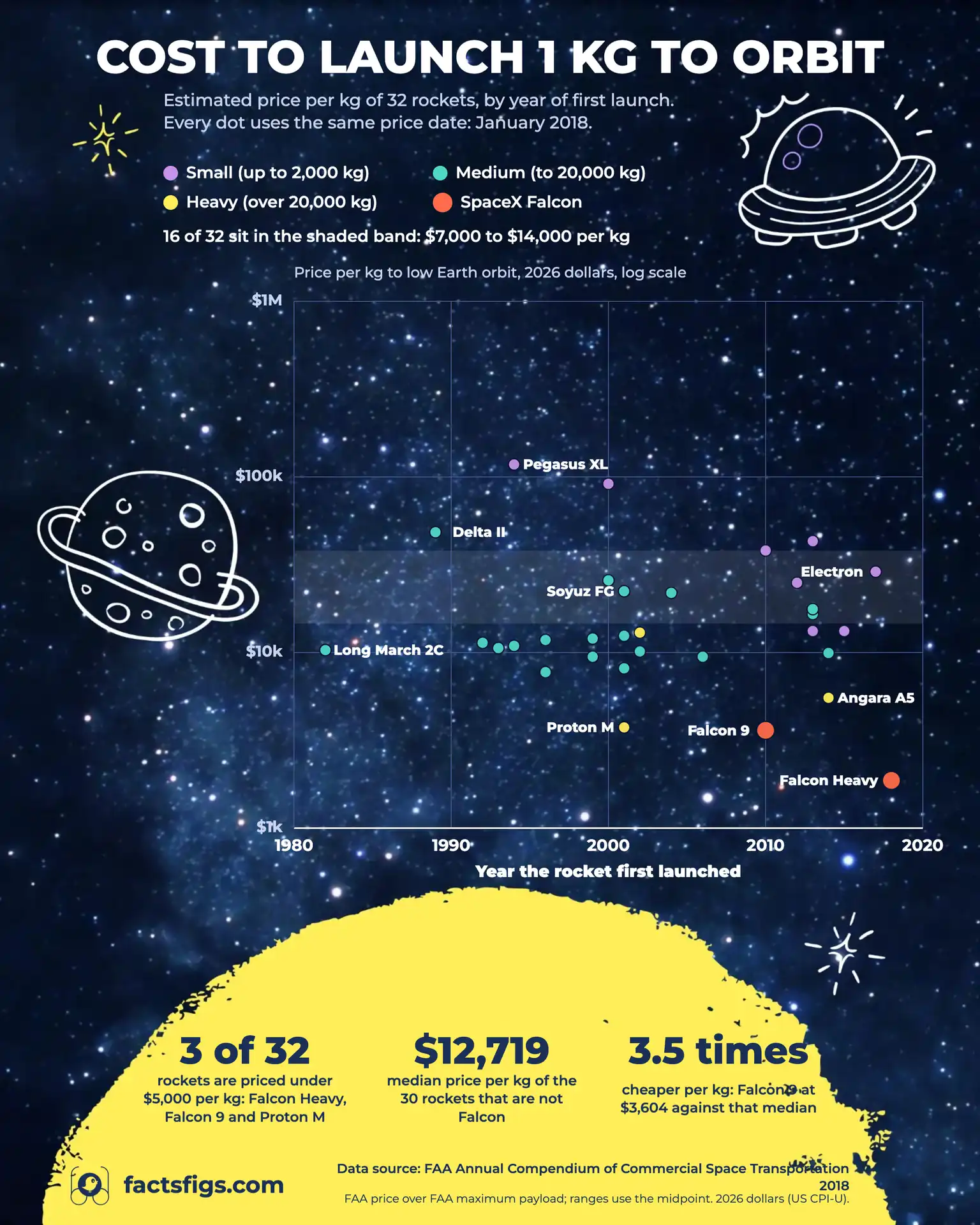
Only Falcon Heavy, Falcon 9 and Proton M are priced under $5,000 per kilogram in the FAA's January 2018 estimates, in 2026 dollars.

Facts & Figures
Visual Intelligence
Newer rockets are not cheaper per kg, and Falcon's list price per kg has barely moved since 2018.
Using the FAA's price estimates for 32 rockets in January 2018, converted to 2026 dollars, the median price is $12,719 per kilogram to low Earth orbit for the 30 rockets that are not Falcons. Only three are under $5,000: Falcon Heavy at $1,869, Falcon 9 at $3,604 and Proton M at $3,745. The year a rocket first flew tells you almost nothing about its price per kilogram. Falcon 9's list price on SpaceX's 2026 sheet is $74 million for 22,000 kg, or $3,364 per kilogram. That is 7% lower than in 2018 in 2026 dollars and 24% higher in current dollars. The steeper fall people quote comes from a 2016 change in the payload on SpaceX's page, not from a price cut.
Cheaper launch so far means one company's rockets, whose list price per kilogram is down 7% in real terms since 2018. The steeper fall people quote comes from a payload change in 2016 and from costs SpaceX has not published.
Continue reading below for the full detailed article →
Overview
The cost to launch per kg to orbit is the price of a launch divided by the most mass the rocket can put into low Earth orbit, a circular orbit a few hundred kilometres up. It is the number most people mean when they ask how cheap rockets have become, and it is easy to get wrong, because three different things get called cost. A price is what a customer pays. A cost is what the maker spends. A government cost is what an agency spends to fly a rocket it owns. SpaceX's list price is a price, and the Space Shuttle figures further down are government costs. This page plots prices only, so every dot answers the same question. The prices are the FAA's estimates for January 2018, taken from its Annual Compendium of Commercial Space Transportation, which says all of them are estimates. For state-run rockets such as China's Long March or Russia's Proton they are estimates of what a state provider would charge. Where the FAA gives a range we use its midpoint and divide by the largest payload it lists, which makes each rocket look as cheap per kilogram as it can. Every price is converted to 2026 dollars with the US consumer price index (CPI-U), so a dollar means the same on every dot.
How many rockets are cheap, how much cheaper Falcon is, and how far its price has moved.
3 of 32 rockets
Only Falcon Heavy, Falcon 9 and Proton M are priced under $5,000 per kilogram in the FAA's January 2018 estimates, in 2026 dollars.
3.5 times
At $3,604 per kilogram in 2018 prices, in 2026 dollars, Falcon 9 is 3.5 times cheaper than the median of the other 30 rockets, $12,719. Falcon Heavy, at $1,869, is 6.8 times cheaper.
-7% in real terms
Falcon 9's list price per kilogram fell from $3,604 to $3,364 in 2026 dollars. In current dollars it rose from $2,719 to $3,364, up 24%.
The test
Across the 32 rockets there is no slope. Rockets that first launched before 2000 have a median price of $11,136 per kilogram in 2026 dollars, those from 2000 to 2009 have $12,719 and those from 2010 on, with the two Falcons left out, have $17,117. The rank correlation between the year of first launch and the price per kilogram is -0.03 across all 32, which is no relationship at all.
Part of that is size. The eight small rockets, those that lift 2,000 kg or less, have a median of $33,480 per kilogram, and six of the 12 rockets that first launched in 2010 or later are small. Among medium and heavy rockets without the Falcons the medians still do not fall: $10,913 for the nine that first flew before 2000, $12,457 for the nine from 2000 to 2009 and $13,252 for the four from 2010 on.
Half the rockets sit in a narrow band. Sixteen of the 32 are priced between $7,000 and $14,000 per kilogram, whether they first flew in 1982 or 2015. Only three are under $5,000: Falcon Heavy at $1,869, Falcon 9 at $3,604 and Proton M at $3,745. Proton M is a Russian rocket whose price the FAA estimates at $65 million for 23,000 kg, close to Falcon 9's figure, and an estimate we cannot check.
Falcon 9 is 3.5 times cheaper per kilogram than the median of the other 30 rockets, and Falcon Heavy is 6.8 times cheaper. That is a real gap, and it belongs to one company's rockets, not to the industry. It is also a price at maximum payload on an expendable rocket, not what SpaceX spends to fly one.
The Falcon
SpaceX's price sheet for 2026 lists a Falcon 9 at $74 million with a payload of 22,000 kg to low Earth orbit, which is $3,364 per kilogram. The sheet says the payload is the maximum capability on a fully expendable vehicle, so it describes a rocket flown without recovering the booster, not a reused one.
Against that, the FAA's January 2018 sheet lists $62 million for 22,800 kg, or $2,719 per kilogram, which is $3,604 in 2026 dollars. The list price per kilogram has fallen 7% in real terms since 2018 and risen 24% in current dollars. The price per launch is up 19% in current dollars and down 10% in real terms, and the payload on the sheet slipped from 22,800 to 22,000 kg.
The bigger drop people remember, from about $4,650 per kilogram to about $2,720, is not a price cut. The FAA's own compendium carries both numbers: its summary table lists $61.2 million for 13,150 kg and its fact sheet lists $62 million for 22,800 kg. The price rose 1.3% while the payload on the page rose 73%. SpaceX's own Falcon 9 page showed 13,150 kg until early April 2016 and 22,800 kg from May 2016, in copies kept by the Internet Archive.
What it costs SpaceX to fly one is a different number, and SpaceX does not publish it. CNBC reported in February 2021 that SpaceX had put its operating cost at about $28 million a launch. That figure is unaudited, dates from five years ago and is not what a customer pays.
The Falcon
Each price is for one launch at the maximum payload to low Earth orbit on a fully expendable rocket. Real dollars are 2026 dollars.
| January 2018 | FAA 2018 compendium, fact sheet | $62 million | 22,800 kg | $2,719 | $3,604 |
| 2024 | SpaceX price sheet, "through 2024" | $69.75 million | 22,000 kg | $3,170 | $3,363 |
| 2025 | SpaceX price sheet, "through 2025" | $69.85 million | 22,000 kg | $3,175 | $3,282 |
| 2026 | SpaceX price sheet, "through 2026" | $74 million | 22,000 kg | $3,364 | $3,364 |
SpaceX's 2026 sheet was read directly. The 2024 and 2025 sheets were read from Internet Archive copies. The FAA's summary table lists $61.2 million and 13,150 kg ($4,654 per kg), figures that match SpaceX's page before April 2016. SpaceX's sheets list no price for a reused booster. Conversion uses US CPI-U annual averages, with 2026 as the January to October average.
The famous chart
Our World in Data publishes a chart of the cost of space launches to low Earth orbit, with data from the Center for Strategic and International Studies (CSIS). It shows 61 rockets with Falcon 9 and Falcon Heavy far below the rest, and it reads as about fifty years of similar prices followed by a break.
We rebuilt part of it from the source. Twenty-three of CSIS's 61 rows cite the FAA's 2018 compendium, and when we recomputed 21 of them from the FAA's fact sheets each matched CSIS's figure to within 2%. The method is the midpoint of the FAA's 2018 price range divided by the maximum payload, adjusted to 2021 dollars. So those points are one 2018 price estimate placed at the year a rocket family first flew, and the Soyuz sits at 1966 with a 2018 price estimate. They are not a record of what launches cost at each date.
CSIS's Falcon 9 figure of $2,600 per kilogram works the same way. It is the midpoint of $62 million and $49 million, which are the FAA's prices for an expendable and a reused booster, over a payload that only the expendable version carries, plotted at 2010. SpaceX's June 2026 prospectus quotes about $2,700 per kilogram for Falcon 9 in 2010, citing NASA. The $62 million and 22,800 kg behind a figure that size are the 2018 numbers in the table above, not 2010 ones.
The other 38 rows come from academic compilations and historical estimates whose basis we could not read. Their median falls from about $21,000 per kilogram for 1960s rockets to $10,750 for those of the 2010s, in 2021 dollars, so a long fall may be real. The table cannot show it as a price trend, because we could not tell whether the early rows are prices or costs.
The Space Shuttle
It depends which cost you mean. The Space Shuttle lifted about 27,500 kg to low orbit by the figure most analysts use, and NASA says up to 29,000 kg depending on the orbit. NASA's estimate of the cost saved by cancelling one flight was $44.4 million in 1993 dollars, which is $1,615 per kilogram. Its average operating cost per flight in the same report was $413.5 million, or $15,036 per kilogram, and left out the development bill.
Whole-programme figures go higher. A 2001 GAO estimate of $759 million per launch is $27,600 per kilogram, and NASA's inspector general wrote that the cost per flight had been estimated as high as $1.5 billion, which is $54,545 per kilogram. One rocket spans a 38-fold range across definitions, which is why it is not on the chart. None of these is a price, because the Shuttle was never sold at one.
The Space Shuttle
Per kilogram figures divide by 27,500 kg to low Earth orbit. Each row is a cost, not a price, and the dollar years differ.
| Marginal: cost saved by cancelling one flight | $44.4 million | 1993 | $1,615 | GAO report citing NASA |
| Average operating cost, development left out | $413.5 million | 1993 | $15,036 | GAO report citing NASA |
| GAO estimate, 2001 | $759 million | Not stated | $27,600 | GAO, as quoted by NASA OIG |
| Whole programme, all direct and indirect costs | Up to $1.5 billion | Not stated | $54,545 | NASA OIG |
| Whole programme, converted by Jones | $1,697 million | 2018 | $61,709 | NASA-hosted paper |
At 29,000 kg every per-kilogram figure is about 5% lower. Dollar years for the 2001 and OIG figures were not stated in the text we read.
Starship
Starship has no published price. SpaceX's June 2026 prospectus says it aims to cut the cost to reach orbit by 99% or more against a historical average. On the $18,500 per kilogram the prospectus cites as that average, that works out at $185 per kilogram or less. It is a target, with no date and no customer price.
Elon Musk has given three per-launch cost targets, all for full reuse and all costs to SpaceX, not prices. Reports have him at $2 million in 2019, "less than $10 million" in February 2022 and about $3 million in April 2024. Divided by the 100 tonnes SpaceX says its newest Starship is designed to carry, those are $20, $100 and $30 per kilogram, so they are calculations on targets and not measurements.
What exists as of 18 November 2026, from news reports and SpaceX's prospectus, is 15 test flights, the latest on 13 November. Boosters have been caught and some reflown, and a ship was caught by the launch tower on 14 November. The two most recent flights each carried 26 Starlink satellites, SpaceX's own. We found no report of a paying customer's payload delivered to orbit and no ship reflown. Space Cargo has been reported as the first named commercial customer, for a mission in 2028.
Of the two operators that publish a price, SpaceX at $3,364 per kilogram is below Rocket Lab's Neutron at $5,385 per kilogram, a rocket that has not yet flown. Rocket Lab said on 9 November 2026 that Neutron's base price was now $70 million, up from $55 million, for 13,000 kg.
The limits
The prices are FAA estimates for January 2018, not quotes. Several are for state-run rockets with no public price list, and rockets from China, Russia, India and Japan may be sold on terms unrelated to these figures. The Soyuz FG range of $50 million to $213 million gives $8,495 to $36,191 per kilogram in 2026 dollars, and we plot the midpoint, $22,342.
Maximum payload is the divisor, which flatters every rocket. Falcon 9's payload is for an expendable booster, and recovering the booster cuts what it can carry. SpaceX's sheets list no reused-booster payload or price, so we do not compute one.
We left out rockets whose price the FAA lists as undisclosed, such as the Long March 5, 6 and 7, and a few whose payload range we could not match to a price. Vehicles that have flown since 2018 without a published price, including Vulcan, Ariane 6, Zhuque-3 and Starship, are not shown. A missing dot is a missing price, not a low one.
The chart does not use CSIS's numbers. The CSIS page reserves all rights and we found no licence to reuse its table, so every dot here comes from the FAA, a US government publication. CSIS's table has 61 rockets and ours has 32, and the first decades of the space age are missing from ours, which is why we draw no long-run trend.
Every rocket
Ordered by year of first launch. Price is the FAA's estimate for January 2018. Where the FAA gives a range, per kilogram figures use its midpoint over the largest payload it lists.
| 1982 | Long March 2C | CASC | $30 million | 3,850 | $7,792 | $10,326 | Medium |
| 1989 | Delta II | ULA | $137.3 million | 3,755 | $36,565 | $48,456 | Medium |
| 1992 | Long March 2D | CASC | $30 million | 3,500 | $8,571 | $11,359 | Medium |
| 1993 | PSLV | ISRO | $21 to $31 million | 3,250 | $8,000 | $10,602 | Medium |
| 1994 | Long March 3A | CASC | $70 million | 8,500 | $8,235 | $10,913 | Medium |
| 1994 | Pegasus XL | Orbital ATK | $40 million | 450 | $88,889 | $117,796 | Small |
| 1996 | Long March 3B/E | CASC | $70 million | 12,000 | $5,833 | $7,730 | Medium |
| 1996 | Ariane 5 ECA | Arianespace | $178 million | 20,000 | $8,900 | $11,794 | Medium |
| 1999 | Long March 4B | CASC | $30 million | 4,200 | $7,143 | $9,466 | Medium |
| 1999 | Dnepr | ISC Kosmotras | $29 million | 3,200 | $9,062 | $12,010 | Medium |
| 2000 | Rockot | Eurockot | $41.8 million | 2,150 | $19,442 | $25,765 | Medium |
| 2000 | Minotaur I | Orbital ATK | $40 million | 580 | $68,966 | $91,394 | Small |
| 2001 | Proton M | ILS / Khrunichev | $65 million | 23,000 | $2,826 | $3,745 | Heavy |
| 2001 | H-IIA/B | MHI / JAXA | $90 to $112.5 million | 16,500 | $6,136 | $8,132 | Medium |
| 2001 | GSLV | ISRO | $47 million | 5,000 | $9,400 | $12,457 | Medium |
| 2001 | Soyuz FG | Roscosmos | $50 to $213 million | 7,800 | $16,859 | $22,342 | Medium |
| 2002 | Atlas V | ULA | $109 to $179 million | 18,814 | $7,654 | $10,143 | Medium |
| 2002 | Delta IV | ULA | $164 to $400 million | 28,790 | $9,795 | $12,981 | Heavy |
| 2004 | Soyuz 2.1a/b | Roscosmos | $80 million | 4,850 | $16,495 | $21,859 | Medium |
| 2006 | Long March 4C | CASC | $30 million | 4,200 | $7,143 | $9,466 | Medium |
Showing 1-20 of 32
Size class: small is up to 2,000 kg, medium 2,000 to 20,000 kg, heavy over 20,000 kg, by maximum payload. Falcon Heavy's year is the FAA's planned first launch. Electron's 2017 first launch did not reach orbit. Conversion uses US CPI-U annual averages (2018 to 2026 factor 1.3252).
FAA: Annual Compendium of Commercial Space Transportation 2018 SpaceX: Capabilities and Services price sheet
The rocket prices and payloads are the FAA's estimates for January 2018 from its 2018 compendium, a US government publication. Falcon 9's 2026 price and payload are from SpaceX's price sheet, and its 2024 and 2025 prices are from Internet Archive copies of earlier sheets. Space Shuttle figures come from a GAO report, a NASA inspector general report and a NASA-hosted paper by Jones, and Starship statements from SpaceX's June 2026 prospectus and news reports by CNBC, Space.com and Reuters. Inflation uses the US Bureau of Labor Statistics CPI-U. The per-kilogram figures, medians and ratios are FactsFigs' own arithmetic. The data was manually collected by FactsFigs. Full credit for the prices goes to the FAA, and the figures are its estimates, not quotes.
FactsFigs reviews, cleans and cross-checks every source dataset before shaping it into a data story. Each visualization is created and designed in FactsFigs Design Studio, an internal tool developed and owned by FactsFigs, and is the original work of a FactsFigs author, not an AI-generated copy of any existing graphic. Individual assets within a visual may or may not be produced with AI tools, but the design of the visual itself is solely FactsFigs' own.
Figures are estimates at the time of publication, provided for information only. Nothing here is financial advice or a guarantee of accuracy.
Last verified: 18 Nov 2026
Related Publications
Transistor counts for 63 chips from 1971 to 2025 still follow a doubling every two years for the biggest packages, while single dies slowed to 2.8 years.
17 Nov 2026
Tesla's Cybercab costs $29,990, under the $30,000 Musk promised, but needs a $299-a-month subscription to run. Total paid after 5 years: $47,631.
15 Nov 2026
Norway sold 97% electric cars in 2025, but only 36% of its fleet is electric. See why the fleet trails sales and who owns it.
15 Nov 2026
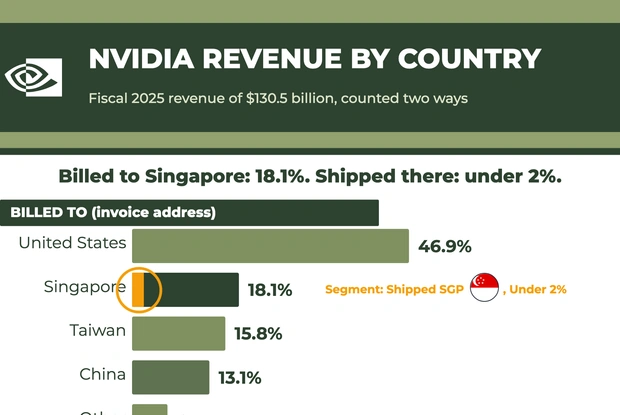
Singapore was 18% of Nvidia's fiscal 2025 revenue by billing address but under 2% by shipments. Recounted by headquarters, China rose from 13% to 19%.
15 Nov 2026