

2.16 years
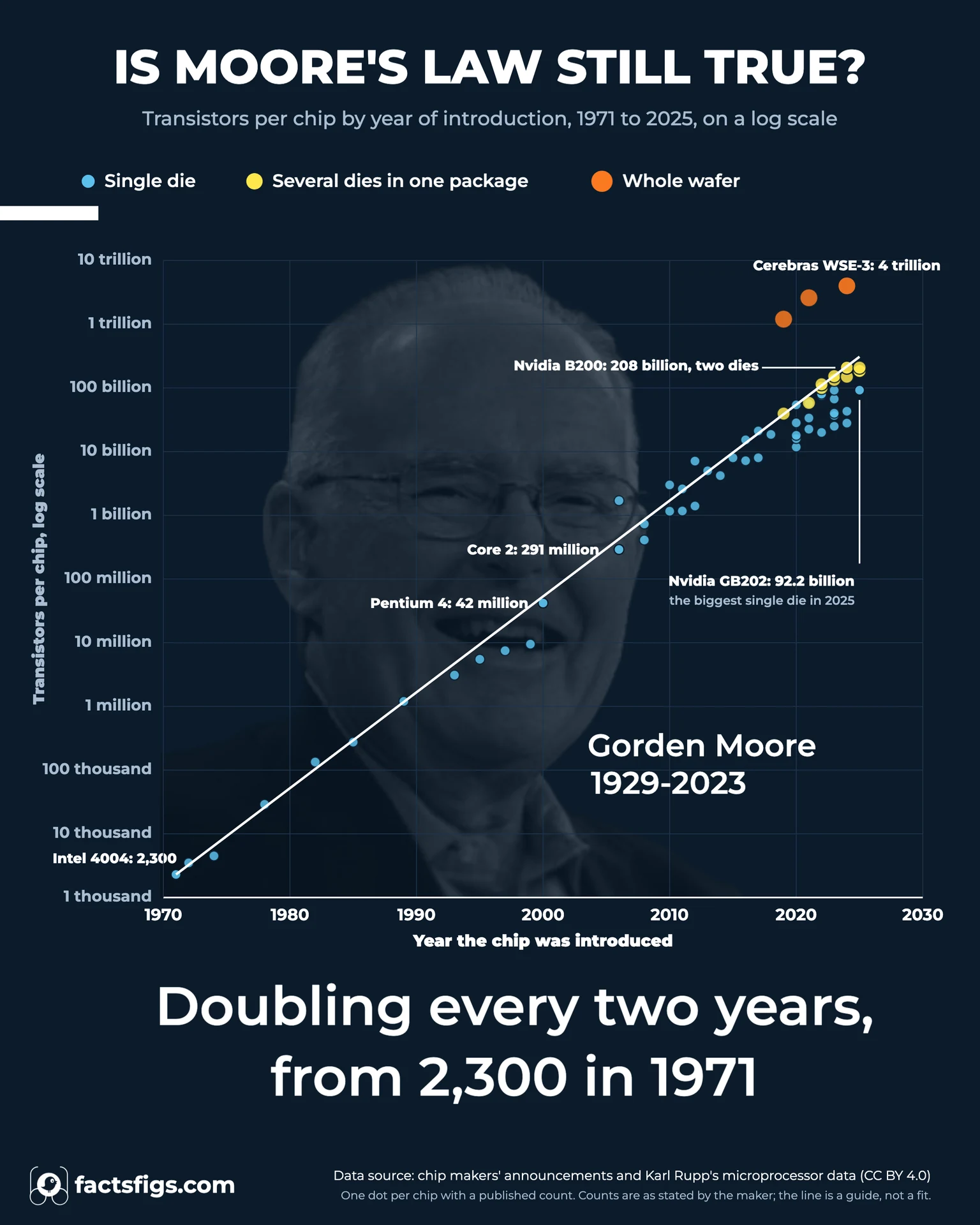
Single-die processors and systems-on-a-chip doubled their transistor count every 2.16 years from 1971 to 2024, using 37 chips. Moore's 1975 revision said every two years.

Facts & Figures
Visual Intelligence
The biggest chips still double about every two years, but a single die now takes longer.
Counting 63 chips with published transistor counts, from the Intel 4004 in 1971 to Nvidia's Blackwell Ultra in 2025, single-die processors doubled their transistor count every 2.16 years on average. The doubling time was 1.96 years up to 1990 and 2.80 years from 2015 to 2025. The biggest chip packages still follow a two-year doubling because they now join two or more dies. Nvidia's B200 has 208 billion transistors on two dies, 95% of the two-year line for 2024, while the biggest single die of 2025, Nvidia's GB202 at 92.2 billion, is 30% of it.
Moore's Law is about how many components fit on one chip at the lowest cost. That count still doubles about every two years, but chiplets, not smaller transistors alone, now keep it on the line.
Continue reading below for the full detailed article →
Overview
Every number here is the transistor count a chip maker states for one chip, taken from its press release, whitepaper or product page, with the year the chip was introduced. A die is one piece of silicon. A package can hold one die or several, and a wafer-scale chip is a whole wafer. The chart keeps the three apart because they are not the same unit. Moore wrote about components per circuit at minimum cost, not the biggest chip anyone could build, so the largest chip each year is a test of the idea and not the idea itself. We plot the chips for which a maker has published a count, weighted towards the largest in each era, and we say where that choice matters. The two-year line starts at the Intel 4004's 2,300 transistors in 1971. A straight line on a log axis is steady doubling, which is why the axis is logarithmic.
The long-run doubling time, how it changed, and what a two-die package reaches.
2.16 years
Single-die processors and systems-on-a-chip doubled their transistor count every 2.16 years from 1971 to 2024, using 37 chips. Moore's 1975 revision said every two years.
2.8 years
The same doubling time was 1.96 years up to 1990, 3.15 years from 2005 to 2015 and 2.80 years from 2015 to 2025. We are moderately sure it has lengthened, because the samples are small and chosen.
208 billion
Nvidia's Blackwell B200 (2024) has 208 billion transistors on two dies, 95% of the two-year line for that year. The biggest single die in 2025, the GB202, is 30% of the line for 2025.
The definition
Moore's Law comes from two papers by Gordon Moore, who later co-founded Intel. In the 19 April 1965 issue of Electronics he wrote that the complexity of an integrated circuit at its minimum cost had increased at roughly a factor of two per year, and that by 1975 the number of components per circuit at minimum cost would be 65,000.
In 1975 he revised the pace. Speaking at the International Electron Devices Meeting, he said the new slope might approximate a doubling every two years, rather than every year, by the end of the decade. That two-year figure is the one most people mean today, and it is a revision, not the 1965 forecast.
Two things are often added that Moore did not say. The first is 18 months. In an interview transcript we could not date, which reads as about 2005, Moore says he did not say 18 months and credits Intel's David House, whose figure described computer performance rather than transistor counts. The second is speed: the forecast is about how many components fit on a chip at the lowest cost, not how fast the chip runs. Intel's own 2015 annual report words it as transistor density doubling about every two years.
The test
We collected transistor counts for 63 chips from 1971 to 2025 that their makers have published, from the Intel 4004 with 2,300 transistors to Nvidia's Blackwell Ultra with 208 billion across two dies. Over the whole period the single-die processors and systems-on-a-chip in the set doubled their count every 2.16 years, close to Moore's 1975 pace. From the 4004 to the biggest single die of 2025 the doubling time is 2.14 years, and to the biggest two-die package it is 2.04.
The average hides a slowdown. Single-die chips doubled every 1.96 years up to 1990 and every 2.29 years from 1990 to 2005. From 2005 to 2015 the doubling time stretched to 3.15 years, and from 2015 to 2025 it was 2.80 years. A fit that is free to choose its own break puts the bend near 2011, with 2.05 years before it and 2.61 after.
We are moderately sure of the slowdown, not certain. The samples are small and chosen, because we picked the largest chips rather than counting every chip, and 11 of the 16 single-die chips from 2015 to 2025 are Apple processors. Apple does not publish transistor counts for the M4 Pro, M4 Max or M5, so its newest large dies are missing and the recent pace may look slower than it is.
The biggest chips
It depends on what counts as one chip. The biggest single die with a published count in 2025 is Nvidia's GB202, the GPU in the GeForce RTX 50 series, with 92.2 billion transistors on 750 square millimetres. Apple's M3 Max reached 92 billion on one die in 2023.
Put two dies in one package and the count roughly doubles. Nvidia's Blackwell B200 has 208 billion transistors on two dies, which Nvidia describes as two-reticle-limit dies joined by a 10 terabyte-per-second link, and the 2025 Blackwell Ultra has the same count. Apple's M3 Ultra, at 184 billion, and AMD's Instinct MI355X, at 185 billion, are close behind. Nvidia has said its 2026 Rubin has 336 billion transistors on two dies, which is outside the 1971 to 2025 range of the chart.
The largest chip of all is a whole silicon wafer. Cerebras says its WSE-3, announced in March 2024, has 4 trillion transistors and 900,000 cores on a 5-nanometre process. That is about 18 times the two-year line for 2024, and it is a different kind of object, so the chart marks it apart. In this article biggest means biggest among chips with a published count in our table, not a census of every chip ever made.
Dies, not only density
A die cannot grow past the reticle limit, the biggest area a chipmaker can print in one exposure. TSMC's chairman Mark Liu and chief scientist H.-S. Philip Wong wrote in March 2024 that typical GPU chips used for AI training had already reached the reticle field limit, at about 100 billion transistors, and forecast that a multichiplet GPU would pass a trillion within a decade.
Set against a line that doubles every two years from 2,300, the numbers show the effect. Nvidia's GB202 sits at 30% of the line in 2025 and Apple's M3 Max at 60% in 2023. The two-die B200 sits at 95% in 2024, and the Blackwell Ultra at 67% in 2025. The line moves ahead faster than one die can follow, and a second die more than doubles the count.
The ratios depend on where the line starts. Anchoring it on the 4004's 2,300, the smallest point on the chart, is the strictest choice. A line fitted through all the single-die points starts near 3,000 transistors in 1971 and ends near 99 billion in 2025, a count a single die has reached.
Density tells the same story in other units. From Nvidia's own count and area tables, the GK110 of 2012 had 12.9 million transistors per square millimetre and the GB202 of 2025 has 122.9 million, a 9.5-fold rise, or a doubling every 4.0 years from those two endpoints. Counts grew faster than density because dies also got bigger and then multiplied.
The obituaries
Moore himself did not announce an end. In 1975 he slowed the pace to a doubling every two years. In a 2005 remark that The Register reported in 2015, he said exponentials cannot continue forever and that a fundamental limit was one to two decades away.
In 2005 Herb Sutter wrote that processor makers had run out of room to raise clock speeds. That is about speed, not transistor counts, and the data agree: the highest clock speed in Rupp's data has stayed between about 3 and 4.7 gigahertz since 2004.
Intel's annual report for 2015, filed on 5 February 2016, said it expected to lengthen the time it uses its 14-nanometre and 10-nanometre process technologies. In September 2022 Nvidia's Jensen Huang said "Moore's Law is dead", in the context of price: Digital Trends reported him saying a 12-inch wafer is far more expensive and that falling chip prices are a story of the past. Intel's Pat Gelsinger replied that it was "alive and well", as CNBC reported on 27 September 2022, and Intel's December 2023 release set a goal of a trillion transistors on a package by 2030.
Most of these statements are about something other than transistor counts. Huang's was about price, Sutter's about clock speed and Intel's 2016 filing about how long each process generation lasts. Cost per transistor is contested: Intel said, as IEEE Spectrum reported, that it was still falling, and a Google engineer showed a slide at a December 2023 conference saying it stalled at 28 nanometres, as Tom's Hardware reported. We found no open dataset to settle it, so this article makes no claim about price.
The pace
Least-squares fits to the log of the count. The first five rows use single-die processors and systems-on-a-chip. The last three use the biggest chip in each year.
| Single-die processors | 1971 to 2024 | 37 | 2.16 |
| Single-die processors | 1971 to 1990 | 7 | 1.96 |
| Single-die processors | 1990 to 2005 | 5 | 2.29 |
| Single-die processors | 2005 to 2015 | 9 | 3.15 |
| Single-die processors | 2015 to 2025 | 16 | 2.80 |
| Biggest single die of any kind | 2015 to 2025 | 10 | 3.13 |
| Biggest package, several dies allowed | 2015 to 2025 | 11 | 2.08 |
| Biggest package, several dies allowed | 1971 to 2025 | 30 | 1.99 |
FactsFigs arithmetic on the chip counts in the table below. Samples are small and chosen, so treat the differences between periods as indicative.
Every chip
Ordered by year, then by count. Class separates a single die, several dies in one package and a whole wafer, which are not the same unit.
| 1971 | Intel 4004 | Intel | 2,300 | Single die | 1 | Maker |
| 1972 | Intel 8008 | Intel | 3,500 | Single die | 1 | Maker |
| 1974 | Intel 8080 | Intel | 4,500 | Single die | 1 | Maker |
| 1978 | Intel 8086 | Intel | 29,000 | Single die | 1 | Maker |
| 1982 | Intel 286 | Intel | 134,000 | Single die | 1 | Maker |
| 1985 | Intel 386 | Intel | 275,000 | Single die | 1 | Maker |
| 1989 | Intel 486 | Intel | 1.2 million | Single die | 1 | Maker |
| 1993 | Intel Pentium | Intel | 3.1 million | Single die | 1 | Maker |
| 1995 | Intel Pentium Pro | Intel | 5.5 million | Single die | 1 | Maker |
| 1997 | Intel Pentium II | Intel | 7.5 million | Single die | 1 | Maker |
| 1999 | Intel Pentium III (Katmai) | Intel | 9.5 million | Single die | 1 | Maker |
| 2000 | Intel Pentium 4 (Willamette) | Intel | 42 million | Single die | 1 | Maker |
| 2006 | Intel Core 2 Duo (Conroe) | Intel | 291 million | Single die | 1 | Maker |
| 2006 | Intel Itanium 9000 (Montecito) | Intel | 1.7 billion | Single die | 1 | Maker |
| 2008 | Intel Core 2 Duo (45 nm) | Intel | 410 million | Single die | 1 | Maker |
| 2008 | Intel Core i7 (Nehalem) | Intel | 731 million | Single die | 1 | Maker |
| 2010 | Intel 2nd gen Core (Sandy Bridge, quad + GPU) | Intel | 1.16 billion | Single die | 1 | Maker |
| 2010 | Nvidia GF100 (Fermi) | Nvidia | 3 billion | Single die | 1 | Maker |
| 2011 | Intel Xeon X5690 (Westmere-EP) | Intel | 1.17 billion | Single die | 1 | Karl Rupp's compilation |
| 2011 | Intel Xeon E7-8870 (Westmere-EX) | Intel | 2.6 billion | Single die | 1 | Karl Rupp's compilation |
Showing 1-20 of 63
Figures are as stated by each maker. Intel's own pages disagree on a few early chips, and the 2012 poster is used: the 4004 is 2,300 there and 2,250 on its 2002 Silicon Showcase page. Twenty-one further chips with a count only from Wikipedia or Rupp's compilation alone are left out, and so is Nvidia's 2026 Rubin.
The record
Each row is one dated statement. The last column says the quantity it concerns, because a transistor count, a price and a clock speed are different claims.
| 19 Apr 1965 | Gordon Moore, Electronics | Complexity at minimum cost up by a factor of two per year | Components per circuit |
| 1975 | Gordon Moore, IEDM | The new slope might approximate a doubling every two years | Components per chip |
| Mar 2005 | Herb Sutter | Makers have run out of room to raise CPU speeds the old way | Clock speed |
| 5 Feb 2016 | Intel's 2015 annual report | Expects to lengthen the time it uses its 14nm and 10nm processes | Process cadence |
| Sep 2022 | Jensen Huang, as reported by press | "Moore's Law is dead", with falling chip prices a story of the past | Price per chip |
| 27 Sep 2022 | Pat Gelsinger, as reported by CNBC | Moore's Law is "alive and well" | Transistors per package |
| 9 Dec 2023 | Intel release | Working to extend Moore's Law to a trillion transistors on a package by 2030 | Transistors per package |
| Dec 2023 | Google engineer, as reported by Tom's Hardware | Transistor cost scaling stalled at 28nm | Cost per transistor |
| 28 Mar 2024 | TSMC chairman and chief scientist | AI training GPUs have already reached the reticle field limit | Single-die size |
Moore, Intel's annual report, Intel's release and TSMC are firsthand. Huang, Gelsinger, the Google slide and Sutter's essay are as reported or summarised, and Moore's 2005 remark reached us secondhand.
The limits
The chart is not a census. It holds the 63 chips with a published count that we could verify, weighted towards the largest of each era, and it leaves out FPGAs, Tesla's Dojo, Graphcore, Microsoft's Maia and Amazon's chips, which we did not check. Another 21 chips whose count rests only on Wikipedia or on Rupp's compilation alone are left out of the chart and the file.
Makers contradict themselves. Intel's 2012 poster gives 2,300 transistors for the 4004 and its 2002 Silicon Showcase page gives 2,250, and the two pages disagree on four other chips. We used the poster and note both. Our World in Data's insight on Moore's Law calls its series the average transistor count, but its own metadata says it is the highest count per chip in each year and its last point is a multi-die accelerator, so we did not use its numbers.
Nanometre names such as 5 nm or 4N are labels each maker sets, not feature sizes, so we do not compare them across companies. A transistor count also says nothing about speed or efficiency: a doubling of transistors is not a doubling of performance.
Karl Rupp: 42 Years of Microprocessor Trend Data Gordon Moore: Cramming more components onto integrated circuits (Electronics, 1965)
The chip counts are the makers' own, from press releases, whitepapers and product pages of Intel, Apple, Nvidia, AMD, IBM and Cerebras, and for eight rows from Karl Rupp's microprocessor trend data, which is CC BY 4.0. Moore's 1965 and 1975 papers were read in full from copies hosted by the University of Maryland and the University of Oslo. The doubling times, the ratios to the two-year line and the density figure are FactsFigs' own arithmetic on those counts. Statements by Huang, Gelsinger and the Google engineer are as reported by the press. The data was manually collected by FactsFigs. Apple does not publish counts for the M4 Pro, M4 Max or M5, and Intel's own pages disagree on a few early chips. Full credit for the counts goes to the chip makers and to Karl Rupp.
FactsFigs reviews, cleans and cross-checks every source dataset before shaping it into a data story. Each visualization is created and designed in FactsFigs Design Studio, an internal tool developed and owned by FactsFigs, and is the original work of a FactsFigs author, not an AI-generated copy of any existing graphic. Individual assets within a visual may or may not be produced with AI tools, but the design of the visual itself is solely FactsFigs' own.
Figures are estimates at the time of publication, provided for information only. Nothing here is financial advice or a guarantee of accuracy.
Last verified: 16 Nov 2026
Related Publications
Tesla's Cybercab costs $29,990, under the $30,000 Musk promised, but needs a $299-a-month subscription to run. Total paid after 5 years: $47,631.
15 Nov 2026
Norway sold 97% electric cars in 2025, but only 36% of its fleet is electric. See why the fleet trails sales and who owns it.
15 Nov 2026
Singapore was 18% of Nvidia's fiscal 2025 revenue by billing address but under 2% by shipments. Recounted by headquarters, China rose from 13% to 19%.
15 Nov 2026
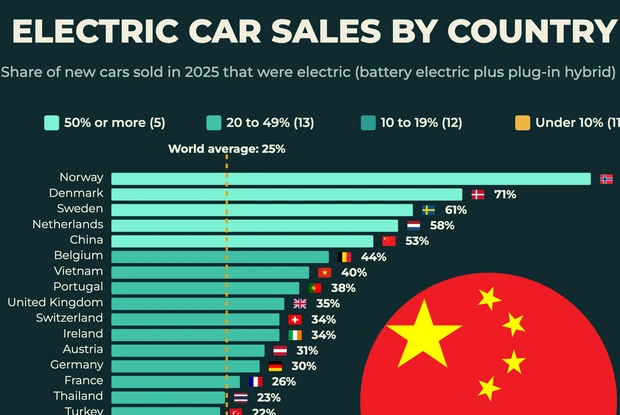
Norway sold 97% electric cars in 2025 and the world 25%, but China is only fifth by share and Vietnam beats Germany.
13 Nov 2026