

520 mi
The highest EPA rating ever recorded: Lucid Air Dream Edition Range, 19-inch wheels, September 2021.

Facts & Figures
Visual Intelligence
For the average car yes. For the best car, not since 2022.
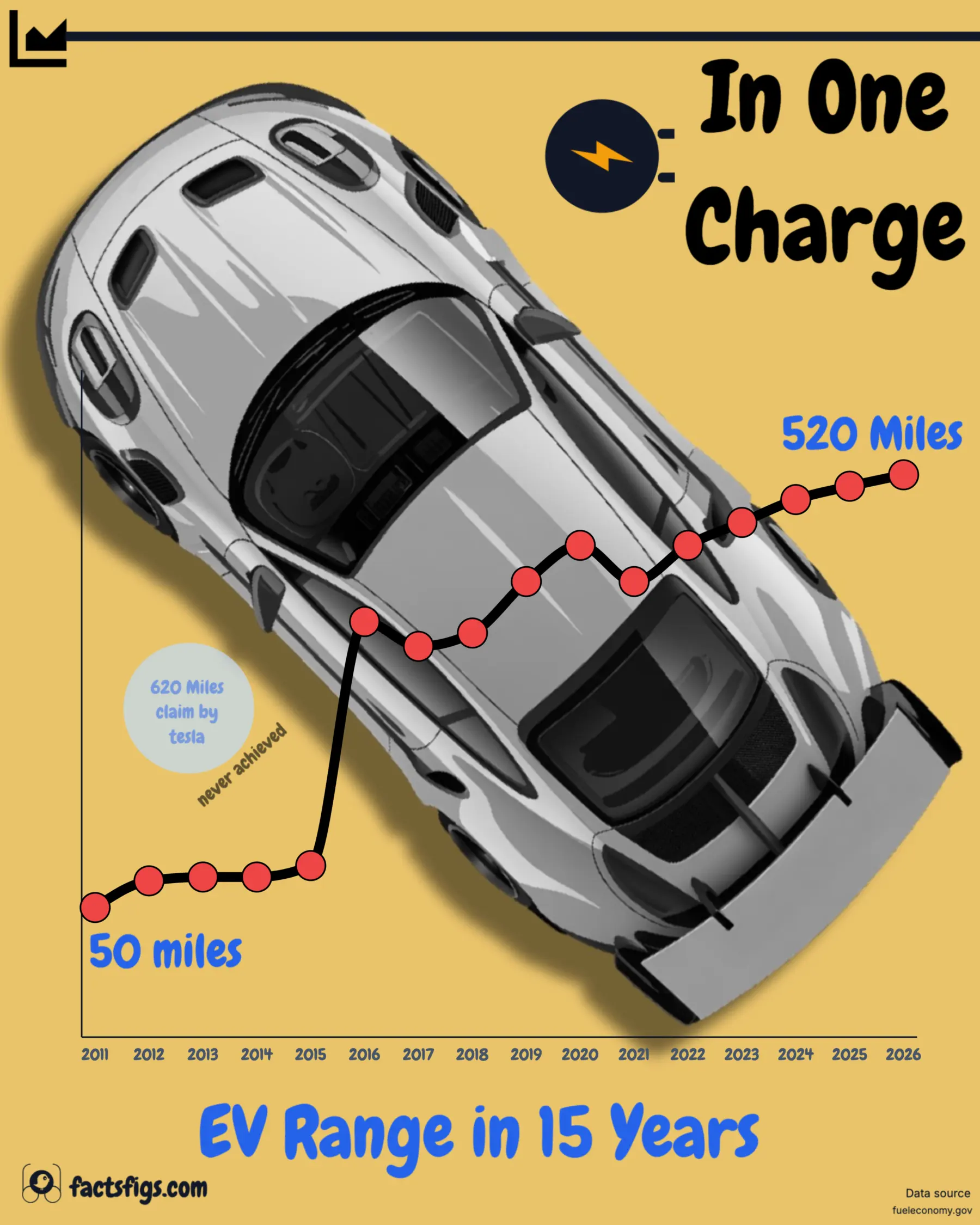
The highest EPA-rated range climbed from 94 miles in 2011 to 520 in 2022, a rise of 96 per cent. Since then it has gone backwards slightly, to 512. The record has stood for five years. It belongs to a Lucid Air Dream Edition Range on 19-inch wheels, rated on 14 September 2021. The median EV kept improving throughout, from 82 miles in 2012 to 295 in 2026. The typical car has been catching up with the best one rather than the frontier moving.
Continue reading below for the full detailed article →
The sourcing, stated first
Every rating on this page comes from fueleconomy.gov, the dataset the EPA and Department of Energy publish and which carries the window-sticker figure for every car sold in the United States. We extracted 1,608 electric records from it. It is the cleanest source in this subject and it can be downloaded in full. Three cautions apply. First, an EPA rating is not a WLTP or NEDC rating: the European and older cycles give higher numbers for the same car, so none of them appears on the chart and the Porsche Taycan and Mercedes EQS figures are held separately. Second, a rating belongs to a TRIM AND A WHEEL SIZE, never to a model name. Third, the label figure is a dynamometer result multiplied by an adjustment factor, usually 0.7 but sometimes vehicle-specific with EPA approval, and the dataset does not record which factor each maker used. The first-generation Roadster sits outside all of this. It has no fueleconomy.gov record at all, in the current dataset or in 71 archived copies going back to 2012, so its figures are Tesla’s own and are not comparable with the rest.
The record, how long it has stood, and how far the promise still is.
520 mi
The highest EPA rating ever recorded: Lucid Air Dream Edition Range, 19-inch wheels, September 2021.
5.1 yrs
Nothing has been rated higher since. The best of 2026 is 512 miles, eight short of the record.
100 mi
The gap between the 620 promised for the 2017 Roadster and the best rating ever achieved by anything.
The finding
From 2011 to 2022 the longest-ranging electric car each year went from 94 miles to 520, a rise of 96 per cent and a decade of steady gains. Then it stopped. The best of 2023 and 2024 was 516, and 2025 and 2026 both sit at 512.
The record itself has stood for over five years: a Lucid Air Dream Edition Range on 19-inch wheels, rated on 14 September 2021. Nothing sold since has beaten it, including Lucid’s own later cars.
Tesla’s best followed the same shape. It reached 405 miles with the Model S in 2021 and 410 by 2025, a gain of 1.2 per cent in four years.
The median tells the opposite story. It rose from 82 miles in 2012 to 258 in 2022 and 295 in 2026, and the number of rated electric models went from 8 to 321. Long range stopped being a frontier achievement and became a standard feature, which is a better outcome for buyers than another record.
Claim against rating
The expectation going in was that announced range would flatter the eventual rating. It does not. Across 20 like-for-like pairs, where a public promise can be matched to the EPA rating of the same trim, 14 cars beat their promise, 2 matched it and 4 fell short. The median result is 3 per cent better than advertised.
The shortfalls are worth naming because they are the exceptions. The original Model S was promised 300 miles in 2009 and rated 265 in 2012, 11.7 per cent short, which Tesla attributed to a change in the test procedure. The Model S Plaid on 21-inch wheels was promised 390 and rated 348; on 19-inch wheels it later rated 396. The Lucid Air Dream Performance was listed at 503 and rated 471.
Three headline figures have no rating at all because the cars were never built or never tested: the Model S Plaid Plus at 520, the tri-motor Cybertruck at over 500, and the 2017 Roadster at 620. A promise with no rating cannot be scored, and this page does not score them.
Promise against rating
Only pairs where the promise and the rating describe the same trim. Positive means the rating came in above what was promised.
| Tesla Model S | 85 kWh pack (top pack) | 2009 | 300 | 265 | -11.7% | Fell short |
| Tesla Model S Plaid | Plaid, 21-inch wheels | 2021 | 390 | 348 | -10.8% | Fell short |
| Lucid Air | Dream Edition Performance | 2020 | 503 | 471 | -6.4% | Fell short |
| Tesla Cybertruck | Dual motor AWD (dataset: " | 2024 | 340 | 325 | -4.4% | Fell short |
| Ford F-150 Lightning | Standard range (SR) 4WD | 2021 | 230 | 230 | +0.0% | Matched |
| Ford Mustang Mach-E | RWD Extended range (98.8 k | 2019 | 300 | 300 | +0.0% | Matched |
| Tesla Model S Plaid | Plaid, 19-inch wheels | 2021 | 390 | 396 | +1.5% | Beat it |
| Tesla Model 3 | Standard Range | 2016 | 215 | 220 | +2.3% | Beat it |
| Lucid Gravity | Gravity Grand Touring (dat | 2023 | 440 | 450 | +2.3% | Beat it |
| Rivian R1T | Dual Max | 2018 | 400 | 410 | +2.5% | Beat it |
| Lucid Air | Dream Edition Range (19-in | 2020 | 503 | 520 | +3.4% | Beat it |
| Rivian R1T | Large pack (135 kWh) | 2018 | 300 | 314 | +4.7% | Beat it |
| Ford F-150 Lightning | Extended range (ER) 4WD | 2021 | 300 | 320 | +6.7% | Beat it |
| Ford F-150 Lightning | Platinum 4WD | 2021 | 280 | 300 | +7.1% | Beat it |
| BMW iX | xDrive50, 20-inch wheels | 2020 | 300 | 324 | +8.0% | Beat it |
| Tesla Cybertruck | Dual motor AWD (dataset: " | 2019 | 300 | 325 | +8.3% | Beat it |
| Chevrolet Silverado EV | Work Truck (WT) first avai | 2022 | 400 | 450 | +12.5% | Beat it |
| Rivian R1T | Dual Standard (105 kWh) | 2018 | 230 | 270 | +17.4% | Beat it |
| Chevrolet Bolt EV | Bolt EV | 2016 | 200 | 238 | +19.0% | Beat it |
| Tesla Cybertruck | Single motor RWD (dataset: | 2019 | 250 | 335 | +34.0% | Beat it |
Pairs where a public promise and an EPA rating describe the same trim. Cars promised under WLTP or other test regimes are excluded rather than converted. The first-generation Roadster is excluded because it has no fueleconomy.gov record at all.
The number that started this
When Tesla unveiled the second-generation Roadster in November 2017 it promised 620 miles of range. Nine years later the highest EPA rating achieved by any production electric car is 520, and that record is five years old.
At the October 2026 reveal Tesla gave a figure of about 300 miles, and its engineers later told Top Gear to expect 310 to 320 in real use. That is roughly half the original promise. None of those numbers is an EPA rating, because the car is not in production and has not been tested.
The 620 figure is not impossible in principle; it is simply unmatched in practice, by anyone, after nine years in which the rest of the industry doubled its typical range. It belongs on the chart as a line nobody has reached rather than as a rating.
fueleconomy.gov vehicle dataset
Every EPA rating here comes from the fueleconomy.gov vehicle dataset, published by the US Department of Energy and the Environmental Protection Agency and administered by Oak Ridge National Laboratory. We downloaded it on 19 October 2026; the file was last modified on 29 September 2026. It contains 1,608 electric records, and the full file can be downloaded from the link above.
Promised figures come from manufacturers’ own announcements and archived product pages, each dated in the research record. A promise is paired with a rating only where both describe the same trim and wheel size; where they do not, no comparison is made.
Ratings under WLTP, NEDC or the older LA4 cycle are recorded separately and never mixed with EPA figures, because those cycles produce higher numbers for the same car. The ratio between them in our data runs between 0.72 and 0.75. The first-generation Tesla Roadster appears in no version of the dataset we could find, including 71 archived copies back to 2012, so its figures are Tesla’s own and sit outside the comparison.
EPA label range is a dynamometer result multiplied by an adjustment factor, normally 0.7 but sometimes vehicle-specific with EPA approval, and the dataset does not record which factor applied. Stored ratings are rarely revised: only 3 of 1,616 records changed across the archived copies. Model year 2027 is incomplete and is excluded from the chart.
Related Publications
Tesla claims 1.99 seconds for the Plaid, measured with a one-foot rollout. Here is what Car and Driver and MotorTrend actually recorded, for it and fourteen other runs.
19 Oct 2026
Suction, not a wing. Every fan car since the 1970 Chaparral presses down harder than it weighs, and only one has ever been shown driving upside down.
19 Oct 2026
Tesla’s Roadster climbed a ramp upside down and flipped over a row of cars. The footage is real, but it is not flight: here is how the suction and thrusters actually work.
18 Oct 2026
Nearly half of Swedish dairy farms milk with robots; the US manages about 4%. Eighteen countries ranked, with the herd-size and budget arithmetic.
07 Oct 2026