Alexander Fleming

Alexander Fleming
Born 6 August 1881 • Died 11 March 1955
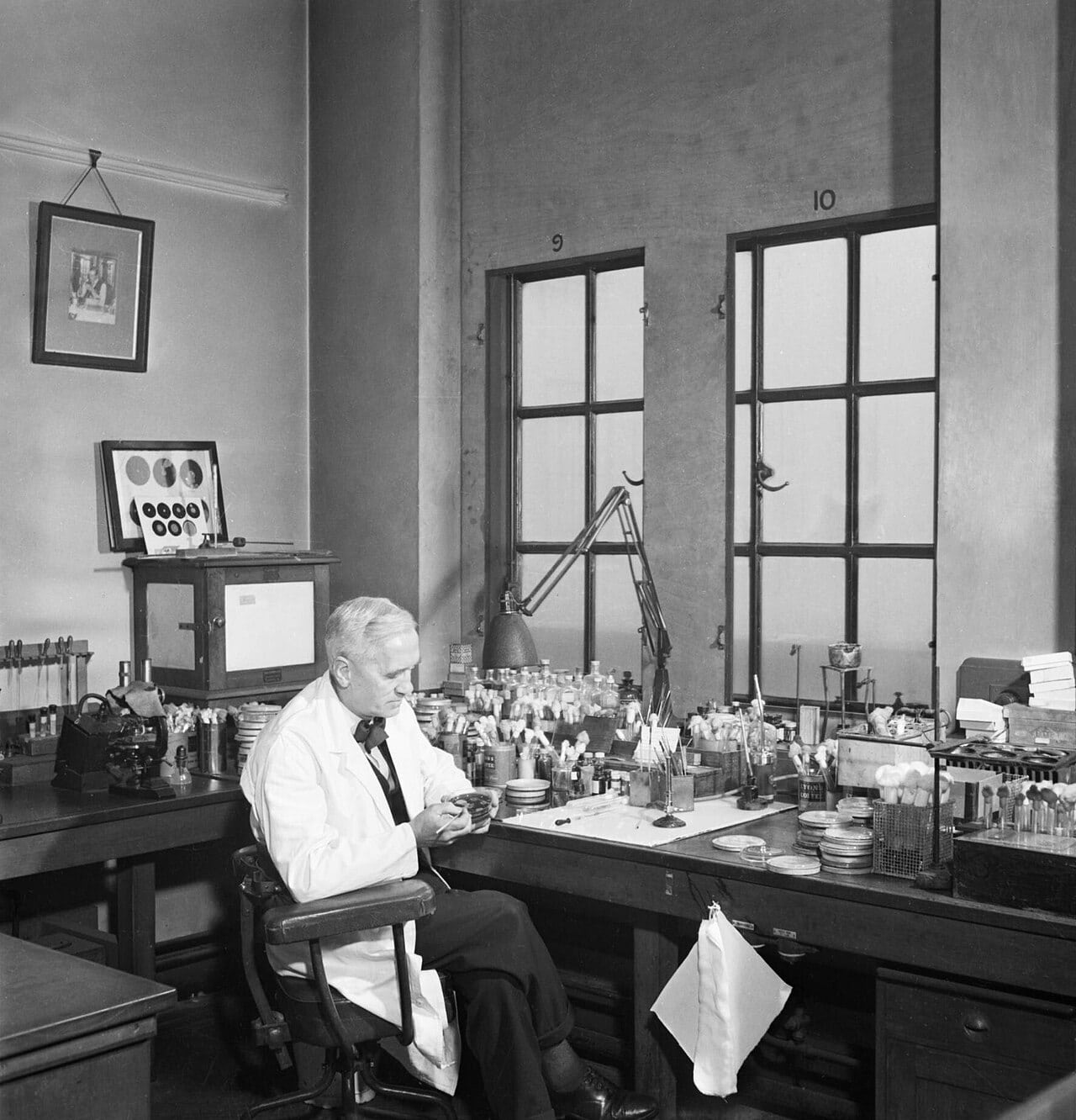
Fleming's laboratory was famously chaotic - plates stacked in piles, cultures left for weeks, colleagues joking about it. In September 1928 he came back from a month in Suffolk, began clearing a bench, and stopped at one plate. A blue-green mould had got in, and around it the staphylococcus colonies had dissolved. He said later that he did not invent penicillin; nature did, and he only discovered it by accident. The accident required a man who looked hard at rubbish before throwing it away.
Rank
#43
Influence
82
Field
Bacteriologist
Historical Perspective
Alexander Fleming was born on a farm at Darvel in Ayrshire on 6 August 1881, the seventh of eight children, and moved to London at thirteen. A small legacy from an uncle let him enter St Mary's Hospital Medical School, where he qualified in 1906 and stayed for essentially his entire career under the bacteriologist Almroth Wright. During the First World War he served in the Royal Army Medical Corps at Boulogne, and his work there on infected wounds showed that the antiseptics being poured into them were killing the body's own defensive cells faster than the bacteria deep in the tissue - a finding largely ignored at the time. In 1922 he discovered lysozyme, a mild antibacterial enzyme present in tears and mucus, after a drop from his own nose fell on a culture. Then, in September 1928, came the contaminated plate. He published in 1929, failed to concentrate the substance, and set it aside. Florey and Chain took it up at Oxford in 1939, treated the first patient in 1941, and American industry mass-produced it in time for the invasion of Europe. The three shared the Nobel Prize in 1945. Fleming died in London on 11 March 1955. Michael Hart ranked him 43rd in The 100.
Influence Meter
82
Measured on a 100-point scale
The first antibiotic, and with it the end of infection as a routine cause of death
Before 1941
What Infection Meant
It is easy to underestimate the world penicillin ended. A scratch from a rose thorn could kill. Pneumonia carried a mortality of around thirty per cent and was called the old man's friend because it ended lives so reliably. Puerperal fever killed women after childbirth in numbers that made hospitals more dangerous than home. Battlefield wounds killed as often through infection as through the injury itself, and amputation was routinely performed to get ahead of gangrene. In 1924 the son of the President of the United States developed a blister playing tennis on the White House court, and died of sepsis at sixteen. Nothing could be done, for anyone, at any price.
There were partial answers before penicillin. The sulphonamides, developed in Germany in the 1930s, were genuinely effective against some organisms and saved many lives. But they were narrow, often toxic, and useless against staphylococcus, the organism that dominated wound infection. Penicillin was the first agent that killed a broad range of bacteria while doing essentially nothing to the patient - and that combination, unremarkable to anyone born since, is the reason the twentieth century's life expectancy curve bends where it does.
September 1928
The Chain of Accidents
The discovery required an improbable sequence. Fleming was working on staphylococci and left a stack of plates on a bench rather than in the incubator while he went on holiday for a month. A spore of Penicillium notatum drifted up - most likely from a mycology laboratory one floor below - and landed on one plate. London then had an unusually cold spell followed by warmth, which is what the sequence needed: the mould grows best cool, the bacteria warm, and had the temperatures been steady in either direction nothing would have shown. When Fleming returned on 3 September and started discarding plates, he lifted one, noticed a clear halo around the mould where the colonies had dissolved, and said something to the effect of that's funny. He photographed it, subcultured the mould, and established that its broth killed staphylococci, streptococci and several other pathogens while being harmless to white blood cells.
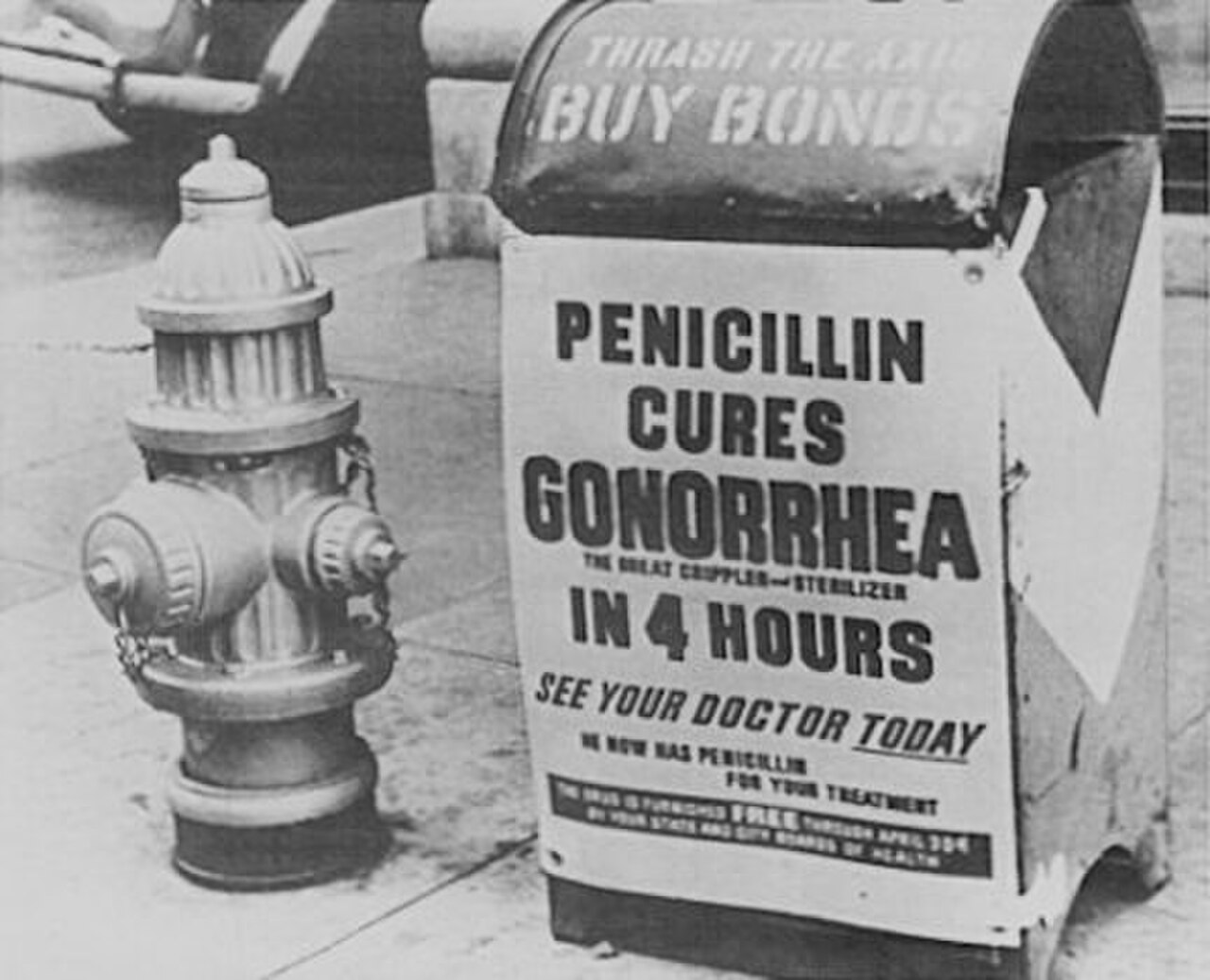
Fleming published in the British Journal of Experimental Pathology in 1929 and the paper attracted almost no attention. The reason is that he could not make the stuff usable: penicillin in broth is present in tiny quantities, is unstable, and resisted every attempt he and his assistants made to concentrate it. He was a bacteriologist, not a chemist, and St Mary's had neither the chemical expertise nor the funding to push further. He kept the mould alive, sent samples to anyone who asked, and by the mid-1930s had largely stopped working on it. Twelve years passed between the observation and the first treated patient - a gap that has been used both to diminish Fleming's role and to make a broader point about how much scientific value can sit unused for want of a different discipline in the next building.
1939-1945
The People Who Made It a Drug
The Nobel Prize was shared three ways, and the popular story has never quite caught up with why.
Howard Florey
An Australian pathologist who led the Oxford team, secured Rockefeller Foundation funding when British money was unavailable, and drove the project through the war. He organised the American production effort personally.
- Role: Led the programme
Ernst Chain
A German-Jewish biochemist who had fled the Nazis, and the man who found how to purify and stabilise penicillin - the specific problem Fleming could not solve.
- Role: Purification
Norman Heatley
Devised the freeze-drying and back-extraction methods and improvised the culture apparatus from bedpans and biscuit tins. Not included in the Nobel, and widely regarded since as the most underacknowledged figure in the story.
- Recognition: An Oxford honorary doctorate, 1990
Albert Alexander
An Oxford policeman with septicaemia from a scratch, the first person treated. He improved dramatically, the supply ran out despite recovering the drug from his urine, and he died. The trial proved both that it worked and that quantity was the whole problem.
- Outcome: Improved, then died
Mary Hunt and a cantaloupe
A laboratory assistant in Illinois found a mouldy melon in a market carrying Penicillium chrysogenum, which yielded some two hundred times more penicillin. Nearly all penicillin since descends from that strain.
- Yield: About 200x
American mass production
Deep-tank fermentation by Pfizer and others took output from a few doses to 2.3 million by D-Day in June 1944, and to enough for every Allied casualty by the end of the war.
- By D-Day: 2.3 million doses
1945
The Warning He Gave in the Same Speech
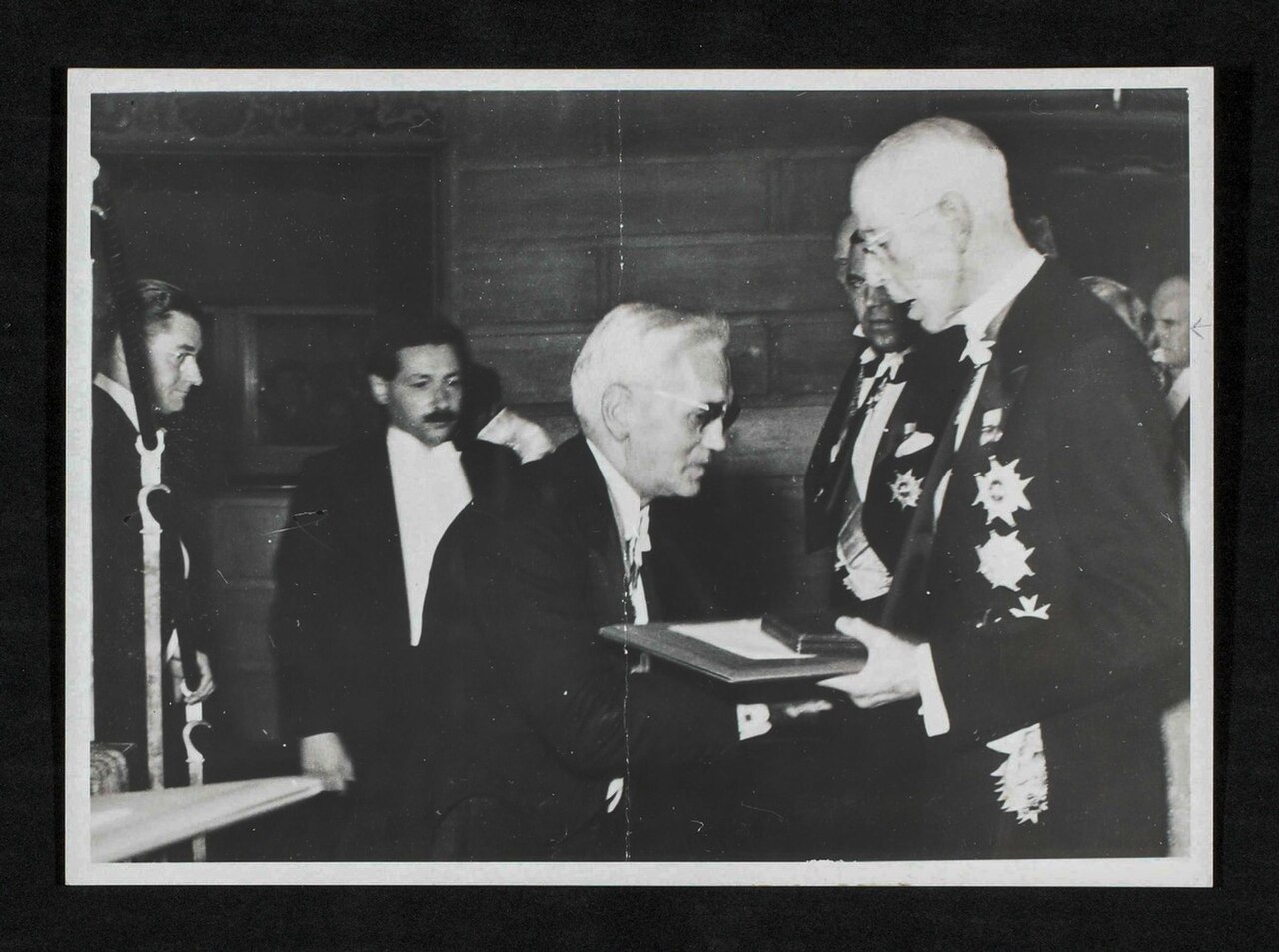
Accepting the Nobel Prize in December 1945, Fleming used part of the lecture to describe how the drug would be lost. It was easy, he said, to make microbes resistant to penicillin in the laboratory by exposing them to concentrations too low to kill them, and the same thing would happen in the body; he imagined a man buying penicillin for a sore throat, taking too little, and breeding resistant organisms that would go on to kill someone else. He was describing, in 1945, the exact mechanism of the antimicrobial resistance crisis that the World Health Organization now lists among the leading threats to global health. Penicillin-resistant staphylococcus appeared within four years of mass use. Roughly 1.3 million deaths a year are now attributed directly to resistant bacterial infections, and the estimate for deaths associated with them is several times higher.
Further Reading
Books About Fleming and Penicillin
The historiography has spent decades adjusting the balance between the discoverer and the developers.
Legacy
Why Number Forty-Three
Michael Hart ranked Fleming 43rd, and there is a reasonable argument that the entry should be shared with Florey and Chain, or that Florey should have it. Fleming observed and named the phenomenon and then could not develop it; Oxford did the work that turned it into medicine, and Florey said as much, with some asperity, for the rest of his life. Fleming's own account was consistently modest. What secured him the public credit was partly the press, which found a lone Scot with a lucky mould a better story than a laboratory team, and partly that he was in Britain and available for interview while Florey was in America running a production programme.
The consequences do not depend on who gets the statue. Estimates of lives saved by penicillin run to the order of two hundred million. Infectious disease stopped being the ordinary way that people died in developed countries, childbirth became survivable as a matter of routine, and surgery could be attempted on the certainty that a post-operative infection was treatable - which is what made transplantation, joint replacement and cardiac surgery possible at all. Fleming also told the world in his acceptance speech exactly how it would be squandered, and the world has spent eighty years doing precisely what he described.
Related Publications