Alexander Graham Bell

Alexander Graham Bell
Born 3 March 1847 • Died 2 August 1922
Bell did not set out to invent a telephone. He was a teacher of deaf children, trying to build a device that would let a deaf person see speech as a visible trace, and working on a harmonic telegraph that could send several messages down one wire at once. The telephone came out of that work almost sideways. He filed the patent on the same day as a rival, hours apart, and the resulting monopoly became the most valuable in the history of American business.
Rank
#42
Influence
81
Field
Inventor and Teacher of the Deaf
Historical Perspective
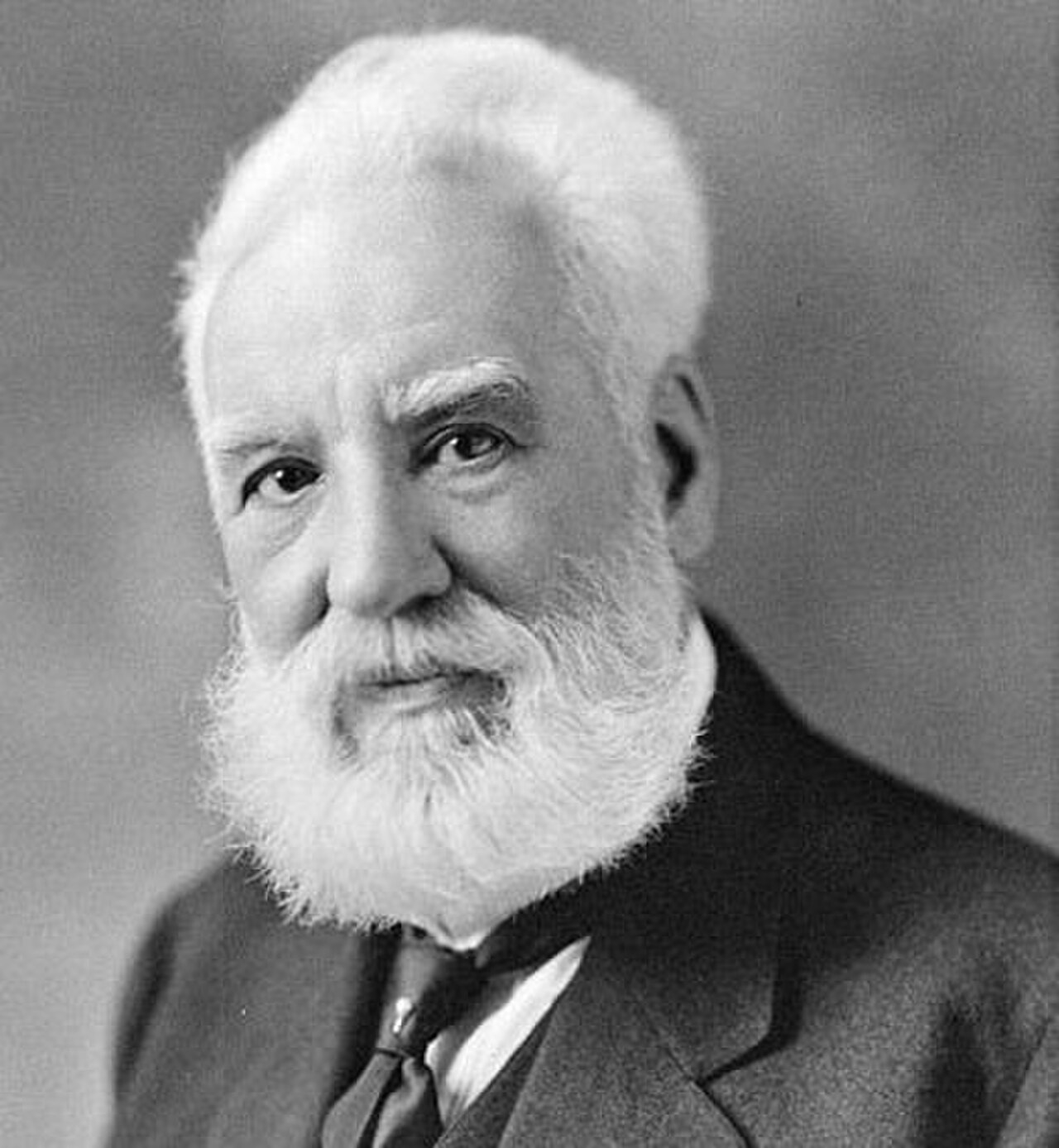
Alexander Graham Bell was born in Edinburgh on 3 March 1847 into a family that had made speech its profession. His grandfather taught elocution, his father Alexander Melville Bell invented Visible Speech, a notation showing precisely how the vocal organs form each sound, and his mother Eliza was substantially deaf - Bell learned to speak close to her forehead so she could feel the vibration. After both his brothers died of tuberculosis the family emigrated to Canada in 1870, and Bell moved to Boston in 1871 to teach Visible Speech to teachers of the deaf, opening his own school in 1872 and becoming professor of vocal physiology at Boston University. Two of his pupils' fathers - Gardiner Hubbard and Thomas Sanders - funded his experiments with multiple telegraphy; Hubbard's deaf daughter Mabel became his wife in 1877. The telephone patent was filed on 14 February 1876, the first intelligible sentence transmitted on 10 March, and the Bell Telephone Company formed in 1877. He spent the rest of his long life on other things entirely, and died at Beinn Bhreagh in Nova Scotia on 2 August 1922. Michael Hart ranked him 42nd in The 100.
Influence Meter
81
Measured on a 100-point scale
Made the human voice travel, and founded the industry that carried it
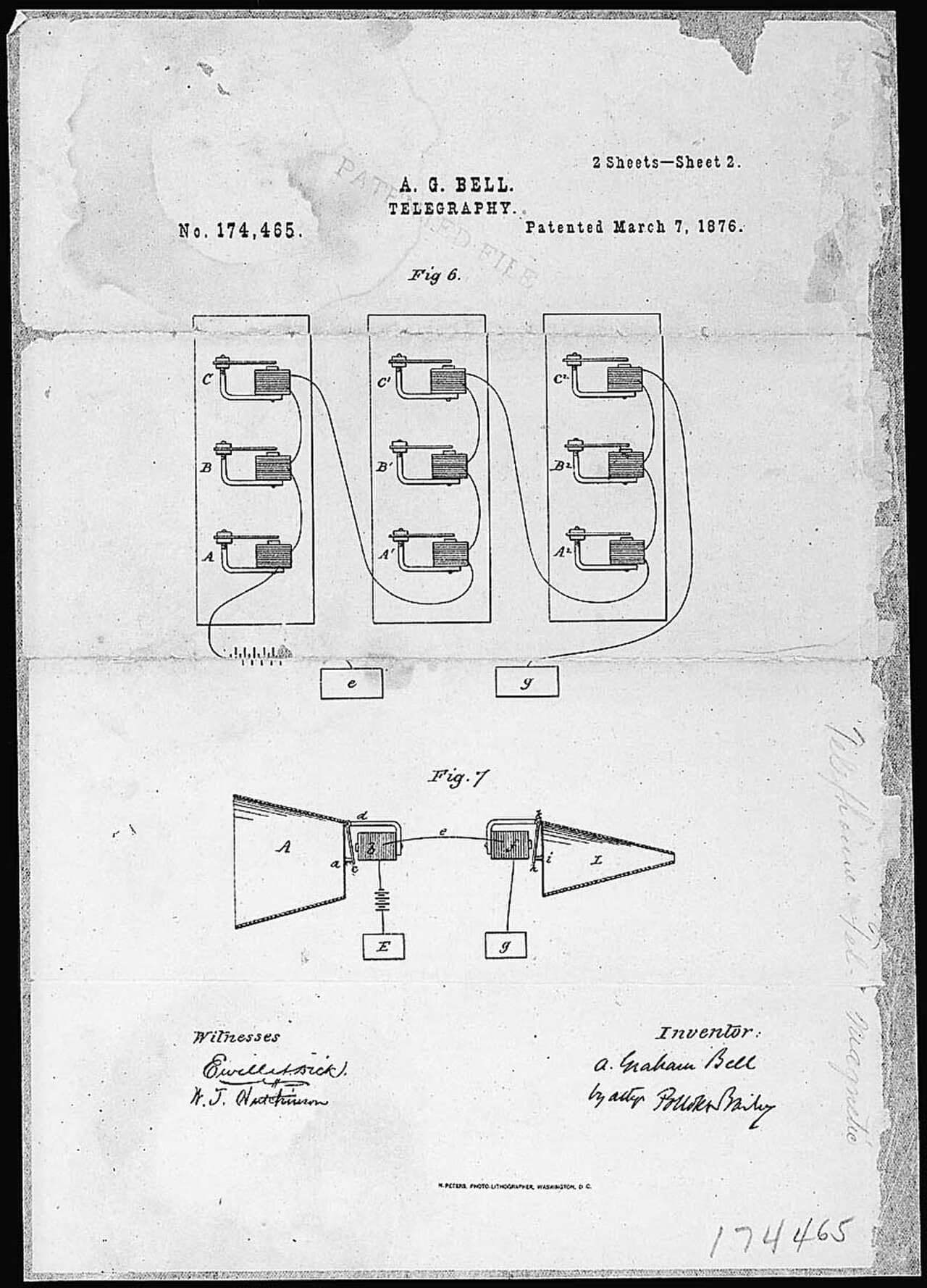
14 February 1876
The Most Valuable Patent Ever Issued
On the morning of 14 February 1876, Bell's lawyer filed his patent application at the US Patent Office. That same day Elisha Gray, an experienced electrical inventor, filed a caveat - a notice of intention to patent - describing a liquid transmitter for transmitting speech. Bell's patent 174,465 was granted on 7 March, and three days later, on 10 March, he transmitted the first intelligible sentence to his assistant in the next room: Mr Watson, come here, I want to see you. The apparatus he used that day employed a liquid transmitter closely resembling Gray's, which he had not described in the same way in his original filing - a coincidence that has been argued over for nearly a century and a half, with allegations of a bribed patent examiner never proven and never quite dismissed. What is beyond dispute is what followed: the patent was challenged in some 587 lawsuits over eighteen years and survived every one, and the monopoly it conferred built the largest company on Earth.
Bell regarded himself first and last as a teacher of the deaf, and said he would rather be remembered for that than for the telephone. The relationship between that work and the Deaf community is nonetheless deeply antagonistic, and for reasons of substance rather than misunderstanding. He was the most prominent advocate of oralism - teaching deaf children to speak and lipread - and campaigned against the use of sign language and against residential deaf schools, on the argument that they would produce a separate community. In 1883 he presented a paper to the National Academy of Sciences, Memoir upon the Formation of a Deaf Variety of the Human Race, warning that deaf intermarriage would produce a deaf subpopulation, and he supported restrictions on deaf people marrying each other. He was a leading figure in the American eugenics movement. Oralism dominated deaf education for most of the twentieth century, sign language was suppressed in classrooms across the West, and the consequences for generations of deaf children are still being reckoned with.
What He Did With the Rest of His Life
Bell was thirty when the telephone company was founded and lived another forty-five years, most of which he spent on entirely different problems.
- The photophone, 1880: Transmitted speech on a beam of light using a selenium receiver. He considered it his greatest invention; it was a century early, and the principle underlies fibre-optic communication.
- A metal detector for a president: Built an induction balance in 1881 to locate the bullet in the dying President Garfield. It failed, probably confused by the metal bedsprings, and Garfield died.
- The vacuum jacket: An early negative-pressure respirator, devised after his newborn son died of respiratory failure. It anticipated the iron lung.
- Hydrofoils: With Casey Baldwin he built the HD-4, which set a world marine speed record of over seventy miles per hour in 1919, when Bell was seventy-two.
- Aviation: Founded the Aerial Experiment Association in 1907, which built the Silver Dart - the first powered flight in Canada, in 1909 - and pioneered the aileron, which displaced the Wrights' wing-warping.
- National Geographic: As its second president from 1898 he turned a dry scientific bulletin into a popular magazine built around photography, which is why it looks the way it does.
1877-1984
What the Patent Became
The Bell Telephone Company was formed in July 1877 with Hubbard, Sanders and Watson, and Bell held a substantial stake he largely stopped paying attention to. Western Union, having declined to buy the patent when offered it for a reported hundred thousand dollars, changed its mind and was beaten in court. By the twentieth century the successor, AT&T, was the largest corporation in the world and operated a regulated national monopoly on American telephony that lasted until the courts broke it up in 1984.
The most consequential part of that empire was Bell Laboratories, funded by monopoly revenues and given unusual freedom. Out of it came the transistor, the laser, the solar cell, information theory, the Unix operating system, the C programming language and the discovery of the cosmic microwave background - nine Nobel Prizes in total. It is a peculiar chain of causation: a Scottish speech teacher's attempt to help deaf children produced a patent that produced a monopoly that funded the laboratory that invented much of the twentieth century's information technology.
Further Reading
Books About Bell
Recent work has been much more willing than earlier biography to treat the deaf-education record as central rather than incidental.
Legacy
Why Number Forty-Two
Michael Hart ranked Bell 42nd, and the priority question hangs over the entry more than for almost anyone else on the list. Antonio Meucci demonstrated a voice-transmitting device in New York in the 1850s and lacked the money to maintain his caveat; the US House of Representatives passed a resolution in 2002 recognising his contribution. Philipp Reis built a working apparatus in Germany in 1861. Elisha Gray filed hours after Bell on the same day. The defensible summary is that Bell was one of several people converging on the same idea, and that he was the one who patented it, defended it and built the industry - which is what determined the shape of global telecommunications.
The telephone did something no previous technology had: it carried the actual voice of an absent person, in real time, to anyone with a line. Written messages had travelled at speed since the telegraph, but a voice is a different order of presence, and the mobile phone in a pocket today is a direct descendant of a device built to help a deaf woman's husband understand how sound works. That the same man campaigned to stop deaf people signing to one another, and to discourage them from marrying, is not a footnote to the story. Both things are him, and the Deaf community has never had the option of forgetting the second.
Related Publications