Ludwig van Beethoven

Ludwig van Beethoven
Born baptised 17 December 1770 • Died 26 March 1827
At the premiere of the Ninth Symphony in Vienna in May 1824, Beethoven stood by the conductor beating time to music he could not hear. When it ended he was still facing the orchestra, several bars behind, and one of the soloists took his arm and turned him round so that he could see the audience on its feet. He was fifty-three and had been deaf for years. The symphony he had just failed to hear is now played at the fall of the Berlin Wall, at the Olympics, and as the anthem of Europe.
Rank
#45
Influence
82
Field
Composer
Historical Perspective
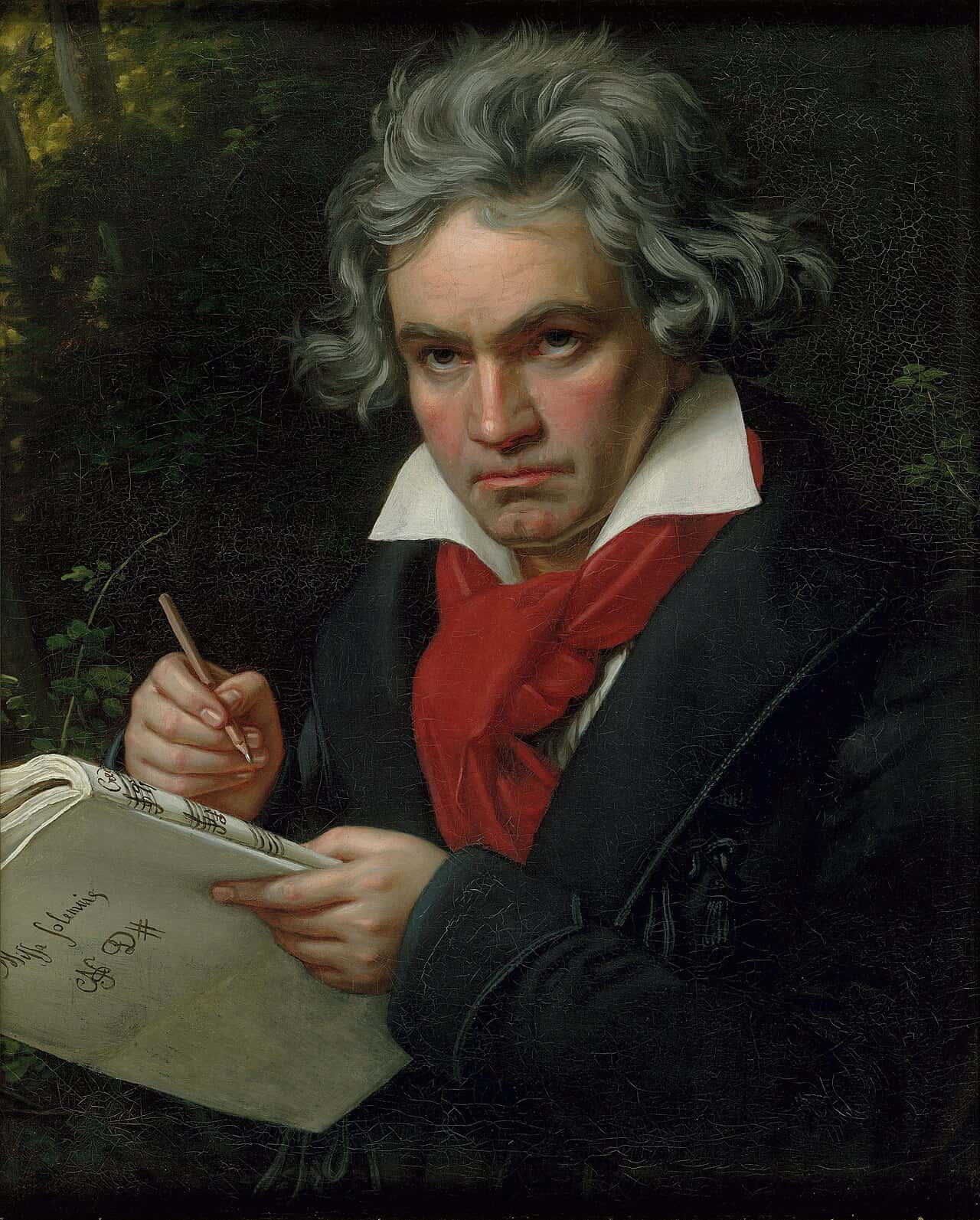
Ludwig van Beethoven was baptised at Bonn on 17 December 1770, the son of a court tenor who drank and who tried, unsuccessfully, to market the boy as a second Mozart, once advertising a seven-year-old as six. Serious training came from the court organist Christian Gottlob Neefe. In November 1792 he moved to Vienna, then the musical capital of Europe, to study with Haydn, and made his name first as a pianist of formidable power and improvisatory skill. Around 1798 he began to notice a ringing in his ears, and by 1802, in a despairing letter to his brothers written at Heiligenstadt and never sent, he described contemplating suicide and deciding that art had held him back from it. What followed was the most productive period of his life. He was substantially deaf by 1812 and profoundly so by about 1818, conducting conversations in writing through the notebooks that survive. He died in Vienna on 26 March 1827, and a crowd estimated in the tens of thousands attended the funeral. Michael Hart ranked him 45th in The 100.
Influence Meter
82
Measured on a 100-point scale
Turned the composer from a craftsman into an artist, and the symphony into a statement
October 1802
The Letter He Never Sent
The Heiligenstadt Testament is a document of a kind almost nothing else in music history resembles. Written in a village outside Vienna where his doctor had sent him to rest his hearing, addressed to his brothers and found among his papers after his death, it describes the particular humiliation of his condition: a musician who cannot hear, who must ask people to shout, who avoids company because he cannot admit the reason and is therefore thought misanthropic. He writes of standing beside someone who could hear a distant flute while he heard nothing, and of how close that brought him to ending his life. What stopped him, he says, was art - the impossibility of leaving the world before he had produced what he felt within him. He came back to Vienna and wrote the Eroica. Whatever one makes of the biographical reading of music, that sequence is documented and it is extraordinary.
The Third Symphony of 1803-04, the Eroica, is conventionally the point where music changes. It runs roughly fifty minutes where a Haydn symphony ran twenty-five, it opens with two hammered chords rather than an introduction, its second movement is a funeral march, and its harmonic language goes places the Classical style had no procedure for. Beethoven originally dedicated it to Napoleon, whom he regarded as the embodiment of republican promise; on hearing that Napoleon had declared himself Emperor, he is reported by his pupil Ferdinand Ries to have torn the title page in fury and said that he too would become a tyrant and trample the rights of man. The surviving manuscript title page has the dedication scratched out so violently that the paper is torn. It was published as a heroic symphony composed to celebrate the memory of a great man.
The Work
What He Actually Changed
He inherited forms from Haydn and Mozart that were essentially complete, and left every one of them larger, longer and structurally different.
The symphony
From the Haydnesque First to the Ninth, which added voices and a choir to a form that had never had them and set Schiller's Ode to Joy as its finale. Composers after him wrote symphonies in the shadow of nine.
- Ninth premiered: 7 May 1824
The piano sonata
Often called the New Testament of piano music. He expanded the instrument's range as fast as makers could build it, and the last three sonatas leave Classical form behind entirely.
- Best known: Pathétique, Moonlight, Appassionata
The string quartet
The late quartets, written when he was totally deaf, were regarded for a century as incomprehensible and are now considered among the summits of Western music. Schubert asked to hear one on his deathbed.
- Late quartets: 1825-1826
The concerto
The Emperor Concerto opens with the soloist rather than the orchestra, a small structural change that says a great deal about where he had moved the balance of authority.
- Violin Concerto: 1806
Opera
Fidelio, revised across a decade, about a woman who disguises herself to rescue her husband from political imprisonment. His only opera and his most explicitly political work.
- First version: 1805
Sacred music
A mass of such scale and difficulty that it is barely liturgical. He called it his greatest work and inscribed the score from the heart, may it go again to the heart.
- His own view: His greatest
The Central Question
How Does a Deaf Man Compose?
The short answer is that composers do not need to hear music to write it, any more than a novelist needs to hear a sentence read aloud. A trained musician reads a score the way a literate person reads prose, hearing it internally; Beethoven had absolute command of that faculty before his hearing went, and it did not depend on his ears. What he lost was the ability to perform, to conduct reliably, to hear his own work played back, and to correct by ear. He sawed the legs off a piano and rested it on the floor to feel the vibration through the wood, and used ear trumpets and a resonating rod held between his teeth.
The more interesting claim, which musicians make often and which cannot really be proved, is that the isolation shaped the music. The late works - the last quartets, the final sonatas, the Missa Solemnis - are strange in ways that have no precedent: abrupt, inward, sometimes harmonically bewildering, occasionally with instructions written in the score addressed to no one in particular. He was writing without any external check on what an audience could follow, which is one explanation for why it took the nineteenth century about seventy years to catch up with them. The cause of the deafness remains uncertain; otosclerosis is the usual guess, and a lock of his hair analysed in 2000 showed very high lead levels, which may or may not be related.
March 1827
The Funeral of a Man Who Worked for Nobody
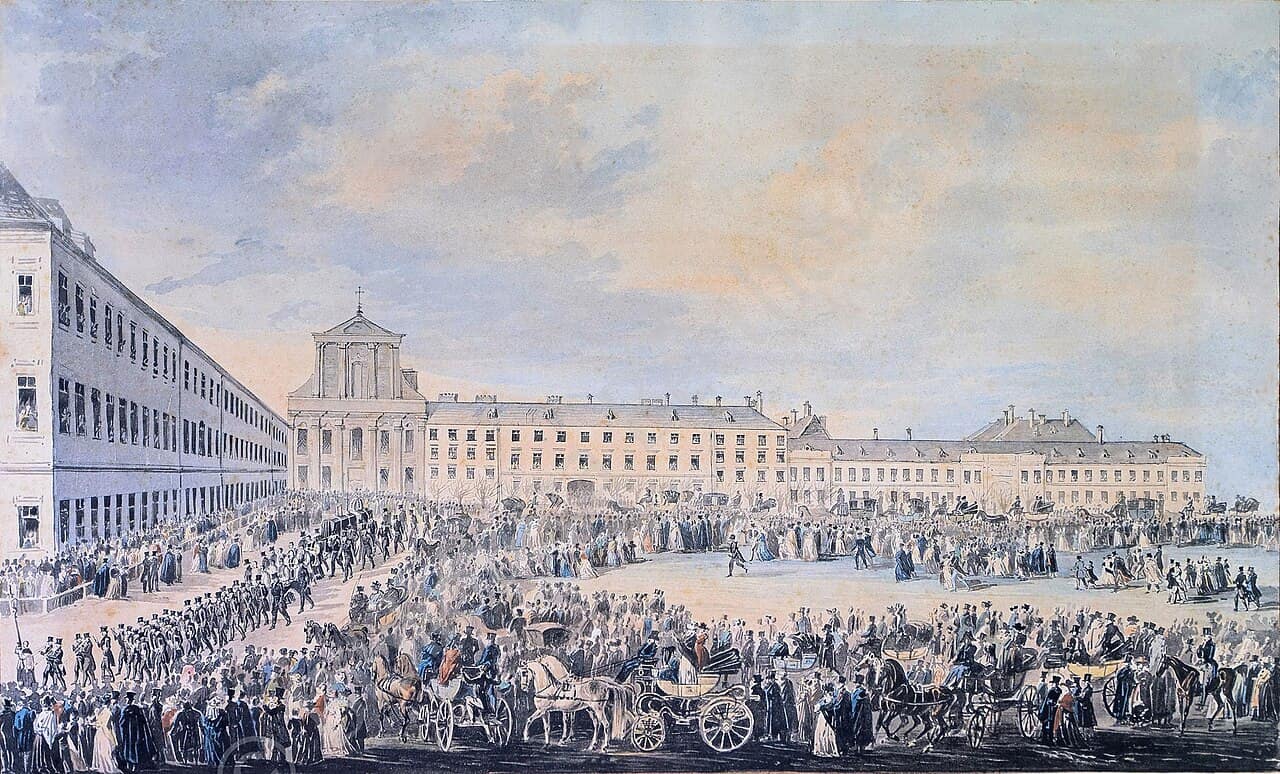
Beethoven's death drew a crowd contemporary accounts put in the tens of thousands, in a city of about three hundred thousand; schools closed, troops were called to manage it, and Schubert was among the torchbearers. That is worth pausing on, because it marks a change in what a composer was. Haydn had worn livery and eaten with the servants at Esterháza. Mozart had spent his life scrambling for commissions and patrons. Beethoven took money from aristocrats but on his own terms - three of them combined to pay him an annuity simply to stay in Vienna - refused to be treated as staff, and famously told a prince that there were and would be thousands of princes but only one Beethoven. He published for a growing middle-class market, and he died as a public figure whose funeral stopped a capital city.
Further Reading
Books About Beethoven
The documentary record is unusually rich: sketchbooks, conversation books, letters and contemporary memoirs.
Legacy
Why Number Forty-Five
Michael Hart ranked Beethoven 45th, the second artist on the list after Shakespeare, and the argument is about the model rather than the melodies. Before him, a composer was a skilled employee producing music for an occasion - a mass, a name-day, a prince's dinner. After him, the composer was an artist with something interior to express, whose work was to be listened to in silence and interpreted rather than merely enjoyed. Every Romantic composer worked in that assumption, and so does the entire modern concert apparatus: the hushed hall, the reverence, the idea of a canon.
The music itself has kept an unusual public function. The Ode to Joy from the Ninth is the anthem of the European Union and was played by Bernstein in Berlin at Christmas 1989 with the word joy replaced by freedom. The opening of the Fifth was the BBC's V-for-victory signal to occupied Europe. Two centuries after the funeral, a deaf man's setting of a poem about universal brotherhood is what institutions reach for when they want to say something they have no other way of saying, and a movement of his is on the Voyager record heading out of the solar system.
Related Publications