Plato

Plato
Born c. 428 BC • Died c. 348 BC
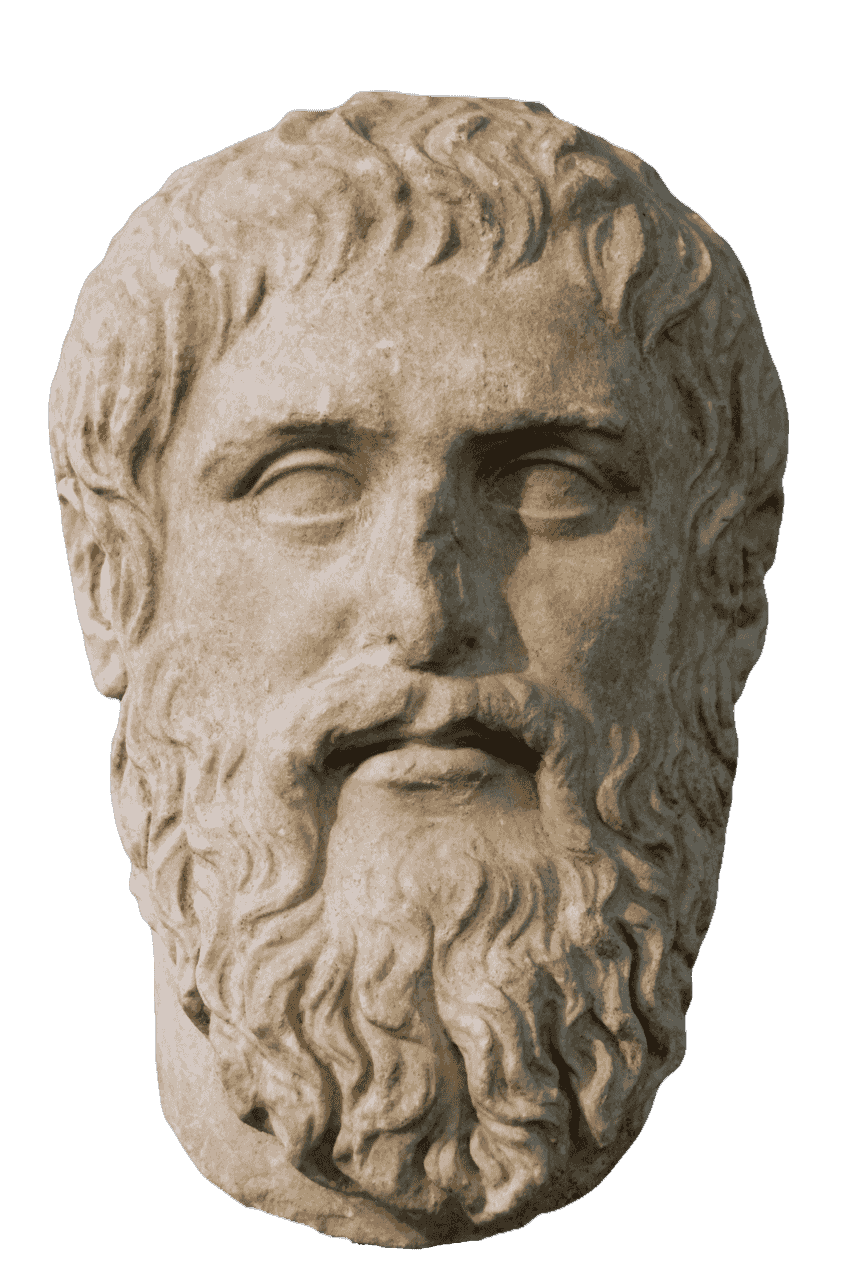
Plato was born into a family that expected him to govern Athens. Then the city he was to serve put his teacher to death for asking questions, and he concluded that politics as practised was incompatible with truth as pursued. He spent the next fifty years writing conversations - not treatises, conversations, in which people argue, get things wrong, lose their tempers and occasionally arrive somewhere. Almost every question Western philosophy still works on appears in them: what is justice, what is knowledge, what is real, how should a state be arranged, what is love.
Rank
#40
Influence
85
Field
Philosopher
Historical Perspective
Plato was born in Athens around 428 BC into a family of considerable standing - his mother's line traced to the lawgiver Solon, and two of his relatives were among the Thirty Tyrants who briefly ruled the city after its defeat by Sparta. He expected a political career and abandoned the idea, he later wrote, after seeing how the city was actually governed and above all after the trial and execution of Socrates in 399 BC on charges of impiety and corrupting the young. He travelled for years afterwards, in Italy and Sicily and possibly Egypt, and around 387 BC founded the Academy in a grove outside Athens - a community of enquiry that lasted, in various forms, until the Romans sacked it in 86 BC and beyond. He made three journeys to Syracuse hoping to shape a ruler into a philosopher-king, and all three failed, the last leaving him briefly in danger of his life. Aristotle joined the Academy around 367 BC and stayed twenty years. Plato died in Athens around 348 or 347 BC, aged about eighty. Michael Hart ranked him 40th in The 100.
Influence Meter
85
Measured on a 100-point scale
Set the questions Western philosophy has been answering for twenty-four centuries
399 BC
The Execution That Made Him a Writer
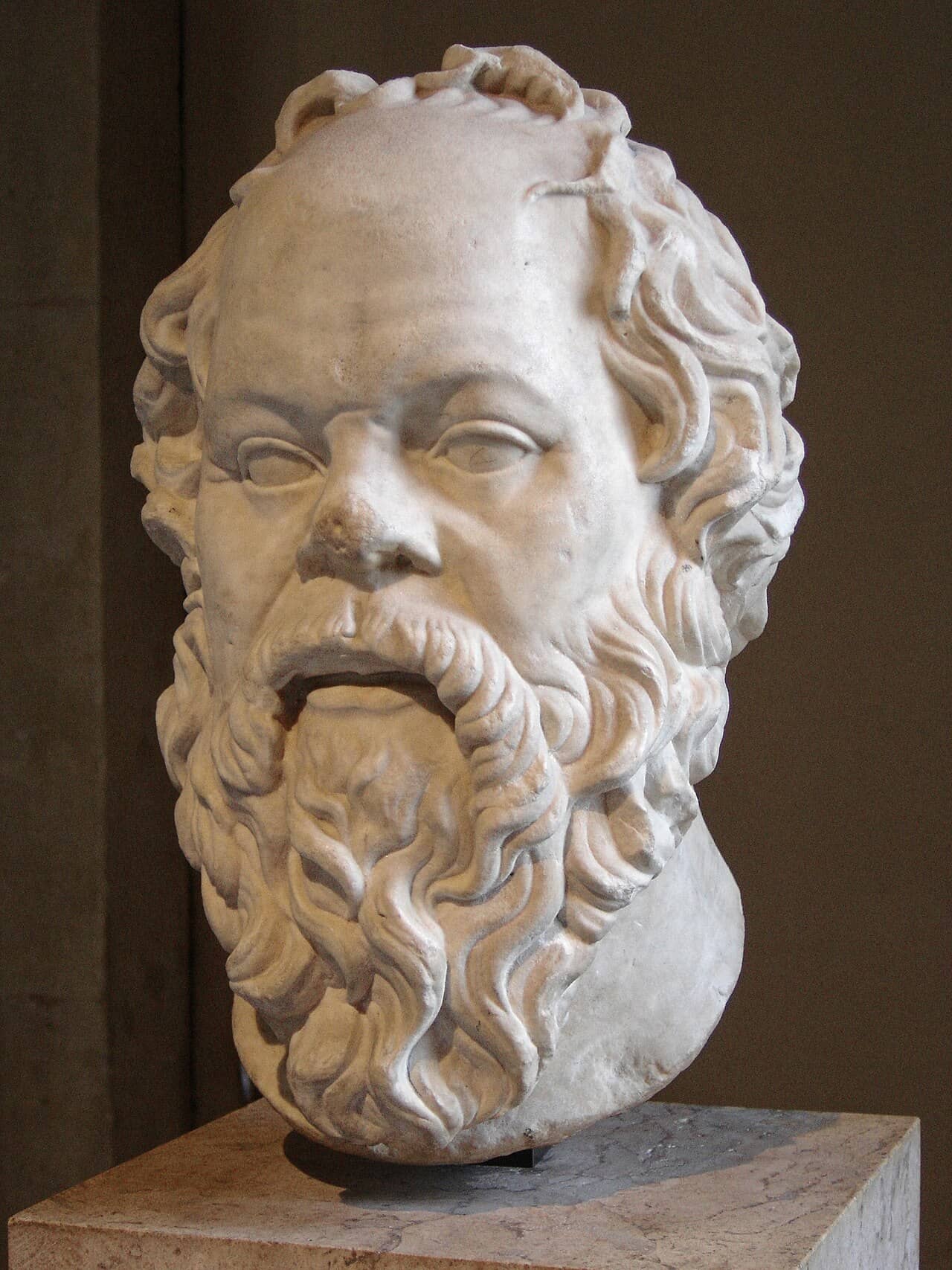
Socrates wrote nothing. He spent his life in the Athenian agora asking people who claimed to know something to define it, and demonstrating that they could not - a practice that made him famous and, eventually, intolerable. In 399 BC, with Athens defeated, humiliated and suspicious, he was tried for impiety and corrupting the youth, convicted by a narrow margin, and executed by hemlock. Plato was about twenty-eight. Nearly everything known about Socrates comes through him, which creates the central problem of the subject: in the early dialogues Socrates appears to be reporting a real method, while in the middle and later ones he is plainly a mouthpiece for positions the historical Socrates is unlikely to have held. Scholars call this the Socratic problem and it has no settled solution. What is clear is that Plato's entire output is in some sense a response to the fact that his city killed the best man he knew for asking questions.
The Ideas That Left the Dialogues
Plato wrote no systematic treatise and the dialogues do not always agree with each other. These are the positions that were extracted from them and shaped everything downstream.
- The Theory of Forms: Beyond the changing things we perceive lie perfect, unchanging Forms - Justice, Beauty, the Circle - of which physical objects are imperfect copies. Knowledge is of the Forms; opinion is of appearances.
- The allegory of the cave: Prisoners chained facing a wall take shadows for reality. One escapes, sees the sun, returns to explain and is disbelieved. It is simultaneously an account of education, of metaphysics, and of what happened to Socrates.
- The tripartite soul: Reason, spirit and appetite, which should stand in the same relation to one another as the three classes of the ideal city. Justice in a person, as in a state, is each part doing its own work.
- The philosopher-king: Cities will not cease from evil, the Republic argues, until philosophers rule or rulers philosophise. The most influential and most criticised political proposal in the Western canon.
- Knowledge as recollection: In the Meno an untaught slave boy is led to a geometrical proof by questioning alone, which Plato takes to show that learning is remembering what the soul already knew - the founding argument for innate knowledge.
- Platonic love: In the Symposium, desire for a beautiful body is the lowest rung of a ladder ascending to the love of Beauty itself. The phrase has since been reduced to meaning a friendship without sex, which is not what it says.
The Republic is the most influential work of political philosophy ever written and it describes a state most modern readers find repellent. Its ideal city is governed by a caste of guardians selected by aptitude and trained for decades; poetry and most music are censored because they corrupt; property and families are abolished among the ruling class, with children raised communally and reproduction managed by the state; and citizens are told a founding myth about metals in their souls to keep them content with their station. Karl Popper attacked it in 1945 as a blueprint for totalitarianism. Defenders reply that it is not a manifesto but an extended analogy, constructed to answer a question about justice in the individual soul, and that Plato's last work, the Laws, is far more practical and far less authoritarian. The argument is unresolved and probably unresolvable, which is a fair description of most arguments about Plato.
c. 387 BC
The First University, More or Less
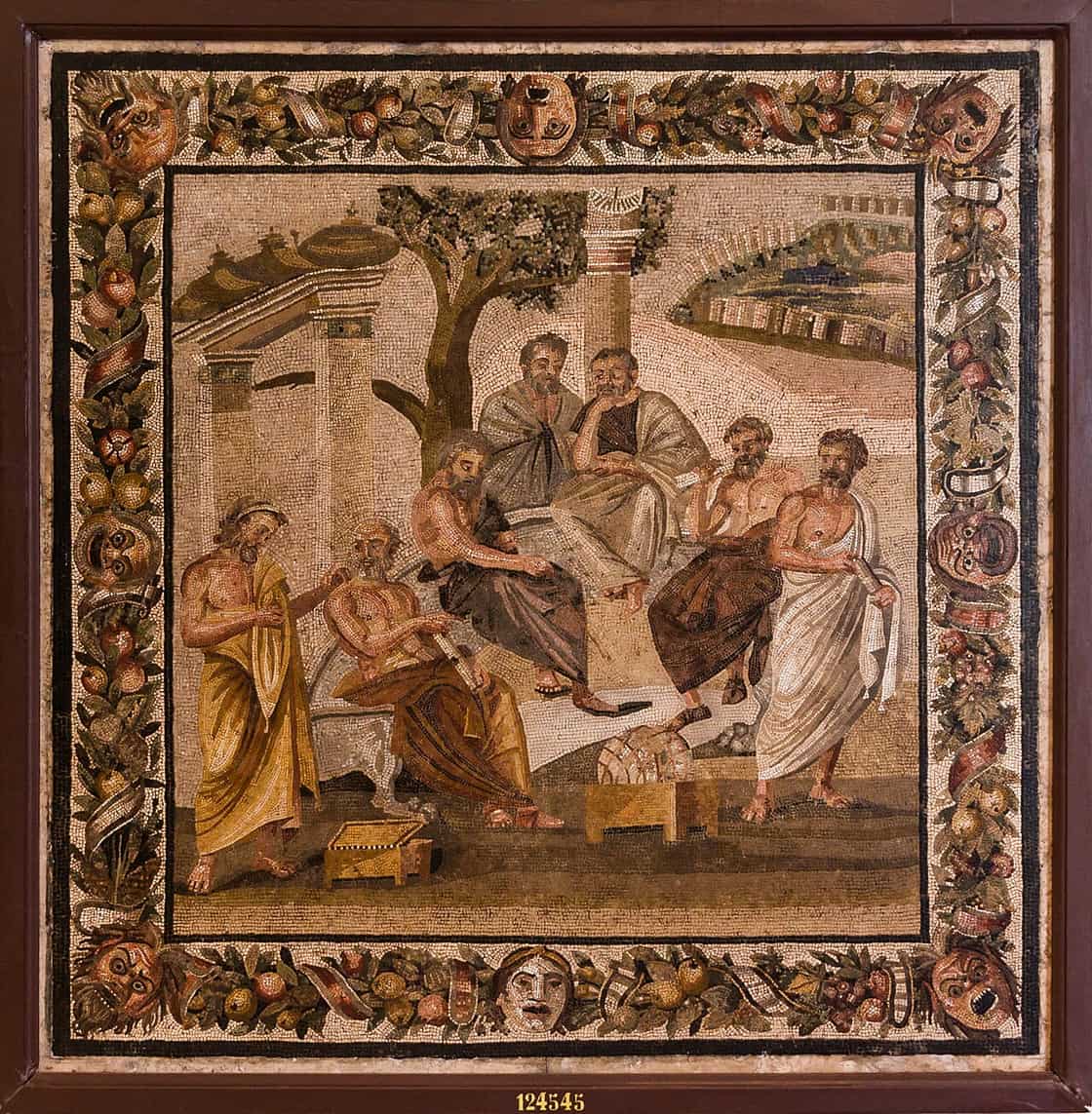
The Academy took its name from a sacred grove dedicated to the hero Akademos, north-west of the city walls, where Plato taught and where students lived and worked together. It was not a university in the modern sense - no fees, no degrees, no fixed curriculum - but it did something no institution had done before: it gathered people to pursue enquiry collectively and continuously, across generations, in mathematics, astronomy and dialectic as well as philosophy. Tradition holds that the entrance bore an inscription warning that no one ignorant of geometry should enter. It ran for roughly three centuries in its original form and was revived later, until the emperor Justinian closed the Neoplatonic schools of Athens in AD 529. Aristotle arrived at seventeen and stayed twenty years, disagreeing with the founder about nearly everything of importance, which is perhaps the strongest evidence that the place worked as intended.
388-360 BC
Three Attempts at Practical Politics, Three Failures
Plato went to Sicily three times, and the episode is the one point where his political theory met an actual ruler. The first visit, around 388 BC, ended with him falling out with the tyrant Dionysius I; a tradition, probably embellished, holds that he was sold into slavery on the return journey and ransomed by a friend. He returned in 366 BC at the invitation of Dion, brother-in-law of the new and young Dionysius II, to educate the ruler into philosophy. The pupil was uninterested, the court intrigued against Dion, and Plato went home. He tried once more in 361 BC and ended under effective house arrest, extracted only by the intervention of a foreign ally.
The Seventh Letter, whose authorship is disputed but which reads as a genuine account of the affair, describes the whole business with unusual candour - the hope that a single well-disposed ruler might be quicker than reforming a city, and the recognition afterwards that he had been naive. It is worth setting against the Republic, because it shows the author of the philosopher-king proposal discovering at first hand how such an arrangement behaves when a real tyrant is one of the two people involved.
Written Works
The Dialogues
Around thirty-five dialogues and thirteen letters are attributed to him, some certainly spurious. Uniquely among major ancient philosophers, the entire body of his work appears to have survived.
Further Reading
Books About Plato
The commentary tradition is continuous from antiquity, which is itself unusual.
Plato: Complete Works
The standard modern English edition in one volume, with the dialogues newly translated and prefaced.
- Published: 1997
The Open Society and Its Enemies, Volume 1
The famous attack, written during the Second World War, treating the Republic as an ancestor of modern totalitarianism. Hugely influential and much disputed.
- Published: 1945
Plato: A Very Short Introduction
A compact and unusually clear entry point by a leading scholar, good on why the dialogue form is not incidental to the philosophy.
- Published: 2003
Plato at the Googleplex
An unorthodox defence that drops Plato into modern America to argue that the questions have not been superseded.
- Published: 2014
Legacy
Why Number Forty
Michael Hart ranked Plato 40th, below Aristotle at thirteen, and the gap reflects Aristotle's greater reach into the sciences. The counterweight is Alfred North Whitehead's often-quoted remark that the safest general characterisation of the European philosophical tradition is that it consists of a series of footnotes to Plato - an overstatement that survives because it is close to true about the questions if not the answers. Metaphysics, epistemology, ethics, political philosophy and aesthetics are all fields he either opened or defined the terms of.
The transmission ran through unexpected channels. Neoplatonism carried his metaphysics into late antiquity, where Augustine absorbed it into Christian theology and gave the Forms a home in the mind of God; the Timaeus was for centuries the only substantial Plato available in the Latin West; and the recovery of the full corpus in fifteenth-century Florence helped set off the Renaissance. Mathematicians still call themselves Platonists when they hold that numbers are discovered rather than invented, which is a live position among working professionals. Twenty-four centuries on, an undergraduate reading the Republic is arguing with a book written by a disappointed Athenian aristocrat who could not stop thinking about why his city killed his teacher.
Related Publications