Alexander the Great

Alexander the Great
Born 20 July 356 BC • Died 10 June 323 BC
Alexander was twenty when his father was murdered and he inherited a kingdom, an army and a plan. He was thirty-two when he died in Babylon, having taken Egypt, Persia and part of India, fought four major pitched battles and lost none of them, and founded cities that still exist. Almost everything about the story invites suspicion of legend, and most of it is documented. The empire fell apart almost immediately. The Greek-speaking world he left behind lasted a thousand years.
Rank
#33
Influence
84
Field
King and Military Commander
Historical Perspective
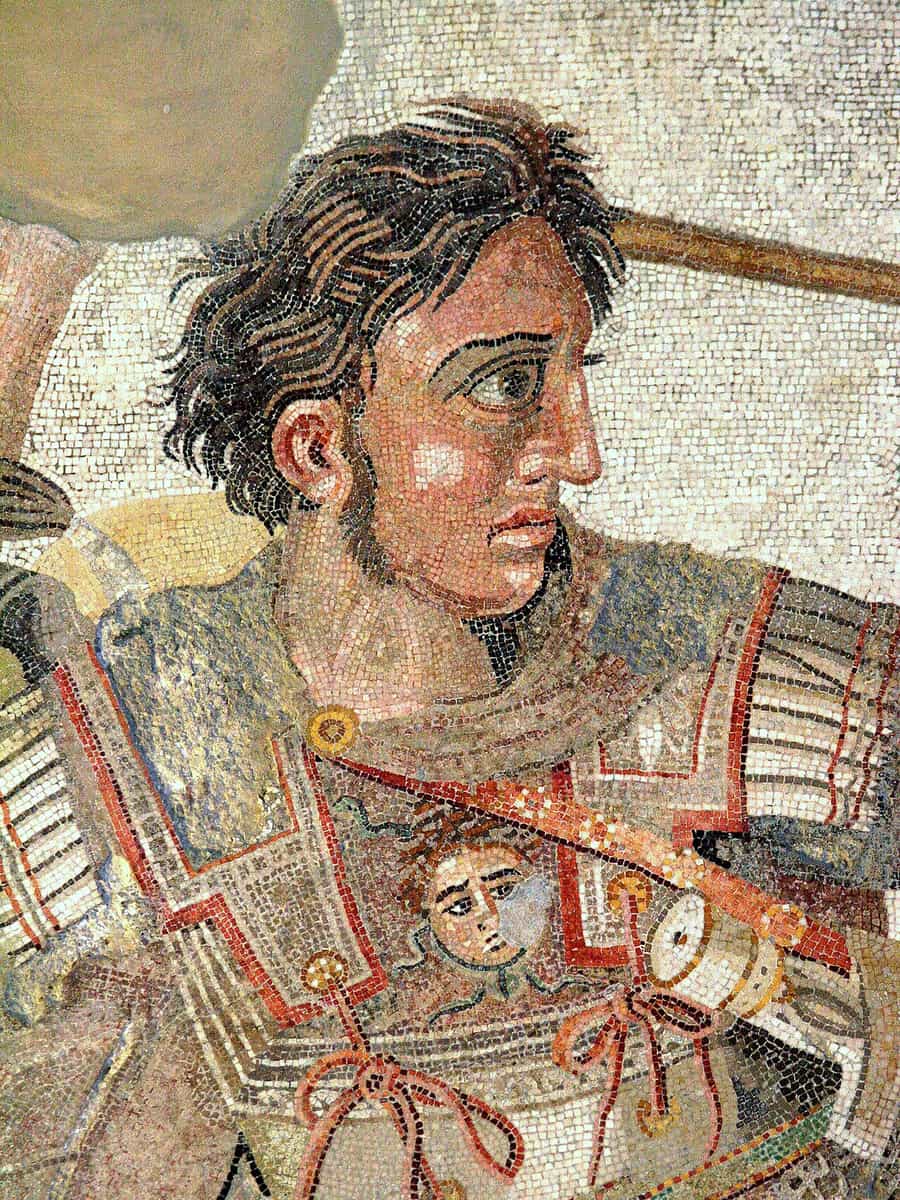
Alexander was born at Pella in Macedon in July 356 BC, son of Philip II and Olympias of Epirus. Philip had spent two decades turning a peripheral kingdom into the dominant military power in Greece, inventing the sarissa phalanx and buying or beating every rival; Aristotle was hired to tutor the boy from about thirteen. Alexander commanded the cavalry wing at Chaeronea at eighteen, and when Philip was assassinated in 336 BC he took the throne at twenty, crushed a Theban revolt by destroying the city, and crossed into Asia in 334. Granicus that year, Issus in 333, the seven-month siege of Tyre and the taking of Egypt in 332, and Gaugamela in 331 finished the Achaemenid Empire. He burned Persepolis, pursued Darius until the Persian king was murdered by his own satrap, and pushed on through Bactria into the Punjab, defeating Porus at the Hydaspes in 326 before his army refused to go further. He died at Babylon in June 323 BC, aged thirty-two. Michael Hart ranked him 33rd in The 100.
Influence Meter
84
Measured on a 100-point scale
Ended the Persian Empire and made Greek the language of the eastern Mediterranean for a millennium
What Philip Left Him
The Army Was Already Built
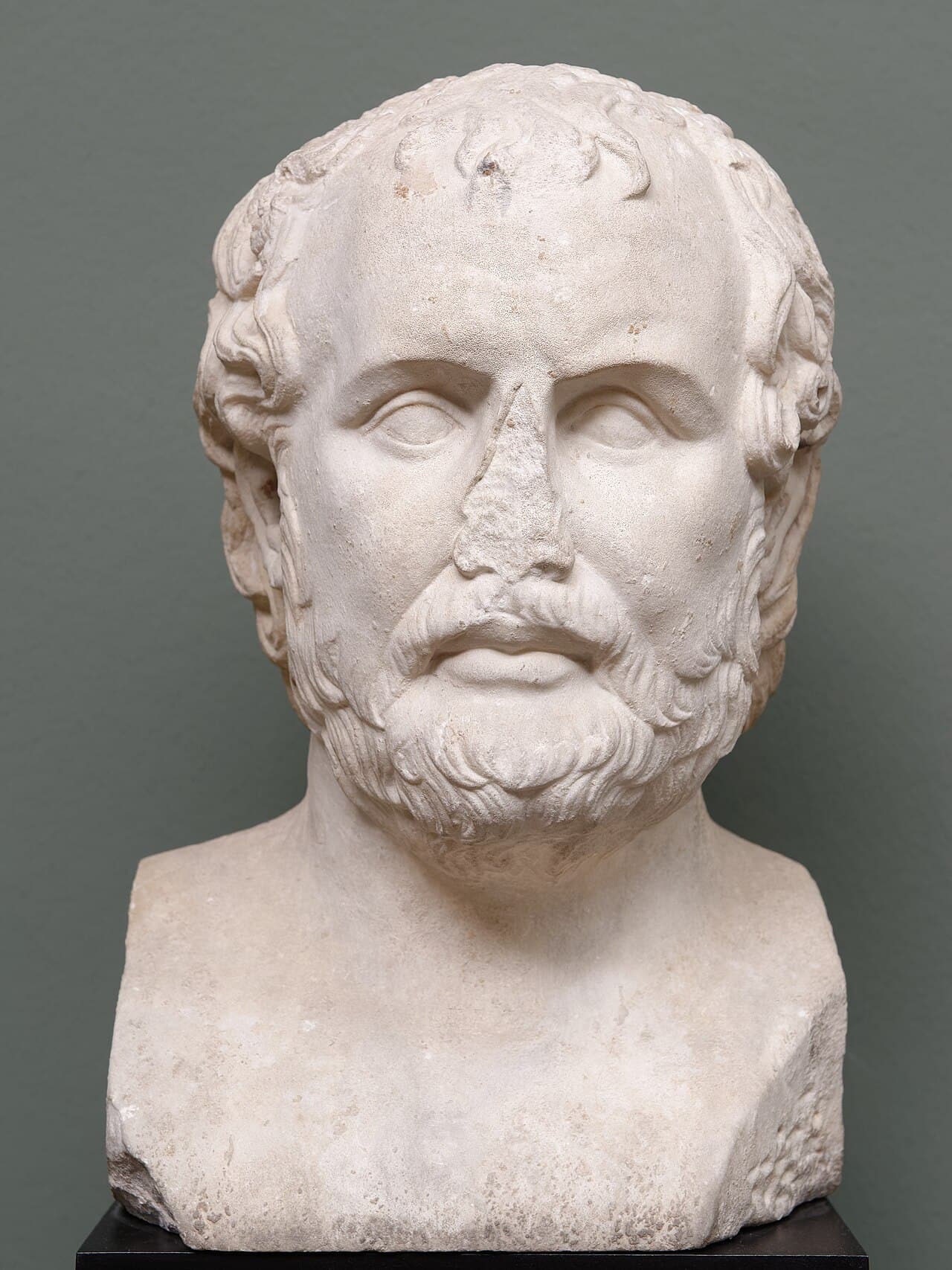
Alexander is often described as a military genius who came from nowhere, which understates his father considerably. Philip II had reorganised the Macedonian infantry around the sarissa, a pike some five to six metres long wielded in a deep phalanx that could not be approached from the front, and paired it with the Companion cavalry - heavy shock horsemen used as the striking arm. He had also secured the gold mines of Mount Pangaion to pay for it, subdued Greece at Chaeronea in 338, and formed the League of Corinth with an invasion of Persia already announced. Alexander inherited a professional standing army, its commanders, its doctrine and its war aim. What he added was the willingness to lead the Companions personally into the decisive gap, an appetite for risk that repeatedly worked, and an unwillingness to stop that his father almost certainly would not have shared.
The Campaigns
Four Battles and a Siege
He fought four major set-piece battles in eleven years and won all of them, usually against larger forces, usually by the same method: hold with the phalanx, break through with the cavalry at the point where the enemy line has been stretched.
Granicus
The opening battle, fought at a river crossing against the Persian satraps of Asia Minor. Alexander led the cavalry charge himself and was nearly killed, saved by Cleitus the Black cutting down an assailant behind him.
- Result: Asia Minor opened
Issus
His first meeting with Darius III, fought in a narrow coastal plain that neutralised Persian numbers. Darius fled the field, abandoning his mother, wife and daughters, whom Alexander treated with conspicuous courtesy.
- Result: Syria and the coast
Siege of Tyre
An island fortress that refused him entry. He spent seven months building a causeway from the mainland to reach it, then stormed the city; the surviving population was killed or enslaved. The causeway is still there.
- Duration: Seven months
Gaugamela
The decisive battle for the empire, fought on ground Darius had levelled for his chariots. Alexander drew the Persian left out of position and drove the Companions into the gap toward Darius, who fled again. The Achaemenid Empire effectively ended here.
- Result: Persia
Hydaspes
Against Porus in the Punjab, in monsoon rain and against war elephants his men had never faced. He won, and then reinstated Porus as a satrap - a treatment of a defeated enemy that impressed contemporaries.
- New problem: War elephants
The mutiny at the Hyphasis
His only unambiguous defeat, and it was administered by his own army. After eight years the Macedonians refused to march further east. He sulked in his tent for three days and then turned back.
- Result: The advance stopped
Alexander founded something over twenty cities, most named after himself, and the one in Egypt laid out in 331 BC became the most consequential city of the ancient Mediterranean after Rome. Alexandria's library and museum made it the intellectual capital of the Greek world for three centuries - Euclid taught there, Eratosthenes measured the Earth there, and the Hebrew Bible was translated into Greek there. Others in the chain, from Alexandria Eschate on the Jaxartes to Alexandria in the Caucasus, planted Greek-speaking populations across Central Asia; the Greco-Bactrian kingdom that followed produced coinage of remarkable quality and left a lasting mark on the Buddhist sculpture of Gandhara, where the Buddha is rendered in a Greek style.
Chronology
Eleven Years, East
Drawn as a single long arc, because the campaign was essentially one continuous movement away from home that never came back.
Character
The Parts the Statues Leave Out
The sources are admiring and still record a great deal that is hard to admire. He burned Persepolis, the Achaemenid ceremonial capital, in an act variously explained as calculated revenge for Xerxes' burning of Athens and as a drunken impulse at a party. He killed Cleitus the Black - the man who had saved his life at the Granicus - by running him through with a spear during a drinking argument, and then would not eat for three days. He had Philotas executed for treason on thin evidence and then had Philotas' father Parmenion, his father's most senior general, murdered pre-emptively. He had Callisthenes, Aristotle's nephew, arrested and killed for opposing his adoption of Persian court ritual.
That last quarrel points at the real difficulty of his later reign. Having conquered Persia, he began behaving like a Persian king - wearing elements of Persian dress, appointing Persians to command, requiring proskynesis, the prostration Persians offered their ruler and Greeks offered only gods, and marrying his officers to Persian noblewomen at Susa in a mass ceremony. To modern historians this looks like a serious attempt at fusing two ruling classes. To his Macedonian veterans it looked like their king going native, and it was the background to two mutinies. The march back through the Gedrosian desert in 325 killed a large part of his army, possibly as a punishment, possibly through miscalculation; the sources do not agree.
323 BC
Ten Days of Fever, and Forty Years of War
Alexander fell ill after a long night of drinking at Babylon in late May 323 BC and died on 10 or 11 June. Malaria, typhoid, poisoning and the cumulative effect of untreated wounds have all been argued; a Babylonian astronomical diary records the death, which fixes the date but not the cause. Asked on his deathbed to whom he left the empire, he is said to have answered to the strongest - a story too neat to be trusted and too useful to abandon, since that is precisely what happened. He left a half-brother with a mental disability and an unborn son, both eventually murdered. His generals, the Diadochi, fought each other for forty years and carved the empire into the Ptolemaic kingdom in Egypt, the Seleucid Empire across Asia, and Antigonid Macedon. His body was hijacked en route to Macedon by Ptolemy and displayed in Alexandria for centuries. The tomb's location is now unknown.
What Actually Survived Him
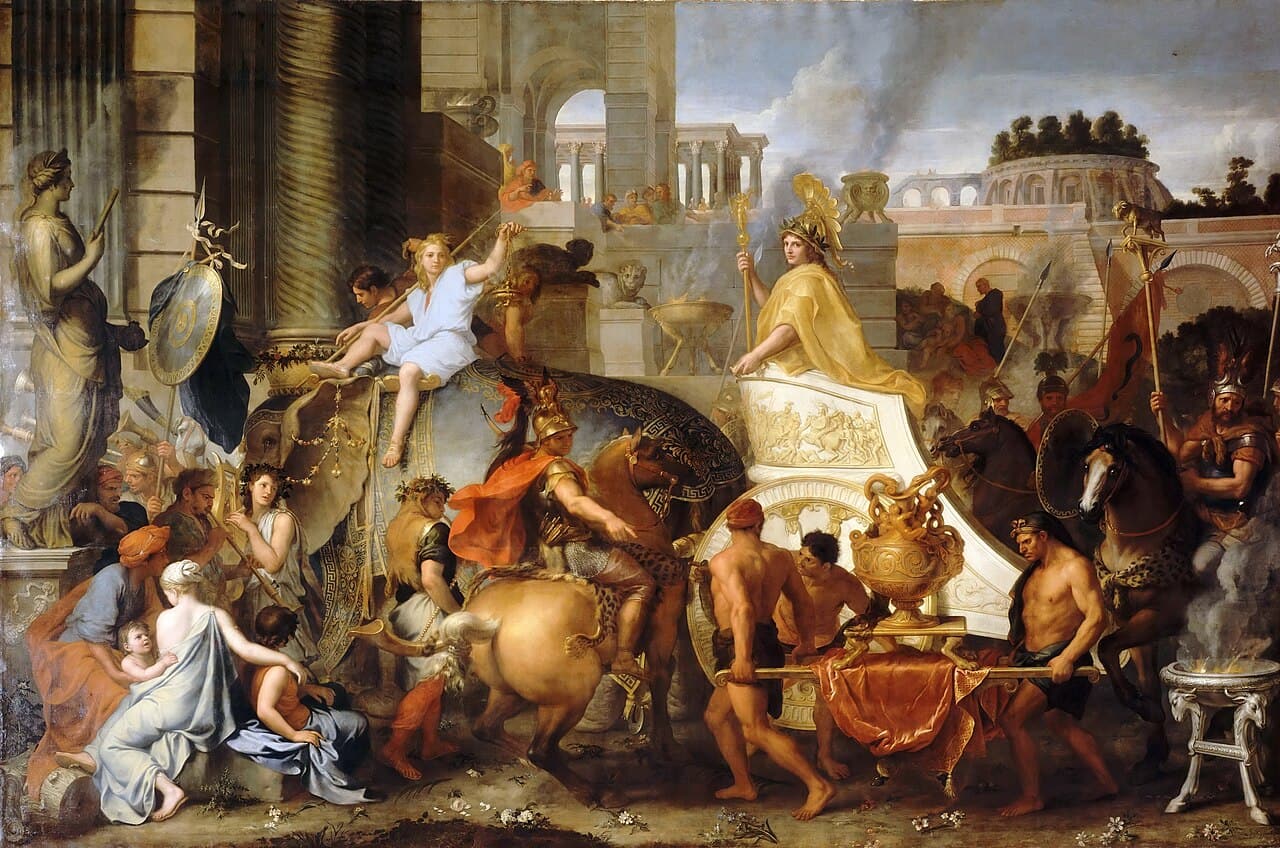
The empire lasted about a year in one piece. The cultural consequences lasted a thousand.
- Greek became the common language of the East: Koine Greek was spoken from the Adriatic to the Indus for centuries. It is the language the New Testament was written in, which is a direct consequence of his campaigns.
- The Hellenistic kingdoms: Ptolemaic Egypt lasted until Cleopatra's death in 30 BC; the Seleucids ruled much of Asia for two centuries. Greek-speaking dynasties governed Egypt and Persia because of eleven years of marching.
- Alexandria and its library: The greatest concentration of learning in the ancient world, and the institution through which much of Greek science and literature reached later ages.
- Greco-Buddhist art: The Buddha was not depicted in human form until Greek-influenced sculptors in Gandhara began doing so, which is why early Buddha images wear what looks like a Greek robe.
- A template for rulers: Caesar reportedly wept at Alexander's statue for having achieved so little by the same age. Pompey, Trajan and Napoleon all measured themselves against him explicitly.
- The road Rome later took: By breaking Persia and Hellenising the East, he created the political and linguistic world Rome would inherit two centuries later rather than have to build.
Further Reading
Books About Alexander
No contemporary account survives. Everything comes through writers working three to five centuries later from lost sources, which is the central problem of the subject.
Legacy
Why Number Thirty-Three
Michael Hart ranked Alexander 33rd, four places below Genghis Khan, and the gap is a judgement about durability. The Mongol conquests produced states that governed for a century and a half; Alexander's empire did not survive a year intact and his own line was extinct within thirteen years. What raises him is that the cultural consequence outlived the political one by an order of magnitude - the eastern Mediterranean spoke Greek and thought in Greek categories for roughly a thousand years because of what he did between the ages of twenty-two and thirty-two.
The clearest measure is indirect. Rome conquered a Hellenised East rather than a Persian one, and absorbed Greek philosophy, literature and art largely through it. Christianity emerged in a Greek-speaking Jewish world, was written down in Greek, and spread through cities Alexander's successors had founded or refounded. Neither of those was any part of his intention, which was chiefly to be the greatest conqueror who had ever lived. He is generally granted that too.
Related Publications