Napoleon Bonaparte

Napoleon Bonaparte
Born 15 August 1769 • Died 5 May 1821
Napoleon is remembered for the battles, and he thought so too - he expected posterity to count Austerlitz and Jena. He was wrong about which part would last. The empire was gone within his own lifetime and every frontier he drew was redrawn at Vienna. What survived, and what still governs the daily life of hundreds of millions of people, is a book of civil law he pushed through in 1804 by chairing the drafting sessions himself and refusing to let the lawyers make it complicated.
Rank
#34
Influence
82
Field
Emperor and Military Commander
Historical Perspective
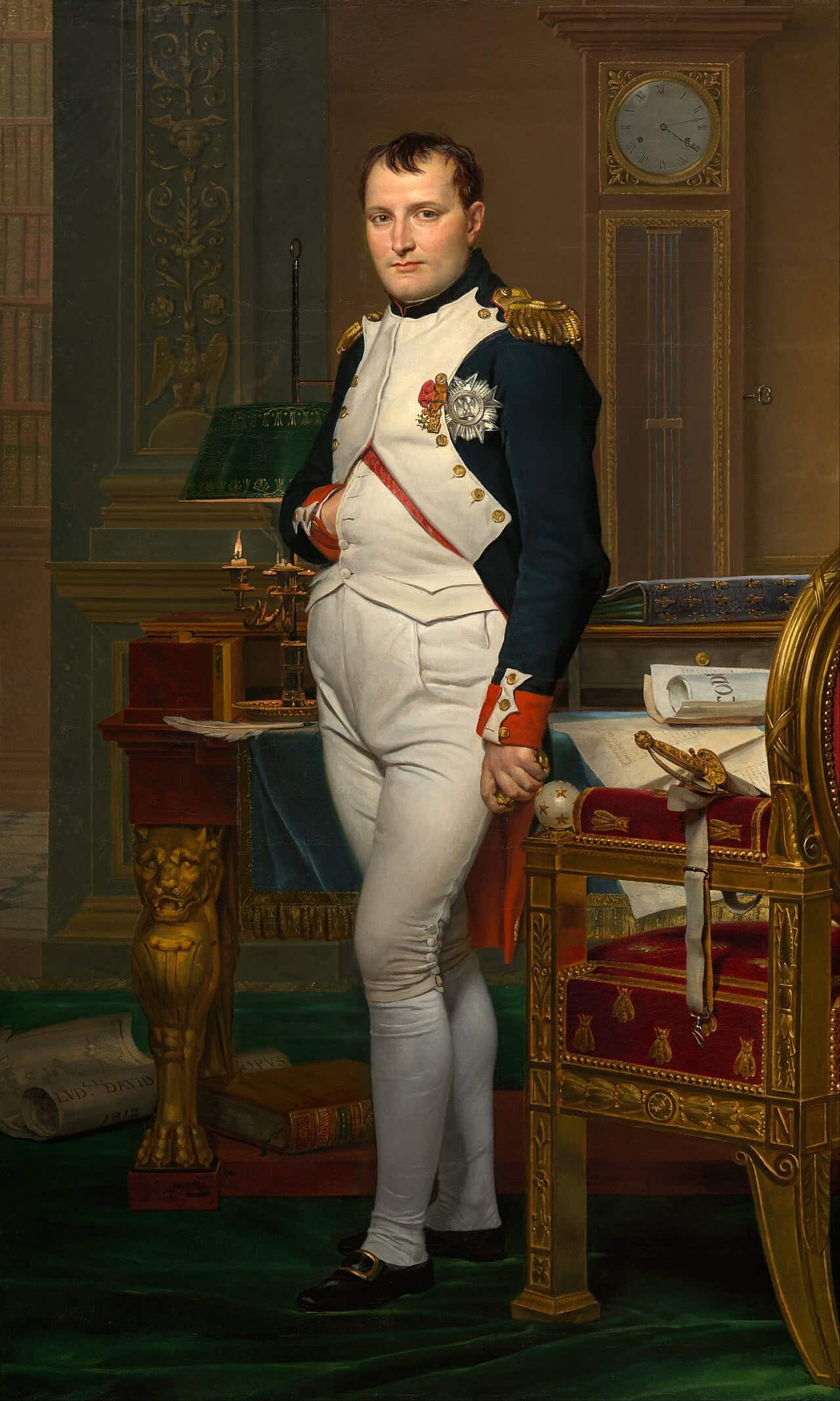
Napoleon Bonaparte was born at Ajaccio in Corsica on 15 August 1769, months after France annexed the island, into minor gentry with more status than money. Sent to military school in France at nine, mocked for his accent, he commissioned into the artillery - the one arm where ability counted more than birth - and was a nobody until the siege of Toulon in 1793, where his handling of the guns won the town and made him a brigadier general at twenty-four. He dispersed a royalist rising in Paris with artillery in October 1795, was given the Army of Italy, and in a single campaign of 1796-97 beat the Austrians repeatedly and made himself the most famous soldier in Europe. After an expedition to Egypt that failed militarily and succeeded politically, he seized power in the coup of 18 Brumaire in November 1799, made himself First Consul, then Emperor in May 1804. A decade of dominance ended in the Russian catastrophe of 1812, defeat at Leipzig in 1813, abdication and Elba, and finally Waterloo on 18 June 1815. He died on Saint Helena on 5 May 1821. Michael Hart ranked him 34th in The 100.
Influence Meter
82
Measured on a 100-point scale
A decade of European domination, and a civil code that outlived it by two centuries
1804
The Thing He Got Right
France in 1789 had something like three hundred and sixty local legal codes, customary in the north and Roman in the south, with privileges attached to birth, province and guild. The Civil Code promulgated in March 1804 replaced all of it with a single body of law, written in French plain enough for a literate citizen to read, resting on principles the Revolution had asserted and no government had yet made operational: equality before the law, an end to feudal obligations and hereditary privilege, secure private property, freedom of contract, freedom of religion, and civil rather than religious control of marriage. Napoleon chaired a large share of the drafting sessions personally and pushed for clarity over legal elegance. He was right about its importance. From Saint Helena he remarked that his true glory was not the forty battles he had won, since Waterloo had erased their memory, but the Civil Code, which would live forever.
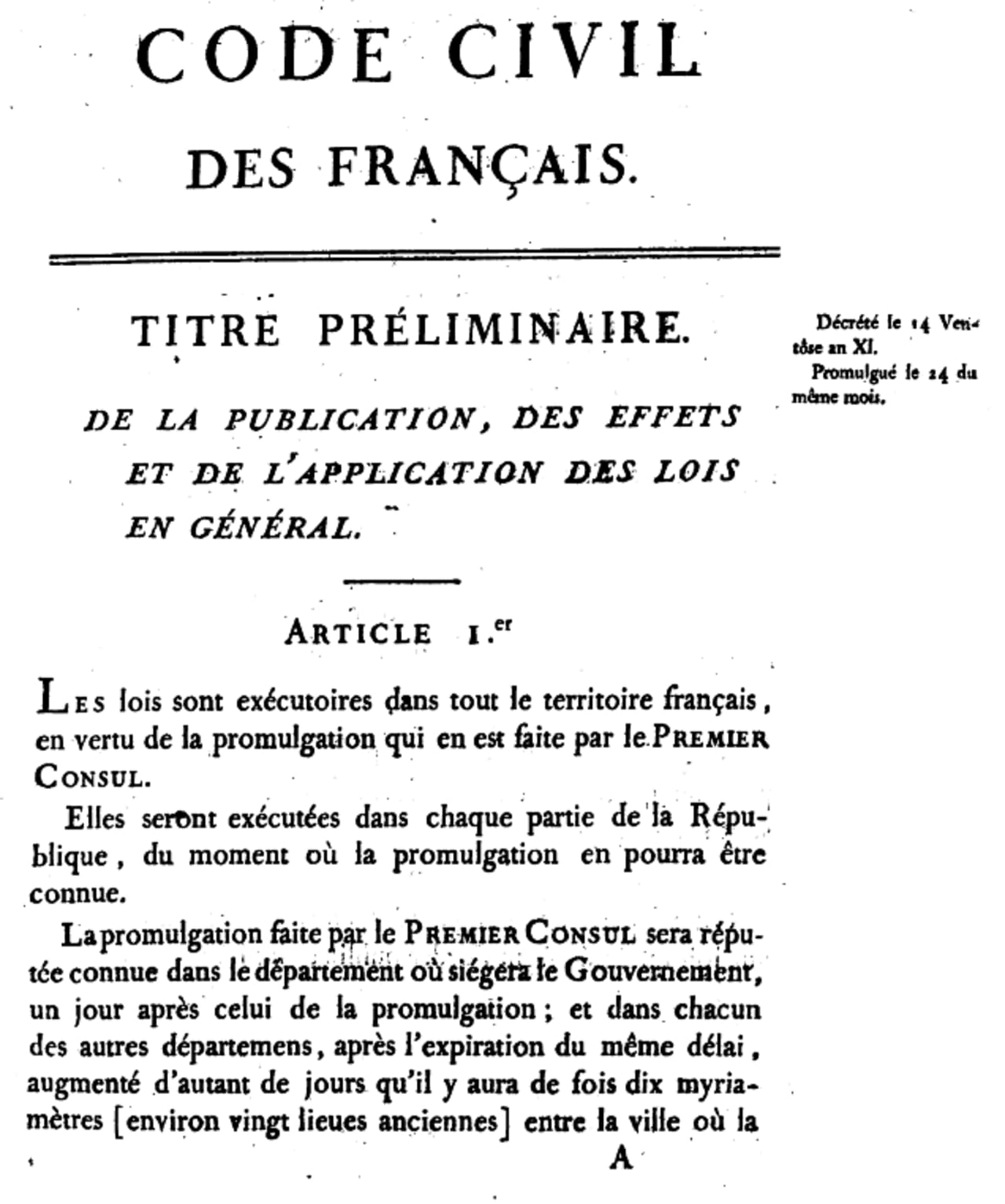
The Napoleonic Code was carried across Europe by his armies and stayed after they left. It is the direct ancestor of the civil law of Belgium, the Netherlands, Luxembourg, Italy, Spain, Portugal, much of Germany, Poland and Switzerland, and through Spain and Portugal of nearly all of Latin America; it shaped the codes of Egypt, Japan, Quebec and Louisiana. Something in the order of a quarter of the world's jurisdictions trace their civil law to it. It was not uniformly progressive: it rolled back the revolutionary position on women, placing wives under the legal authority of their husbands, restricting their property rights and making divorce far harder for them than for men - provisions that took French feminists more than a century to dismantle. Napoleon also reinstated slavery in the French colonies in 1802, which the Revolution had abolished.
The Battles
What Made Him Difficult to Beat
Napoleon's tactical reputation rests less on any single innovation than on speed and on a reorganisation of how an army moves. He divided his forces into corps - self-contained formations of infantry, cavalry and artillery, each able to fight alone against a larger enemy long enough for the others to arrive. That let him march an army along separate roads, feeding itself from the country rather than crawling behind a supply train, and concentrate it at the point of contact. His favourite manoeuvre was to send a corps around an enemy's flank into their rear, cutting the line of retreat and forcing them to fight facing the wrong way.
Austerlitz on 2 December 1805 is the demonstration piece: he deliberately weakened his right and abandoned the high ground to invite an Austro-Russian attack there, waited for their centre to thin as it fed the assault, then took the Pratzen Heights and split their army in half. Within a year Prussia was destroyed at Jena-Auerstedt and within two Russia was beaten at Friedland. He fought something like seventy battles across his career and lost perhaps eight of them. The failures came when the method met conditions it could not handle - a Spanish guerrilla war with no army to defeat, and a Russian campaign where the country was too large to live off and the enemy declined to be brought to a decisive battle.
1812
The Retreat From Moscow
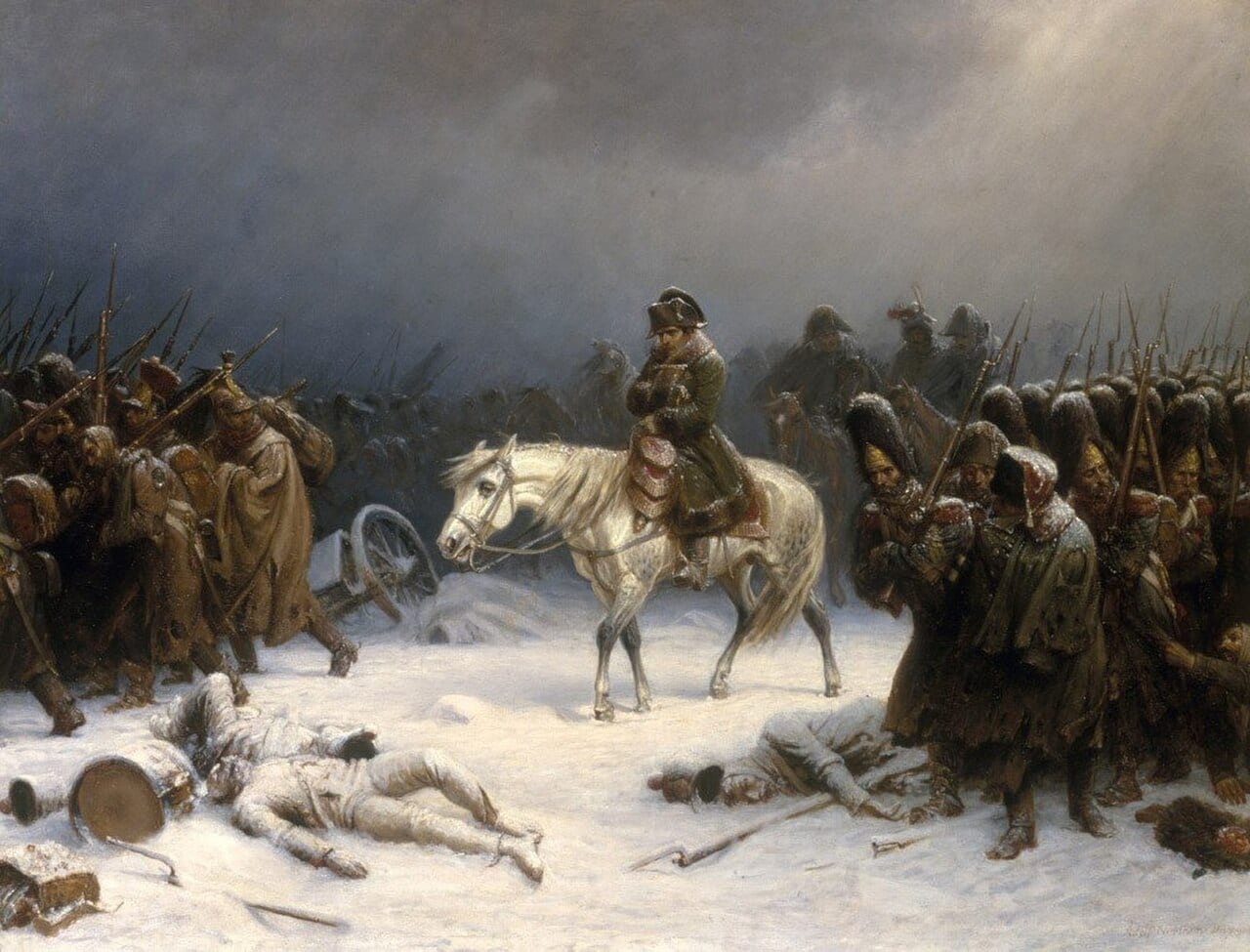
Napoleon crossed the Niemen in June 1812 with the largest army Europe had ever assembled, something over half a million men drawn from every state under his control. The Russians refused a decisive engagement and withdrew, burning as they went, until Borodino on 7 September - a battle so costly on both sides that it settled nothing. He entered Moscow a week later to find it largely deserted and then burning, waited five weeks for a surrender that never came, and began withdrawing in October. The retreat destroyed the army: cold, starvation, typhus and Cossack raids reduced it to a fraction of what had set out, with perhaps thirty to forty thousand men still in formation at the crossing of the Berezina. The catastrophe was not primarily military. It was logistical and it was self-inflicted, and it convinced the rest of Europe that he could be beaten.
What Europe Looked Like Afterwards
The Congress of Vienna tried to restore the world of 1789 and could not, because too much of what he had done was not on the map.
- The Holy Roman Empire was gone: Abolished in 1806 after eight hundred years, and the hundreds of German statelets consolidated into a few dozen - the precondition for German unification sixty years later.
- Nationalism was let loose: French occupation provoked national feeling in Germany, Italy, Spain and Russia. The nineteenth century's defining political force was in large part a reaction to him.
- Feudalism did not come back: Serfdom, seigneurial dues and legal privilege by birth were abolished wherever his armies reached, and restoring them proved impossible even for restored monarchies.
- Latin America went independent: His installation of his brother on the Spanish throne in 1808 shattered the legitimacy of Spanish rule in the Americas, and the independence wars followed directly.
- The United States doubled: The Louisiana Purchase of 1803, sold to fund the European war, transferred some 2.1 million square kilometres for about fifteen million dollars.
- Egypt entered European scholarship: The scientists he took to Egypt in 1798 produced the Description de l'Egypte and found the Rosetta Stone, which gave Champollion the key to hieroglyphs.
1815-1821
Six Years on a Rock, Writing His Own Legend
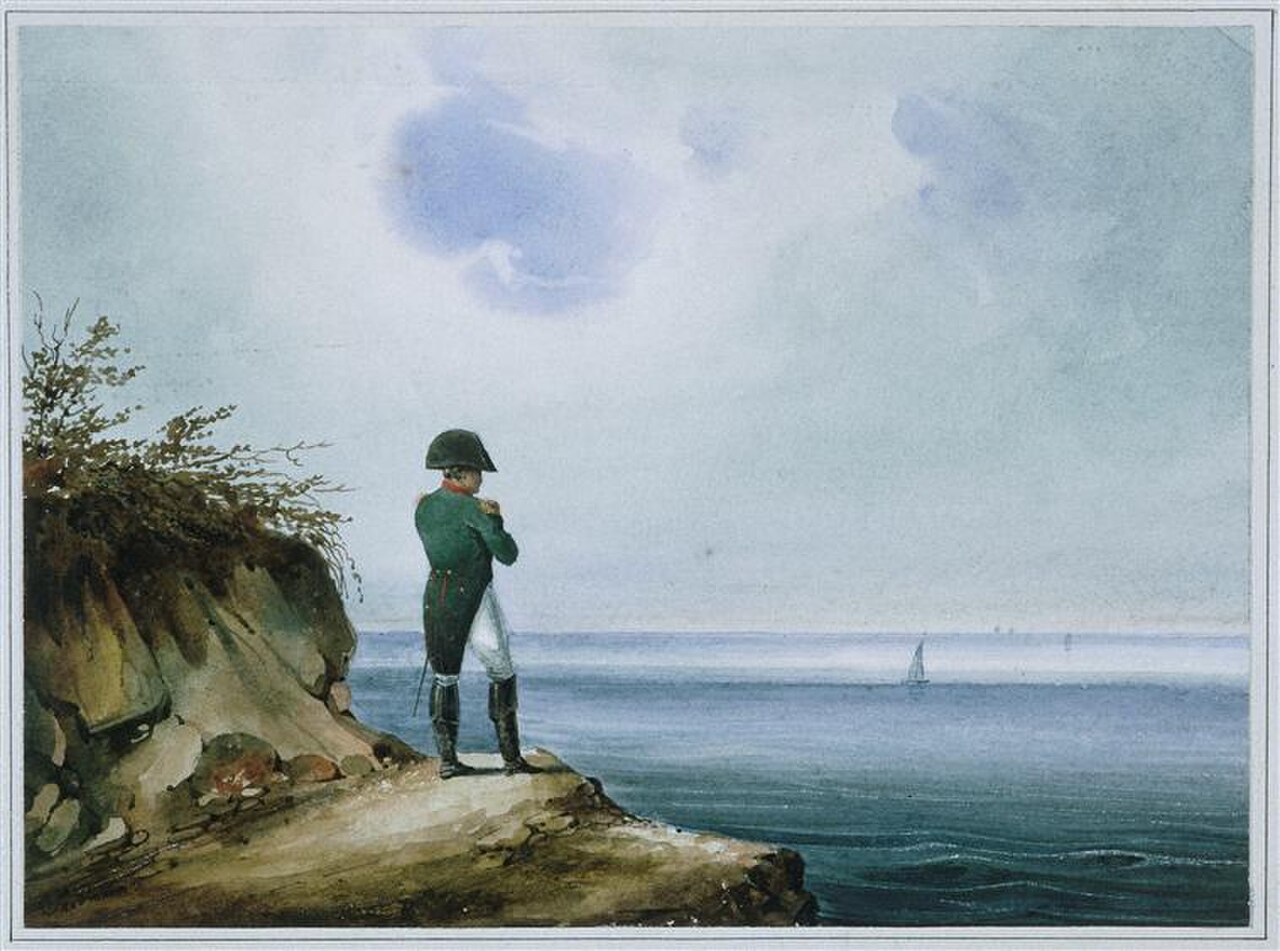
After Waterloo the British sent him to Saint Helena, a volcanic island in the South Atlantic roughly two thousand kilometres from the nearest land, and kept him there under guard for the rest of his life. He spent six years at Longwood House dictating memoirs to a small circle of companions, and the result was one of the most successful posthumous rehabilitations ever undertaken. The Napoleon of those dictations is a reluctant emperor who wanted a united and liberal Europe, was forced into war by British gold and monarchical reaction, and served the Revolution rather than himself. It is a serious distortion, and it worked: it fed the Napoleonic legend that helped return his nephew to power as Napoleon III, and it still shapes popular accounts. He died on 5 May 1821, aged fifty-one, most likely of stomach cancer, which had also killed his father. His remains were returned to Paris in 1840 and lie under the dome of Les Invalides.
Further Reading
Books About Napoleon
The bibliography is said to run to tens of thousands of volumes, and the arguments in it have not converged.
Legacy
Why Number Thirty-Four
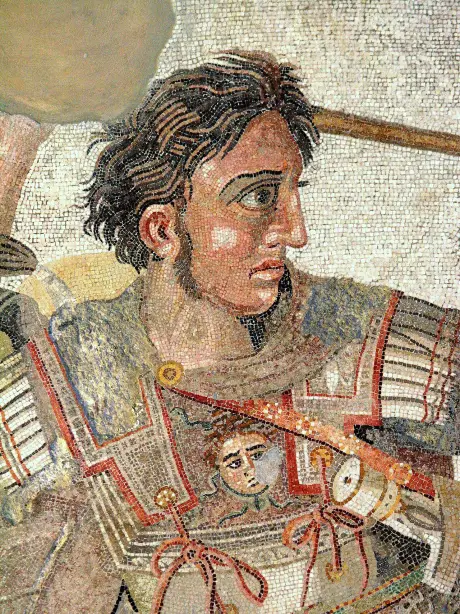
Michael Hart ranked Napoleon 34th, below Alexander and well below Washington, and the ordering makes an argument. Washington had the same opportunity and declined it; Napoleon took it, and the empire he built was dismantled within his own lifetime by a coalition of the powers he had humiliated. Judged as a conqueror he is a spectacular failure with a brilliant record, having ended with France smaller than he found it and two million or more dead across Europe.
The ranking is nonetheless defensible on the code. It is genuinely unusual for a body of law to be exported by force and then kept voluntarily by the people it was imposed on, and that is what happened: the restored monarchies of Europe found the Napoleonic administrative machinery - the prefects, the standardised weights and measures, the property registers, the civil law itself - too useful to unwind. Hundreds of millions of people today live under legal systems descended from a document drafted in eighteen months by a committee that an artillery officer from Corsica chaired in person because he thought the lawyers were making it too obscure.
Related Publications