William Shakespeare

William Shakespeare
Born baptised 26 April 1564 • Died 23 April 1616
Shakespeare stole nearly all his plots. Hamlet, Lear, Macbeth, Romeo and Juliet and Julius Caesar were all existing stories, and his contemporaries thought borrowing them entirely normal. What he did with them was not normal. Before Shakespeare, characters on the English stage announced what they were; after him they think in front of you, change their minds, deceive themselves, and say things whose meaning the speaker has not yet grasped. He also happened to be writing at the moment English was acquiring tens of thousands of new words, and he used more of them than anyone.
Rank
#31
Influence
87
Field
Playwright and Poet
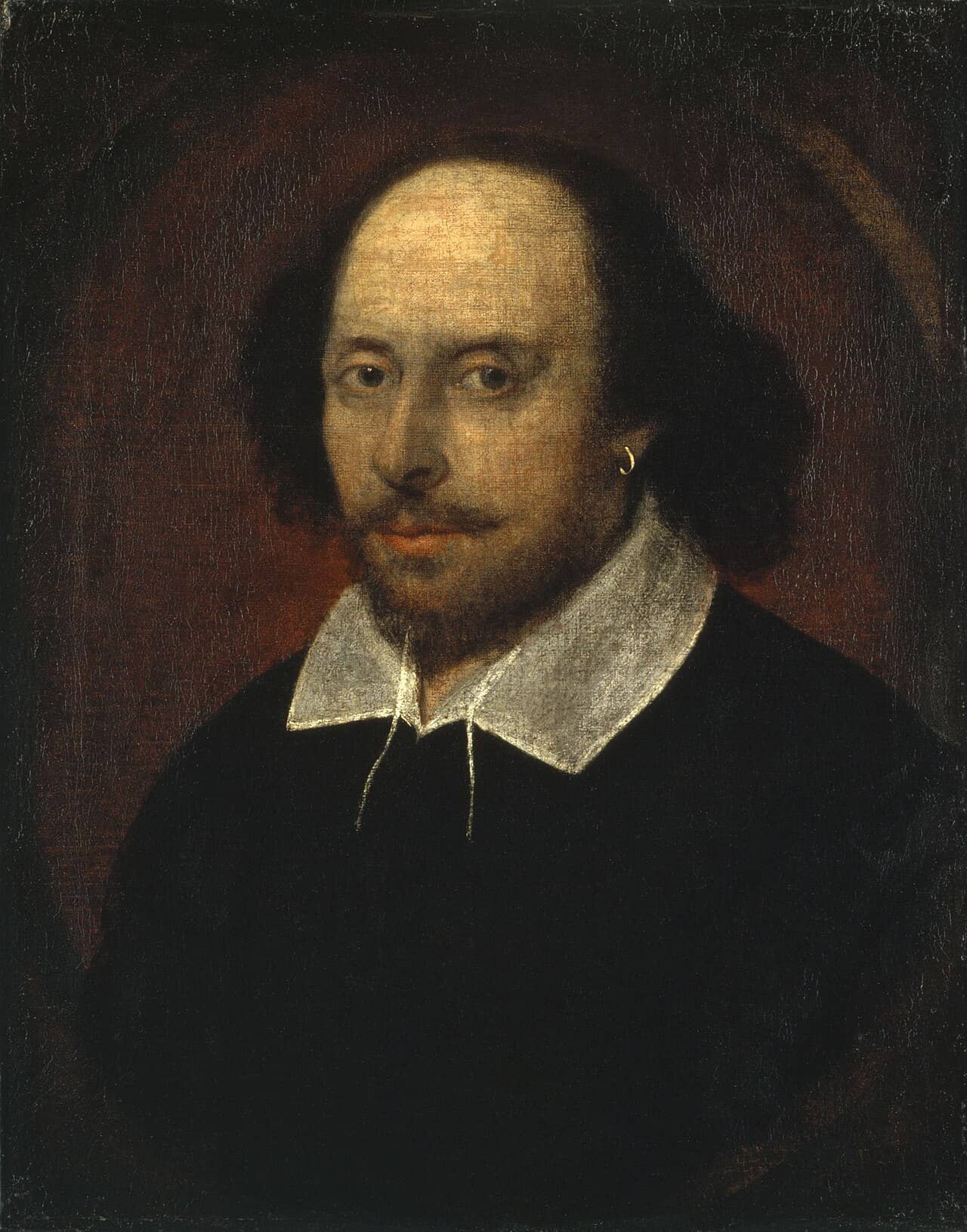
Historical Perspective
William Shakespeare was baptised at Stratford-upon-Avon on 26 April 1564, the son of John Shakespeare, a glover and wool dealer who rose to be bailiff of the town and then fell into debt. He almost certainly attended the local grammar school, where the curriculum was Latin rhetoric and Ovid, and he did not attend a university. At eighteen he married Anne Hathaway, who was twenty-six and pregnant; Susanna was born in 1583 and the twins Hamnet and Judith in 1585. Then the record goes silent for seven years - the lost years - until 1592, when a rival dramatist attacked him in print as an upstart crow, which at least establishes that he had arrived. By 1594 he was a founding shareholder of the Lord Chamberlain's Men, who became the King's Men under James I in 1603 and built the Globe in 1599. He wrote roughly thirty-eight plays across some twenty-four years, retired to Stratford as a substantial property owner, and died there on 23 April 1616. Michael Hart ranked him 31st in The 100.
Influence Meter
87
Measured on a 100-point scale
The most performed writer in any language, and a permanent alteration to English itself
1594-1613
He Was a Businessman Who Wrote
Shakespeare's position was unusual and it explains a great deal about the plays. He was not a writer selling scripts to a company; he was a sharer - a part-owner of the Lord Chamberlain's Men, taking a cut of the receipts, and also an actor in it. He therefore wrote for a specific building, a known audience and particular colleagues whose capacities he knew: the great roles were built for Richard Burbage, and the late plays' shift toward indoor staging follows the company's acquisition of the Blackfriars theatre.
It also made him rich, which almost no playwright of the period managed. In 1597 he bought New Place, the second-largest house in Stratford, and he went on acquiring land, tithes and property there for the rest of his life. When the Globe was built in 1599 from the timbers of a dismantled earlier theatre, he was one of the syndicate that owned it. The commercial detail matters because it is the reason the plays exist in the form they do: he was writing to fill a theatre twice a week, against competition, for an audience that included apprentices standing in the yard and courtiers in the galleries, and had to satisfy all of them in the same three hours.
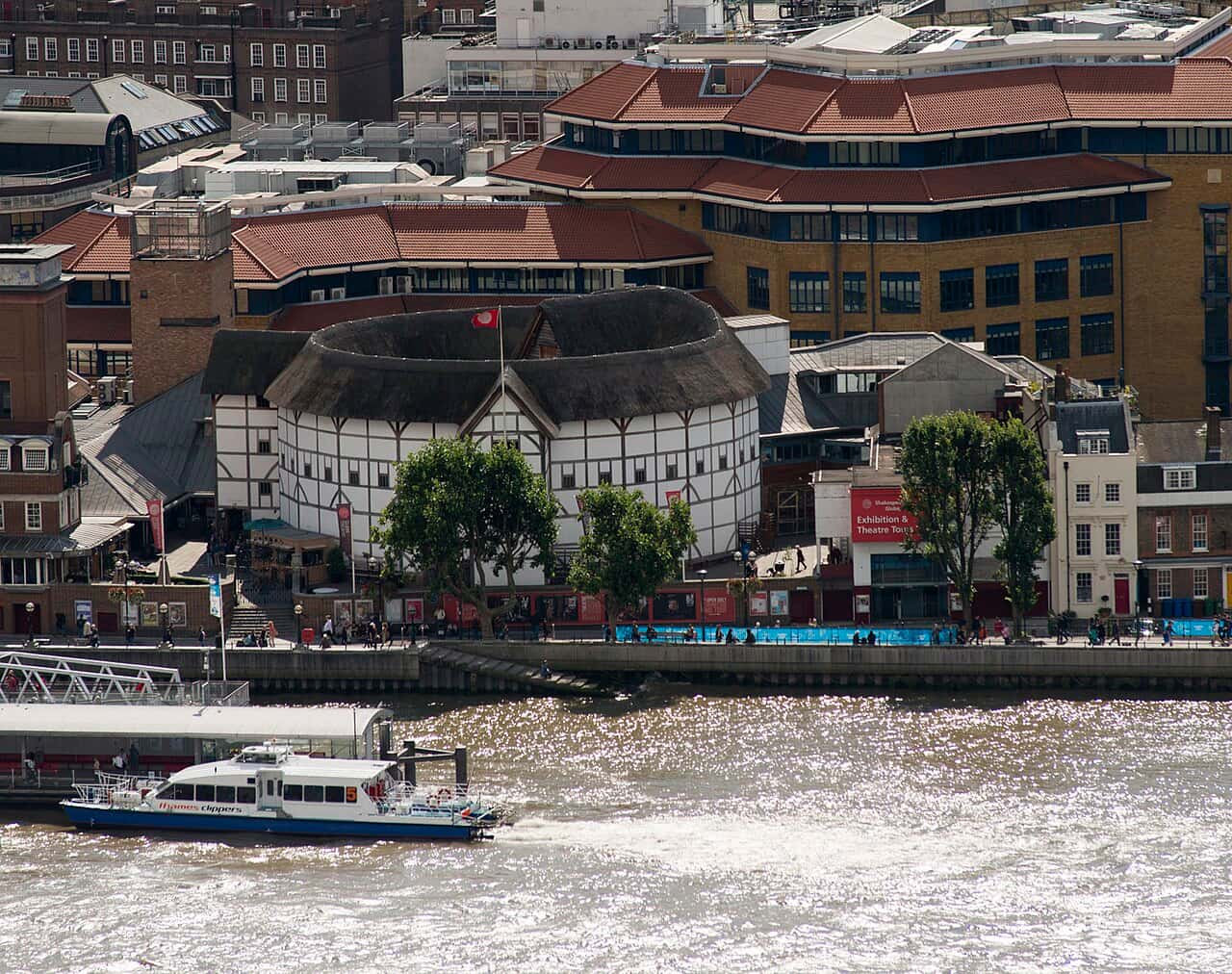
The Globe
A Wooden O With No Scenery
The Globe held perhaps three thousand people around an open yard, played in daylight with no lighting, almost no scenery and no curtain. Everything the audience needed to know about where they were and what time it was had to be in the words - which is why the plays open so often with someone describing the dawn, or the cold, or the wood. Boys played the women. There were no directors and probably no full rehearsals; actors were given only their own lines with cues. The building burned down on 29 June 1613 when a cannon fired during a performance of Henry VIII set the thatch alight; nobody was killed, though one man's breeches caught fire and were put out with a bottle of ale. These constraints are usually described as limitations. They are better read as the specification the writing was built to meet.
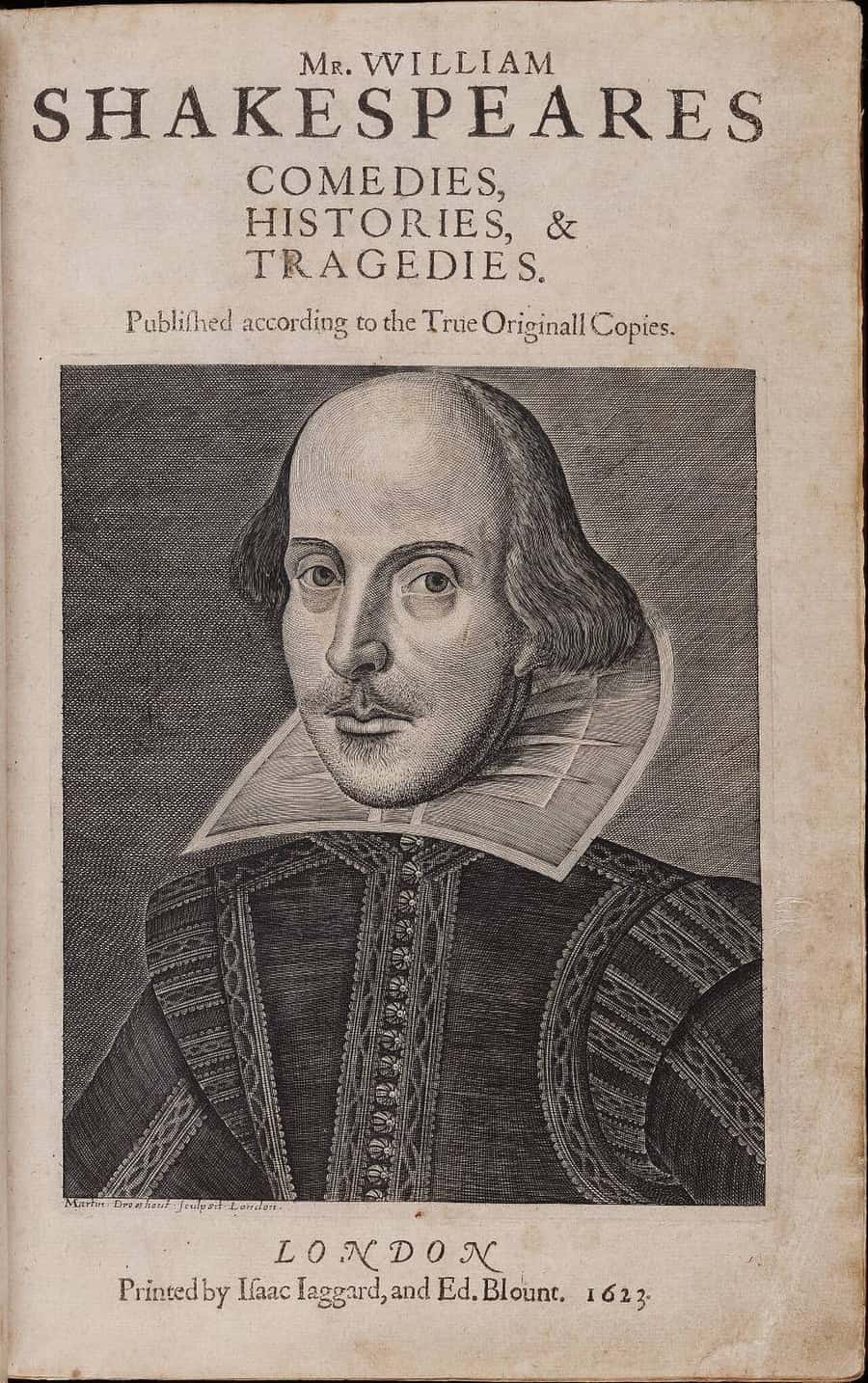
About half of Shakespeare's plays had never been printed when he died, and he made no apparent effort to publish them - scripts were company property, and printing one gave it away to rivals. Macbeth, Julius Caesar, Twelfth Night, As You Like It, The Tempest, Antony and Cleopatra and a dozen more existed only as playhouse manuscripts. In 1623, seven years after his death, two of his fellow actors, John Heminges and Henry Condell, collected thirty-six plays into the volume now called the First Folio, explicitly to preserve the memory of so worthy a friend. Roughly 750 copies were printed and about 235 survive. Without it, half the canon would be gone, and the case for Shakespeare as the greatest writer in English could not be made, because the evidence would not exist.
The Work
Four Phases in About Twenty-Four Years
Dating is approximate and contested, but the arc of the career is clear enough: history and farce, then comedy, then the tragedies, then a strange late turn toward reconciliation and magic.
| c. 1589-1594 | Henry VI, Richard III, The Comedy of Errors, Titus Andronicus | Apprentice work: strong plots, verse still formal and end-stopped |
| c. 1595-1600 | Romeo and Juliet, A Midsummer Night's Dream, Henry IV, Much Ado, Henry V | Mastery of comedy and history; Falstaff, the first great comic character in English |
| c. 1600-1608 | Hamlet, Othello, King Lear, Macbeth, Antony and Cleopatra | The tragedies. Verse loosens, soliloquy becomes genuine thinking rather than announcement |
| c. 1608-1613 | The Winter's Tale, Cymbeline, The Tempest, Henry VIII | Romances: loss followed by improbable restoration, written for an indoor theatre |
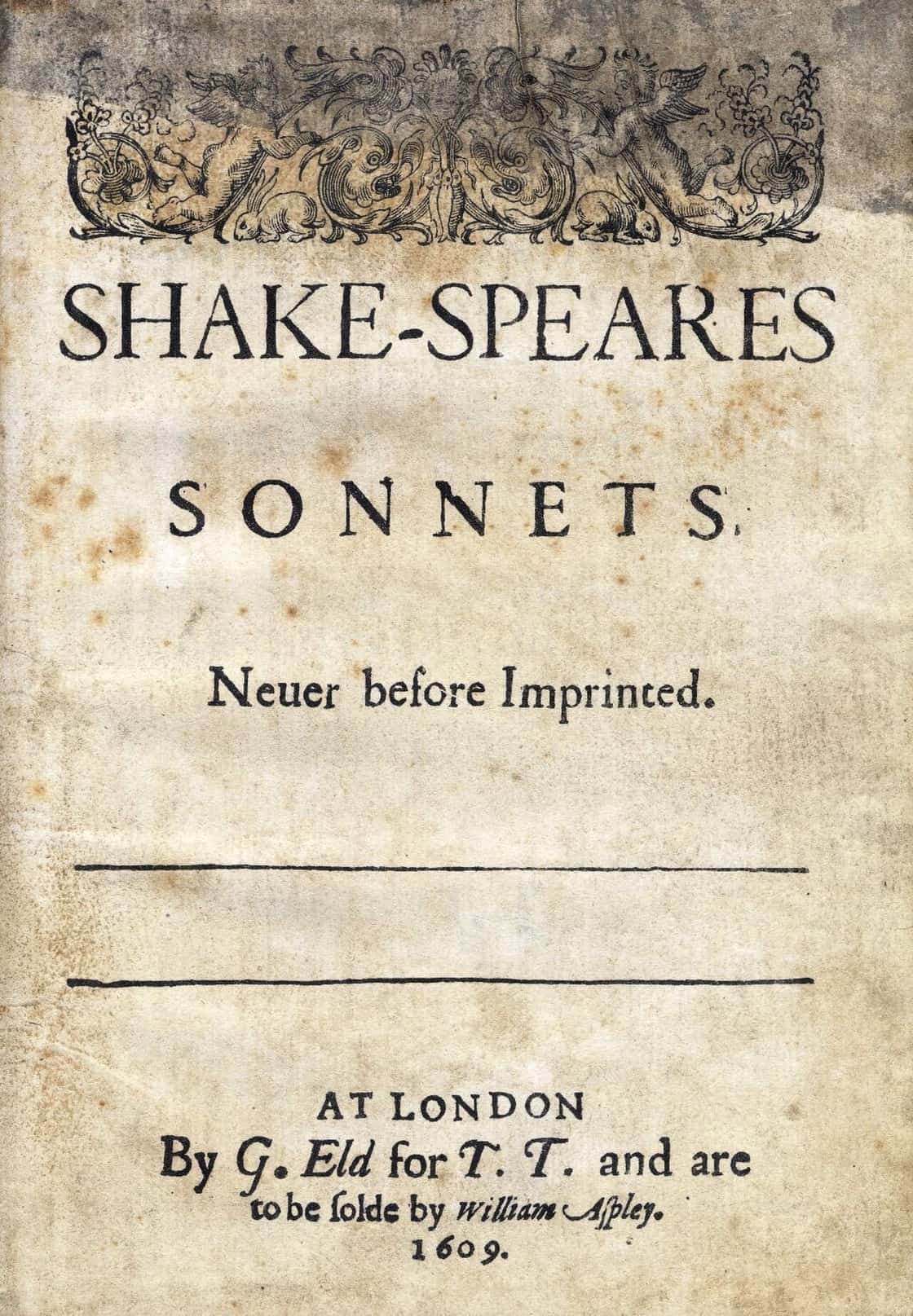
154 sonnets were published in 1609, probably without his authorisation, along with the narrative poems Venus and Adonis and The Rape of Lucrece, which were the works that made his name in print during his lifetime.
English
What He Did to the Language
Shakespeare wrote in a language that was expanding faster than at any time before or since: English was absorbing Latin, French and Italian vocabulary at speed, its spelling was unfixed, and there was no dictionary to consult. His working vocabulary of some twenty thousand words is roughly twice that of most contemporaries, and the Oxford English Dictionary credits him with the first recorded use of well over a thousand - though modern scholarship treats that figure cautiously, since he is simply the best-preserved writer of his era and first attestation is not invention. The phrases are the more certain legacy. A foregone conclusion, in a pickle, wild-goose chase, the be-all and the end-all, salad days, one fell swoop, break the ice, laughing stock, too much of a good thing, and a great many more entered English through his plays and are now used daily by people who have never read a line of him.
What Was Actually New
He invented neither the tragedy, the history play, the comedy, blank verse nor the sonnet. The novelty is elsewhere.
- Characters who change: Before him, stage figures largely represent a fixed quality. Hamlet, Lear, Macbeth and Cleopatra become different people across five acts, and the change is caused by what happens to them.
- Soliloquy as real thought: Earlier soliloquies explain the plot to the audience. His characters use them to work something out, arrive somewhere unexpected, and sometimes lie to themselves in the process.
- Villains with a case: Shylock, Edmund, Iago and Richard III are given arguments good enough to disturb an audience, which is why productions can still be built around any of them sympathetically.
- Comedy and horror in one scene: The porter in Macbeth, the gravediggers in Hamlet, the Fool in Lear - classical decorum forbade mixing registers, and he mixed them for effect.
- Verse that follows the voice: His blank verse loosens steadily across the career, running past line-endings and breaking mid-line, until in the late plays it reads like thinking rather than metre.
- Plots taken and transformed: Almost every story is borrowed from Holinshed, Plutarch, Italian novellas or older plays. The originality is entirely in what the borrowed frame is made to carry.
The Documents
What We Actually Know
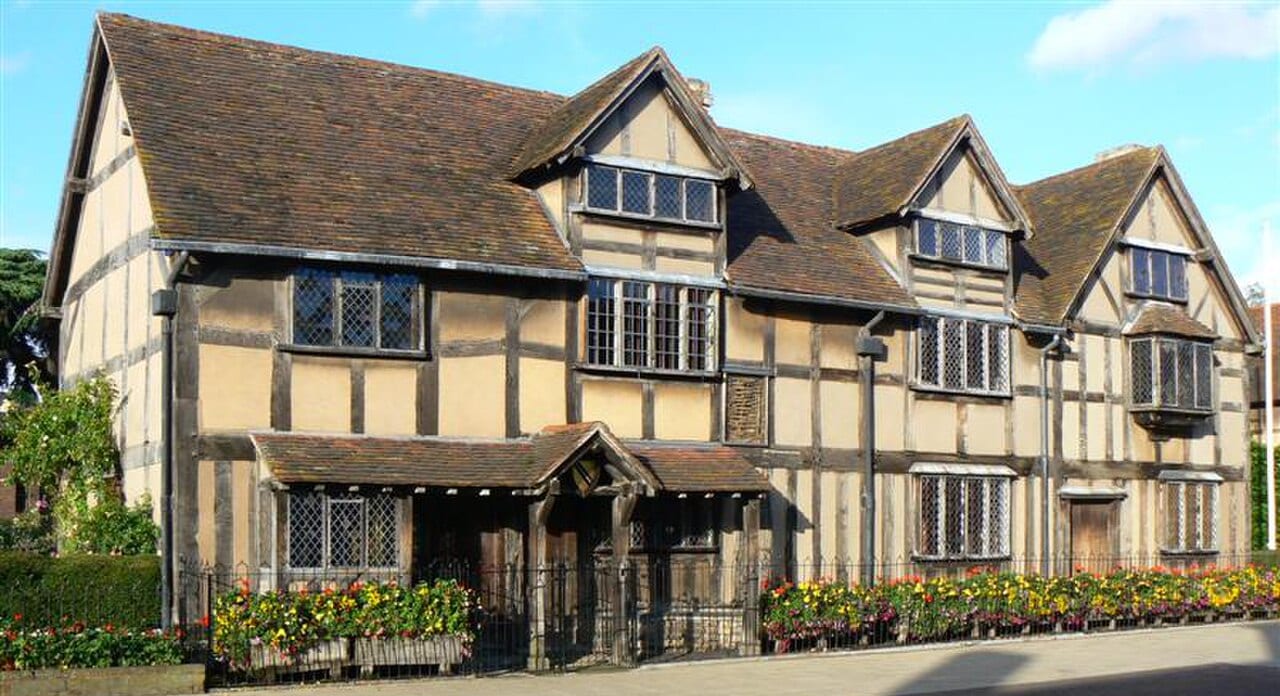
The biographical record is thinner than the fame demands but not as thin as is often claimed. There are around seventy documents: baptism and burial records, the marriage licence, property deeds, tax assessments, court cases over small debts, the company's royal patents, his testimony in a lawsuit, and his will. What is missing is the interior life - no letters, no diary, no manuscript in his hand beyond six signatures and possibly a passage in a collaborative play. The will leaves his estate to Susanna and famously bequeaths Anne his second-best bed, a line that has generated centuries of speculation and probably means only that the best bed was for guests and the second-best was theirs. His son Hamnet died at eleven in 1596, four or five years before Hamlet.
Written Works
The Shape of the Canon
Thirty-eight plays by most modern counts, two narrative poems and 154 sonnets.
The Authorship Question
Why Scholars Do Not Take It Seriously
Proposals that someone else - Bacon, Oxford, Marlowe, a committee - wrote the plays began in the mid-nineteenth century, two hundred and fifty years after his death, and rest largely on the assumption that a provincial grammar-school boy could not have known what the plays know. Professional Shakespeare scholarship rejects this essentially unanimously, on documentary grounds: contemporaries who knew him as an actor and a colleague attributed the plays to him repeatedly and in print, including Ben Jonson, who knew him well, criticised him in detail, and wrote the memorial poem at the front of the Folio. The plays also contain the sort of errors a man without a classical university education would make, and their vocabulary is saturated with the glove trade, small-town litigation and the practical business of the stage. The grammar school he attended taught rhetoric and Latin literature to a standard most modern universities do not attempt.
Legacy
Why Number Thirty-One
Michael Hart ranked Shakespeare 31st, which is high for an artist in a list dominated by prophets, conquerors and scientists - Hart's reasoning being that no other writer has been read, performed and translated on anything like this scale. The plays exist in more than a hundred languages, are performed somewhere in the world essentially every day, and have generated an industry of adaptation running from Verdi's operas to Kurosawa's Throne of Blood and Ran to a permanent presence in film and television. In much of the world he is the writer through whom English literature is first encountered.
The deeper claim, made most forcefully by Harold Bloom and disputed by plenty of critics, is that he changed how people understand themselves - that the habit of watching a character overhear their own thoughts and be altered by them supplied a model of inwardness that the novel and eventually psychology inherited. Freud read him constantly and took two of his central ideas from Greek tragedy by way of Hamlet. Whether or not that is too large a claim, the smaller one is unarguable: several hundred phrases in ordinary daily English were minted or fixed by a man filling a wooden theatre on the south bank of the Thames, twice a week, for money.
Related Publications