Thomas Edison

Thomas Edison
Born 11 February 1847 • Died 18 October 1931
Edison did not invent the light bulb. At least twenty people had made incandescent lamps before him, and he said so. What he did was decide that a bulb by itself was useless, and then build everything else: a filament that lasted, a vacuum good enough to keep it, a socket, a switch, a meter, a fuse, insulated cable, a dynamo, and a generating station on Pearl Street to feed all of it. He sold the system, not the lamp. That is the pattern of his whole career, and it is why he mattered more than better scientists did.
Rank
#35
Influence
83
Field
Inventor and Industrialist
Historical Perspective
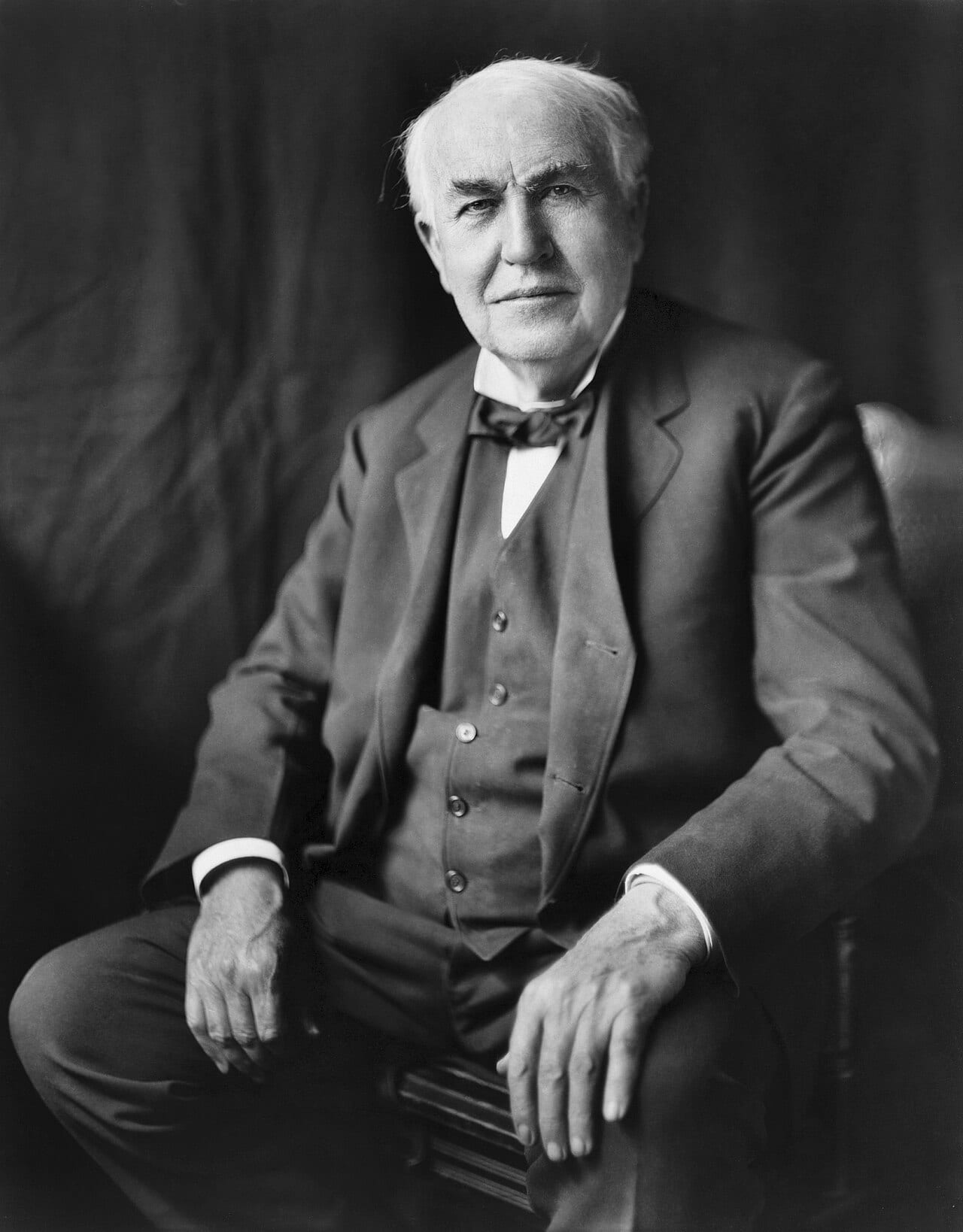
Thomas Alva Edison was born at Milan, Ohio on 11 February 1847, the youngest of seven, and had perhaps three months of formal schooling before his mother took over his education at home. Scarlet fever and repeated ear infections left him nearly deaf from about twelve, a condition he later insisted helped him concentrate. He sold newspapers and sweets on the railway, learned telegraphy after rescuing a station agent's child from a moving train, and spent his early twenties as an itinerant night operator, inventing improvements to telegraph equipment as he went; his first patent, in 1869, was for an electric vote recorder that nobody wanted. Money from telegraph work let him set up at Menlo Park, New Jersey in 1876 and promise a minor invention every ten days and a big one every six months. He very nearly delivered: the carbon telephone transmitter, the phonograph in 1877, the practical incandescent lamp in 1879, the Pearl Street generating station in 1882, and the kinetoscope followed. He died at West Orange on 18 October 1931. Michael Hart ranked him 35th in The 100.
Influence Meter
83
Measured on a 100-point scale
Electrified the city, recorded sound, and invented the research laboratory as an institution
1876
The Invention Factory
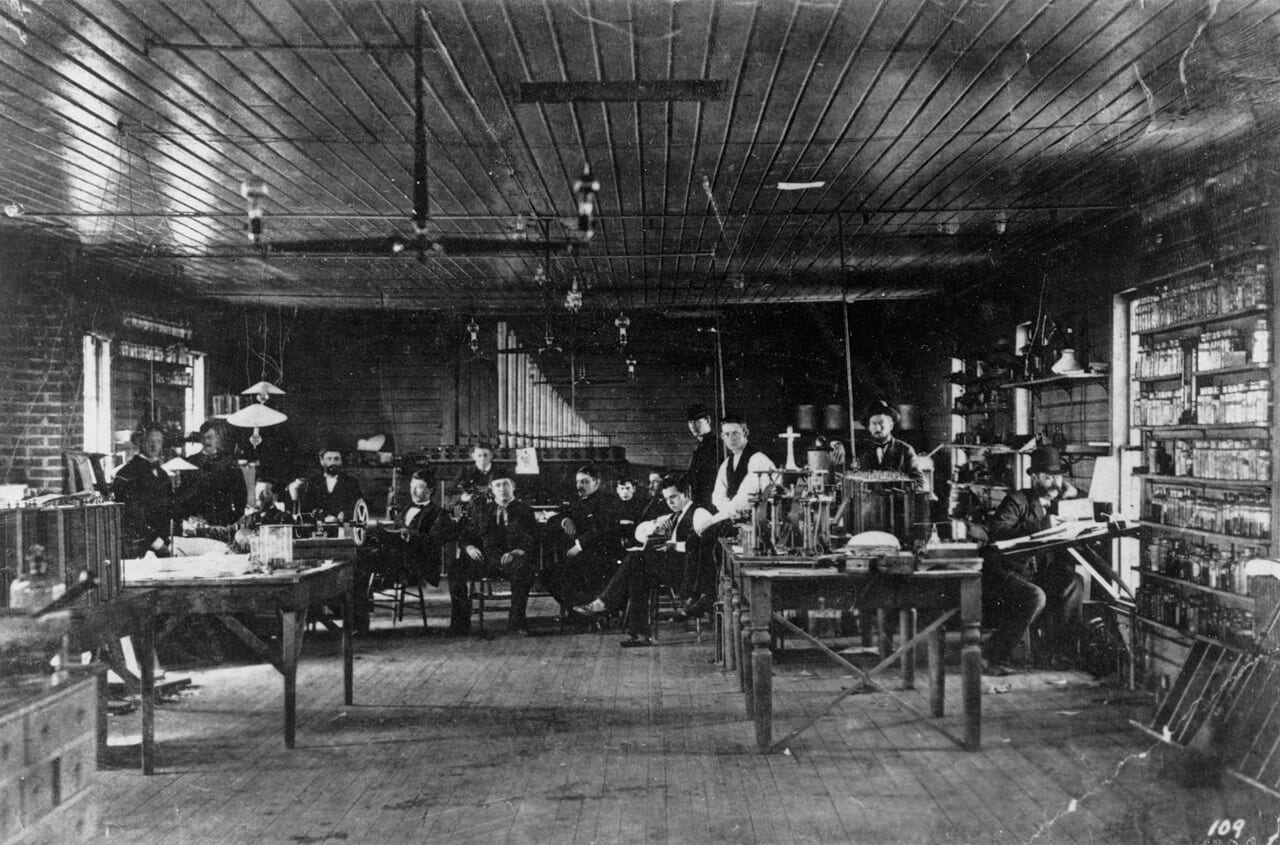
The thing at Menlo Park that had never existed before was not any device but the arrangement itself. Edison assembled a permanent staff - machinists, glassblowers, chemists, mathematicians, a full machine shop, a library, a stock of essentially every material he could obtain - and pointed them at commercial problems chosen in advance. Invention had previously been the work of individuals in workshops, funded by patrons or their own trade. Edison made it a process with an input, a payroll and an expected output, and promised investors results on a timetable. Nearly every corporate research laboratory of the twentieth century, from General Electric to Bell Labs to the pharmaceutical industry, is a descendant of that model. He is often called the greatest inventor in history; the better claim is that he invented the organisation that made individual inventors largely obsolete.
The phonograph of 1877 is the one invention Edison can be said to have produced from nothing. There was no prior art, no competing team, and no obvious demand: nobody had ever heard a recorded human voice, and there was no reason to think it possible. Working on a telegraph repeater, he noticed that a stylus running over an indented tape made a sound resembling speech, and reasoned that the process could be reversed. He sketched a cylinder wrapped in tinfoil, had his machinist John Kruesi build it, and recited Mary Had a Little Lamb into it. It played back. Kruesi is reported to have said, in German, my God. The device made Edison internationally famous as the Wizard of Menlo Park within months, and he then largely ignored it for a decade while he electrified New York.
1878-1882
Not the Bulb, the System
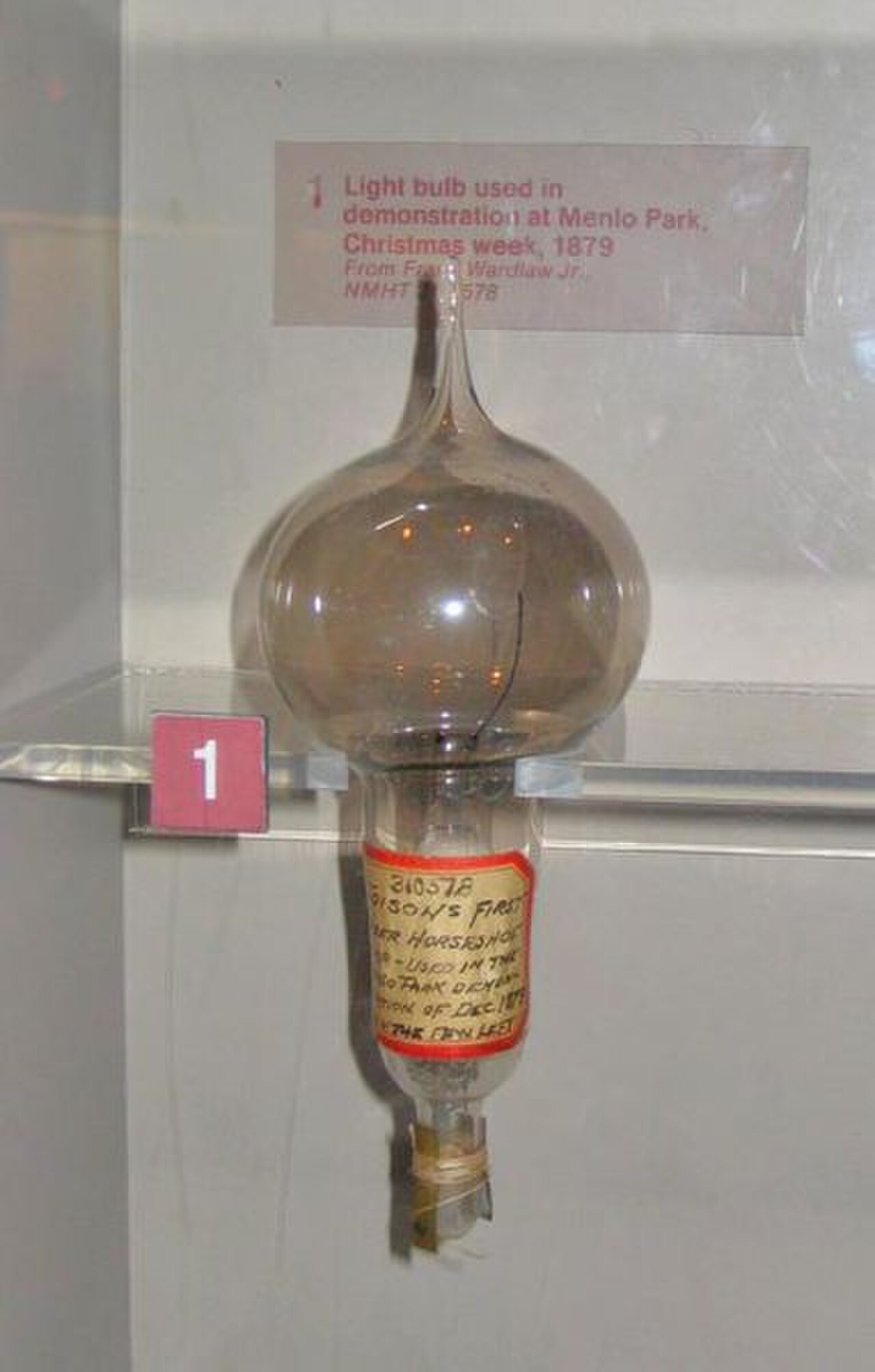
Incandescent lamps existed and did not work: filaments burned out in minutes and the vacuums were poor. Edison's team tested something like six thousand plant materials for a filament, settling first on carbonised cotton thread that burned for over thirteen hours in October 1879 and then on carbonised bamboo that ran past twelve hundred. But the harder problem was economic. Gas lighting was an established utility with pipes, meters and bills, and to displace it electricity had to arrive the same way. So Edison's people designed the parallel circuit that let one lamp be switched off without killing the others, the screw socket, the safety fuse, the underground conductors, the electricity meter that let customers be billed, and the dynamos to drive it. Pearl Street Station began supplying fifty-nine customers in lower Manhattan on 4 September 1882. It is the ancestor of every power grid in the world.
1888-1892
The War of the Currents, and Why He Lost It
Edison's system was direct current, and DC cannot be transmitted efficiently over distance. Westinghouse, using Tesla's polyphase alternating-current designs and transformers, could. Edison's response was a public campaign about the dangers of AC that did him lasting reputational damage.
| Transmission distance | About a mile before losses became ruinous | Effectively unlimited, using transformers to step voltage up and down |
| Generating stations needed | One per neighbourhood | One per region |
| Safety at the wire | Lower voltage, genuinely safer to touch | High transmission voltage, dangerous if mishandled |
| Edison's argument | Publicised AC electrocutions of animals, and quietly assisted the development of the AC electric chair | Won the 1893 Chicago World's Fair contract and the Niagara Falls project |
| Outcome | Obsolete for distribution by the 1890s | The standard everywhere, then and now |
Edison was pushed out of his own company in the 1892 merger that formed General Electric, which promptly adopted alternating current.
The Output
What Came Out of the Laboratories
1,093 US patents, and a considerable number of commercial failures alongside them.
The phonograph
The first device to record and reproduce sound. Improved into a commercial product from 1887, and the foundation of the recording industry.
- Recorded first: Mary Had a Little Lamb
The carbon transmitter
The microphone element that made Bell's telephone loud enough to be usable over distance. Carbon transmitters remained standard in telephones for a century.
- Improved: Bell's telephone
The electric lighting system
Lamp, socket, fuse, meter, cable, dynamo and central station, sold as one integrated utility. The model for the electricity industry.
- First station: Pearl Street, 1882
The kinetoscope
A peep-show viewer for moving film, developed largely by his assistant W. K. L. Dickson, together with the first film studio, the Black Maria. Edison's insistence on individual viewing rather than projection let others take the cinema.
- Largely by: W. K. L. Dickson
The alkaline storage battery
A nickel-iron rechargeable cell developed over a decade of testing that he said involved some ten thousand combinations. It became his most profitable single product.
- Most profitable: Of all his products
The iron ore separator
A magnetic ore-milling venture that consumed most of his personal fortune and failed completely when cheap Mesabi Range ore was discovered. He is said to have shrugged that they had had a hell of a good time spending it.
- Outcome: Total loss
The Other Ledger
What the Wizard Story Leaves Out
Edison's method was systematic trial rather than theory - his own line about genius being one per cent inspiration and ninety-nine per cent perspiration is a fair description of it - and Tesla, who worked for him briefly, remarked with some bitterness that a little theory would have saved him ninety per cent of the labour. The criticism is partly fair and partly misses the point: Edison was solving engineering and commercial problems where the physics was already adequate and the difficulty was in the details.
Less defensible is the credit. The laboratories operated under his name, and the patents and the fame attached to him rather than to the staff who did much of the work - Dickson on motion pictures, Kruesi and Batchelor on the machinery, Upton on the mathematics. He worked his people to exhaustion, expecting eighteen-hour days, and he was a formidable manipulator of publicity who announced results before he had them. The animal electrocutions staged during the currents war were a genuinely ugly episode. He was a great inventor; he was also the first person to understand that inventing is a business, with everything that implies.
Further Reading
Books About Edison
The papers project at Rutgers has published a fraction of some five million surviving pages.
Legacy
Why Number Thirty-Five
Michael Hart ranked Edison 35th, and the case is cumulative rather than resting on one thing. Recorded sound, electric light in ordinary homes, the electrical grid and moving pictures are each large; taken together they account for a substantial fraction of what daily life in the twentieth century felt like. The lamp is the emblem, but the distribution system is the achievement, because it is what made electricity a utility rather than a novelty.
The institutional legacy may outrank all of it. Before Menlo Park, invention was episodic and personal; after it, it was a line item. Every industrial research laboratory, every corporate R&D budget, every pharmaceutical pipeline runs on the assumption Edison was the first to act on - that if you assemble the right people and materials and point them at a defined commercial problem, useful results will arrive on a schedule. He was wrong about alternating current, careless about credit, and better at business than at physics. He was also right about the most important thing, which is that the invention that matters most is a way of producing inventions.
Related Publications