John Dalton

John Dalton
Born c. 6 September 1766 • Died 27 July 1844
The idea that matter is made of indivisible particles is as old as Democritus, and for two thousand years it stayed exactly what he left it: an argument. John Dalton, a Quaker teacher in Manchester with no university education and a weather diary he had kept since he was twenty-one, turned it into something a chemist could use. His move was deceptively small. If atoms are real, they have weights; if they have weights, the fixed proportions in which substances combine are not a curiosity but a measurement of them. Chemistry has been counting atoms ever since.
Rank
#32
Influence
80
Field
Chemist and Physicist
Historical Perspective
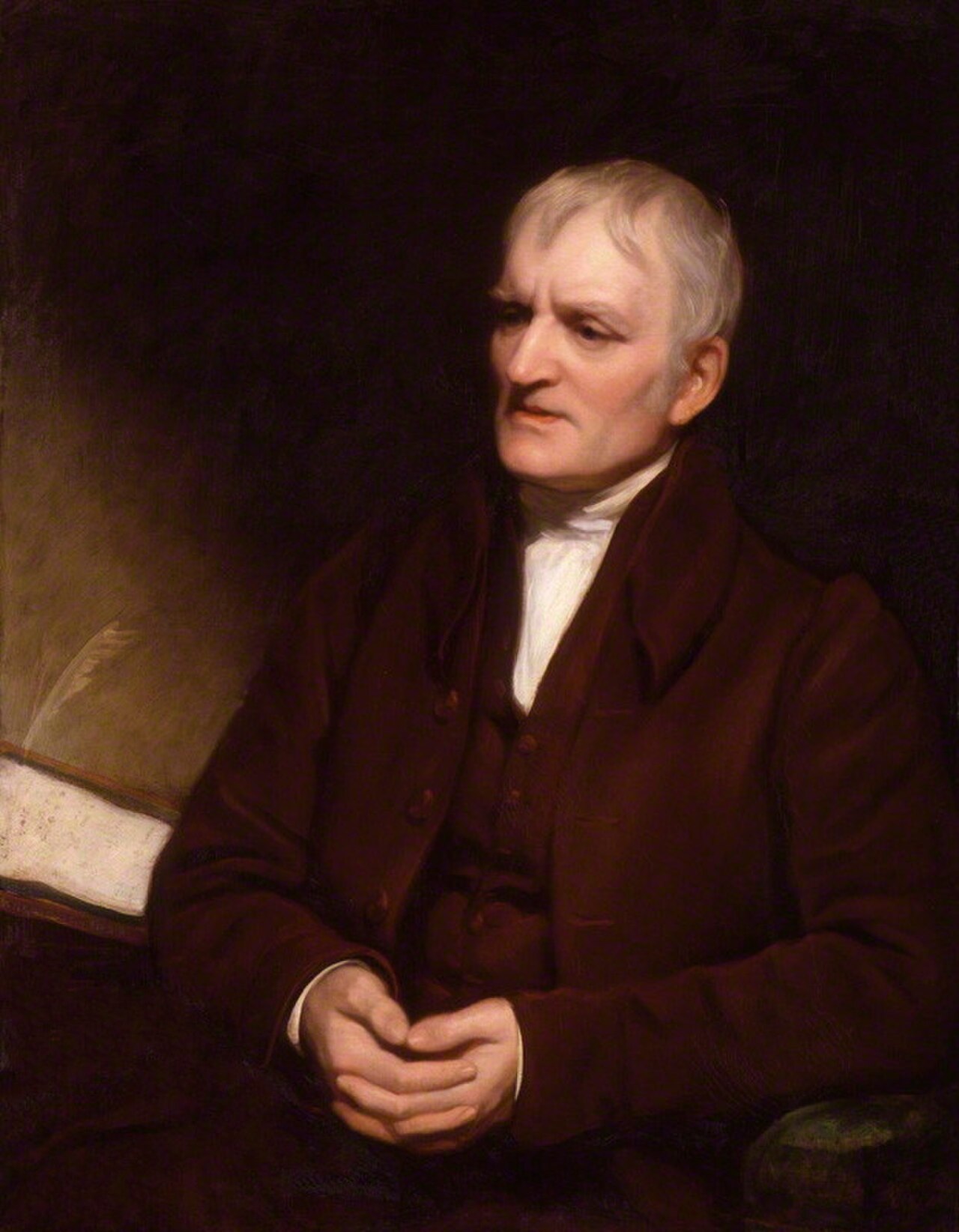
John Dalton was born at Eaglesfield in Cumberland in early September 1766, the son of a Quaker weaver, into a family poor enough that he was teaching in the village school at twelve. As a Dissenter he was barred from Oxford and Cambridge, and his education came instead from the local Quaker network - notably Elihu Robinson and John Gough, a blind natural philosopher who taught him Latin, Greek and mathematics. He moved to Manchester in 1793 to teach at the New College there and remained in the city for the rest of his life, supporting himself by private tuition. His first published work was on meteorology, and his first paper to the Manchester Literary and Philosophical Society, in 1794, described the colour blindness he and his brother shared. The atomic theory emerged from his work on gases between 1801 and 1803, was circulated in lectures from 1803, and appeared in print in A New System of Chemical Philosophy in 1808. He died in Manchester on 27 July 1844, and more than forty thousand people filed past his coffin. Michael Hart ranked him 32nd in The 100.
Influence Meter
80
Measured on a 100-point scale
Turned the atom from a philosophical idea into a weighable quantity
1787-1844
Two Hundred Thousand Weather Readings
Dalton began a meteorological diary in 1787, aged twenty-one, and kept it for fifty-seven years, entering something over two hundred thousand observations - temperature, pressure, humidity, rainfall, wind - with the last made the day before he died. It looks like an eccentricity and it was the foundation of everything else. Trying to account for why water vapour behaves as it does in air led him to the question of whether gases in a mixture interfere with one another, and to the law of partial pressures he presented in October 1803: in a mixture of gases, each exerts the pressure it would exert alone, and the total is their sum. That result only makes sense if the gases are made of separate particles that largely ignore each other, which is the point at which the atom stopped being philosophy and became a hypothesis with consequences he could test.
The Atomic Theory, in Five Claims
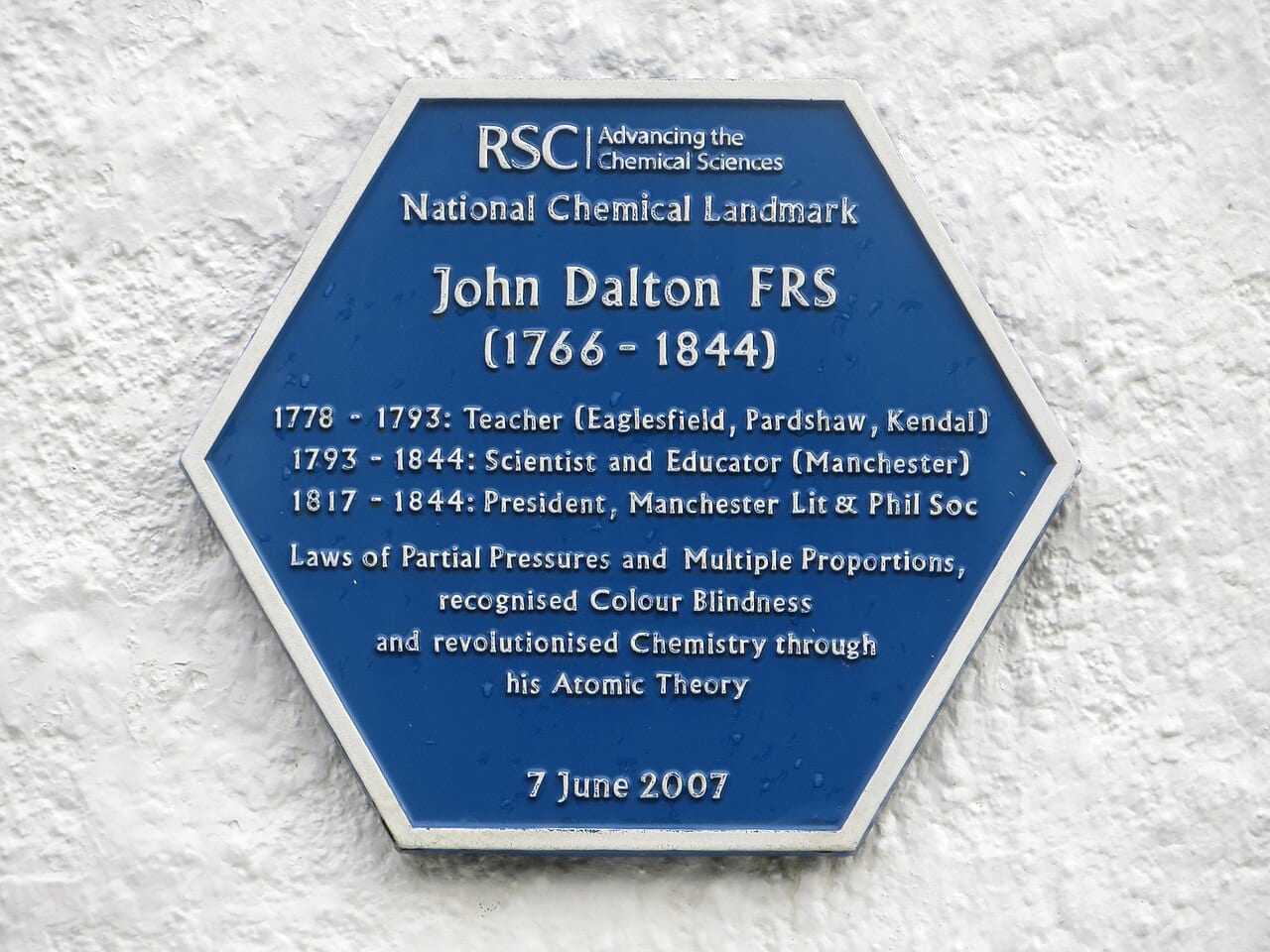
Set out in lectures from 1803 and printed in 1808. Two of the five turned out to be wrong, which did not matter nearly as much as the other three being right.
- All matter is made of atoms: Indivisible and indestructible particles - a revival of Democritus, but now offered as a physical hypothesis rather than a metaphysical one.
- All atoms of a given element are identical: Same size, same mass, same properties. Isotopes later showed this to be wrong, but it was the assumption that made weighing possible.
- Each element has a characteristic atomic weight: The decisive move. Weights cannot be measured absolutely, so Dalton set hydrogen at 1 and expressed everything else relative to it - a convention chemistry still uses.
- Compounds form in simple whole-number ratios: Atoms combine as small integers, which is why a compound's composition by weight is always the same. This explains the law of definite proportions rather than merely restating it.
- Chemical reactions rearrange atoms, never create or destroy them: Which supplies the physical reason for Lavoisier's conservation of mass, thirty years after Lavoisier established it experimentally.
- The rule of greatest simplicity: Where the ratio was unknown he assumed the simplest one, giving water as OH and ammonia as NH. Wrong in both cases, and the source of most of the errors in his weight tables.
The law of multiple proportions is the piece of evidence that made the theory persuasive rather than merely plausible. Dalton noticed that when two elements form more than one compound, the weights of the second element combining with a fixed weight of the first stand in small whole-number ratios. Carbon and oxygen form two gases, and the oxygen in one is exactly twice the oxygen in the other for the same carbon. There is no reason for a continuous, infinitely divisible matter to behave that way. There is an obvious reason for particulate matter to do so: one atom of oxygen in the first case, two in the second. It is one of the cleanest inferences in the history of science, and it is why chemists accepted atoms decades before any physical evidence of one existed.
1808
Circles With Lines In Them
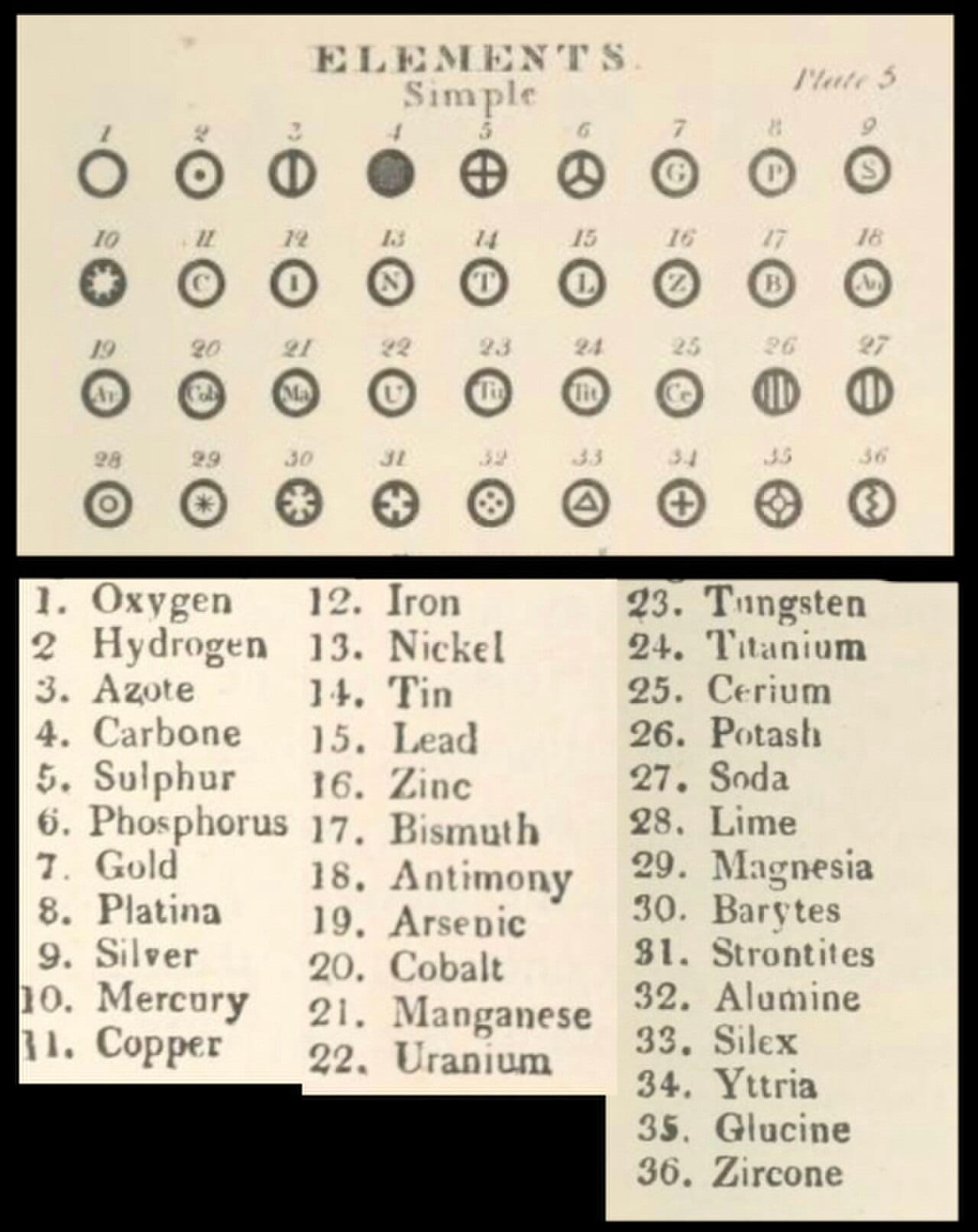
Dalton needed a notation and invented one: circles with distinguishing marks inside - hydrogen an empty circle, oxygen a circle with a dot, carbon a filled black disc, and compounds shown as those circles joined together. It was visual, intuitive, and it lost. Within a decade the Swedish chemist Jons Jacob Berzelius proposed using the initial letters of the Latin names instead, giving H, O, C, Fe, and the notation chemistry still uses; it was easier to typeset and extended without limit as new elements were found. Dalton disliked it and went on using his circles for the rest of his life. The episode is a fair illustration of him: original, stubborn, and more interested in the physical picture than in the convenience of anyone else working with it.
The Other Work
What Else He Did, and Got Wrong
He was a working scientist for half a century, and the atomic theory was one result among several.
The first paper on colour blindness
He and his brother saw scarlet as little different from green. He described the condition systematically, and the defect is still called Daltonism in several languages.
- His own theory: Wrong
His eyes were tested in 1995
He left instructions that his eyes be examined after death. Preserved for two centuries, they were DNA-tested in 1995 and showed deuteranopia - he had blamed a blue tint in the fluid of the eye, which was not the cause.
- Diagnosis: Deuteranopia
Law of partial pressures
Each gas in a mixture exerts its own pressure independently. Still taught as Dalton's law, and still the basis of calculations from diving tables to anaesthesia.
- Published: 1805
Thermal expansion of gases
Found independently that gases expand equally with temperature, a result usually credited to Gay-Lussac, who published more precisely a year later.
- Credit went to: Gay-Lussac
Fifty-seven years of weather records
Over two hundred thousand entries, made from the same location, and a genuinely valuable early climate dataset. Much of the original was destroyed by bombing in 1940.
- Lost: Manchester Blitz, 1940
Rejecting Avogadro
Amedeo Avogadro's hypothesis would have corrected Dalton's formula errors within three years. Dalton rejected it, and the confusion over atomic weights persisted until Cannizzaro settled it in 1860.
- Cost: Half a century of muddle
Manchester
A Life of Almost Aggressive Plainness
Dalton never married, lived in lodgings, and for twenty-six years took the same walk and played bowls on the same afternoon each week. He taught mathematics privately at modest fees for most of his life and served the Manchester Literary and Philosophical Society for over four decades, presenting more than a hundred papers there. As a Quaker he refused to be presented at court until friends dressed him in the scarlet robes of an Oxford doctorate - a colour his colour blindness allowed him to believe was a respectable grey.
The recognition arrived anyway. He was elected to the Royal Society in 1822 without applying, received its Royal Medal in 1826, and was granted a government pension. When he died in July 1844 Manchester gave him a civic funeral: his body lay in state for four days and something over forty thousand people filed past. For a Dissenting weaver's son from a Cumberland village who had been excluded from every English university, it was an unusual conclusion, and a fair measure of what the city thought a scientist was worth.
Written Works
Books and Papers by Dalton
He published steadily for fifty years, most of it through the Manchester society.
Legacy
Why Number Thirty-Two
Michael Hart ranked Dalton 32nd, and the case is that he made the central object of modern chemistry usable. Democritus had atoms as an idea; Lavoisier had elements and conservation of mass; Dalton supplied the connection - that an element is a kind of atom, that the kind has a weight, and that the weight can be worked out from what a chemist can actually measure in a laboratory. Everything downstream depends on it. Mendeleev's periodic table is an arrangement by atomic weight, and could not have been assembled without one.
The theory as he stated it is now substantially wrong in its details. Atoms are divisible, atoms of an element are not identical because isotopes exist, and his formulae for water and ammonia were incorrect for a reason he refused to fix. None of that damages the standing of the idea, because being productively wrong in the details while right in the frame is how most science advances. Atoms themselves were not directly confirmed until Einstein's 1905 analysis of Brownian motion and Perrin's experiments after it - a full century after a Manchester tutor with a weather diary decided to give them weights.
Related Publications