Antoine Laurent Lavoisier

Antoine Laurent Lavoisier
Born 26 August 1743 • Died 8 May 1794
Antoine Laurent Lavoisier (1743-1794) did not discover a single one of the major gases that made him famous. Other chemists found them first. What he did was weigh them - before a reaction and after, with an accuracy no one had bothered with - and then say what the numbers meant. That habit destroyed a theory that had organised chemistry for a century, gave the discipline a vocabulary it still uses, and established that matter is never lost. He financed the work with a fortune made collecting taxes for the crown, and in 1794 that fortune's origin cost him his life.
Rank
#20
Influence
82
Field
Chemist
Historical Perspective
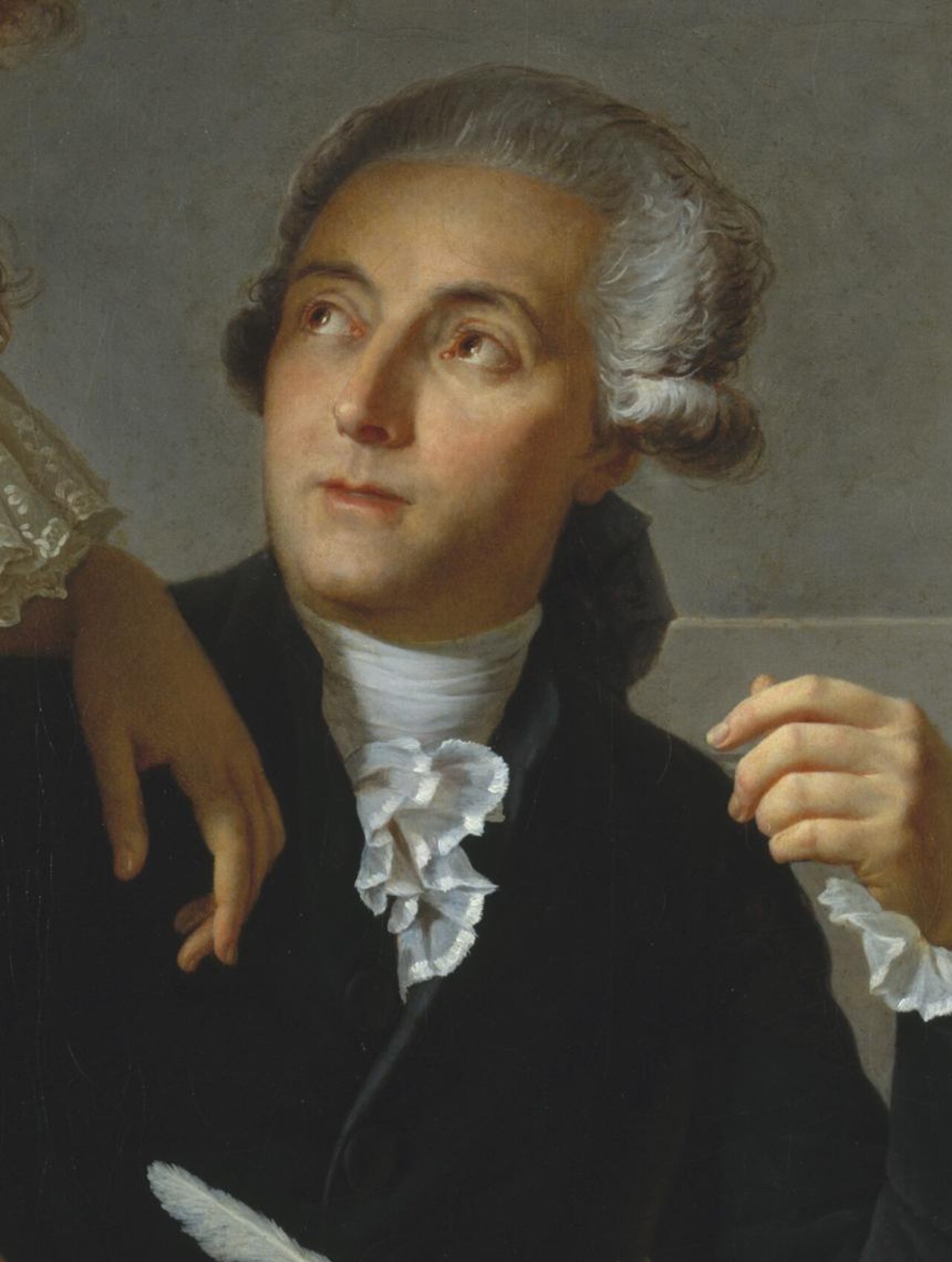
Antoine Laurent Lavoisier was born in Paris on 26 August 1743 into a wealthy legal family, studied at the Collège des Quatre-Nations, and took a law degree in 1764 before deciding he preferred science. He was elected to the Académie des Sciences in 1768, at twenty-five, and in the same period bought a share in the Ferme générale, the private consortium that collected indirect taxes for the French crown. The two careers ran in parallel for a quarter of a century: he was a diligent public administrator - working on gunpowder manufacture, agriculture, hospital reform, street lighting and the metric system - and, in the mornings and evenings around that work, the most exacting experimental chemist in Europe. His laboratory in Paris, staffed in part by his wife and collaborator Marie-Anne Paulze Lavoisier, produced the sequence of measurements that made chemistry quantitative. The tax farm made all of it affordable and eventually destroyed him. He was arrested with the other former tax farmers, tried, and guillotined on 8 May 1794. Michael Hart placed him 20th in The 100, immediately after Copernicus, as the man who did for chemistry roughly what Newton had done for physics.
Influence Meter
82
Measured on a 100-point scale
Turned chemistry from a collection of recipes into a science with a balance at its centre
The Laboratory Partnership
Marie-Anne Paulze Lavoisier
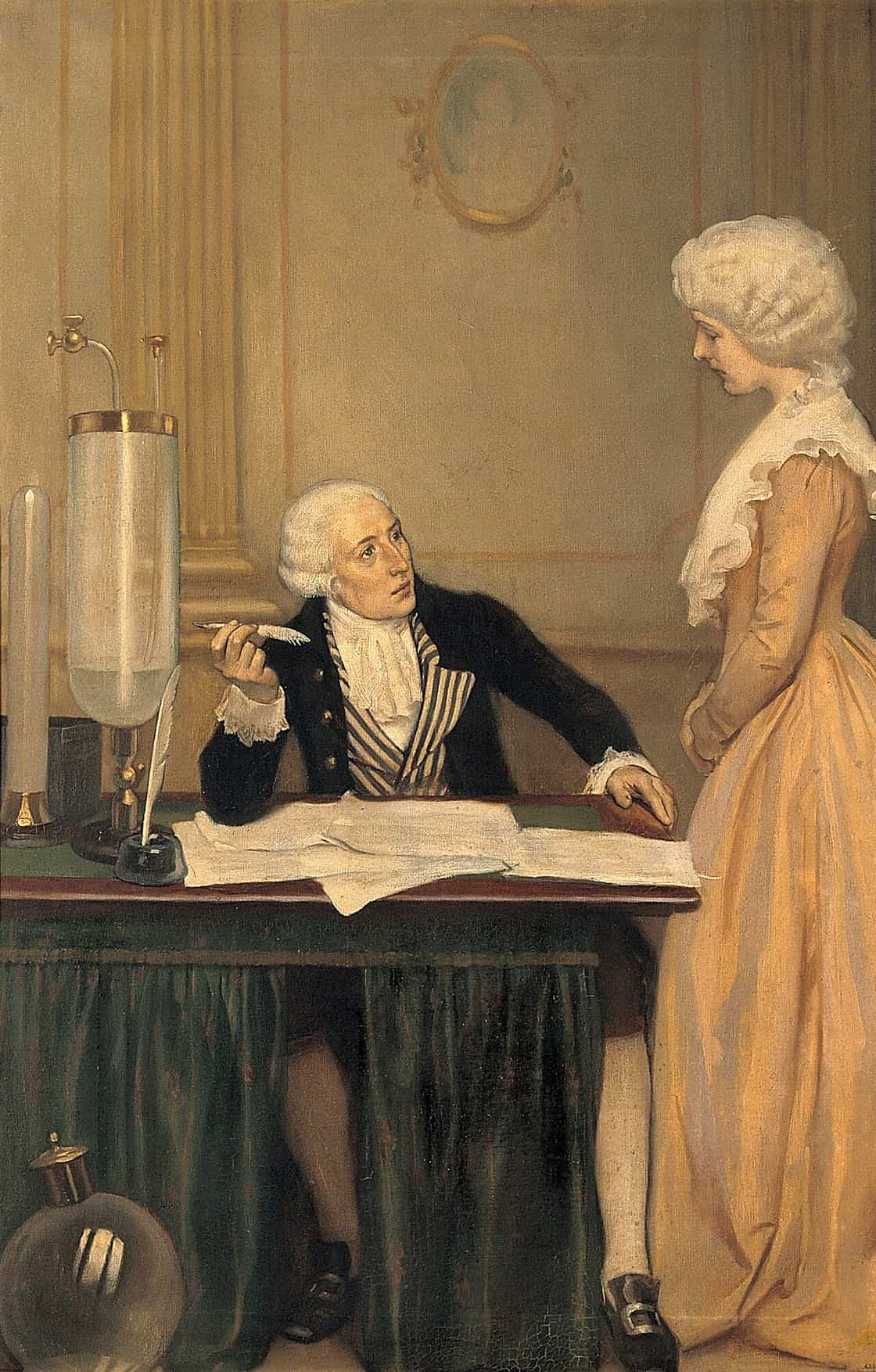
Lavoisier married Marie-Anne Pierrette Paulze in 1771; she was the daughter of a fellow tax farmer, and thirteen years old at the wedding, an arrangement that was legal and not extraordinary among the French gentry of the period. What followed was one of the most productive scientific partnerships of the century. She learned English and Latin in order to translate the work of British chemists for him - including Richard Kirwan's Essay on Phlogiston, which she rendered into French with critical notes attached, so that her husband could rebut it. She trained as a draughtswoman under the painter Jacques-Louis David and produced the detailed engravings of laboratory apparatus that illustrate the Traité élémentaire de chimie, drawings precise enough that historians have used them to rebuild the instruments. She kept the laboratory notebooks, hosted the weekly gatherings where Parisian science was argued out, and after his execution assembled and published his unfinished memoirs. David's famous double portrait of the couple shows the arrangement plainly: the chemist at his desk, and his collaborator standing over the work.
The Other Career
How a Tax Collector Paid for Modern Chemistry
The Ferme générale was a private company that bought the right to collect France's indirect taxes - on salt, tobacco, imported goods - and kept the difference between what it gathered and what it owed the crown. It was efficient, immensely profitable, and among the most hated institutions in the country. Lavoisier bought into it at twenty-six and worked at it seriously for decades, inspecting operations across France and writing reports on fraud. He also backed the construction of a customs wall around Paris to stop goods being smuggled past the toll gates, a project that made him personally unpopular with the city's poor in a way that would matter later.
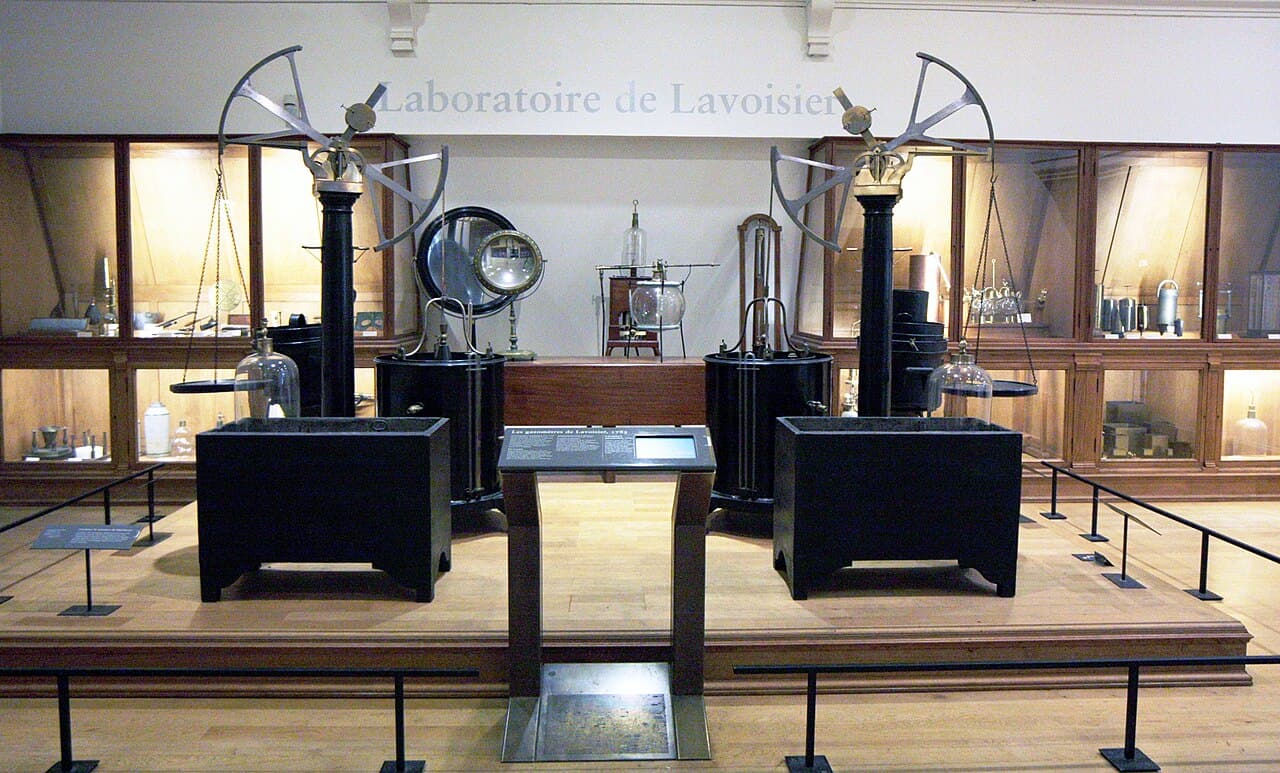
The money bought equipment. Precision balances, sealed glass vessels, and the great burning lenses and gasometers he used were extraordinarily expensive, and no French university would have funded them. He put his own fortune into the laboratory and into the public appointments he took on without much regard for payment: he was made a commissioner of the Régie des poudres in 1775 and substantially improved French gunpowder, worked on agricultural improvement on his estate at Fréchines, reported on prison and hospital conditions, and sat on the commission that designed the metric system. It is a strange double ledger. The same institution that funded the finest laboratory in Europe also supplied the charge sheet that sent its owner to the scaffold.
Method
The Instrument That Did the Arguing
Chemistry before Lavoisier was not short of observations; it was short of accounting. Substances were described by how they looked, smelled and behaved, and when something appeared to be lost in a reaction - as wood seems to be lost in burning - it was explained by a substance called phlogiston that escaped into the air. Lavoisier's method was to close the system and weigh it. He would seal a reaction inside a glass vessel, weigh the whole apparatus before and after, and insist that the totals match. Once you do that consistently, phlogiston has nowhere to hide: burning metals gain weight rather than losing it, and the gain is exactly the weight the surrounding air loses. In 1783 he published Réflexions sur le phlogistique, a direct assault on the theory, and by the end of the decade it was finished. His laboratory notebooks record measurements to a precision that his contemporaries found faintly absurd, and in 1784 he presented water-synthesis figures to the Académie carried out to eight decimal places.
In 1774 Lavoisier established by sealed-vessel experiment what is now called the law of conservation of mass: in a chemical reaction, matter is neither created nor destroyed, only rearranged. The total weight before equals the total weight after, always. The principle is usually paraphrased from his Traité as 'nothing is lost, nothing is created, everything is transformed.' It sounds obvious now, and that is a measure of how completely it won. It is the reason a chemical equation can be balanced at all, and it converted chemistry from a descriptive craft into a subject where arithmetic decides who is right.
The Work, In Detail
Six Experiments That Rebuilt a Science
Almost none of these involved discovering a new substance. They involved explaining substances other people had already found.
Combustion as combination with air
Burning is not the escape of phlogiston but the combination of a substance with one component of the air. Metals heated in sealed air gain exactly the weight the air loses, and the reaction stops when that component is used up.
- Overturned: Phlogiston theory
Naming oxygen
Joseph Priestley and Carl Wilhelm Scheele isolated the gas first; Lavoisier recognised what it did and named it oxygène, from the Greek for 'acid former', on the mistaken belief that it was present in all acids. The name stuck; the reasoning behind it did not.
- Isolated by: Priestley and Scheele
Conservation of mass
Sealed-vessel weighings before and after reaction, showing that total mass is unchanged - the accounting rule that makes quantitative chemistry possible.
- Method: Closed-system weighing
Water is a compound
With Pierre-Simon Laplace, synthesised water by burning hydrogen in oxygen, demolishing water's two-thousand-year standing as an element. He named the second gas hydrogène, 'water former'.
- With: Laplace
Respiration is slow combustion
Measured the oxygen consumed and heat produced by a living animal and concluded that breathing is a combustion inside the body - the founding insight of metabolic physiology. Later work with Armand Seguin measured human subjects at rest and at work.
- With: Seguin
The ice calorimeter
Built with Laplace, it measured the heat of a reaction by how much ice it melted, giving the first reliable quantitative measurements in what became thermochemistry.
- Measures: Heat of reaction
Lavoisier by the Numbers
Substances listed as elements
The Traité élémentaire de chimie of 1789 tabulated 33 substances he judged to be elementary. Most were right; light and caloric were not.
Fast fact signal
Age at election to the Académie
Elected to the Académie des Sciences in 1768, before he had published any of the work he is remembered for.
Fast fact signal
Age at execution
Guillotined on 8 May 1794, with roughly a decade of planned work unfinished.
Fast fact signal
Co-defendants condemned with him
Tried and executed the same day as 27 other former members of the Ferme générale.
Fast fact signal
Months until his exoneration
The verdict was overturned about eighteen months after his death and his confiscated belongings returned to his widow.
Fast fact signal
1787
Renaming the Whole of Chemistry
With Guyton de Morveau, Claude Louis Berthollet and Antoine François de Fourcroy, Lavoisier published the Méthode de nomenclature chimique, which threw out the alchemical names inherited from centuries of workshop tradition and replaced them with a system in which a compound's name states what it is made of. Learning the name now taught you the chemistry - and this is why the language of the subject has needed so little revision since.
| Oil of vitriol | Sulphuric acid | Sulfuric acid |
| Spirit of salt | Muriatic acid | Hydrochloric acid |
| Aqua fortis | Nitric acid | Nitric acid |
| Flowers of zinc | Zinc oxide | Zinc oxide |
| Dephlogisticated air | Oxygen | Oxygen |
| Inflammable air | Hydrogen | Hydrogen |
| Fixed air | Carbonic acid gas | Carbon dioxide |
| Azote (lifeless air) | Azote | Nitrogen |
The naming convention survives almost unchanged: acids, oxides and salts are still named by their constituents. French chemists still call nitrogen azote.
Chronology
From the Academy to the Scaffold
Fifty years that ran from a wealthy Parisian childhood through the reconstruction of a science to the Place de la Révolution.
1793-1794
Eight May
Lavoisier had supported moderate reform and continued serving the new republic - he was still working on the metric system when the Convention adopted it on 1 August 1793. It did not protect him. On 24 November 1793 the arrest of all former members of the Ferme générale was ordered, and the tax farmers were prosecuted as a group on charges of defrauding the treasury and adulterating tobacco. The trial was summary; the outcome was decided by the category the defendants belonged to rather than by anything they had individually done. Lavoisier was condemned with twenty-seven co-defendants and guillotined at the Place de la Révolution on 8 May 1794, aged fifty. The mathematician Joseph-Louis Lagrange is said to have remarked the next day that it had taken only a moment to cut off that head, and that a century might not produce another like it. About eighteen months later the convictions were annulled, and Lavoisier's confiscated possessions were returned to his widow with a note addressed to the widow of a man falsely condemned.
Written Works
Books and Memoirs by Lavoisier
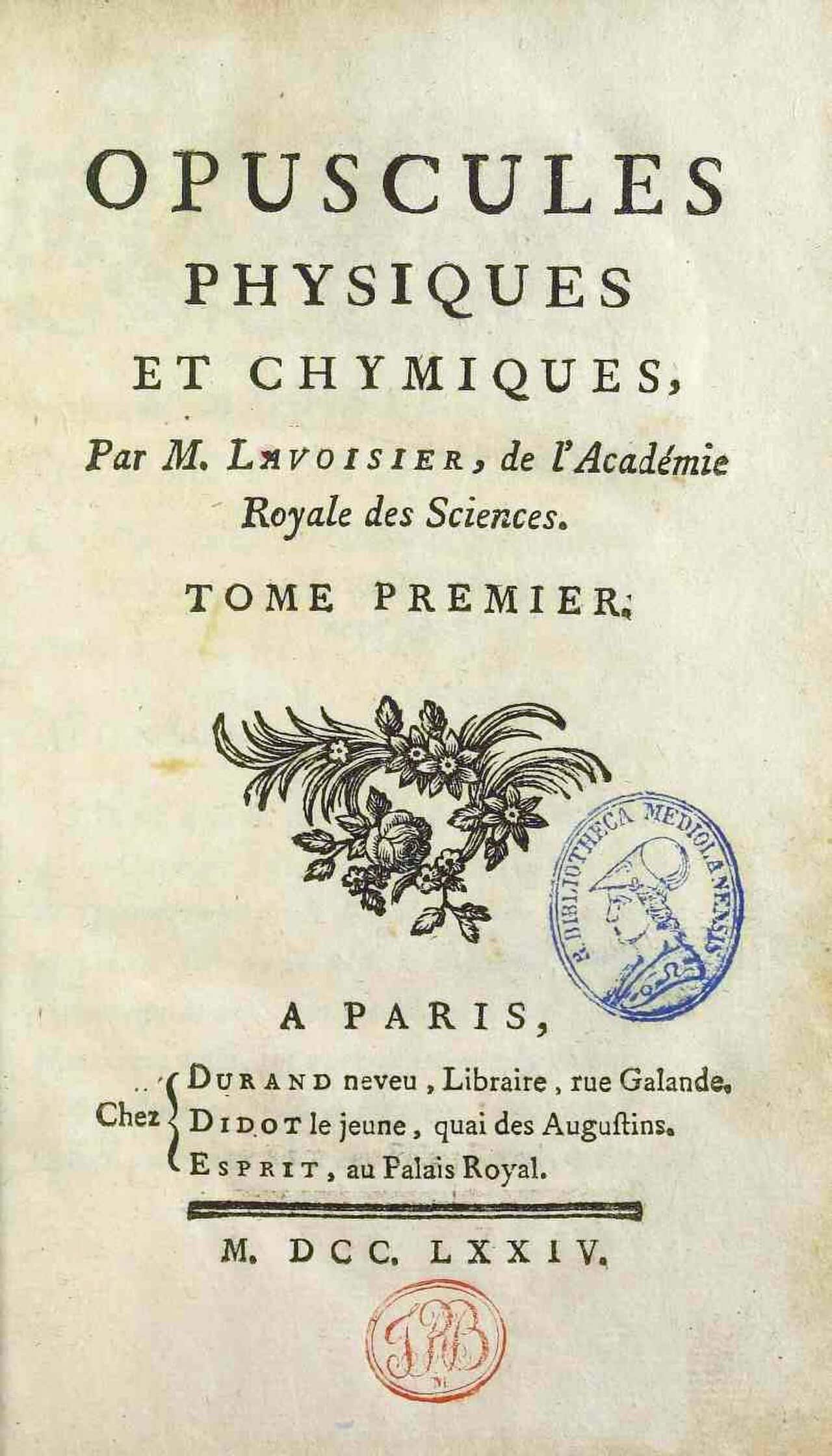
He published steadily in the Académie's memoirs; these are the works that carried the argument.
Further Reading
Books About Lavoisier
Biographies covering the chemistry, the administration, and the trial.
Lavoisier in the Year One
A compact narrative of the birth of modern chemistry set against the Revolution that killed its founder, written for general readers in the Great Discoveries series.
- Published: 2005
- Subtitle: The Birth of a New Science in an Age of Revolution
Antoine Lavoisier: Science, Administration and Revolution
The standard scholarly biography, unusual in taking his career as a public administrator as seriously as his laboratory work and showing how the two fed each other.
- Published: 1993
- Series: Cambridge Science Biographies
The Chemical Revolution
A large scholarly literature examines whether Lavoisier's break with phlogiston was a revolution or a long consolidation of other chemists' results - the standard entry point for readers who want the argument rather than the life.
- Topic: Debate over his originality
Legacy
Why Number Twenty
Michael Hart ranked Lavoisier 20th, directly after Copernicus, and the pairing is deliberate: both men took a field with plenty of accumulated data and supplied the organising idea that made sense of it. The most common objection to Lavoisier's reputation is that he discovered very little. Priestley and Scheele found oxygen; Cavendish worked on hydrogen and water; Black had studied fixed air. Lavoisier's contribution was to interpret, to systematise, and above all to insist on the balance - and the objection rather misses how much of scientific progress consists of exactly that. Without conservation of mass and a rational nomenclature, John Dalton could not have proposed atomic weights two decades later, and the nineteenth-century chemistry that followed would have had nothing to build on.
There is also the counterfactual, which is unusually sharp in his case. He was fifty when he died, at the height of his powers, with work on respiration and animal heat still in progress. It is one of the few executions in the history of science whose cost can be partly itemised. France recognised this fairly quickly: his name is among the seventy-two inscribed on the Eiffel Tower, and the exoneration came within two years. Chemistry students today learn his conservation law in their first lessons and use his naming system in every one after that, usually without ever being told whose they are.
Related Publications