Fuel saving over Newcomen
75% less coal
Watt engines achieved up to roughly five times the fuel efficiency of the atmospheric engines they replaced.
Born 19 January 1736 • Died 25 August 1819
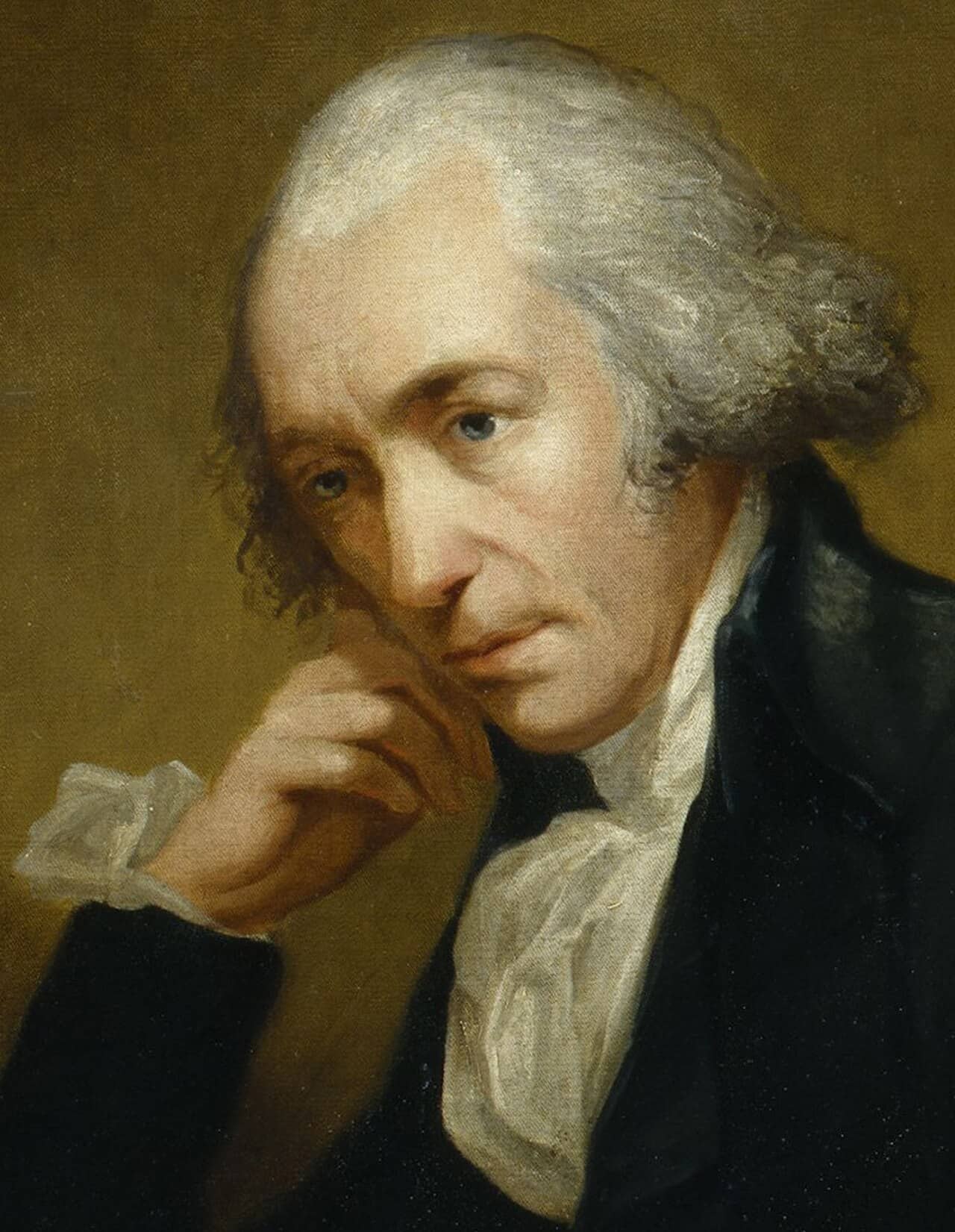
James Watt (1736-1819) did not invent the steam engine. Working engines had been pumping water out of British mines for half a century before he touched one. What Watt did was work out why they wasted almost all their fuel, fix it, and then keep fixing it for another thirty years until the result could turn a shaft at a controlled speed anywhere a boiler could be fed. That distinction - between a machine that drains a coal mine and a machine that drives a cotton mill in a town with no coal - is the difference between an interesting device and an industrial revolution.
Rank
#22
Influence
85
Field
Engineer and Inventor
Historical Perspective
James Watt was born in Greenock on the Firth of Clyde on 19 January 1736, the son of a shipwright and merchant. He was a sickly child educated largely at home, showed an early aptitude for mechanical work in his father's workshop, and went to London in 1755 to train as a mathematical instrument maker before setting up in Glasgow in 1757 with a workshop attached to the university. That position mattered: it put him among men like Joseph Black, whose work on latent heat gave him the vocabulary for what he later discovered. In 1763 he was asked to repair the university's model Newcomen engine, and found he could not make it run for long on any reasonable amount of fuel. Working out why occupied him for two years, and the answer came to him in May 1765 while walking on Glasgow Green: keep the cylinder permanently hot and condense the steam somewhere else. He patented the separate condenser in 1769, spent a frustrating decade trying to build it with the ironworking precision then available, and in 1775 entered the partnership with Matthew Boulton in Birmingham that finally made it work. Michael Hart placed him 22nd in The 100, as the man who supplied the Industrial Revolution with its prime mover.
Influence Meter
85
Measured on a 100-point scale
Made mechanical power portable, controllable and cheap - the engine under the Industrial Revolution
1763
The Newcomen atmospheric engine, in service since 1712, worked by admitting steam into a cylinder and then spraying cold water inside to condense it, creating a partial vacuum that let atmospheric pressure push the piston down. It was reliable, it was strong, and it was appallingly wasteful, because every stroke chilled the cylinder that the next stroke had to reheat. When the University of Glasgow asked Watt to repair its teaching model, he found it could barely complete a few strokes before exhausting its boiler. Rather than patching it, he measured it - steam consumption, cylinder volumes, quantities of injection water - and concluded that roughly three-quarters of the heat supplied was being spent simply warming the cylinder back up. Joseph Black's concept of latent heat let him see why the loss was so large: condensing steam releases far more heat than anyone had appreciated, and all of it was going into the iron.
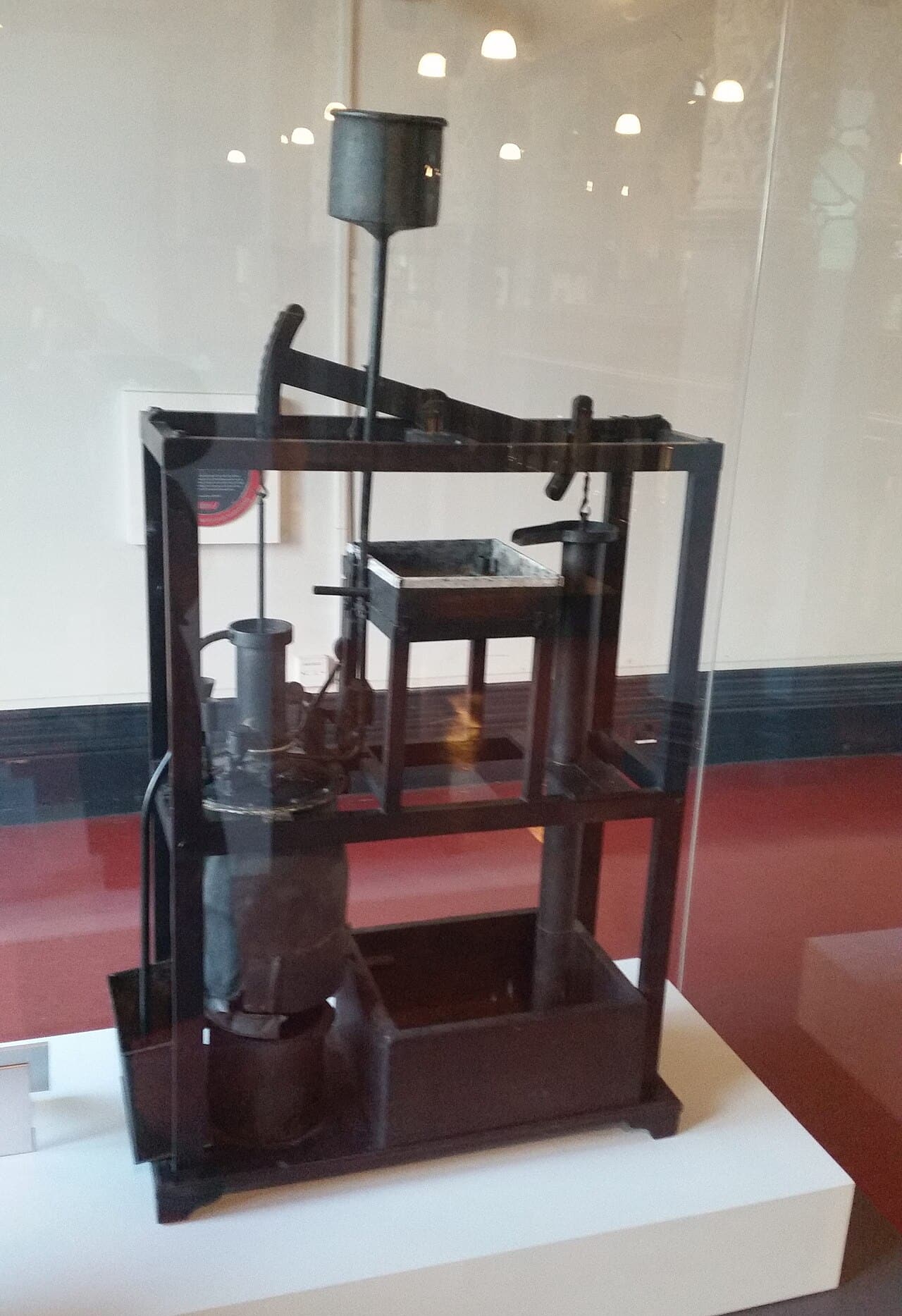
The solution came to Watt on a Sunday walk across Glasgow Green in May 1765, and it is one of the genuinely elegant ideas in the history of engineering: if the cylinder must stay hot and the steam must be made cold, then do the two things in different places. Connect a separate vessel - a condenser - kept permanently cool, and let the steam rush into it to be condensed there, while the working cylinder stays hot throughout, insulated by a surrounding steam jacket. Nothing about the thermodynamic principle was new. What was new was noticing that two requirements assumed to be in conflict were only in conflict because they had been assigned to the same piece of metal.
1769-1775
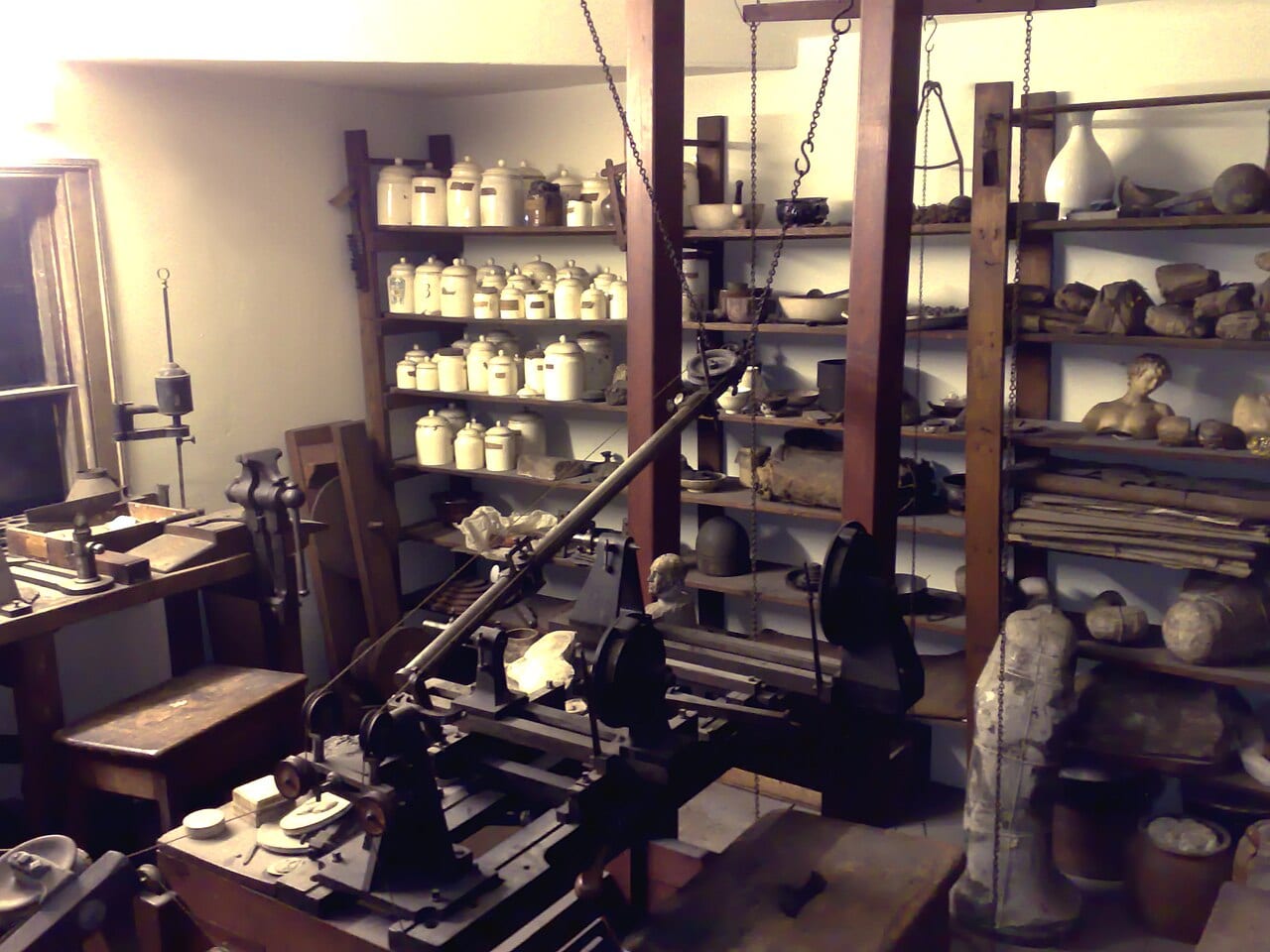
Watt's specification for patent 913, 'a method of lessening the consumption of steam and fuel in fire engines', was accepted on 5 January 1769 and enrolled that April. Having the idea turned out to be the easy part. The separate condenser only pays if the piston seals well enough to hold a vacuum, and British foundries in 1769 could not bore a large cylinder straight enough to make that possible. Watt spent years at Kinneil House near Bo'ness, funded by the ironmaster John Roebuck, producing engines that leaked. He supported himself as a surveyor, laying out canal routes across Scotland, and grew despondent enough to consider abandoning the project. Roebuck's bankruptcy in 1773 transferred his share to Matthew Boulton, the Birmingham manufacturer, and that changed everything: Boulton had capital, a workforce, commercial nerve, and access to John Wilkinson's newly precise cylinder-boring machinery. In 1775 Boulton also secured an Act of Parliament extending the patent to 1800, giving the partnership twenty-five years of protection.
The headline figure that sold the engine: Boulton and Watt charged customers a royalty based on a share of the fuel their engine saved, so the saving had to be real and measurable.
75% less coal
Watt engines achieved up to roughly five times the fuel efficiency of the atmospheric engines they replaced.
1775-1800
The partnership divided the work along its natural seam. Watt designed, calculated and worried; Boulton sold, financed and pushed. Their early market was Cornwall, where deep tin and copper mines had to pump water and where coal had to be shipped in at ruinous cost - precisely the customer for whom fuel efficiency was worth paying for. Boulton and Watt did not usually sell engines outright. They supplied the critical parts and the expertise, and charged an annual royalty calculated on a third of the fuel the engine saved compared with a Newcomen of the same duty, which meant the firm's income was tied directly to the improvement Watt had made. It also meant years of litigation against infringers, which consumed much of Watt's later energy.
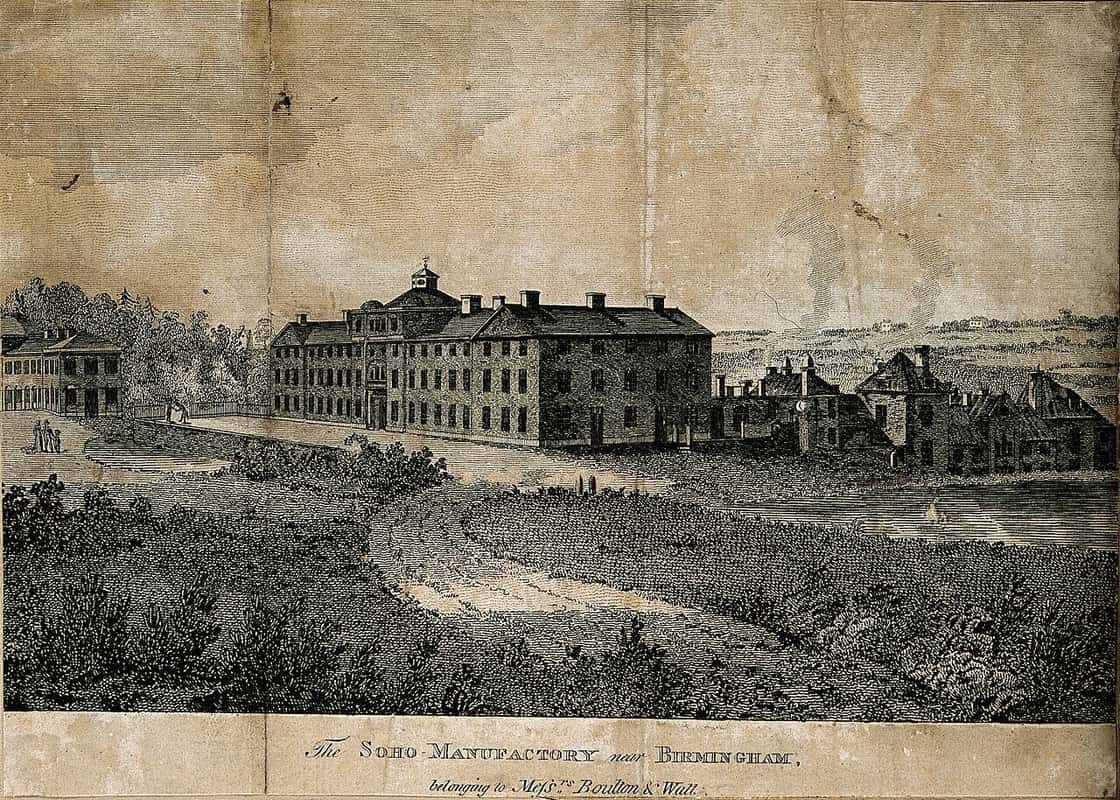
Boulton's more consequential contribution may have been commercial vision. It was he who pressed Watt to stop thinking about pumping and start thinking about rotary motion - about mills, not mines - correctly judging that the demand for a machine to turn a shaft would dwarf the demand for one to lift water. The Soho Manufactory, and from 1795 the purpose-built Soho Foundry, became the model for precision-engineered production, and Watt was drawn into the intellectual world of Birmingham's Lunar Society alongside Erasmus Darwin, Joseph Priestley and Josiah Wedgwood. By the time the patent expired in 1800 and Watt retired to Heathfield Hall, the rotative steam engine was established in textile mills, breweries, ironworks, potteries and waterworks across Britain.
Chronology
Drawn along a reciprocating stroke rather than a curve, because that is the motion the whole career was spent perfecting.
The Full List
The separate condenser is the famous one. The rest is what made the engine general-purpose, and several are still standard mechanical practice.
Condensing the steam in a permanently cooled vessel outside a permanently hot cylinder, cutting fuel consumption by roughly three-quarters. Patent 913.
A gear train converting the engine's reciprocating beam into continuous rotation, adopted because the obvious solution - the crank - was already patented by someone else. Patent 1,306.
Admitting steam alternately to both sides of the piston so that it delivers power on every stroke rather than every other one, nearly doubling output for a given cylinder. Patent 1,321.
A linkage that guides the piston rod in a straight line from the arc of a rocking beam - necessary once the engine pushed as well as pulled. Watt regarded it as his most ingenious piece of design.
Spinning weights that rise with speed and throttle the steam supply, holding the engine at a constant rate without human attention - one of the first automatic feedback controls, and the ancestor of control engineering.
A device tracing pressure against volume inside the working cylinder, giving engineers their first direct picture of what an engine was doing. Kept as a trade secret for years, and later fundamental to thermodynamics.
A unit defined as 33,000 foot-pounds per minute, devised so that customers could compare an engine with the animals it replaced. A marketing convenience that became a standard.
An entirely separate invention: a press that transferred fresh ink from an original onto damp thin paper, giving offices their first practical copying method. Patent 1,244, and a commercial success in its own right.
Before and After
The two machines look similar and work on the same broad principle. The differences are what let one drain a mine and the other run an economy.
| Where steam condenses | Inside the working cylinder | In a separate, permanently cooled condenser |
| Cylinder temperature | Cycles hot to cold every stroke | Held hot by a surrounding steam jacket |
| Fuel consumption | Very high; viable only at the pithead | Roughly a quarter as much for the same work |
| Power strokes | One per cycle | Two per cycle, once double-acting |
| Type of motion | Reciprocating only - a pump | Rotary, via sun and planet gear |
| Speed control | Manual adjustment | Automatic, by centrifugal governor |
| Practical siting | Coal mines, where fuel was almost free | Anywhere coal could be delivered |
| Typical use | Draining mines | Mills, foundries, breweries, waterworks, mines |
Watt worked at low pressure throughout and actively distrusted high-pressure steam; it was Richard Trevithick, after the patent lapsed in 1800, who took that step and made locomotives possible.
Legacy in Units
Watt needed a way to tell a brewer how much engine to buy, so he measured what a strong dray horse could sustain and rounded it into a unit: one horsepower, 33,000 foot-pounds of work per minute. It was a sales tool, and it outlived every engine he built. Seventy years after his death the British Association for the Advancement of Science adopted the watt as the unit of power in 1889, and in 1960 the eleventh General Conference on Weights and Measures confirmed it as an SI base-derived unit. The consequence is quiet and universal: every light bulb, kettle, motor, solar panel and power station on Earth is rated in units named after a Greenock instrument maker, and the ratings are read daily by billions of people who have no idea they are citing anybody. He was buried at Handsworth in Birmingham, and honoured with a statue in Westminster Abbey whose inscription credited him with having increased the power of man.
Further Reading
Watt published almost nothing beyond patent specifications and letters, so his record is the archive at Birmingham and the historians who have worked through it.
Legacy
Michael Hart ranked Watt 22nd, and the ranking survives the obvious objection. Watt did not invent the steam engine, and he was in some respects a conservative engineer: he distrusted high-pressure steam, and his patent - aggressively defended for twenty-five years - probably delayed the locomotive by holding back the rivals who wanted to build it. But the case for him is that before 1769 mechanical power was tied to the places nature happened to provide it: a fast river, a windy ridge, or a coal seam so cheap that waste did not matter. After Watt, power could be installed wherever it was wanted, at a fuel cost that made sense, running at a speed a machine could depend on. Factories no longer had to be built beside waterfalls. That single change of constraint is what industrialisation is.
The second-order effects reach further than the engines. The Boulton and Watt works pushed British metalworking toward tolerances that had not previously been commercially necessary, and that precision underwrote every machine tool that followed. The centrifugal governor gave engineers their first working example of automatic feedback control, a concept that reappears in everything from thermostats to flight computers. And the indicator diagram, invented so a mechanic could see inside a cylinder, became one of the instruments from which nineteenth-century thermodynamics was assembled. Watt spent his life on a practical problem about wasted coal, and the answers turned out to be load-bearing for the next two centuries of technology.
Related Publications