Nicolaus Copernicus

Nicolaus Copernicus
Born 19 February 1473 • Died 24 May 1543
Nicolaus Copernicus (1473-1543) held no university chair, published almost nothing in his lifetime, and worked as an administrator for a cathedral chapter on the Baltic coast. In the hours he could spare he built a mathematical model of the heavens with the Sun at its centre and the Earth in motion around it - a claim that contradicted both the astronomy and the common sense of every educated person alive. He kept it largely to himself for thirty years. The book that finally carried it into print reached him, by tradition, only in the last days of his life.
Rank
#19
Influence
84
Field
Astronomer
Historical Perspective
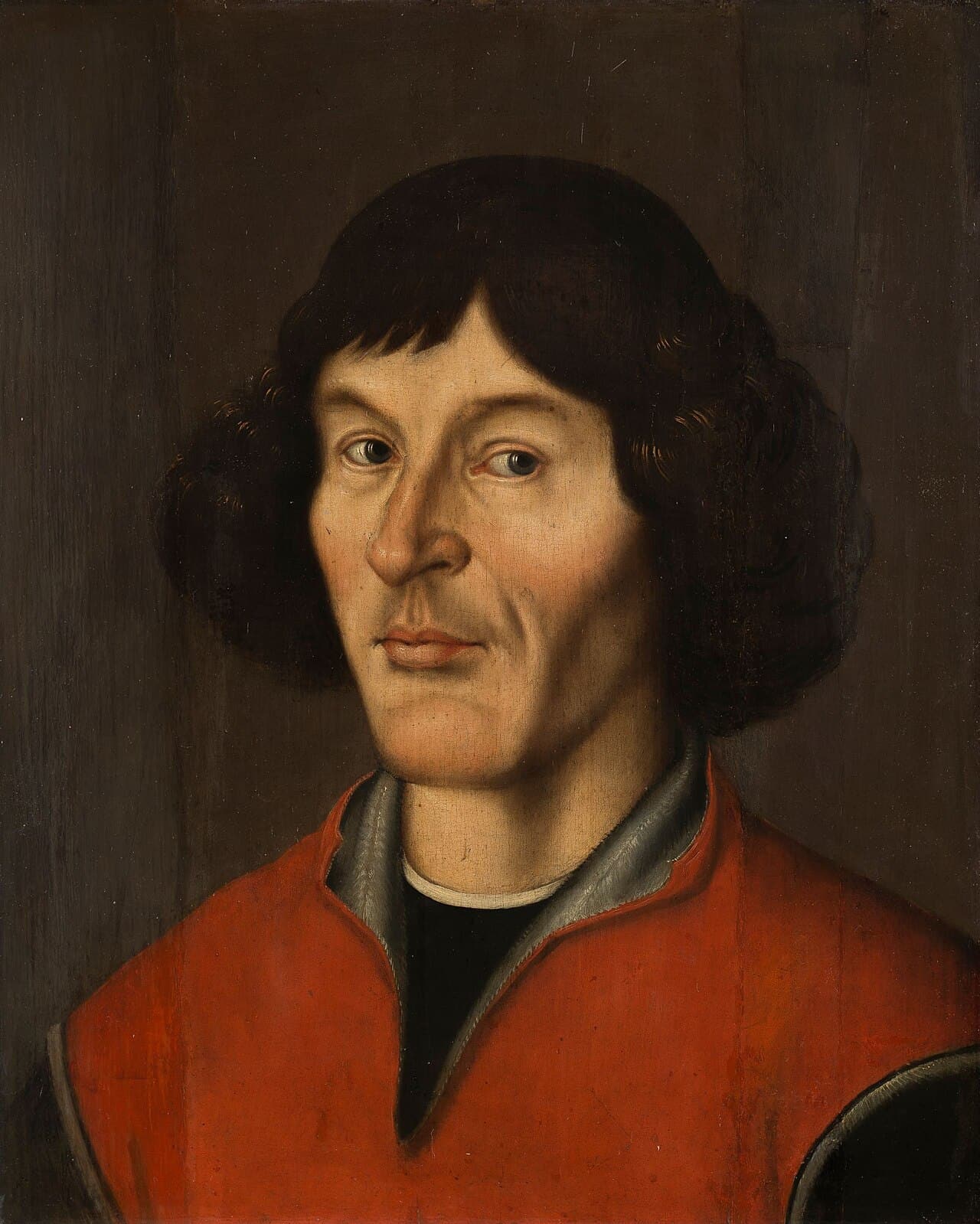
Nicolaus Copernicus was born on 19 February 1473 in Toruń, a prosperous trading city on the Vistula in Royal Prussia, then part of the Kingdom of Poland. His father, a copper merchant, died when the boy was about ten, and his maternal uncle Lucas Watzenrode - soon to become Bishop of Warmia - took charge of his education and his career. That patronage sent him to the University of Kraków in 1491, then to Bologna, Padua and Ferrara, where he took a doctorate in canon law on 31 May 1503. He returned north to a life of committee work: canon of the Warmia chapter, physician to his uncle, administrator of estates at Olsztyn, negotiator, and author of a treatise on currency reform. Astronomy was, formally speaking, his hobby. He had already sketched the heliocentric idea in a short handwritten outline, the Commentariolus, before 1514, and circulated it among a handful of correspondents. The full mathematical argument, De revolutionibus orbium coelestium, appeared in Nuremberg in 1543, the year he died. Michael Hart placed him 19th in The 100, on the grounds that no single change of viewpoint has done more to shape how humanity understands its own position in the universe.
Influence Meter
84
Measured on a 100-point scale
One book that reassigned the centre of the universe and made modern astronomy possible
TL;DR
The canon who rearranged the sky
A church administrator with no observatory and no academic post produced the idea that the Earth is a planet - and delayed publishing it for most of his adult life.
! Why This Matters:
- • The claim: The Sun, not the Earth, sits at the centre; the Earth spins daily and orbits the Sun yearly.
- • Why it mattered: It turned the Earth into one planet among several, dissolving the ancient split between the heavens and the world below.
- • Why he waited: The model contradicted Aristotle, Ptolemy and everyday experience, and it could not yet outpredict them.
- • Who finished it: Kepler supplied the ellipses, Galileo the observations, Newton the physics that made the motion make sense.
? Key Data:
- • Years of work: c. 1510-1543
- • First printing: Nuremberg, 1543
- • Copies in the first edition: Roughly 400-500
- • Hart's rank: 19th of 100
Continue reading below for the full detailed article →
1491-1503
A Very Long Education
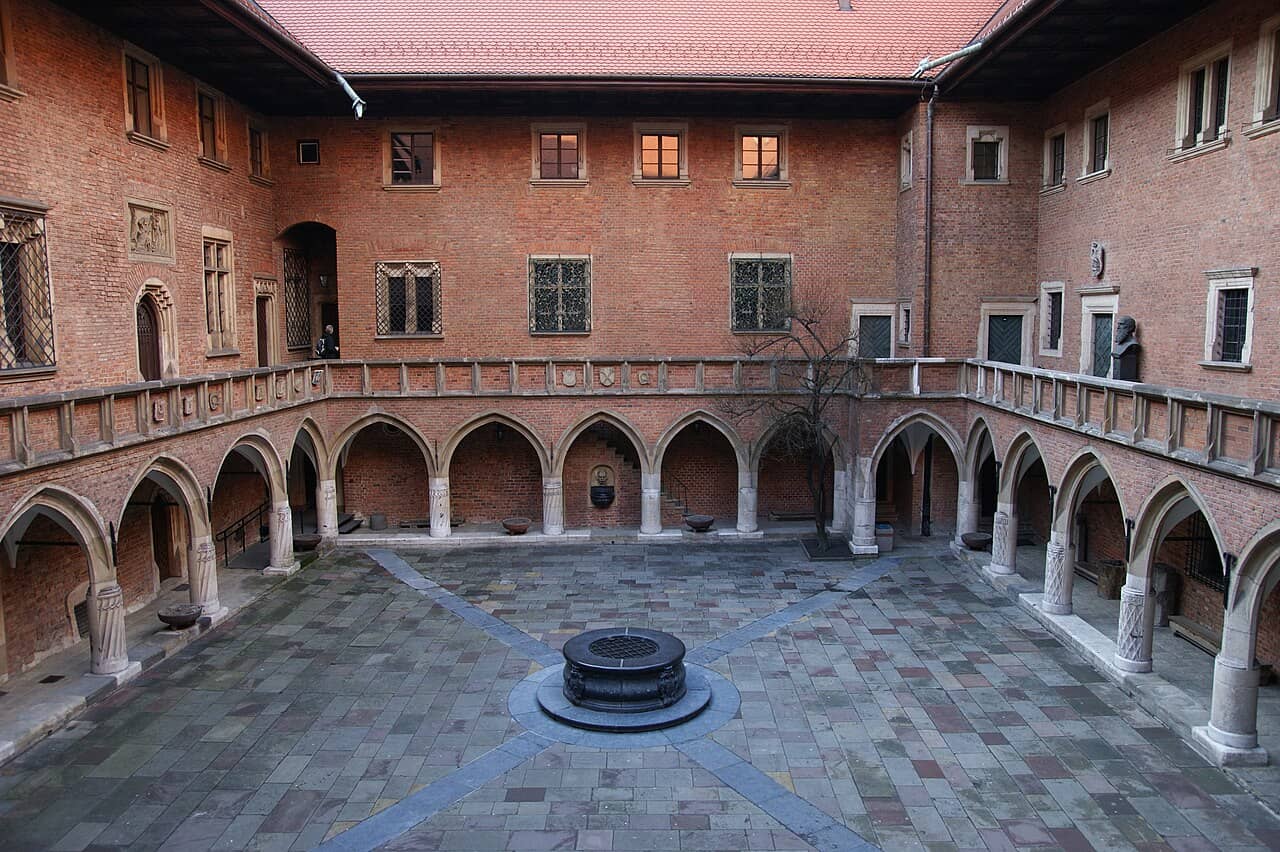
Copernicus enrolled at the University of Kraków in 1491, where the arts faculty had an unusually strong tradition in mathematics and astronomy, and where he began collecting the instruments and tables he would use for the rest of his life. He left without taking a degree - not unusual then - and in 1496 went south to Bologna to read canon law. There he lodged with the astronomer Domenico Maria Novara and helped him with observations, an apprenticeship that mattered more to his later work than any lecture course. He studied medicine at Padua, and on 31 May 1503 took his doctorate in canon law at Ferrara, a smaller and cheaper university where an examination could be sat without a long residency. He came home a lawyer and physician who had spent seven years in Italy watching the sky.
1503-1543
The Day Job
Copernicus had been elected a canon of the Warmia cathedral chapter in 1497, while still a student, and the income from that position supported him for the rest of his life. From 1503 he lived at his uncle's episcopal palace at Lidzbark as physician and secretary, and after Watzenrode's death in 1512 he settled at Frombork, the cathedral town on the Vistula Lagoon, where he remained. His duties were unglamorous and constant: managing chapter estates, auditing accounts, arbitrating disputes, treating patients, and sitting on the diplomatic delegations that dealt with the neighbouring Teutonic Order.
From 1516 to 1521 he administered the chapter's holdings from Olsztyn Castle, and during the Polish-Teutonic war of 1519-1521 he helped organise the defence of Olsztyn itself. He also thought seriously about money. His Monetae cudendae ratio of 1526 argued that the debasement of coinage was ruining Prussian trade and that good coin driven out by bad would simply disappear from circulation - an early statement of what later economists would call Gresham's law. Astronomy had to be fitted around all of this, which is one reason it took him so long.
Frombork
Observing From a Cathedral Wall
Copernicus made his observations from Frombork, working with instruments he built himself: a triquetrum, a quadrant, and an armillary sphere - devices of wood and brass with no lenses of any kind, since the telescope was still sixty years away. The site was poor. Frombork sits at 54 degrees north on a foggy lagoon, and he complained about the difficulty of catching Mercury at all. Only a few dozen of his own observations survive, and his model leaned far more heavily on the accumulated records of Ptolemy and the Arabic astronomers than on anything he measured. This is worth stating plainly, because it locates his achievement precisely: Copernicus was not a great observer who discovered something new in the sky. He was a mathematician who took the existing data and asked what arrangement would account for it more elegantly.
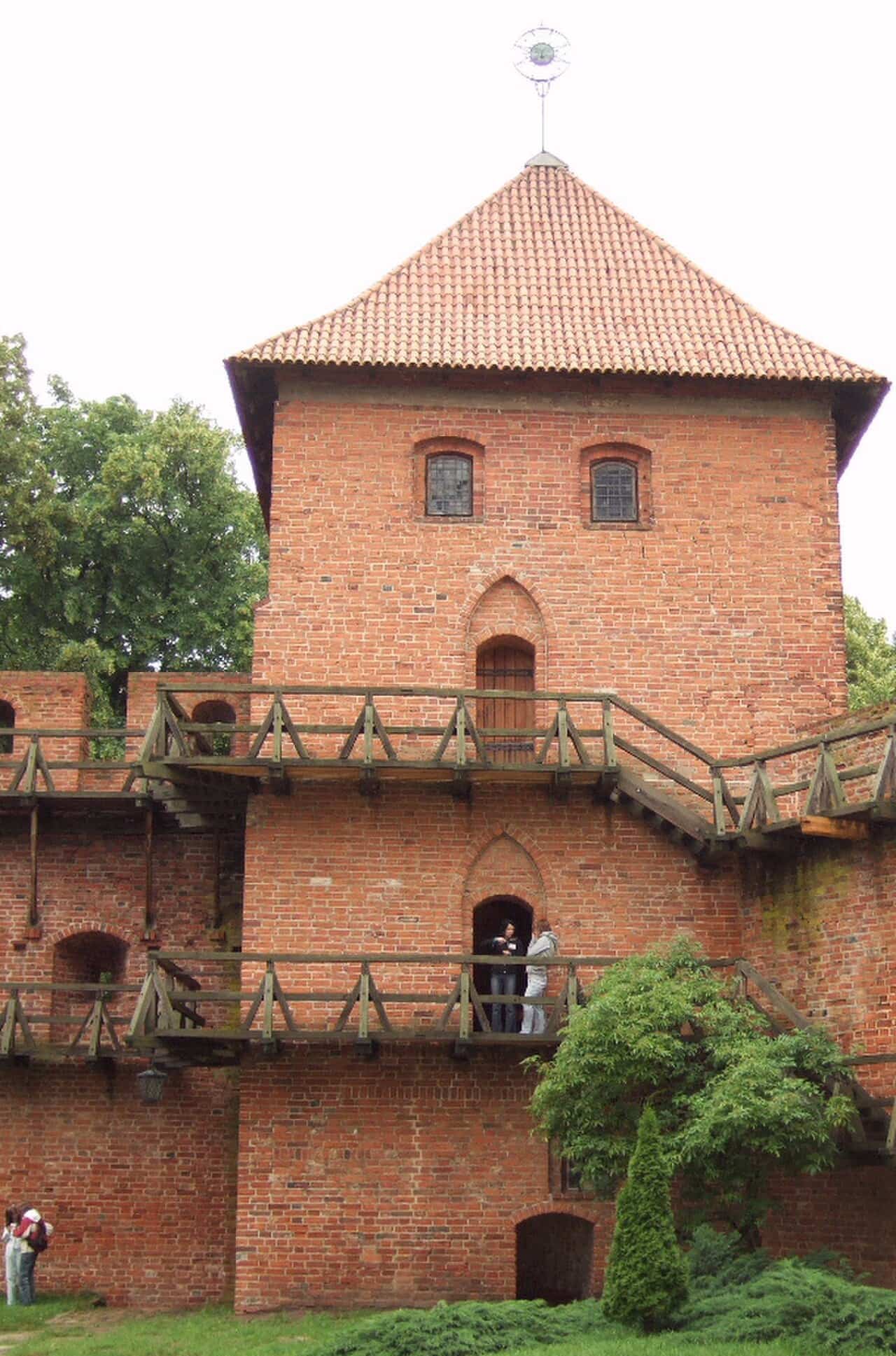
Copernicus wrote out the heliocentric idea in a short manuscript, the Commentariolus, at some point before 1514, and passed handwritten copies to a small circle of correspondents. It set out the core propositions without the supporting mathematics, and he never printed it. No copy was published until 1878, more than three centuries after his death. The delay between having the idea and publishing the proof runs to roughly three decades - a gap that has fascinated historians ever since, and that is variously explained by his own perfectionism, the sheer difficulty of the geometry, his heavy administrative workload, and a reasonable fear of ridicule.
What Copernicus Actually Claimed
The Commentariolus laid out a small set of propositions. Stated flatly, they overturn the physics of the ancient world.
- There is no single centre of all things: The celestial spheres do not share one common centre, so the universe has no one privileged midpoint.
- The Earth is not the centre of the universe: It is the centre only of the Moon's orbit - the Moon alone goes round the Earth.
- The Sun is the centre of the planetary system: All the planets, Earth included, revolve about the Sun, which sits near the middle of their orbits.
- The universe is vastly larger than the Earth's orbit: The distance from Earth to Sun is negligible compared with the distance to the fixed stars - which is why no stellar shift is seen as the Earth moves.
- The daily motion of the sky is the Earth turning: The heavens appear to rotate once a day because the Earth spins on its axis, not because the sky revolves.
- The Sun's apparent motion is our own: What looks like the Sun travelling through the year is the Earth carrying us around it.
- Retrograde motion is a trick of perspective: Planets appear to reverse direction only because we watch them from a moving platform - the single most economical result of the whole model.
The Manuscript
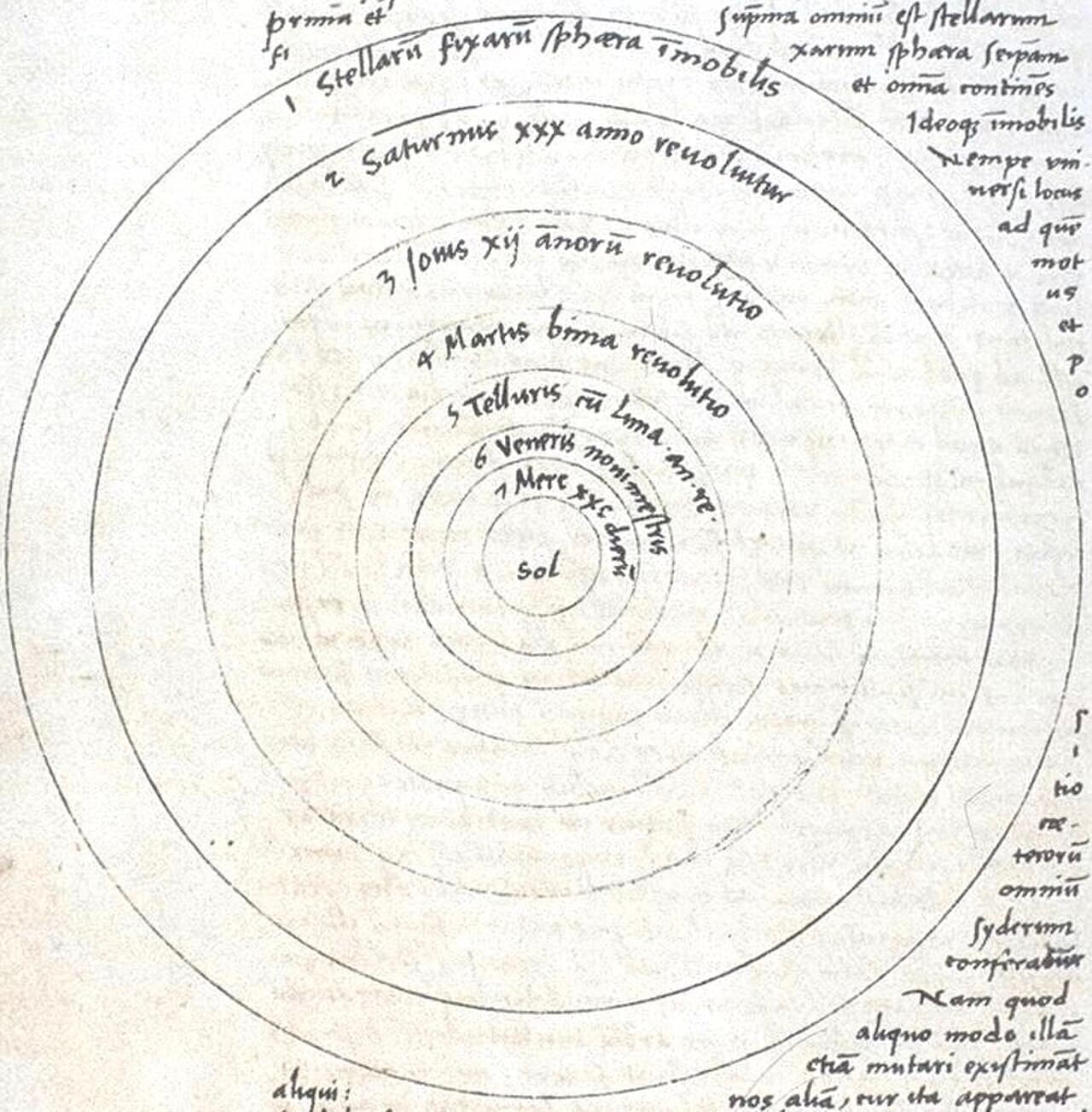
The Diagram at the Centre of the Book
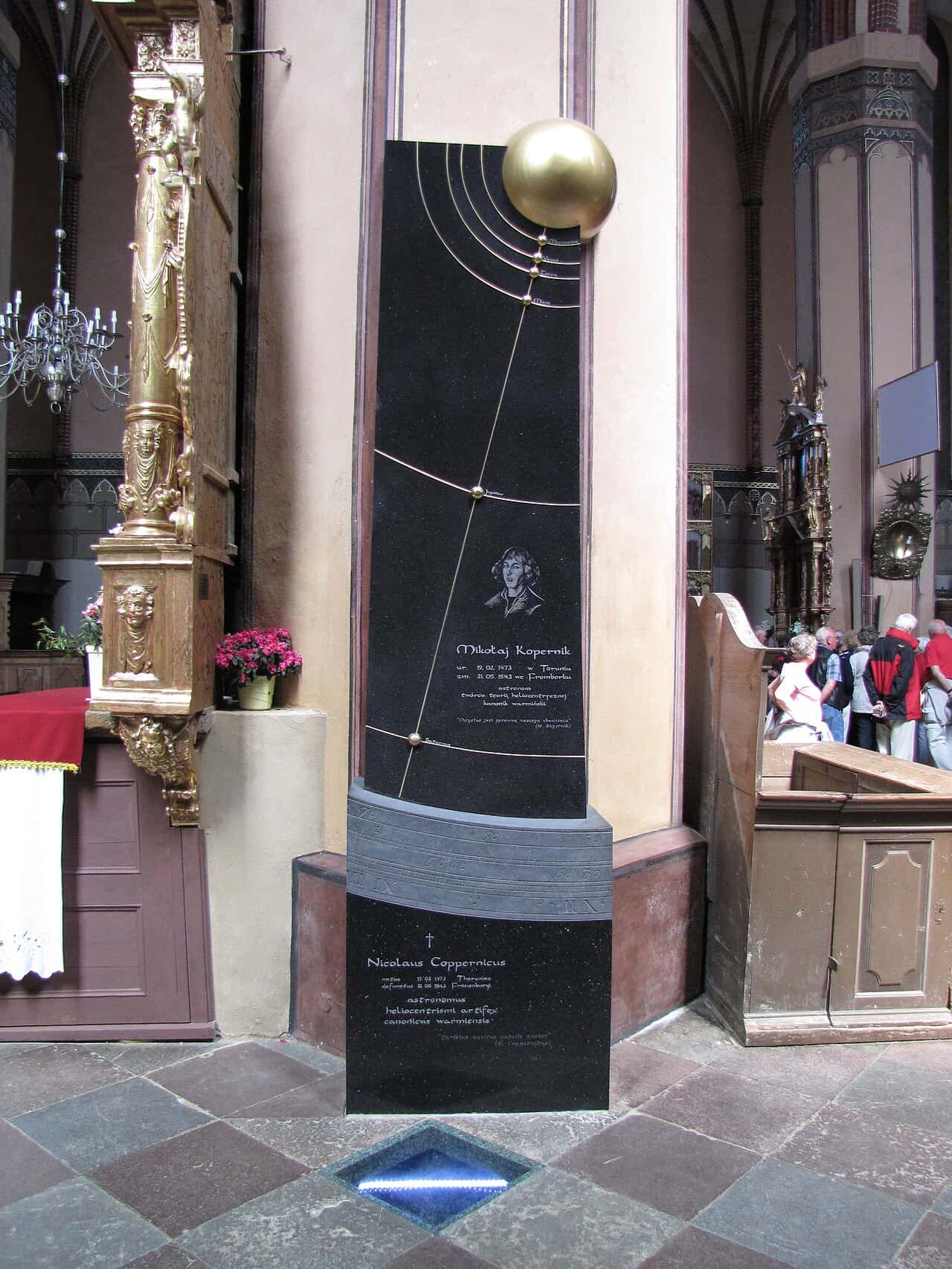
On one page of the surviving autograph manuscript of De revolutionibus, Copernicus drew the system as a set of nested circles: the Sun labelled at the middle, then Mercury, Venus, the Earth with its Moon, Mars, Jupiter, Saturn, and an outer sphere of fixed stars. It is a famously calm piece of draughtsmanship for a diagram that dismantles the medieval cosmos. The model's real advantage was not accuracy - it predicted planetary positions about as well as the Ptolemaic system, and no better - but coherence. In the old scheme the retrograde loops of the planets had to be built in by hand, each planet given its own epicycle tuned to match the Earth's year, an unexplained coincidence repeated five times. Put the Earth in motion and the loops appear on their own, as a consequence of where the observer is standing.
Side by Side
Two Models of the Same Sky
Both systems could predict where a planet would appear. They disagreed about what was actually happening - and about how much had to be assumed to make the numbers work.
| What is at the centre? | The Earth, motionless | The Sun, near the centre of the orbits |
| Why does the sky turn daily? | The whole heavens revolve around us | The Earth rotates on its axis |
| Why do planets loop backwards? | Each planet rides an epicycle added for the purpose | We observe them from a moving Earth |
| Order of the planets | Assigned by convention; no fixed rule | Determined by orbital period - a genuine prediction |
| Why are no stellar shifts seen? | The Earth does not move, so none are expected | The stars are immensely far away |
| Predictive accuracy | Good, after centuries of adjustment | Comparable - not yet better |
| Physics of the motion | Aristotelian spheres, unexplained | Left unexplained until Newton, 1687 |
The Copernican model won on economy and internal logic long before it won on precision. Kepler's ellipses (1609) and Newton's gravitation (1687) supplied what it lacked.
1539-1543
Rheticus, Osiander, and a Book Delivered Too Late
The manuscript might have stayed in a drawer. What changed was the arrival at Frombork in 1539 of Georg Joachim Rheticus, a young mathematics professor from Wittenberg, who read the work, grasped it, and spent the next two years persuading its author to let it be printed. Rheticus published a summary of his own in 1540, then carried the manuscript to the Nuremberg printer Johannes Petreius. When Rheticus had to leave for a new post, oversight of the printing passed to Andreas Osiander, a Lutheran theologian, who added an unsigned preface stating that the model was merely a convenient device for calculation and need not be taken as literally true. Copernicus had written nothing of the kind, and readers for decades took the preface for his own view. He was by then beyond correcting it: he had suffered a stroke late in 1542, and tradition holds that a finished copy was placed in his hands at Frombork on 24 May 1543, the day he died.
Chronology
Seventy Years on the Baltic Rim
A life spent almost entirely within a few hundred miles of the Vistula, drawn here as the closed circuit its subject spent thirty years describing.
Beyond Astronomy
The Other Careers of Nicolaus Copernicus
Astronomy occupied his spare hours. These were the roles he was actually paid and appointed to hold.
Canon of Warmia
Elected to the cathedral chapter in 1497 and formally installed that October; the post provided his income for forty-six years and required constant administrative work.
- From: 1497
Doctor of Canon Law
Took his doctorate at Ferrara on 31 May 1503 after study at Bologna and Padua, and served the chapter as a legal adviser and diplomat.
- Awarded: 31 May 1503
Physician
Trained at Padua and practised for decades, treating his uncle the bishop, fellow canons, and the poor of the district without charge.
- Trained at: Padua
Estate administrator at Olsztyn
Ran the chapter's economic affairs from Olsztyn Castle, and helped organise the town's defence during the Polish-Teutonic war of 1519-1521.
- Years: 1516-1521
Monetary theorist
His Monetae cudendae ratio of 1526 attacked coin debasement and described how sound money is driven out of circulation by bad - a principle later named for Thomas Gresham.
- Published: 1526
Translator from Greek
Rendered the Epistles of the Byzantine writer Theophylact Simocatta into Latin, printed around 1509 - his only book published in his own lifetime other than De revolutionibus.
- Printed: c. 1509
Written Works
Books and Treatises by Copernicus
He wrote little and printed less. The list is short, and one item on it changed astronomy.
Further Reading
Books About Copernicus
Modern accounts of his life, his book, and the thirty-year silence between the two.
The Book Nobody Read
An astronomer's account of tracking down hundreds of surviving copies of De revolutionibus and reading their margins, which shows that the book was in fact studied closely by the people who mattered.
- Published: 2004
- Subtitle: Chasing the Revolutions of Nicolaus Copernicus
A More Perfect Heaven
A narrative history of the Copernican revolution built around the visit of Rheticus to Frombork, with a stage play at its centre imagining the argument that got the book published.
- Published: 2011
Copernicus' Secret
A biography focused squarely on the puzzle of the delay - why the manuscript waited three decades and what finally moved its author to release it.
- Published: 2007
- Subtitle: How the Scientific Revolution Began
The Copernican Revolution
Kuhn's study of how the change of model actually happened, written before The Structure of Scientific Revolutions and still the standard account of the idea's slow acceptance.
- Published: 1957
Legacy
Why Number Nineteen
Michael Hart ranked Copernicus 19th, and the ranking rests on consequence rather than correctness. Much of the detail in De revolutionibus is wrong: Copernicus kept perfectly circular orbits and therefore still needed epicycles to fit the observations, and his predictions were no more accurate than the system he replaced. What he supplied was the correct arrangement. Kepler replaced the circles with ellipses in 1609, Galileo's telescope found moons orbiting Jupiter and phases on Venus that made sense only if the model was true, and Newton's Principia in 1687 finally explained why any of it moved as it did. Each of them started from the premise Copernicus had established.
The larger consequence was philosophical. Removing the Earth from the centre removed the ancient distinction between the heavens and the world below, and made the Earth a planet - an object of the same kind as the lights in the sky, subject to the same rules. Scientists still invoke the Copernican principle when they assume our vantage point is not special, an assumption that underwrites modern cosmology. It is an unusual legacy for a cathedral canon who audited estate accounts, defended a castle, wrote about the coinage, and let his one important book sit unpublished for thirty years.
Related Publications