Antony van Leeuwenhoek

Antony van Leeuwenhoek
Born 24 October 1632 • Died 26 August 1723
In 1676 a cloth merchant in Delft looked at a drop of water from a barrel in his yard and reported to the Royal Society in London that it contained thousands of living creatures, so small that a million of them would not fill a grain of sand. The Society did not believe him. It sent a delegation. He was right, and he had been the only human being ever to see them. For roughly fifty years afterwards, essentially everything known about microscopic life was known because one self-taught Dutchman with no scientific training kept looking and kept writing letters.
Rank
#36
Influence
79
Field
Microscopist
Historical Perspective
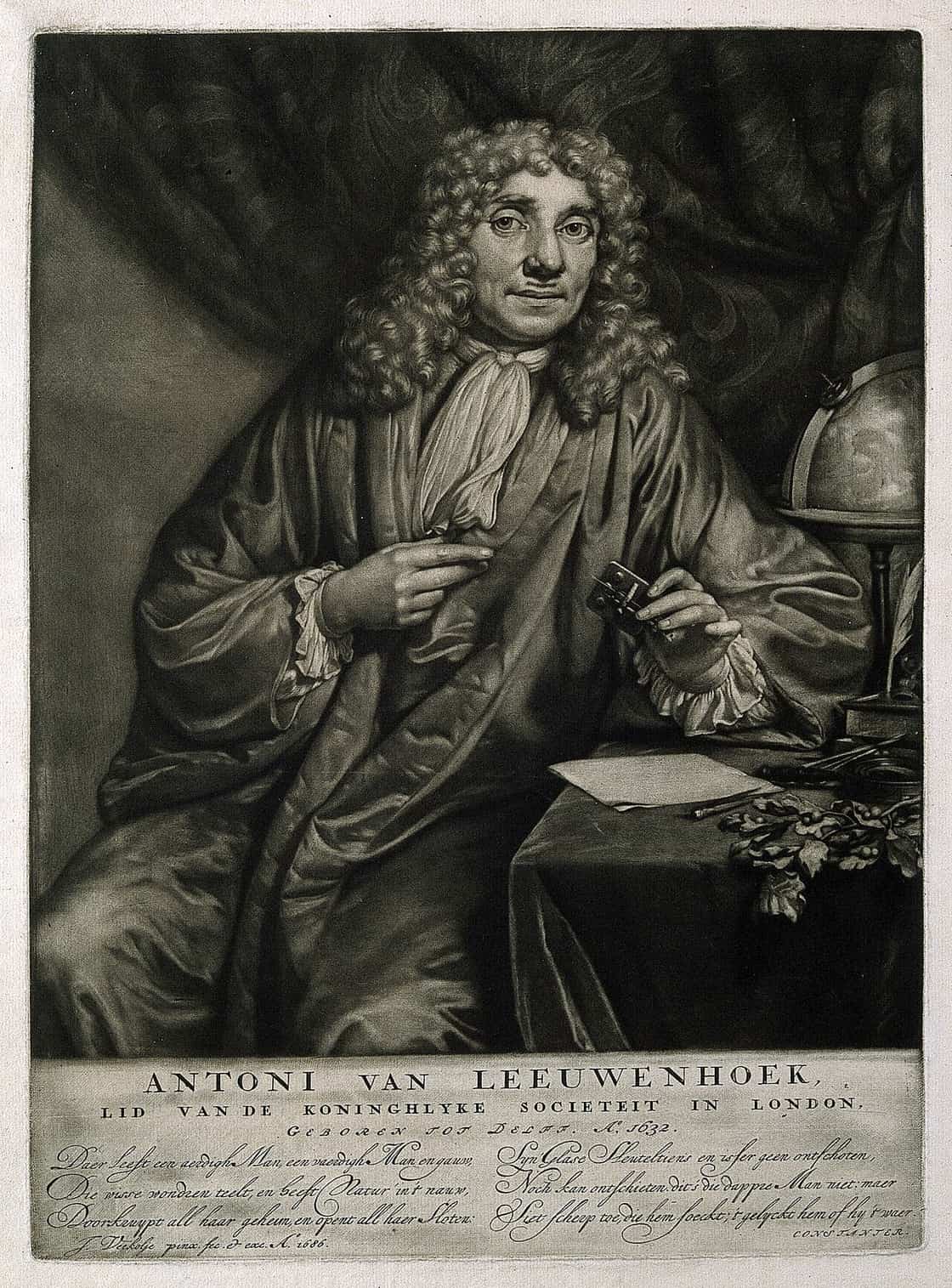
Antonie van Leeuwenhoek was born in Delft on 24 October 1632, the son of a basket maker who died when the boy was five. He was apprenticed to a cloth merchant in Amsterdam, returned to Delft and opened his own draper's shop in 1654, and from 1660 held a series of comfortable municipal posts - chamberlain to the sheriffs, surveyor, wine gauger - which gave him a steady income and, crucially, time. Cloth merchants used small magnifying glasses to count thread density, and it was probably there that his interest began. Self-taught, without Latin and therefore cut off from the scientific literature of his day, he developed a method of making tiny, near-spherical lenses of extraordinary quality and mounted them in small brass plates. From 1673, at the urging of his neighbour the physician Reinier de Graaf, he began writing to the Royal Society, and continued for half a century - about 560 letters, in Dutch, describing an invisible world. He died on 26 August 1723, aged ninety. Michael Hart ranked him 36th in The 100.
Influence Meter
79
Measured on a 100-point scale
Discovered the microbial world, two centuries before anyone knew what to do with it
The Instrument
Not a Microscope as Anyone Would Recognise It
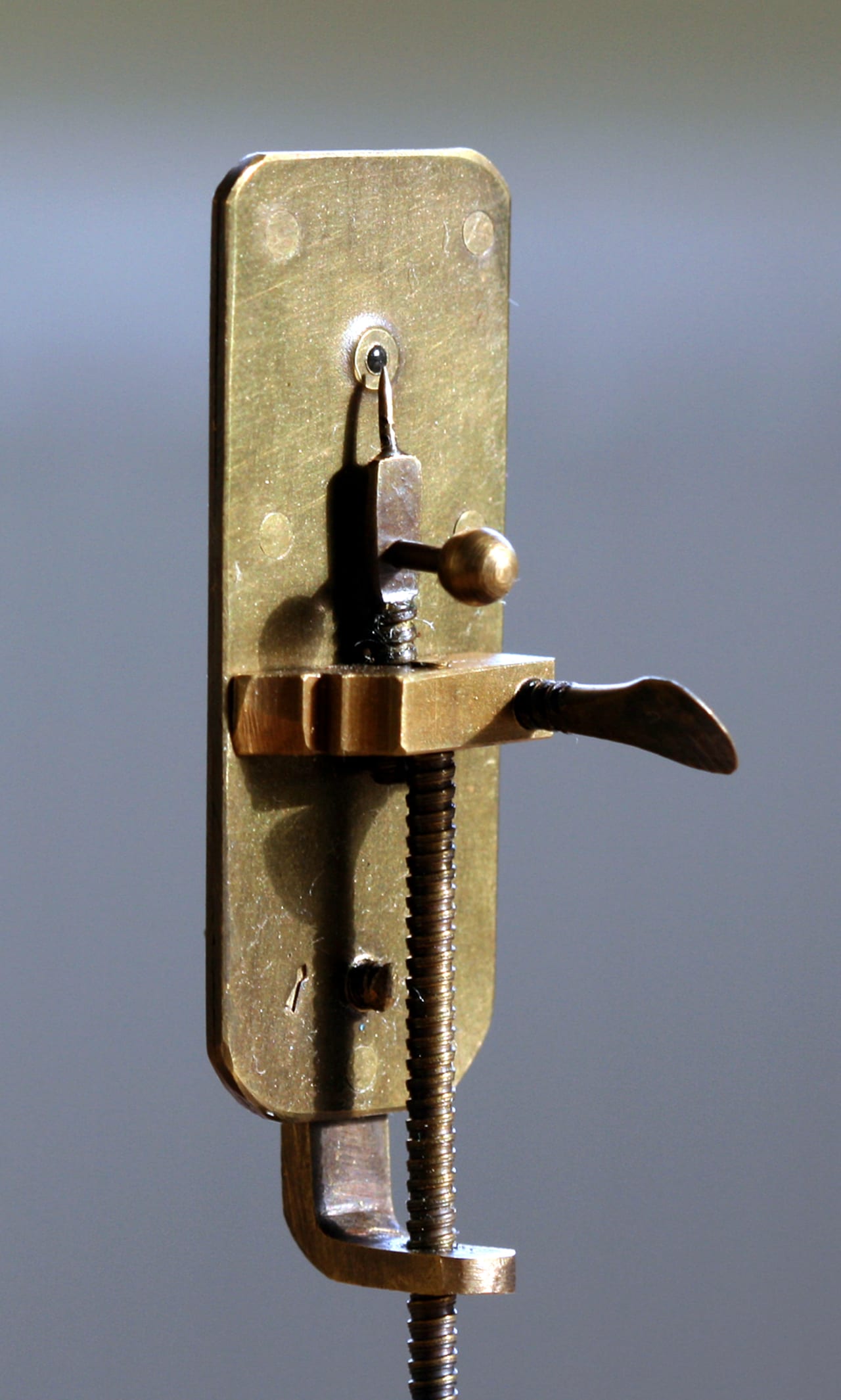
Leeuwenhoek's devices look nothing like a microscope. Each is a brass plate a few centimetres long holding a single tiny lens, with a specimen mounted on a pin adjusted by screws; the user holds it up to the light almost against the eye. Compound microscopes with two lenses already existed and were more impressive to look at, but their chromatic and spherical aberration made them useless above about fifty times magnification. Leeuwenhoek's single lenses reached two hundred and seventy-five times, possibly higher, with a clarity nobody matched until the nineteenth century. He made over five hundred of them and never explained his method, encouraging visitors to believe he ground them by hand while probably also drawing fine glass threads and melting the ends into tiny spheres. Nine or ten survive. When a surviving instrument was examined with modern techniques in 2021, the lens turned out to be a small ground bead - a technique known at the time, deployed with unusual skill.
On 9 October 1676 Leeuwenhoek reported to the Royal Society that rainwater standing in a tub, and later pepper water, teemed with living creatures he called animalcules - little animals - moving purposefully, of several distinct kinds, and unimaginably small. It was the discovery of protozoa, and in 1683, from the scrapings of his own teeth, of bacteria. The claim was so extreme that the Society's secretary Henry Oldenburg asked for corroboration; Leeuwenhoek supplied signed statements from a notary, a minister and other respectable Delft citizens who had looked through the lens. Robert Hooke was eventually able to repeat the observations, and the Society elected Leeuwenhoek a Fellow in 1680. He never attended a meeting and never learned English or Latin, and the Society translated his Dutch letters for its Philosophical Transactions for fifty years.
What He Saw First
A single untrained man, working alone in a Dutch town, made a substantial proportion of the foundational observations of biology.
- Protozoa: Free-living single-celled organisms in pond and rain water, reported in 1674 and described in detail from 1676. The first living things ever seen that nobody knew existed.
- Bacteria: Observed in 1683 in the plaque from his own teeth, and sketched clearly enough that the shapes are identifiable today. Nobody else saw bacteria for well over a century.
- Spermatozoa: Described in 1677, together with the observation that they were present in the semen of many species, which reframed the entire question of how generation works.
- Red blood cells: Described their shape and size, and measured them with reasonable accuracy - the first quantitative cell biology anyone attempted.
- The capillary circulation: Watched blood pass from arteries to veins through capillaries in a tadpole's tail and an eel's fin, supplying the direct visual proof of the loop William Harvey had inferred without ever seeing it.
- Muscle striations and much else: Cross-striations in skeletal muscle, the structure of wood and plant tissues, insect compound eyes, the life cycle of the flea and the aphid - the last two used to attack the idea of spontaneous generation.
Delft
The Town, the Painter and the Executor
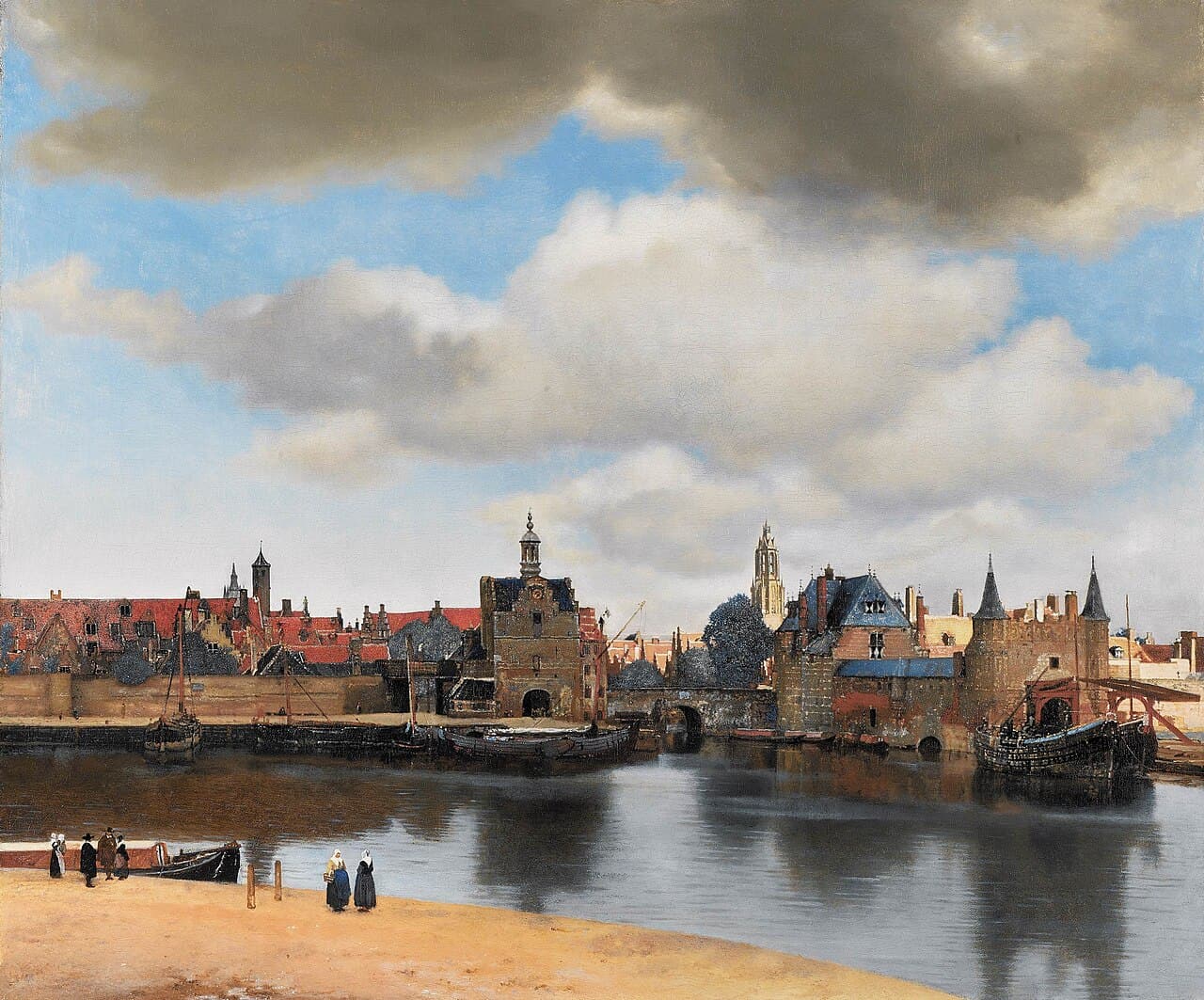
Leeuwenhoek and Johannes Vermeer were born in Delft in the same year, 1632, and baptised weeks apart. When Vermeer died insolvent in 1675, Leeuwenhoek was appointed executor of his estate - the two men certainly knew each other in a small town of some twenty-five thousand people. It has often been suggested that Leeuwenhoek sat for The Astronomer and The Geographer, and that Vermeer's optical precision owed something to lenses; both remain plausible and unproven. What the connection does illustrate is the setting. The Dutch Republic of the seventeenth century was the richest and most literate society in Europe, with a glass and optics trade, a culture of careful observation, and enough prosperous burghers with leisure that a draper could spend fifty years looking at pond water and be taken seriously for it.
After 1723
A Discovery Nobody Could Use
Leeuwenhoek's death in 1723 was followed by something close to a dead stop. He had never taught his lens-making method to anyone, and the instruments he bequeathed to the Royal Society were eventually lost; without comparable optics, nobody could confirm or extend the finer observations, and microscopy went quiet for the better part of a century until achromatic compound lenses arrived in the 1830s and Ernst Abbe put lens design on a theoretical footing later still.
The deeper reason for the delay is that the discovery had nowhere to go. Leeuwenhoek had found organisms nobody had a use for: there was no theory connecting them to disease, no chemistry to analyse them, no notion of a cell as the unit of life. Anton van Leeuwenhoek saw bacteria in 1683 and it took until Pasteur and Koch in the 1860s and 1870s - nearly two hundred years - for anyone to establish that some of them cause illness. His animalcules were used as a weapon against the theory of spontaneous generation almost immediately, and then largely admired as a curiosity. It is one of the clearest cases in the history of science of an observation arriving before the framework that could make sense of it.
Further Reading
Books About Leeuwenhoek
He wrote no book. The record is the letters, published in translation by the Royal Society across fifty years.
Legacy
Why Number Thirty-Six
Michael Hart ranked Leeuwenhoek 36th, and the argument is one of priority on a very large scale. The microbial world contains most of the organisms alive, governs decay, fermentation, soil fertility and digestion, and includes the agents of most of the infectious disease that has ever killed human beings. One man found all of it, without training, without institutional support, and without any theory suggesting where to look.
The counter-argument is that he did not know what he had. He offered no germ theory, no classification that lasted, and no method anyone could copy, and the field he opened lay largely dormant until Pasteur and Koch reached it from a different direction nearly two centuries later. That is a real limitation and it is why he sits at thirty-six rather than higher. But it is also a strange thing to hold against him. He looked through a lens he made himself at water everybody had been drinking for as long as there had been people, and reported honestly that it was full of life. Everything from germ theory to antibiotics to the study of the human microbiome starts from that observation.
Related Publications