Edward Jenner

Edward Jenner
Born 17 May 1749 • Died 26 January 1823
Smallpox killed something like three hundred million people in the twentieth century alone, and it had been doing so for at least three thousand years. It destroyed the Aztec and Inca populations, killed reigning monarchs across Europe, blinded and disfigured a large share of those it spared. It is now gone - not controlled, not rare, gone, existing only in two guarded freezers. That is the only time humanity has done this to a disease, and it starts with a rural English doctor and a dairymaid's blistered hand.
Rank
#70
Influence
83
Field
Physician
Historical Perspective
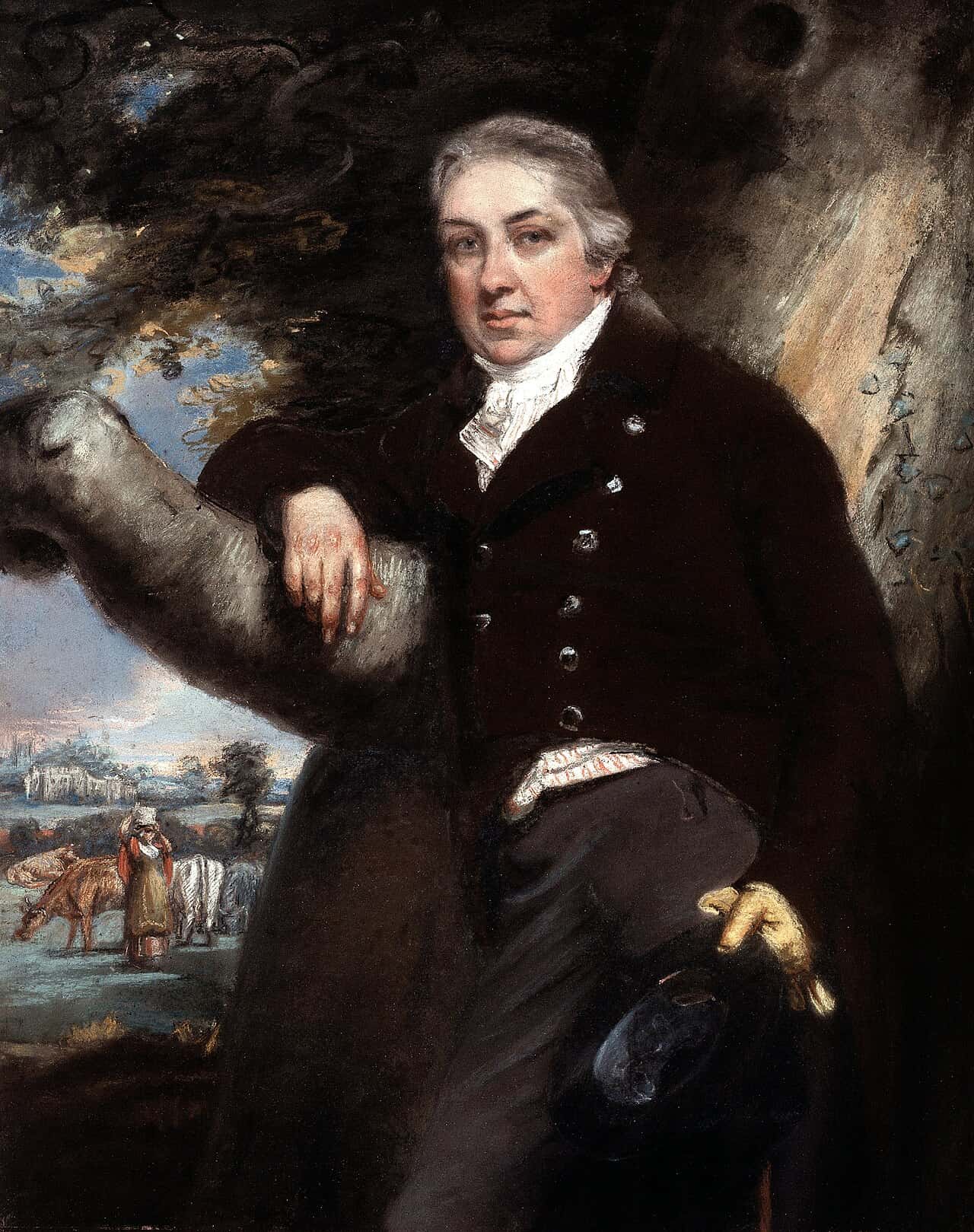
Edward Jenner was born at Berkeley in Gloucestershire on 17 May 1749, the eighth child of the vicar, and was orphaned at five. Apprenticed to a surgeon at thirteen, he went to London at twenty-one to study under John Hunter, the greatest surgeon and experimental anatomist of the age, who told him not to speculate but to try the experiment - advice Jenner followed for the rest of his life. He returned to Berkeley as a country practitioner and stayed, refusing offers to move to London. Smallpox was then endemic and lethal, killing perhaps ten per cent of the population in ordinary years and far more in epidemics. Variolation - deliberate infection with smallpox matter to produce a mild case - was practised and worked, but killed one or two per cent of those treated and could start outbreaks. Jenner tested the widely known country belief that people who caught cowpox from cattle were subsequently immune. On 14 May 1796 he inoculated James Phipps, aged eight, with matter from cowpox pustules on the hand of a dairymaid named Sarah Nelmes, and in July exposed him to smallpox. Nothing happened. He published his Inquiry in 1798. He died at Berkeley on 26 January 1823. Michael Hart ranked him 70th in The 100.
Influence Meter
83
Measured on a 100-point scale
The first vaccine, and the only disease humanity has ever eradicated
14 May 1796
An Experiment That Could Not Be Done Today
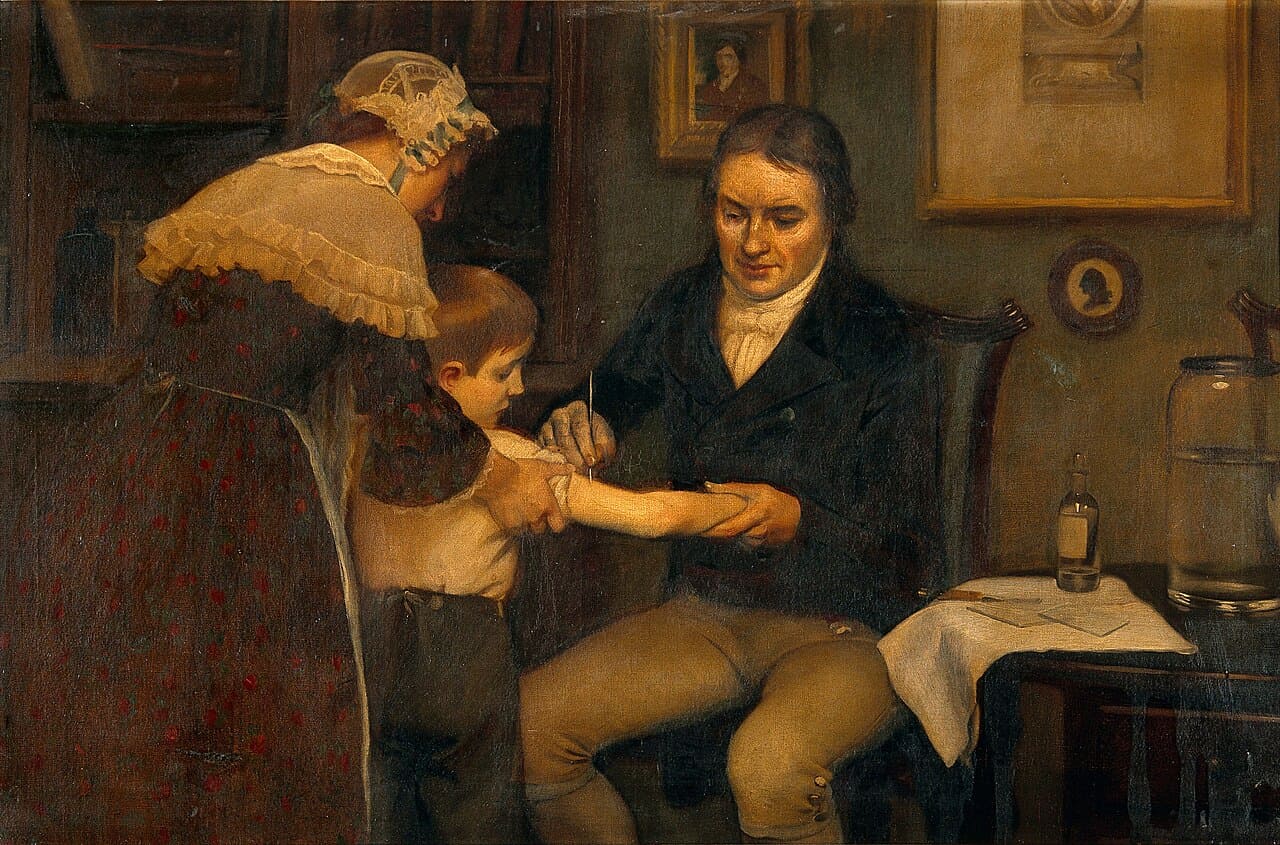
Jenner took matter from the cowpox sores on Sarah Nelmes's hand and scratched it into the arm of James Phipps, the eight-year-old son of his gardener. The boy had a mild fever and a sore arm and recovered within days. On 1 July, Jenner then inoculated him with material taken directly from a smallpox pustule - the standard variolation procedure, which reliably produced the disease. Phipps did not fall ill. Jenner repeated the challenge later and again got nothing. No modern ethics committee would approve deliberately exposing a healthy child to a disease with a thirty per cent mortality rate on the strength of a hypothesis, and it is worth being clear that this is what he did. He also tested it on his own eleven-month-old son. The Royal Society rejected his first paper as too revolutionary and insufficiently evidenced; he gathered more cases and published privately in 1798.
Two parts of the standard story deserve correction. First, Jenner did not discover the cowpox connection; it was folk knowledge in dairying counties, and at least six people had acted on it before him, including a Dorset farmer called Benjamin Jesty who vaccinated his wife and sons with a darning needle in 1774. What Jenner did was test it systematically, demonstrate that the protection survived a deliberate smallpox challenge, show that the material could be passed from person to person rather than requiring a cow each time, and publish. Second, the romantic detail about a milkmaid with a flawless complexion telling him she could never catch smallpox appears to be a later embellishment; it is not in his own account. Neither correction reduces what he did, and the second point is a useful reminder that the memorable version of a scientific story is often the least reliable part of it.
1798-1850s
Cartoons, Clergy and Compulsion
Opposition was immediate and took several forms that will be entirely recognisable. James Gillray's famous 1802 cartoon showed vaccinated patients sprouting cows from their bodies. Some clergy objected that introducing animal matter into a human being was ungodly and that disease was divine chastisement not to be evaded. Variolators, who made a living from the older method, had a financial interest and said so less openly. There were also honest objections: early technique was inconsistent, the material was sometimes contaminated, and protection was later found to wane, which required revaccination that Jenner had not anticipated.
The evidence nonetheless won quickly by the standards of the period. Parliament granted Jenner £10,000 in 1802 and £20,000 in 1807 in recognition. Britain made vaccination free in 1840, compulsory in 1853, and enforced it with penalties from 1867 - which produced an organised anti-vaccination movement, the Leicester demonstrations of 1885, and eventually a conscientious objection clause in 1898, the first use of that phrase in English law. The argument between public health and individual consent that this opened has never closed, and its terms in 2026 would be familiar to anyone reading a pamphlet from 1885.
1798-1980
How a Disease Was Removed From the World
Eradication took a hundred and eighty-two years from Jenner's Inquiry, and the last stretch was a specific and extraordinary piece of organisation.
The vaccine spread within years
By 1800 it had reached most of Europe and America; Jenner sent material to Jefferson, and the Spanish Balmis expedition of 1803 carried it to the Americas and Asia in the arms of orphaned boys vaccinated in sequence to keep it viable across the ocean.
- Kept alive by: Arm-to-arm passage
Napoleon released prisoners for him
Napoleon had his army vaccinated and, though at war with Britain, released English prisoners at Jenner's request, reportedly saying he could refuse that man nothing.
- Napoleon: Vaccinated his army
The WHO campaign
Launched when smallpox still killed some two million people a year in thirty-one countries. Its budget was modest and its method was not mass vaccination but surveillance and containment - find every case, vaccinate everyone around it.
- Deaths in 1967: About 2 million a year
Ring vaccination
The insight that eradicating a disease does not require vaccinating everyone, only breaking every chain of transmission. It is now standard practice in outbreak control for other diseases.
- Method: Contain, do not blanket
The last natural case
Ali Maow Maalin, a hospital cook in Merca, Somalia. He survived, and later worked on polio eradication in Somalia until his death in 2013.
- Where: Somalia
Declared eradicated
The World Health Assembly certified that smallpox no longer existed in nature. Two laboratory stocks remain, in the United States and Russia, and their destruction is still argued about.
- Remaining stocks: Two
Further Reading
Books About Jenner and Smallpox
The eradication campaign is unusually well documented by the people who ran it.
Legacy
Why Number Seventy
Michael Hart ranked Jenner 70th, and the case is arithmetical. Smallpox is estimated to have killed some three hundred million people in the twentieth century alone, more than every war of that century combined, and it had been doing so for millennia. It is now extinct. No other human disease has ever been deliberately eliminated, and the campaign that did it rests on the method Jenner published in 1798 and deliberately declined to profit from.
The wider legacy is the principle. Vaccination against polio, measles, diphtheria, tetanus, hepatitis, influenza and, in 2020, a novel coronavirus all descend from the demonstration that deliberate exposure to a harmless relative of a disease can teach the immune system to defeat the real one. The mechanism was not understood for another century - Jenner had no idea why it worked, since neither immunology nor germ theory existed - which makes his result an unusually pure case of an empirical observation being right long before anyone could explain it. Estimates of lives saved by vaccination since run into the billions.
Related Publications