Wilhelm Conrad Roentgen

Wilhelm Conrad Roentgen
Born 27 March 1845 • Died 10 February 1923
Röntgen was working in a darkened room with a cathode-ray tube wrapped in black card when he noticed a faint green glow on a coated screen a metre away. Nothing known should have crossed that distance through cardboard. He spent the next seven weeks alone in the laboratory, barely speaking to anyone, eating and sleeping there, until he understood what he had. The first thing he photographed with it was his wife's hand. She looked at the image of her own bones and said she had seen her death.
Rank
#71
Influence
79
Field
Physicist
Historical Perspective
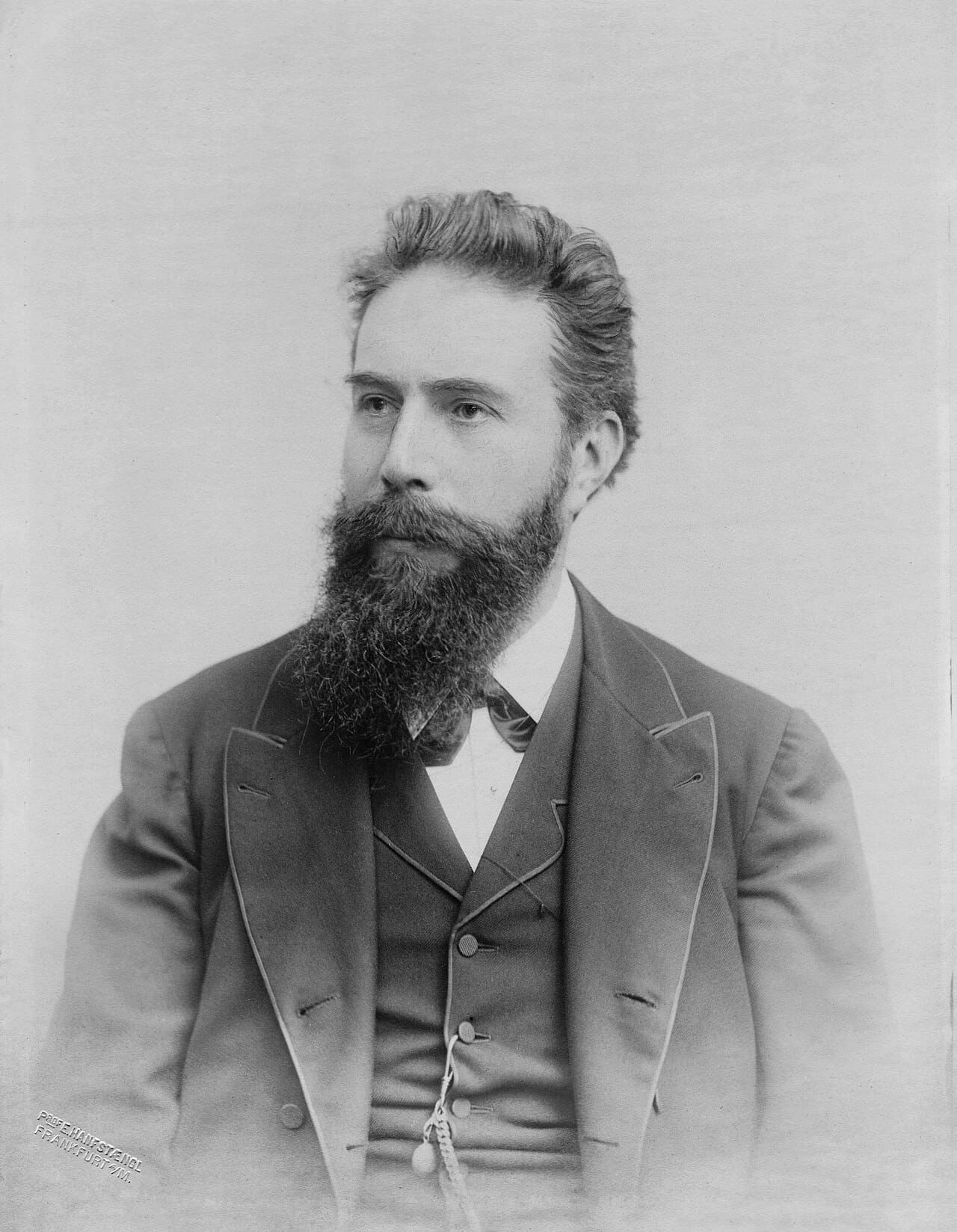
Wilhelm Conrad Röntgen was born at Lennep in Prussia on 27 March 1845 and raised in the Netherlands. He was expelled from technical school in Utrecht in 1865 for refusing to name the classmate who had drawn a caricature of a teacher, which left him without the certificate needed for university - a piece of stubbornness that nearly ended his career before it began. He got into the Zurich polytechnic on the strength of an examination instead, took a doctorate in 1869, and became professor of physics at Würzburg in 1888. On the evening of 8 November 1895, working with a Crookes tube covered in black cardboard, he saw a barium platinocyanide screen fluorescing at a distance the known cathode rays could not reach. He worked in near-isolation for seven weeks, established that the new rays passed through flesh but not bone or metal, made the famous radiograph of his wife Anna Bertha's hand on 22 December, and submitted his paper on 28 December 1895. The news reached newspapers within a week. He was awarded the first Nobel Prize in Physics in 1901 and died at Munich on 10 February 1923. Michael Hart ranked him 71st in The 100.
Influence Meter
79
Measured on a 100-point scale
Made the inside of the living body visible, and gave the method away
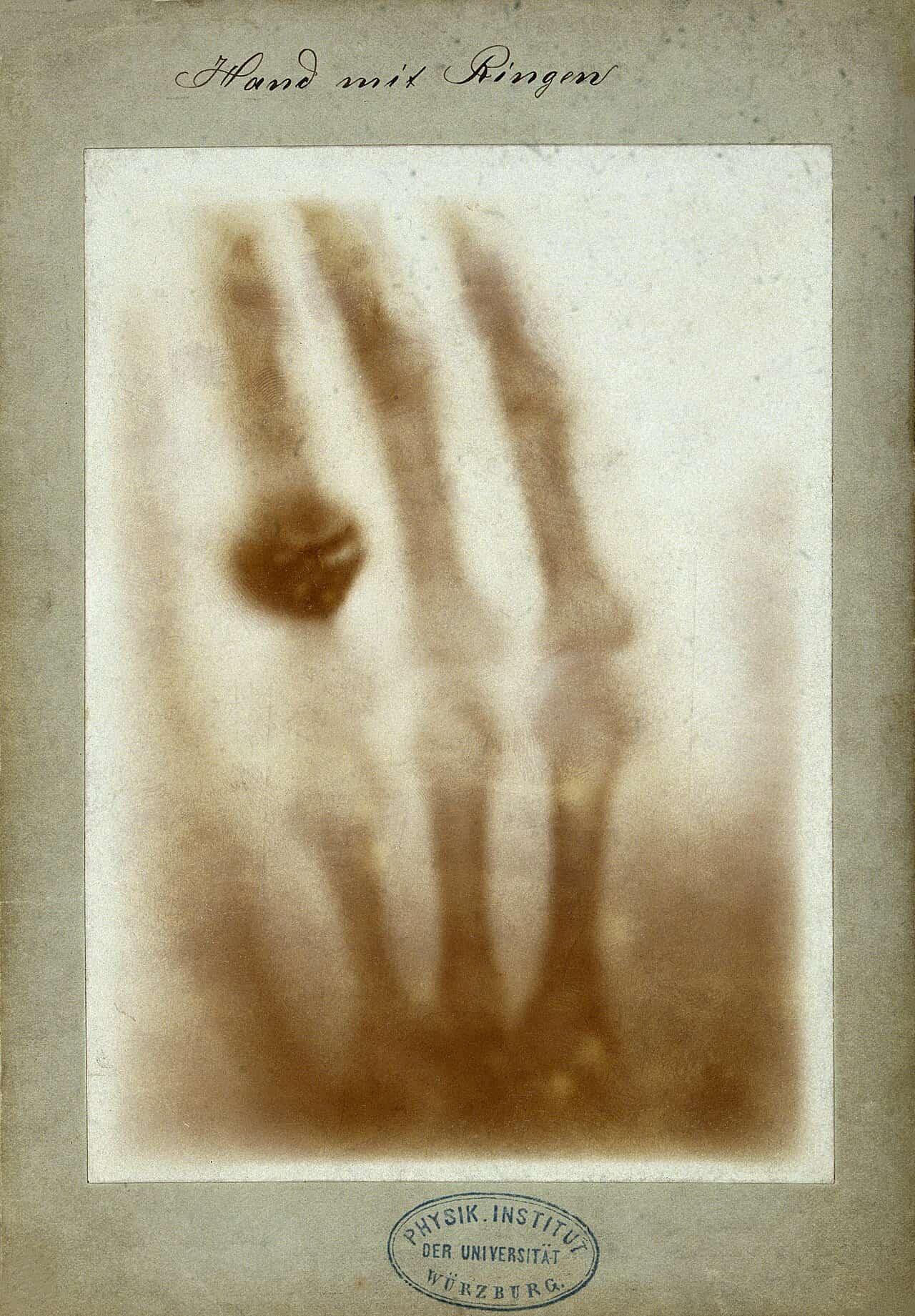
22 December 1895
The Most Consequential Photograph Ever Taken
Six weeks into his investigation, Röntgen asked his wife Anna Bertha to place her hand on a photographic plate and held it there for about fifteen minutes. The developed image shows the bones of her fingers clearly, the soft tissue as a faint shadow, and her wedding ring as a dense ring around one finger. It is the first radiograph of a living human being, and the first time anyone had ever seen inside a body that was not dead or cut open. Her reaction, reported ever since, was that she had seen her own death. The image did more than any argument to convey what had been found: when Röntgen's paper circulated in January 1896 he included prints, and physicists and physicians across Europe and America - almost all of whom already had the necessary apparatus, since Crookes tubes were common laboratory equipment - reproduced the effect within days.
The speed of adoption is without parallel in the history of medical technology. Röntgen submitted his paper on 28 December 1895; an Austrian newspaper reported it on 5 January 1896; the news was in London and New York within days. In Britain a radiograph was used to locate a needle in a woman's hand in January, and by February surgeons in several countries were imaging fractures and foreign bodies before operating. Within a year over a thousand papers on X-rays had been published. The reason is that no new equipment was required: any physics laboratory had a vacuum tube and an induction coil, so every institution that read the paper could repeat the experiment that afternoon. The dangers were not understood for some years, and a generation of early radiologists and technicians developed burns, cancers and amputations - many of them commemorated on a monument in Hamburg.
1896-1923
The Patent He Would Not Take
Röntgen refused to seek any patent on X-rays or their applications, on the stated ground that a discovery of this kind belonged to humanity rather than to the person who happened to make it. Given the scale of the medical imaging industry that followed, this is among the most expensive principled decisions on record. He also declined a title of nobility that would have added a von to his name, and when he received the first Nobel Prize in Physics in 1901 he donated the prize money to his university. He attended the ceremony but would not give the customary lecture.
He was a private and somewhat austere man who disliked publicity and resented the suggestion, made by some contemporaries, that the discovery had been a lucky accident - his response was that he had not been looking, but that he had known what to do when he saw it. He also disliked the name Röntgen rays, which German usage adopted anyway and still uses. Post-war hyperinflation destroyed his savings and he spent his last years in modest circumstances at a country house, dying of colorectal cancer in 1923, probably unrelated to his work since he had used lead shielding fairly early.
What Came Out of It
X-rays were the first of a sequence of discoveries that opened the interior of matter, and they arrived within a few years of each other.
- Medical imaging: Radiography made it possible to diagnose fractures, tuberculosis, tumours and foreign bodies without cutting. Every later technique - CT, angiography, mammography, fluoroscopy - descends from it.
- Radioactivity: Henri Becquerel discovered radioactivity in 1896 while investigating whether fluorescent materials emitted X-rays. Marie and Pierre Curie followed directly. Röntgen's paper started the chain.
- The structure of the atom: X-ray spectra let Moseley in 1913 determine atomic number and reorder the periodic table on a physical basis rather than by weight.
- X-ray crystallography: Diffraction through crystals reveals atomic arrangement. It gave the structure of salt, of penicillin, of haemoglobin - and, through Rosalind Franklin's Photograph 51, of DNA.
- Airport security and industrial inspection: The same penetrating property used to check baggage, welds, castings, pipelines and paintings for forgery beneath the surface.
- Radiotherapy: Within a few years the rays were being used to destroy tumours as well as image them, which remains a mainstay of cancer treatment.
Chronology
Seven Weeks, and Then the World
Drawn as a rising flight, because the interval between a private observation and global adoption is the shortest on this list.
Further Reading
Books About Röntgen
He ordered his personal papers burned at his death, which has left the biographical record unusually thin for a modern scientist.
Legacy
Why Number Seventy-One
Michael Hart ranked Röntgen 71st, and the ranking rewards a discovery whose consequences ran in two directions at once. On the medical side, it gave doctors the ability to see inside a living patient - which sounds unremarkable now and was, in 1896, genuinely miraculous to people who had never conceived of it. Billions of radiographs are taken every year, and the diagnostic imaging industry is measured in tens of billions of dollars.
On the physical side, the discovery detonated a decade. Becquerel found radioactivity in 1896 while trying to work out whether it related to X-rays; the Curies isolated radium; Thomson found the electron in 1897; Rutherford found the nucleus in 1911; and X-ray crystallography eventually produced the structure of DNA. Modern physics is conventionally dated from the mid-1890s, and Röntgen's seven weeks alone in a darkened room at Würzburg are its opening act. He refused to profit from any of it, which is worth stating plainly in a list that contains a good many people who did.
Related Publications